PUBLISHER: Mordor Intelligence | PRODUCT CODE: 2113259

PUBLISHER: Mordor Intelligence | PRODUCT CODE: 2113259
Africa Agricultural Film - Market Share Analysis, Industry Trends & Statistics, Growth Forecasts (2026 - 2031)
According to Mordor Intelligence, the Africa agricultural film market size is expected to grow from USD 450.0 million in 2025 to USD 478.62 million in 2026 and is forecast to reach USD 651.18 million by 2031 at 6.36% CAGR over 2026-2031.
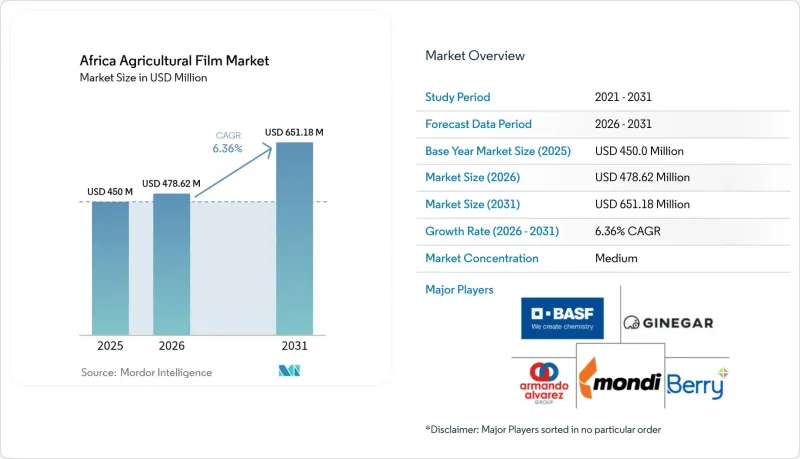
This report is Segmented by Type (Low-Density Polyethylene (LDPE), Linear Low-Density Polyethylene (LLDPE), and More), by Application (Mulching, and More), by Film Thickness (Less Than 80 Microns, and More), and by Geography (South Africa, and More). The Market Forecasts are Provided in Terms of Value (USD).
Africa Agricultural Film Market Trends and Insights
Raising Food Demand and Need for Higher Farm Productivity
In Africa, cereals are staple foods, with maize, wheat, and rice being the most important, and maize leading in consumption. Maize constitutes the primary daily subsistence need for most Kenyans. While Africa's cereal consumption continues to rise, production remains significantly lower, widening the import gap and increasing the demand for yield-boosting technologies such as mulch and greenhouse covers. The third Comprehensive African Agriculture Development Programme (CAADP) roadmap aligns continental policies to prioritize productivity tools that reduce water stress and shorten growth cycles. Ethiopia's achievement of wheat self-sufficiency, which eliminated USD 1 billion in imports, has encouraged similar adoption programs in Zambia and Mozambique. Agricultural films enhance soil moisture retention and canopy microclimate, enabling farmers to overcome yield deficits during unpredictable weather conditions. This ongoing supply-demand gap establishes agricultural films as essential inputs across food-insecure regions.
Surging Greenhouse Cultivation Acreage Across Africa
Morocco operates 40,000 hectares of greenhouses, producing 2 million metric tons of horticultural output, demonstrating the transition to protected cultivation. Technology partnerships between Dutch and Moroccan companies provide diffusive polyethylene covers that improve yield and water-use efficiency. Research in similar arid regions indicates cucumber yields of 12.3 kg/m2 under optimized diffusive films, confirming the agricultural benefits of specialized covers. Kenya and South Africa implement comparable greenhouse systems, driven by the need to adapt to increasing rainfall variability. The expansion of greenhouse area maintains consistent demand for UV-stable, thermally insulated, and high-light-transmission films.
Counterfeit Low-Grade Films Flooding Informal Markets
The presence of informal trading routes enables significant volumes of low-quality agricultural films to enter Nigeria and Kenya. This influx of substandard products reduces farmer trust in film effectiveness and damages established brand value. Studies of Nigeria's plastics market indicate persistent regulatory gaps that enable uncertified imports to circumvent quality control measures. The rapid degradation of counterfeit films leads to crop losses, which discourages farmers from making future purchases and limits the sales growth of legitimate manufacturers.
Other drivers and restraints analyzed in the detailed report include:
- Product Innovations in Multilayer Films and Anti-Drip Additives
- Government Subsidies on Agricultural Film
- Low Farmer Awareness and Limited Technical Training on Proper Film Use
For complete list of drivers and restraints, kindly check the Table Of Contents.
Segment Analysis
Low-density polyethylene (LDPE) maintains 42.35% of the Africa agricultural film market share in 2025. This dominance stems from established supply chains, proven flexibility, and suitability for low-tension installation methods. Standard LDPE grades support mulching and tunnel applications across diverse regions, from Nigeria's semi-arid maize cultivation areas to South Africa's wine regions. Linear-low and high-density variants address silage and bale wrapping requirements, while ethyl vinyl acetate and ethylene butyl acrylate copolymers provide solutions for greenhouse roofs requiring high light transmission.
Biodegradable films, despite their smaller market presence, are growing at a 10.12% CAGR. This growth is driven by clear regulations under EN17033 and climate-smart pilot programs supported by donor funding. Field trials in maize and tomato cultivation demonstrate yields comparable to LDPE while eliminating collection costs, improving overall cost efficiency. New material formulations combine poly (3-hydroxybutyrate-co-3-hydroxyvalerate) or starch with recycled LDPE to achieve both structural strength and controlled degradation. Manufacturers are developing nanoclay barriers and stearic-acid-surface treatments to improve water retention and soil respiration, reducing transplant stress and accelerating plant growth cycles. Recycled-content films, though experiencing slower growth, appeal to cooperatives focused on creating circular economies through the reuse of agricultural plastic waste.
Complete Report Scope:
- By Type
- Low-Density Polyethylene (LDPE)
- Linear Low-Density Polyethylene (LLDPE)
- High-Density Polyethylene (HDPE)
- Ethyl Vinyl Acetate / Ethylene Butyl Acrylate
- Biodegradable Films
- Reclaims
- By Application
- Mulching
- Greenhouse
- Silage and Ensiling
- By Film Thickness
- Less Than 80 Microns
- 80-120 Microns
- More Than 120 Microns
- By Geography
- South Africa
- Morocco
- Egypt
- Rest of Africa
List of Companies Covered in this Report:
- Berry Global, Inc. (Amcor plc)
- Ginegar Plastic Products Ltd.
- BASF SE
- Armando Alvarez S.A.
- Novamont S.p.A. (Versalis S.p.A.)
- Gundle Plastics Group (Pty) Ltd (Winhold (Pty) Ltd.)
- Polifilm Extrusion GmbH
- Ampa Plastics Group (Pty) Ltd (Evonik Industries AG)
- Polywrap Development (PTY) Ltd.
- Qingdao Kingchuan Yuanrong International Trading Co., Ltd
- Mondi PLC
- INDEVCO Group S.A.L.
- Shakti Industries Limited
- UFlex Limited
- Nile Drip (HWA Group)
Additional Benefits:
- The market estimate (ME) sheet in Excel format
- 3 months of analyst support
TABLE OF CONTENTS
1 Introduction
- 1.1 Study Assumptions and Market Definition
- 1.2 Scope of the Study
2 Research Methodology
3 Executive Summary
4 Market Landscape
- 4.1 Market Overview
- 4.2 Market Drivers
- 4.2.1 Raising Food Demand and Need for Higher Farm Productivity
- 4.2.2 Surging Greenhouse Cultivation Acreage Across Africa
- 4.2.3 Product Innovations in Multilayer Films and Anti-Drip Additives
- 4.2.4 Government Subsidies on Agricultural Film
- 4.2.5 Rapid Expansion of Horticulture Export Clusters
- 4.2.6 Emergence of Biodegradable and Compostable Film Standards
- 4.3 Market Restraints
- 4.3.1 Counterfeit Low-Grade Films Flooding Informal Markets
- 4.3.2 Low Farmer Awareness and Limited Technical Training on Proper Film Use
- 4.3.3 Volatility in Crude-Derived Polymer Feedstock Prices
- 4.3.4 Sub-Scale Local Recycling Infrastructure
- 4.4 Regulatory Landscape
- 4.5 Technological Outlook
- 4.6 Porter's Five Forces Analysis
- 4.6.1 Bargaining Power of Suppliers
- 4.6.2 Bargaining Power of Buyers
- 4.6.3 Threat of New Entrants
- 4.6.4 Threat of Substitute Products
- 4.6.5 Intensity of Competitive Rivalry
5 Market Size and Growth Forecasts (Value)
- 5.1 By Type
- 5.1.1 Low-Density Polyethylene (LDPE)
- 5.1.2 Linear Low-Density Polyethylene (LLDPE)
- 5.1.3 High-Density Polyethylene (HDPE)
- 5.1.4 Ethyl Vinyl Acetate / Ethylene Butyl Acrylate
- 5.1.5 Biodegradable Films
- 5.1.6 Reclaims
- 5.2 By Application
- 5.2.1 Mulching
- 5.2.2 Greenhouse
- 5.2.3 Silage and Ensiling
- 5.3 By Film Thickness
- 5.3.1 Less Than 80 Microns
- 5.3.2 80-120 Microns
- 5.3.3 More Than 120 Microns
- 5.4 By Geography
- 5.4.1 South Africa
- 5.4.2 Morocco
- 5.4.3 Egypt
- 5.4.4 Rest of Africa
6 Competitive Landscape
- 6.1 Market Concentration
- 6.2 Strategic Moves
- 6.3 Market Share Analysis
- 6.4 Company Profiles (Includes Global Level Overview, Market Level Overview, Core Segments, Financials as Available, Strategic Information, Market Rank/Share for Key Companies, Products and Services, and Recent Developments)
- 6.4.1 Berry Global, Inc. (Amcor plc)
- 6.4.2 Ginegar Plastic Products Ltd.
- 6.4.3 BASF SE
- 6.4.4 Armando Alvarez S.A.
- 6.4.5 Novamont S.p.A. (Versalis S.p.A.)
- 6.4.6 Gundle Plastics Group (Pty) Ltd (Winhold (Pty) Ltd.)
- 6.4.7 Polifilm Extrusion GmbH
- 6.4.8 Ampa Plastics Group (Pty) Ltd (Evonik Industries AG)
- 6.4.9 Polywrap Development (PTY) Ltd.
- 6.4.10 Qingdao Kingchuan Yuanrong International Trading Co., Ltd
- 6.4.11 Mondi PLC
- 6.4.12 INDEVCO Group S.A.L.
- 6.4.13 Shakti Industries Limited
- 6.4.14 UFlex Limited
- 6.4.15 Nile Drip (HWA Group)
7 Market Opportunities and Future Outlook

