PUBLISHER: Mordor Intelligence | PRODUCT CODE: 2121596

PUBLISHER: Mordor Intelligence | PRODUCT CODE: 2121596
Agricultural Films - Market Share Analysis, Industry Trends & Statistics, Growth Forecasts (2026 - 2031)
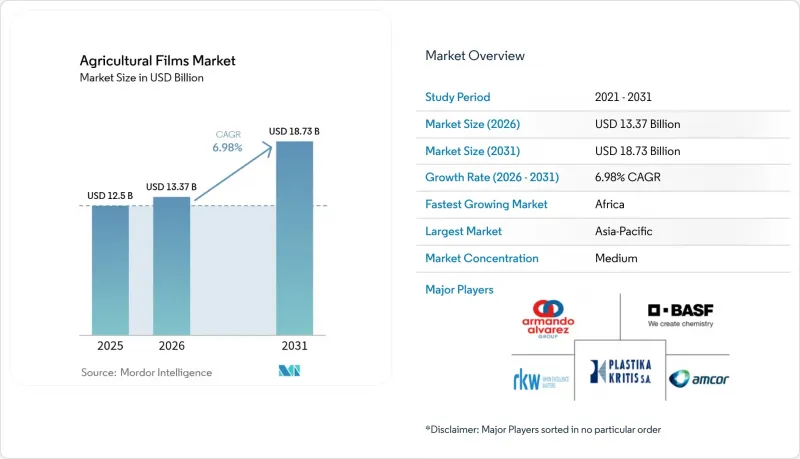
According to Mordor Intelligence, the agricultural films market size is expected to grow from USD 12.50 billion in 2025 to USD 13.37 billion in 2026 and is forecast to reach USD 18.73 billion by 2031 at 6.98% CAGR over 2026-2031.
This report is Segmented by Type (Low-Density Polyethylene, Linear Low-Density Polyethylene, High-Density Polyethylene, Reclaims, and More), by Thickness (Up To 80 Mm and More), by Application (Greenhouse, Mulching, Silage, and Other Applications), and by Geography (North America, South America, Europe, Asia-Pacific, Middle East, and Africa). The Market Forecasts are Provided in Terms of Value (USD).
Global Agricultural Films Market Trends and Insights
Rising adoption of greenhouse cultivation
Protected cultivation now extends from high-value horticulture to staple crops, delivering yield increases of 25-40% and supporting year-round supply continuity. Automation and artificial-intelligence climate controls lower labor inputs, enabling mid-scaled growers to enter the segment. Substrate-based systems eliminate soil-borne disease vectors and require sterile barrier films with superior impermeability, spurring demand for multilayer PE structures. Cannabis, nutraceutical, and pharmaceutical crops command premium film specifications that optimize wavelength management, thermal retention, and diffused light distribution. Greenhouse operators in British Columbia forecast an 18% vegetable-output lift by 2025 through renewable-energy integration that further lowers operational overhead.
Growing popularity of mulching to curb evaporation
Plastic mulch films cut irrigation volumes 30-50% in arid zones and increasingly underpin regeneration practices within conservation agriculture. Global consumption has surpassed 2 million metric tons, with Asia accounting for the bulk due to intensive vegetable systems. Reflective films lower soil-surface temperatures 4-6 °C, extending cropping windows in heat-stressed climates. Biodegradable innovations meet organic-certification needs and reduce labor associated with film retrieval, though elevated cost remains an adoption hurdle. Variable-rate mulch applicators paired with precision agriculture data help growers optimize film thickness and placement, reinforcing resource-efficiency goals. Chinese directives mandating thicker mulch to improve recyclability push material science toward higher-strength formulations that withstand multiple cycles.
High initial investment in greenhouse infrastructure
Hi-tech greenhouses demand USD 2,500-4,000 per m2 compared with USD 400-500 for low-tech counterparts, posing steep upfront barriers for smallholders. Beyond construction, climate controls, fertigation, and energy systems can consume 40% of annual revenue, challenging profitability when produce prices fall. Limited collateral and high interest rates restrict access to credit, especially in frontier economies. Equipment leasing models and pay-as-you-grow service contracts ease the capital strain but require robust extension support. Financial viability varies by crop, and shiitake mushrooms yield internal returns, yet melons remain unprofitable under identical cost structures.
Other drivers and restraints analyzed in the detailed report include:
- Government subsidies for protected cultivation
- Surge in demand for photo-selective spectral films
- Environmental concerns over disposal of PE films
For complete list of drivers and restraints, kindly check the Table Of Contents.
Segment Analysis
Low-Density Polyethylene held 42.75% agricultural films market share in 2025, underpinned by its balanced cost-to-performance ratio and ease of extrusion into covers. The material's dominance stems from superior optical clarity and elongation properties that minimize mechanical stress during installation. The industry's pivot to sustainability is catalyzing an 8.35% CAGR for Reclaims through 2031, aided by multilayer designs that embed recycled content without compromising crop-facing functionality. Chemical advances in compatibilizers allow higher PCR ratios, mitigating odor and gel issues that historically constrained recycled-PE uptake.
Linear-Low-Density Polyethylene adds puncture resistance requested by silage users, while Ethyl Vinyl Acetate copolymers impart enhanced light diffusion for premium greenhouse films. High-density polyethylene and specialized resins, such as polyamide, address niche requirements for structural rigidity and solvent resistance, but remain cost-limited. Rising demand for downgauged films drives the need for high-melt-strength grades that sustain tensile integrity at reduced thickness, thereby compressing resin usage metric tons per hectare and lowering the overall plastic footprint.
Complete Report Scope:
- By Product Type
- Low-Density Polyethylene
- Linear Low-Density Polyethylene
- High-Density Polyethylene
- Ethyl Vinyl Acetate / Ethylene Butyl Acrylate
- Reclaims (Recycled PE)
- Other Types (Polypropylene Agricultural Films, Polyamide Agricultural Films, Ethylene Vinyl-Alcohol Copolymer Resins, and PVC)
- By Thickness
- Up to 80 µm
- 80-150 µm
- Above 150 µm
- By Application
- Greenhouse
- Mulching
- Silage
- Other Applications (Low Tunnels, Fumigation)
- By Geography
- North America
- United States
- Canada
- Mexico
- Rest of North America
- South America
- Brazil
- Argentina
- Rest of South America
- Europe
- Germany
- United Kingdom
- France
- Spain
- Italy
- Russia
- Rest of Europe
- Asia-Pacific
- China
- India
- Japan
- Australia
- Rest of Asia-Pacific
- Middle East
- Saudi Arabia
- United Arab Emirates
- Rest of Middle East
- Africa
- South Africa
- Egypt
- Rest of Africa
- North America
Geography Analysis
Asia-Pacific held 37.10% of the agricultural films market in 2025, driven by extensive greenhouse acreage in China and subsidy-backed modernization programs in India, Japan, and South Korea. Regional manufacturers have cost advantages and benefit from a localized supply of stabilizer additives and extrusion machinery, enabling rapid product iteration. Domestic innovation focuses on diffusive films that counteract high solar-irradiation intensity while optimizing crop photosynthetic efficiency. Government programs targeting plastic waste reduction prompt the development of thicker, recyclable mulch variants, cementing local research collaborations between resin producers and agricultural institutes.
Africa represents the fastest-growing territory with a projected 8.85% CAGR through 2031, supported by horticultural export expansion and favorable trade preferences. Kenya's floriculture valorizes protected cultivation, generating and guiding neighboring economies toward greenhouse models. South African bioplastics leverage duty-free access under the African Growth and Opportunity Act, offering cost-competitive biodegradable inputs for regional film converters. Despite growth potential, endemic infrastructure gaps in film retrieval and recycling constrain circular-economy ambitions.
Europe and North America illustrate mature yet dynamic markets where sustainability regulation spurs continual material advancement. The European Commission's 2025 update to food-contact regulations imposes stricter purity thresholds, compelling film formulators to refine additive packages and contamination-control protocols. Middle East investments in water-efficiency and year-round production use high-diffusion covers paired with desalinated or recycled water in closed-loop systems, while South American and Oceanian niche segments favor specialty mulch and silage products aligned with export-driven produce quality requirements.
- Berry Global Inc. (Amcor)
- Armando Alvarez Group
- BASF SE
- Novamont SpA
- Polifilm Group
- Ginegar Plastic Products
- Trioplast Industrier
- NDVECO Group
- Plastika Kritis SA
- Exxon Mobil Corporation
- Kuraray Co.
- AB Rani Plast Oy
- RKW Group
- Group Barbier
- Coveris Holding
Additional Benefits:
- The market estimate (ME) sheet in Excel format
- 3 months of analyst support
TABLE OF CONTENTS
1 Introduction
- 1.1 Study Assumptions and Market Definition
- 1.2 Scope of the Study
2 Research Methodology
3 Executive Summary
4 Market Landscape
- 4.1 Market Overview
- 4.2 Market Drivers
- 4.2.1 Rising adoption of greenhouse cultivation
- 4.2.2 Growing popularity of mulching to curb evaporation
- 4.2.3 Government subsidies for protected cultivation
- 4.2.4 Surge in demand for photo-selective spectral films
- 4.2.5 Farm-level shift toward recycled-content films
- 4.2.6 Carbon-credit monetization for biodegradable films
- 4.3 Market Restraints
- 4.3.1 High initial investment in greenhouse infrastructure
- 4.3.2 Environmental concerns over disposal of PE films
- 4.3.3 Volatility in ethylene feedstock pricing
- 4.3.4 Lack of standardized film recovery logistics
- 4.4 Regulatory Landscape
- 4.5 Technological Outlook
- 4.6 Porter's Five Forces
- 4.6.1 Bargaining Power of Suppliers
- 4.6.2 Bargaining Power of Buyers
- 4.6.3 Threat of New Entrants
- 4.6.4 Threat of Substitute Products
- 4.6.5 Intensity of Competitive Rivalry
5 Market Size and Growth Forecasts (Value)
- 5.1 By Product Type
- 5.1.1 Low-Density Polyethylene
- 5.1.2 Linear Low-Density Polyethylene
- 5.1.3 High-Density Polyethylene
- 5.1.4 Ethyl Vinyl Acetate / Ethylene Butyl Acrylate
- 5.1.5 Reclaims (Recycled PE)
- 5.1.6 Other Types (Polypropylene Agricultural Films, Polyamide Agricultural Films, Ethylene Vinyl-Alcohol Copolymer Resins, and PVC)
- 5.2 By Thickness
- 5.2.1 Up to 80 µm
- 5.2.2 80-150 µm
- 5.2.3 Above 150 µm
- 5.3 By Application
- 5.3.1 Greenhouse
- 5.3.2 Mulching
- 5.3.3 Silage
- 5.3.4 Other Applications (Low Tunnels, Fumigation)
- 5.4 By Geography
- 5.4.1 North America
- 5.4.1.1 United States
- 5.4.1.2 Canada
- 5.4.1.3 Mexico
- 5.4.1.4 Rest of North America
- 5.4.2 South America
- 5.4.2.1 Brazil
- 5.4.2.2 Argentina
- 5.4.2.3 Rest of South America
- 5.4.3 Europe
- 5.4.3.1 Germany
- 5.4.3.2 United Kingdom
- 5.4.3.3 France
- 5.4.3.4 Spain
- 5.4.3.5 Italy
- 5.4.3.6 Russia
- 5.4.3.7 Rest of Europe
- 5.4.4 Asia-Pacific
- 5.4.4.1 China
- 5.4.4.2 India
- 5.4.4.3 Japan
- 5.4.4.4 Australia
- 5.4.4.5 Rest of Asia-Pacific
- 5.4.5 Middle East
- 5.4.5.1 Saudi Arabia
- 5.4.5.2 United Arab Emirates
- 5.4.5.3 Rest of Middle East
- 5.4.6 Africa
- 5.4.6.1 South Africa
- 5.4.6.2 Egypt
- 5.4.6.3 Rest of Africa
- 5.4.1 North America
6 Competitive Landscape
- 6.1 Market Concentration
- 6.2 Strategic Moves
- 6.3 Market Share Analysis
- 6.4 Company Profiles (Includes Global Level Overview, Market Level Overview, Core Segments, Financials as Available, Strategic Information, Market Rank/Share for Key Companies, Products and Services, and Recent Developments)
- 6.4.1 Berry Global Inc. (Amcor)
- 6.4.2 Armando Alvarez Group
- 6.4.3 BASF SE
- 6.4.4 Novamont SpA
- 6.4.5 Polifilm Group
- 6.4.6 Ginegar Plastic Products
- 6.4.7 Trioplast Industrier
- 6.4.8 NDVECO Group
- 6.4.9 Plastika Kritis SA
- 6.4.10 Exxon Mobil Corporation
- 6.4.11 Kuraray Co.
- 6.4.12 AB Rani Plast Oy
- 6.4.13 RKW Group
- 6.4.14 Group Barbier
- 6.4.15 Coveris Holding
7 Market Opportunities and Future Outlook

