PUBLISHER: Global Market Insights Inc. | PRODUCT CODE: 2101954

PUBLISHER: Global Market Insights Inc. | PRODUCT CODE: 2101954
Agricultural Drone Market Opportunity, Growth Drivers, Industry Trend Analysis, and Forecast 2026 - 2035
The Global Agricultural Drone Market was valued at USD 3.7 billion in 2025 and is estimated to grow at a CAGR of 10.2% to reach USD 9.7 billion by 2035.
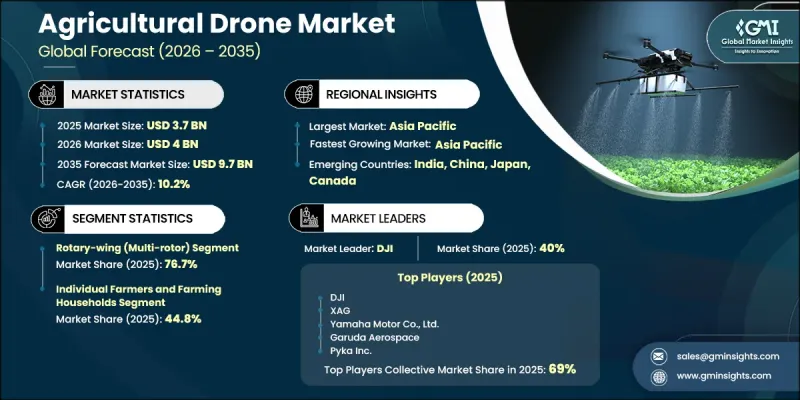
Expansion in this market is driven by the widespread adoption of precision agriculture practices, continuous reductions in drone hardware pricing, and rapid advancement of AI-enabled agricultural analytics platforms. A major transformation is underway as manual agricultural operations are increasingly substituted with autonomous drone-based systems that improve productivity and reduce labor dependency. At the same time, commercial farming enterprises and agricultural service providers are increasingly accepting higher initial technology investment in return for measurable gains in yield optimization, input efficiency, and operational scalability. Regulatory frameworks across multiple regions are gradually becoming more standardized, improving clarity for commercial drone usage and encouraging long-term investment across the ecosystem. The improving unit economics of drone adoption are also accelerating penetration, as declining equipment costs and improved operational efficiencies shorten return-on-investment cycles to fewer than three growing seasons in several high-value crop segments. A further structural shift is the rise of service-based deployment models where operators provide drone services on a per-acre basis, reducing capital burden for farmers and enabling faster adoption among small and mid-sized agricultural producers.
| Market Scope | |
|---|---|
| Start Year | 2025 |
| Forecast Year | 2026-2035 |
| Start Value | $3.7 Billion |
| Forecast Value | $9.7 Billion |
| CAGR | 10.2% |
The rotary-wing drone segment held a 76.7% share in 2025, reflecting strong demand for multi-rotor systems in spraying, mapping, and monitoring applications that require stable hovering, vertical takeoff capability, and adaptable payload configurations. These systems range from compact multi-rotor platforms used for small-field operations to advanced high-capacity models designed for large-scale commercial spraying across extensive farmland areas, supporting applications in major crop production systems including grains and oilseeds.
The individual farmers and farming households segment accounted for 44.8% share in 2025, making it the largest end-user category. This dominance is driven by increasing awareness of precision farming benefits, including improved crop health monitoring, efficient pesticide application, and enhanced yield forecasting. Farmers across both developed and emerging agricultural economies are progressively integrating drone technologies into routine farm management practices to improve productivity and reduce input wastage.
North America Agricultural Drone Market captured 27.7% share in 2025 owing to its extensive commercial farming base across key agricultural regions. Regulatory oversight in the region is shaped by structured operational frameworks that govern commercial drone usage, while streamlined authorization systems have improved accessibility for agricultural applications in controlled airspace zones, supporting broader adoption across large-scale farming operations.
Major companies operating in the global agricultural drone industry include DJI, XAG Co., Ltd., Yamaha Motor Co., Ltd., EagleNXT, Kray Technologies, EAVISION, Hylio Inc., Rantizo, Pyka Inc., Garuda Aerospace, Marut Drones, AgTecher, SKYX Aerospace Pvt. Ltd., General Aeronautics Pvt. Ltd., and OPTRON (Pty) Ltd. The key strategies adopted by companies in the agricultural drone market focus on improving autonomous flight capabilities and AI-powered analytics to enhance precision farming outcomes. Firms are investing in expanding drone-as-a-service models that lower entry barriers for farmers by shifting from ownership to subscription-based usage. Strategic partnerships with agritech firms and farming cooperatives are strengthening distribution and on-field adoption. Companies are also developing multi-functional drones capable of spraying, imaging, and mapping within a single platform to improve operational efficiency.
Table of Contents
Chapter 1 Methodology & Scope
- 1.1 Research approach
- 1.2 Quality commitments
- 1.2.1 GMI AI policy & data integrity commitment
- 1.2.1.1 Source consistency protocol
- 1.2.1 GMI AI policy & data integrity commitment
- 1.3 Research trail & confidence scoring
- 1.3.1 Research trail components
- 1.3.2 Scoring components
- 1.4 Data collection
- 1.4.1 Partial list of primary sources
- 1.5 Data mining sources
- 1.5.1 Paid sources
- 1.5.1.1 Sources, by region
- 1.5.1 Paid sources
- 1.6 Base estimates and calculations
- 1.6.1 Base year calculation for any one approach
- 1.7 Market estimates & forecasts parameters
- 1.8 Forecast model
- 1.8.1 Quantified market impact analysis
- 1.8.1.1 Mathematical impact of growth parameters on forecast
- 1.8.1 Quantified market impact analysis
- 1.9 Research transparency addendum
- 1.9.1 Source attribution framework
- 1.9.2 Quality assurance metrics
- 1.9.3 Our commitment to trust
- 1.10 Market definitions
Chapter 2 Executive Summary
- 2.1 Industry synopsis, 2022 - 2035
- 2.1.1 Type trends
- 2.1.2 Component trends
- 2.1.3 End User trends
- 2.1.4 Application trends
- 2.1.5 Regional trends
Chapter 3 Industry Insights
- 3.1 Industry ecosystem analysis
- 3.2 Industry impact forces
- 3.2.1 Growth drivers
- 3.2.1.1 Increasing adoption of precision agriculture practices
- 3.2.1.2 Government support and favorable drone regulations
- 3.2.1.3 Growing labor shortages and demand for farm automation
- 3.2.1.4 Advancements in drone, AI, and sensor technologies
- 3.2.2 Industry pitfalls and challenges
- 3.2.2.1 High acquisition and maintenance costs
- 3.2.2.2 Regulatory restrictions and airspace compliance
- 3.2.3 Market opportunities
- 3.2.3.1 Expansion of Drone-as-a-Service (DaaS) business models
- 3.2.3.2 Growing adoption across emerging agricultural economies
- 3.2.1 Growth drivers
- 3.3 Growth potential analysis
- 3.4 Regulatory landscape (Driven by primary research)
- 3.4.1 North America
- 3.4.2 Europe
- 3.4.3 Asia Pacific
- 3.4.4 Latin America
- 3.4.5 MEA
- 3.5 Technology landscape
- 3.5.1 Current technological trends
- 3.5.2 Emerging technologies
- 3.6 Pricing trend analysis (Driven by primary research)
- 3.7 Future market trends
- 3.8 Patent analysis
- 3.9 Porter's analysis
- 3.10 PESTEL analysis
- 3.11 Impact of AI and Generative AI on the market (Driven by primary research)
- 3.12 Value chain analysis (Driven by primary research)
- 3.13 Investment & funding analysis (Driven by primary research)
- 3.14 Consumer insights (Driven by primary research)
Chapter 4 Competitive Landscape, 2025
- 4.1 Introduction
- 4.2 Company market share analysis, by region, 2025
- 4.2.1 North America
- 4.2.2 Europe
- 4.2.3 Asia Pacific
- 4.2.4 Middle East & Africa
- 4.2.5 Latin America
- 4.3 Key developments
- 4.3.1 Key partnerships & collaborations
- 4.3.2 Major M&A activities
- 4.3.3 Product innovations & launches
- 4.3.4 Market expansion strategies
- 4.4 Competitive positioning matrix
Chapter 5 Market Size and Forecast, By Type, 2022 - 2035 (USD Million)
- 5.1 Key trends
- 5.2 Rotary-Wing (Multi-rotor)
- 5.3 Fixed-Wing
- 5.4 Hybrid
Chapter 6 Market Size and Forecast, By Component , 2022 - 2035 (USD Million)
- 6.1 Key trends
- 6.2 Hardware
- 6.3 Software & Services
Chapter 7 Market Size and Forecast, By Application, 2022 - 2035 (USD Million)
- 7.1 Key trends
- 7.2 Crop Spraying
- 7.3 Crop Monitoring & Health Assessment
- 7.4 Field Mapping & Soil Analysis
- 7.5 Irrigation Management
- 7.6 Livestock Monitoring
- 7.7 Planting & Seeding
- 7.8 Others
Chapter 8 Market Size and Forecast, By End User, 2022 - 2035 (USD Million)
- 8.1 Agricultural Service Providers
- 8.2 Individual Farmers & Farming Households
- 8.3 Government Agencies
- 8.4 Research Institutions & Universities
- 8.5 Others
Chapter 9 Market Size and Forecast, By Region, 2022 - 2035 (USD Million)
- 9.1 Key trends
- 9.2 North America
- 9.2.1 U.S.
- 9.2.2 Canada
- 9.3 Europe
- 9.3.1 Germany
- 9.3.2 France
- 9.3.3 UK
- 9.3.4 Netherlands
- 9.3.5 Spain
- 9.3.6 Italy
- 9.4 Asia Pacific
- 9.4.1 China
- 9.4.2 Japan
- 9.4.3 South Korea
- 9.4.4 India
- 9.4.5 Australia
- 9.5 Middle East & Africa
- 9.5.1 Saudi Arabia
- 9.5.2 UAE
- 9.5.3 South Africa
- 9.6 Latin America
- 9.6.1 Brazil
- 9.6.2 Argentina
- 9.6.3 Mexico
Chapter 10 Company Profiles
- 10.1 DJI
- 10.2 XAG Co., Ltd
- 10.3 Yamaha Motor Co., Ltd.
- 10.4 EagleNXT
- 10.5 Kray Technologies
- 10.6 EAVISION
- 10.7 Hylio Inc.
- 10.8 Rantizo
- 10.9 Pyka Inc.
- 10.10 Garuda Aerospace
- 10.11 Marut Drones
- 10.12 AgTecher
- 10.13 SKYX AEROSPACE PVT. LTD
- 10.14 General Aeronautics Pvt. Ltd.
- 10.15 OPTRON (Pty) Ltd

