PUBLISHER: Mordor Intelligence | PRODUCT CODE: 2156925

PUBLISHER: Mordor Intelligence | PRODUCT CODE: 2156925
Asia-Pacific Agricultural Drones - Market Share Analysis, Industry Trends & Statistics, Growth Forecasts (2026 - 2031)
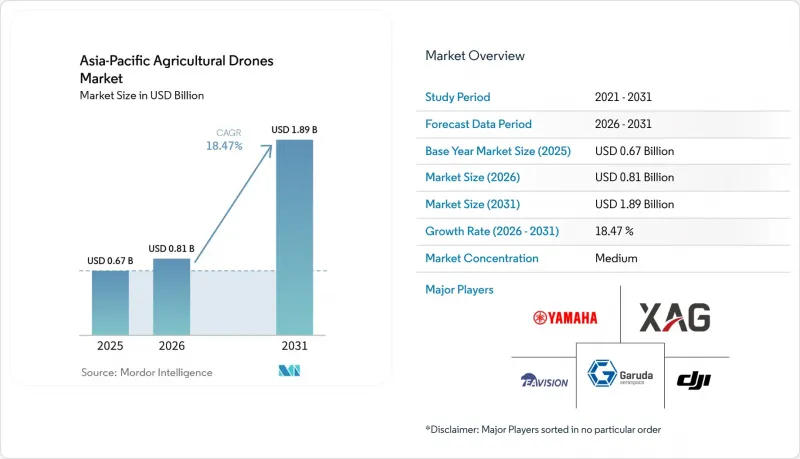
According to Mordor Intelligence, the Asia-Pacific agricultural drones market was valued at USD 0.67 billion in 2025 and is forecast to grow from USD 0.81 billion in 2026 to reach USD 1.89 billion by 2031, at a CAGR of 18.47% during the forecast period (2026 to 2031).
Asia-Pacific Agricultural Drones Market Trends and Insights
Government Subsidies and Precision-Agriculture Programs
Government subsidies lower the initial cost of deploying agricultural drones and shorten the adoption cycle across the Asia-Pacific agricultural drones market. China added plant-protection drones to its 2025 scrappage-and-replacement subsidy program through a joint directive issued in February 2025. The program allowed operators to obtain enhanced purchase support when retiring older agricultural equipment. Jiangsu, Sichuan, Anhui, Yunnan, and Inner Mongolia issued 2024 to 2026 implementation programs that extended support to smallholders and cooperatives. These programs also set annual use requirements, which linked subsidy payments to actual drone operations. Under the Sub-Mission on Agricultural Mechanization (SMAM), India provides purchase subsidies of 40% to 100% to eligible farmer-producer organizations and self-help groups for agricultural machinery and equipment, including agricultural drones. Japan provides smart agriculture grants that can cover up to 50% of eligible drone and precision-equipment costs. Training and operating conditions can also increase the available pool of qualified operators, addressing a separate capacity constraint.
Agricultural Labor Shortages and Farm Automation
Labor shortages support the use of aerial systems where conventional farm work is becoming difficult to staff. Japan had an agricultural workforce of 1.1 million in 2024, a reduction of approximately 18% from 2020, thereby increasing the need for technologies to automate labor-intensive agricultural tasks. NTT and Hokkaido University began a joint project in April 2025 to develop digital-twin farms and autonomous multi-drone operations to reduce reliance on manual labor by automating field monitoring and other repetitive tasks. Their planned Smart Agriculture Operation Center model targets commercial deployment by 2030. In Japan, OPTiM Corporation covered 26,000 hectares across 110,000 fields in 133 municipalities through its Pinpoint Time Spraying service in fiscal year 2024, with more than 94% of its clients indicating an intention to renew for fiscal year 2025, indicating sustained demand for labor-saving drone services.
High Acquisition and Lifecycle Costs for Advanced Systems
Advanced systems remain expensive for farms that cannot spread costs across large spray areas or multiple clients. The capital requirements include aircraft, batteries, payloads, and supporting equipment. Operators also require trained personnel, maintenance, software access, and reliable replacement parts over the life of a fleet. Smallholders often cannot justify these costs from a limited number of seasonal applications. The cost barrier is most restrictive where farms are fragmented, and each operation covers a small area. Subsidies and service models mitigate this challenge, but they do not eliminate lifecycle costs for the provider. Fleet owners still need sufficient recurring demand to maintain equipment utilization and recover the initial investment. This restraint helps explain why service networks are particularly important in the Asia-Pacific agricultural drone's market.
Other drivers and restraints analyzed in the detailed report include:
- Expansion of Drone Spraying and Drone-as-a-Service Models
- Rising Input Costs and Demand for Variable Rate Application
- Fragmented Aviation, Pesticide, and Data Regulations
For complete list of drivers and restraints, kindly check the Table Of Contents.
Segment Analysis
Rotary-wing drones accounted for 64.6% of the drone-type share in 2025, the largest share in this category. Their hovering capability supports low-altitude spraying across paddy fields, wheat, orchards, and vegetable farms. Operators can adjust application rates and avoid excessive spraying at field edges. Fixed-wing platforms serve larger plantations, broadacre properties, and difficult terrain, with longer endurance improving coverage per charge. Hybrid vertical takeoff and landing designs combine endurance with flexible deployment, reducing the need for separate aircraft for mapping and scouting. Each platform must meet national aviation requirements.
Hybrid drones are the fastest-growing drone type, with a forecast CAGR of 21.0% from 2026 to 2031. Their vertical takeoff and landing capability, combined with longer flight endurance, supports flexible deployment for mapping, surveillance, and other agricultural applications where runway access is limited. Fixed-wing platforms continue to support mapping over larger land areas, while rotary-wing drones remain widely used for spraying and low-altitude agricultural operations. China requires licensing, while India uses phased approvals. Aeronext Inc. and MAZEX Co., Ltd formed a 2026 alliance for autonomous multi-drone operations in Japan. SZ DJI Technology Co., Ltd. tested AGRAS T50 spraying and aerial lifting in Thai durian orchards in 2026. These developments are supporting wider adoption of versatile drone platforms across diverse agricultural applications in the Asia-Pacific region.
Hardware accounted for 53.2% of component revenue in 2025. Aircraft systems remain capital-intensive, and many service providers own fleets. Software generates revenue through mission planning, precision analytics, and field-management tools, which are typically bundled with equipment and service contracts. Hardware suppliers benefit when systems are linked to data platforms. OPTiM covered 26,000 hectares across 110,000 fields in 133 municipalities during fiscal year 2024, with more than 94% of clients indicating intent to renew. Hardware remains important even as services account for a growing share of revenue.
Services are the fastest-growing component, with a forecast CAGR of 22.5% from 2026 to 2031. Outsourced spraying, mapping, and monitoring eliminate the need for farms to purchase aircraft, making this model suitable for farms that require occasional or seasonal services. Flight data and prescriptions can remain within the provider's software environment, making system changes costly for customers. Vendors without proprietary software may find it harder to protect margins. This shifts competition toward data interoperability and integration with farm-management or credit platforms, which can strengthen customer retention.
Complete Report Scope:
- By Drone Type
- Fixed-wing Drones
- Rotary-wing Drones
- Hybrid Drones
- By Component
- Hardware
- Software
- Services
- By Application
- Field Mapping and Surveying
- Crop Spraying
- Crop Monitoring/Field Surveillance
- Livestock Monitoring
- Irrigation Management
- Soil and Field Analysis
- By Farm Size
- Large-scale Farms
- Small and Medium scale Farms
- By Geography
- China
- India
- Japan
- Australia
- Rest of Asia-Pacific
List of Companies Covered in this Report:
- SZ DJI Technology Co., Ltd.
- XAG Co., Ltd.
- Yamaha Motor Co., Ltd.
- Garuda Aerospace Pvt. Ltd.
- Nileworks Inc.
- Marut Drones Pvt. Ltd.
- Suzhou Eavision Robotic Technologies Co., Ltd.
- General Aeronautics Pvt. Ltd.
- IoTechWorld Avigation Pvt. Ltd.
- Terra Drone Corporation
- Parrot Drones SAS
- AgEagle Aerial Systems Inc.
- Sentera
Additional Benefits:
- The market estimate (ME) sheet in Excel format
- 3 months of analyst support
TABLE OF CONTENTS
1 INTRODUCTION
- 1.1 Study Assumptions and Market Definition
- 1.2 Scope of the Study
2 RESEARCH METHODOLOGY
3 EXECUTIVE SUMMARY
4 MARKET LANDSCAPE
- 4.1 Market Overview
- 4.2 Market Drivers
- 4.2.1 Government Subsidies and Precision-Agriculture Programs
- 4.2.2 Agricultural Labor Shortages and Farm Automation
- 4.2.3 Expansion of Drone Spraying and Drone-as-a-Service Models
- 4.2.4 Rising Input Costs and Demand for Variable Rate Application
- 4.2.5 Localized Swarm Operations for Smallholder and Fragmented Farms
- 4.2.6 Integration of Drone Data With Farm Credit, Insurance, and Traceability Systems
- 4.3 Market Restraints
- 4.3.1 High Acquisition and Lifecycle Costs for Advanced Systems
- 4.3.2 Fragmented Aviation, Pesticide, and Data Regulations
- 4.3.3 Shortage of Certified Pilots and Agricultural Data Specialists
- 4.3.4 Patchy Rural Connectivity and Inconsistent Data Ownership Rules
- 4.4 Regulatory Landscape
- 4.5 Technological Outlook
- 4.6 Porter's Five Forces Analysis
- 4.6.1 Bargaining Power of Suppliers
- 4.6.2 Bargaining Power of Buyers
- 4.6.3 Threat of New Entrants
- 4.6.4 Threat of Substitute Products
- 4.6.5 Intensity of Competitive Rivalry
5 MARKET SIZE AND GROWTH FORECASTS (VALUE)
- 5.1 By Drone Type
- 5.1.1 Fixed-wing Drones
- 5.1.2 Rotary-wing Drones
- 5.1.3 Hybrid Drones
- 5.2 By Component
- 5.2.1 Hardware
- 5.2.2 Software
- 5.2.3 Services
- 5.3 By Application
- 5.3.1 Field Mapping and Surveying
- 5.3.2 Crop Spraying
- 5.3.3 Crop Monitoring/Field Surveillance
- 5.3.4 Livestock Monitoring
- 5.3.5 Irrigation Management
- 5.3.6 Soil and Field Analysis
- 5.4 By Farm Size
- 5.4.1 Large-scale Farms
- 5.4.2 Small and Medium scale Farms
- 5.5 By Geography
- 5.5.1 China
- 5.5.2 India
- 5.5.3 Japan
- 5.5.4 Australia
- 5.5.5 Rest of Asia-Pacific
6 COMPETITIVE LANDSCAPE
- 6.1 Market Concentration
- 6.2 Strategic Moves
- 6.3 Market Share Analysis
- 6.4 Company Profiles (Includes Global Level Overview, Market Level Overview, Core Segments, Financials as Available, Strategic Information, Market Rank/Share, Products and Services, Recent Developments)
- 6.4.1 SZ DJI Technology Co., Ltd.
- 6.4.2 XAG Co., Ltd.
- 6.4.3 Yamaha Motor Co., Ltd.
- 6.4.4 Garuda Aerospace Pvt. Ltd.
- 6.4.5 Nileworks Inc.
- 6.4.6 Marut Drones Pvt. Ltd.
- 6.4.7 Suzhou Eavision Robotic Technologies Co., Ltd.
- 6.4.8 General Aeronautics Pvt. Ltd.
- 6.4.9 IoTechWorld Avigation Pvt. Ltd.
- 6.4.10 Terra Drone Corporation
- 6.4.11 Parrot Drones SAS
- 6.4.12 AgEagle Aerial Systems Inc.
- 6.4.13 Sentera
7 MARKET OPPORTUNITIES AND FUTURE OUTLOOK

