PUBLISHER: Mordor Intelligence | PRODUCT CODE: 2113993

PUBLISHER: Mordor Intelligence | PRODUCT CODE: 2113993
Agriculture Drones - Market Share Analysis, Industry Trends & Statistics, Growth Forecasts (2026 - 2031)
According to Mordor Intelligence, the agriculture drones market size was valued at USD 1.5 billion in 2025 and estimated to grow from USD 1.8 billion in 2026 to reach USD 3.9 billion by 2031, at a CAGR of 16.72% during the forecast period (2026-2031).
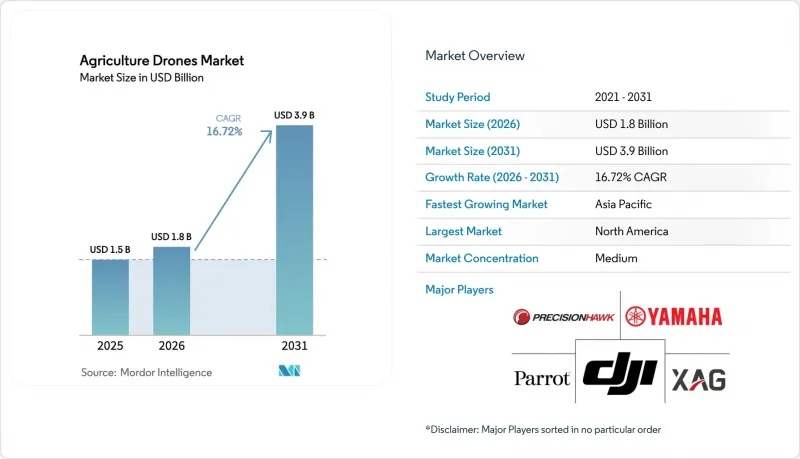
This report is Segmented by Product (Fixed-Wing Drones, Rotary-Wing Drones, and More), by Component (Hardware, Software, and Services), by Application (Field Mapping and Surveying, Crop Spraying, and More), by Farm Size (Large-Scale Commercial Farms and Small and Medium Farms), and by Geography (North America, South America, Europe, and More). The Market Forecasts are Provided in Terms of Value (USD).
Global Agriculture Drones Market Trends and Insights
Rapid Decline in Drone Hardware Prices
Entry-level agricultural drones now retail for USD 2,000-4,000, down from USD 14,500 in 2016, allowing smallholder cooperatives to justify ownership. Mid-range platforms, priced at USD 8,000-15,000, include obstacle avoidance and automated mission planning features, which were once reserved for enterprise models topping USD 20,000. Modular airframes support payload swaps, extending the useful life and improving the return on investment. Subsidies in India and Australia eliminate up to 80.0% of the purchase cost, accelerating fleet turnover. Hardware margins are stabilizing even as unit prices fall, signaling a maturing supply chain.
Expansion of 5G and Edge-AI Enabling Real-Time Analytics
Fifth-generation networks reduce latency to below twenty milliseconds, allowing drones to transmit imagery and receive prescription maps during a single flight. Trials on United States corn farms demonstrate that onboard convolutional networks can classify stress with 94.0% accuracy, thereby removing cloud-upload bottlenecks. Private 5G installations on large estates coordinate swarms of ten or more drones, providing daily coverage of over 1,000 acres. Edge processing also addresses privacy worries because raw images never leave the farm. Module prices under USD 500 are anticipated by 2027, opening the technology to mid-size growers.
Air-Traffic Integration Hurdles
Unmanned Traffic Management systems for integrating agricultural drones into controlled airspace are under development, delaying Beyond Visual Line of Sight operations essential for large farms. The Federal Aviation Administration's 2024 Notice of Proposed Rulemaking for Beyond Visual Line of Sight remains unresolved, leaving operators reliant on waivers. The European Union's U-space regulation mandates the implementation of U-space airspace by 2027, but the timing of implementation varies. Remote identification requirements add USD 100-300 per unit in hardware costs. Until the infrastructure matures, drones remain limited to visual line-of-sight operations, covering 50-100 acres per flight.
Other drivers and restraints analyzed in the detailed report include:
- Government Subsidies for Precision Agriculture
- Rising Agro-Chemical Cost Pushing Variable-Rate Spraying Demand
- Short Battery Endurance for Large Acreage
For complete list of drivers and restraints, kindly check the Table Of Contents.
Segment Analysis
Rotary-wing drones held a 62.0% market share in the agricultural drones market in 2025, dominating crop spraying and livestock monitoring due to their hovering capability and maneuverability, despite having endurance limitations. Hybrid drones are projected to grow at a 18.9% CAGR through 2031, driven by demand for platforms that combine vertical takeoff with fixed-wing cruise efficiency. AeroVironment's Quantix Recon offers 45-minute flight times and 400-acre coverage per sortie, addressing productivity gaps in broad-acre estates. Fixed-wing drones, with an endurance of 45-90 minutes, are commonly used in mapping and surveying, but they lack the precision required for variable-rate spraying. Regulatory approvals for Beyond Visual Line of Sight (BVLOS) operations will benefit hybrid and fixed-wing drones due to their extended range.
Rotary-wing platforms dominate the sub-USD 10,000 segment, with manufacturers such as SZ DJI Technology Co., Ltd. and XAG Co., Ltd. offering feature-rich models. Hybrid platforms are gaining traction due to their versatility in spraying, scouting, and irrigation management, particularly in regions such as India and Southeast Asia, where smallholder farmers cultivate multiple crops.
In 2025, hardware accounted for 55.0% of the agricultural drones market size, including airframes, sensors, batteries, and ground control stations. However, the services segment is projected to grow at a CAGR of 17.8% through 2031. Drone-as-a-Service (DaaS) models reduce upfront capital requirements and transfer operational risks to specialized providers. Companies such as DroneDeploy, Inc. and PrecisionHawk, Inc. offer subscription-based analytics platforms that bundle flight operations, data processing, and agronomic insights for USD 5-15 per acre per season, making precision agriculture accessible to farms that cannot justify investments of USD 10,000-30,000 in hardware.
Software components, such as flight planning, image stitching, and machine learning inference, are increasingly delivered via cloud platforms, creating recurring revenue streams and improving vendor margins. Services such as pilot training, maintenance contracts, and regulatory compliance support are particularly valuable in regions like India and Africa, where technical expertise is limited.
Complete Report Scope:
- By Product
- Fixed-wing Drones
- Rotary-wing Drones
- Hybrid Drones
- By Component
- Hardware
- Software
- Services
- By Application
- Field Mapping and Surveying
- Crop Spraying
- Crop Monitoring/Field Surveillance
- Livestock Monitoring
- Irrigation Management
- Soil and Field Analysis
- By Farm Size
- Large-scale Commercial Farms
- Small and Medium Farms
- By Geography
- North America
- United States
- Canada
- Rest of North America
- South America
- Brazil
- Argentina
- Rest of South America
- Europe
- Germany
- United Kingdom
- France
- Russia
- Rest of Europe
- Asia-Pacific
- China
- India
- Japan
- Australia
- Rest of Asia-Pacific
- Middle East
- Saudi Arabia
- United Arab Emirates
- Rest of Middle East
- Africa
- South Africa
- Kenya
- Rest of Africa
- North America
Geography Analysis
The Asia-Pacific region is projected to grow at an 18.5% CAGR during 2026-2031, driven by China's extensive manufacturing capabilities and government-supported agricultural modernization initiatives. These programs position drones as essential tools for enhancing food security. The region faces labor shortages and rising wages, making automation a viable investment. SZ DJI Technology Co., Ltd. leverages its expertise in consumer drones to offer the Agras T50, T40, T25, and T10 series, priced between USD 5,000 and USD 27,000, targeting both smallholder and commercial farming segments.
North America accounted for the largest market share, holding 36.0% in 2025, supported by a well-established precision agriculture infrastructure. The United States Department of Agriculture's (USDA) USD 300 million Direct Conservation Loan Program prioritizes aerial platforms and sensor networks. The Federal Aviation Administration's (FAA) Part 107 regulation, along with incremental beyond visual line of sight (BVLOS) waivers, facilitates the deployment of multi-drone fleets on large-scale commercial farms.
Europe's growth is constrained by the European Union Aviation Safety Agency's (EASA) U-space airspace integration timelines and the General Data Protection Regulation (GDPR) 's data privacy requirements, which slow the adoption of drone services. Germany, France, and the United Kingdom lead the region's deployment efforts. In South America, Brazil's large-scale sugarcane, soybean, and corn operations benefit from variable-rate spraying, while Argentina's grain and cattle sectors adopt drones for crop monitoring and pasture management. Africa and the Middle East face infrastructure gaps, including limited 4G/5G coverage and inadequate pilot training programs, which slow adoption compared to developed regions.
- SZ DJI Technology Co., Ltd.
- Yamaha Motor Co., Ltd.
- Parrot S.A.
- AeroVironment, Inc.
- PrecisionHawk, Inc.
- AgEagle Aerial Systems Inc.
- Trimble Inc.
- DELair SAS
- DroneDeploy, Inc.
- XAG Co., Ltd.
- Kray Technologies LLC
- Hylio, Inc.
- ShenZhen AEE Technology company
- AgEagle Aerial Systems
- Drone Volt S.A.
Additional Benefits:
- The market estimate (ME) sheet in Excel format
- 3 months of analyst support
TABLE OF CONTENTS
1 Introduction
- 1.1 Study Assumptions and Market Definition
- 1.2 Scope of the Study
2 Research Methodology
3 Executive Summary
4 Market Landscape
- 4.1 Market Overview
- 4.2 Market Drivers
- 4.2.1 Rapid decline in drone hardware prices
- 4.2.2 Expansion of 5G and edge-AI enabling real-time analytics
- 4.2.3 Government subsidies for precision agriculture
- 4.2.4 Rising agro-chem cost pushing variable-rate spraying demand
- 4.2.5 Climate-change driven need for crop stress monitoring
- 4.2.6 Carbon-credit markets rewarding low-input farming
- 4.3 Market Restraints
- 4.3.1 Air-traffic integration hurdles
- 4.3.2 Data-privacy concerns among farmers
- 4.3.3 Short battery endurance for large acreage
- 4.3.4 Fragmented regulatory standards across countries
- 4.4 Regulatory Landscape
- 4.5 Technological Outlook
- 4.6 Porter's Five Forces
- 4.6.1 Threat of New Entrants
- 4.6.2 Bargaining Power of Suppliers
- 4.6.3 Bargaining Power of Buyers
- 4.6.4 Threat of Substitutes
- 4.6.5 Intensity of Competitive Rivalry
5 Market Size and Growth Forecasts (Value)
- 5.1 By Product
- 5.1.1 Fixed-wing Drones
- 5.1.2 Rotary-wing Drones
- 5.1.3 Hybrid Drones
- 5.2 By Component
- 5.2.1 Hardware
- 5.2.2 Software
- 5.2.3 Services
- 5.3 By Application
- 5.3.1 Field Mapping and Surveying
- 5.3.2 Crop Spraying
- 5.3.3 Crop Monitoring/Field Surveillance
- 5.3.4 Livestock Monitoring
- 5.3.5 Irrigation Management
- 5.3.6 Soil and Field Analysis
- 5.4 By Farm Size
- 5.4.1 Large-scale Commercial Farms
- 5.4.2 Small and Medium Farms
- 5.5 By Geography
- 5.5.1 North America
- 5.5.1.1 United States
- 5.5.1.2 Canada
- 5.5.1.3 Rest of North America
- 5.5.2 South America
- 5.5.2.1 Brazil
- 5.5.2.2 Argentina
- 5.5.2.3 Rest of South America
- 5.5.3 Europe
- 5.5.3.1 Germany
- 5.5.3.2 United Kingdom
- 5.5.3.3 France
- 5.5.3.4 Russia
- 5.5.3.5 Rest of Europe
- 5.5.4 Asia-Pacific
- 5.5.4.1 China
- 5.5.4.2 India
- 5.5.4.3 Japan
- 5.5.4.4 Australia
- 5.5.4.5 Rest of Asia-Pacific
- 5.5.5 Middle East
- 5.5.5.1 Saudi Arabia
- 5.5.5.2 United Arab Emirates
- 5.5.5.3 Rest of Middle East
- 5.5.6 Africa
- 5.5.6.1 South Africa
- 5.5.6.2 Kenya
- 5.5.6.3 Rest of Africa
- 5.5.1 North America
6 Competitive Landscape
- 6.1 Market Concentration
- 6.2 Strategic Moves
- 6.3 Market Share Analysis
- 6.4 Company Profiles (Includes Global-Level Overview, Market-Level Overview, Core Segments, Financials as Available, Strategic Information, Market Rank/Share for Key Companies, Products and Services, and Recent Developments)
- 6.4.1 SZ DJI Technology Co., Ltd.
- 6.4.2 Yamaha Motor Co., Ltd.
- 6.4.3 Parrot S.A.
- 6.4.4 AeroVironment, Inc.
- 6.4.5 PrecisionHawk, Inc.
- 6.4.6 AgEagle Aerial Systems Inc.
- 6.4.7 Trimble Inc.
- 6.4.8 DELair SAS
- 6.4.9 DroneDeploy, Inc.
- 6.4.10 XAG Co., Ltd.
- 6.4.11 Kray Technologies LLC
- 6.4.12 Hylio, Inc.
- 6.4.13 ShenZhen AEE Technology company
- 6.4.14 AgEagle Aerial Systems
- 6.4.15 Drone Volt S.A.
7 Market Opportunities and Future Outlook

