PUBLISHER: Global Market Insights Inc. | PRODUCT CODE: 2101963

PUBLISHER: Global Market Insights Inc. | PRODUCT CODE: 2101963
Ophthalmic Devices Market Opportunity, Growth Drivers, Industry Trend Analysis, and Forecast 2026 - 2035
The Global Ophthalmic Devices Market was valued at USD 50.7 billion in 2025 and is estimated to grow at a CAGR of 5.4% to reach USD 85.1 billion by 2035.
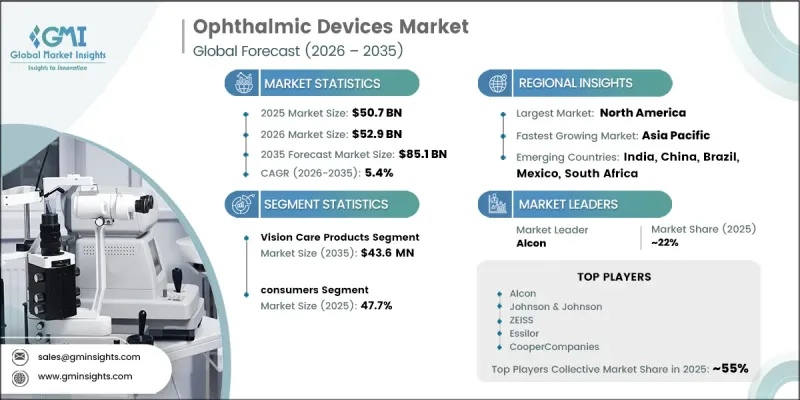
Market growth is supported by the increasing preference for minimally invasive ophthalmic procedures, the rising prevalence of eye disorders, continuous technological advancements in ophthalmic products, and the growing adoption of contact lenses and spectacles. Ophthalmic devices include a broad range of medical technologies used to diagnose, monitor, and treat eye diseases while also supporting vision correction through products such as contact lenses and intraocular lenses. These solutions play a vital role in managing conditions including cataracts, glaucoma, refractive errors, and other vision-related disorders. Increasing digital device usage, expanding urban populations, and changing lifestyle patterns have contributed to a higher incidence of visual impairment across all age groups. At the same time, consumers are increasingly seeking vision correction products that combine superior visual performance, comfort, and modern design. Continuous innovation in diagnostic technologies, surgical equipment, and vision care products is expected to sustain long-term growth in the ophthalmic devices market.
| Market Scope | |
|---|---|
| Start Year | 2025 |
| Forecast Year | 2026-2035 |
| Start Value | $50.7 Billion |
| Forecast Value | $85.1 Billion |
| CAGR | 5.4% |
The vision care products segment accounted for 51.7% share in 2025. Rising cases of refractive disorders, including myopia, hyperopia, and astigmatism, along with increasing digital eye strain, continue to drive demand for advanced vision correction products. Growing consumer preference for innovative spectacle lenses featuring blue-light filtering technology, anti-reflective coatings, and photochromic functionality has further strengthened demand by enhancing everyday visual comfort and eye protection.
The consumers segment held a 47.7% share in 2025. Market leadership is supported by increasing public awareness regarding eye health and the growing incidence of vision impairment associated with prolonged screen exposure and evolving lifestyle habits. Consumers continue to seek vision correction products that offer improved comfort, convenience, effectiveness, and attractive designs. Expanding adoption of daily disposable contact lenses, digital eye care services, and home delivery solutions has further reinforced the segment's leading position while supporting continued market expansion.
North America Ophthalmic Devices Market accounted for 36.6% share in 2025. Regional growth is driven by the increasing prevalence of vision-related disorders, supported by an aging population, rising incidence of chronic health conditions affecting eye health, and growing demand for advanced vision care solutions. Continued investment in modern diagnostic equipment, innovative surgical technologies, and high-quality vision correction products is expected to support sustained market development across the region.
Key players operating in the global ophthalmic devices market include Alcon, ZEISS, Johnson & Johnson, Essilor, CooperCompanies, Bausch + Lomb, Canon, HOYA, TOPCON Healthcare, NIDEK, Haag-Streit Group, Visionix, Coburn Technologies, HEINE, Ophtec, and Ziemer Ophthalmology. Companies operating in the ophthalmic devices market are strengthening their market presence by investing heavily in product innovation, advanced diagnostic technologies, and minimally invasive surgical solutions. Manufacturers are expanding their portfolios with technologically advanced vision care products, premium intraocular lenses, and next-generation ophthalmic imaging systems to address evolving clinical needs. Strategic collaborations with healthcare providers, optical retailers, and distribution partners are helping companies expand global reach and improve product accessibility. Businesses are also prioritizing research and development to enhance product performance, patient comfort, and clinical outcomes while introducing digital technologies that improve diagnosis and treatment efficiency.
Table of Contents
Chapter 1 Research Methodology
- 1.1 Research approach
- 1.2 Quality commitments
- 1.2.1 GMI AI policy & data integrity commitment
- 1.2.1.1 Source consistency protocol
- 1.2.1 GMI AI policy & data integrity commitment
- 1.3 Research trail & confidence scoring
- 1.3.1 Research trail components
- 1.3.2 Scoring components
- 1.4 Data collection
- 1.4.1 Partial list of primary sources
- 1.5 Data mining sources
- 1.5.1 Paid sources
- 1.5.1.1 Sources, by region
- 1.5.1 Paid sources
- 1.6 Base estimates and calculations
- 1.6.1 Base year calculation for any one approach
- 1.7 Forecast model
- 1.7.1 Quantified market impact analysis
- 1.7.1.1 Mathematical impact of growth parameters on forecast
- 1.7.1 Quantified market impact analysis
- 1.8 Research transparency addendum
- 1.8.1 Source attribution framework
- 1.8.2 Quality assurance metrics
- 1.8.3 Our commitment to trust
Chapter 2 Executive Summary
- 2.1 Industry 360° synopsis
- 2.2 Key market trends
- 2.2.1 Regional trends
- 2.2.2 Product trends
- 2.2.3 End use trends
- 2.3 CXO perspectives: Strategic imperatives
Chapter 3 Industry Insights
- 3.1 Industry ecosystem analysis
- 3.2 Industry impact forces
- 3.2.1 Growth drivers
- 3.2.1.1 Increase in number of people suffering from ophthalmic disorders
- 3.2.1.2 Technological advancements in products
- 3.2.1.3 Favorable government initiatives
- 3.2.1.4 Rising adoption of contact lenses and spectacles
- 3.2.2 Industry pitfalls and challenges
- 3.2.2.1 High cost of the ophthalmic devices
- 3.2.2.2 Increasing adoption of refurbished ophthalmic devices
- 3.2.3 Market opportunities
- 3.2.3.1 Growing adoption of premium IOLs and phacoemulsification devices
- 3.2.3.2 Expansion in emerging markets
- 3.2.1 Growth drivers
- 3.3 Growth potential analysis
- 3.4 Regulatory landscape (Driven by primary research)
- 3.4.1 North America
- 3.4.2 Europe
- 3.4.3 Asia Pacific
- 3.4.4 Latin America
- 3.4.5 MEA
- 3.5 Technology landscape
- 3.5.1 Current technological trends
- 3.5.2 Emerging technologies
- 3.6 Pricing trend analysis (Driven by primary research)
- 3.7 Future market trends
- 3.8 Porter's analysis
- 3.9 PESTEL analysis
- 3.10 Impact of AI and Generative AI on the market (Driven by primary research)
- 3.11 Value chain analysis (Driven by primary research)
- 3.12 Sustainability and environmental impact
- 3.12.1 Use of recyclable materials
- 3.12.2 Energy-efficient manufacturing processes
- 3.13 Consumer insights (Driven by primary research)
- 3.14 Treatment infrastructure & clinical adoption landscape
- 3.15 Gap analysis
Chapter 4 Competitive Landscape, 2025
- 4.1 Introduction
- 4.2 Company matrix analysis
- 4.3 Company market share analysis (Driven by primary research)
- 4.3.1 Global
- 4.3.2 North America
- 4.3.3 Europe
- 4.3.4 Asia Pacific
- 4.4 Competitive positioning matrix
- 4.5 Competitive analysis of major market players
- 4.6 Key developments
- 4.6.1 Mergers & acquisitions
- 4.6.2 Partnerships & collaborations
- 4.6.3 New product launches
- 4.6.4 Expansion plans
Chapter 5 Market Estimates and Forecast, By Product, 2022 - 2035 ($ Mn)
- 5.1 Key trends
- 5.2 Vision care products
- 5.2.1 Contact lenses
- 5.2.1.1 Soft contact lenses
- 5.2.1.2 Rigid gas permeable lenses (RGP)
- 5.2.1.3 Toric
- 5.2.1.4 Other contact lenses
- 5.2.2 Spectacle lenses
- 5.2.1 Contact lenses
- 5.3 Surgical devices
- 5.3.1 Cataract surgery devices
- 5.3.1.1 Intraocular lenses
- 5.3.1.2 Phacoemulsification devices
- 5.3.1.3 Ophthalmic viscoelastic devices
- 5.3.1.4 Cataract surgical lasers
- 5.3.1.5 IOL injectors
- 5.3.1.6 Other cataract surgery devices
- 5.3.2 Glaucoma surgery devices
- 5.3.2.1 Glaucoma drainage devices
- 5.3.2.2 Glaucoma lasers
- 5.3.2.3 Minimally invasive glaucoma surgery (MIGS)
- 5.3.2.4 Other glaucoma surgery devices
- 5.3.3 Refractive surgery devices
- 5.3.3.1 Excimer lasers
- 5.3.3.2 Femtosecond lasers
- 5.3.3.3 Other refractive surgery devices
- 5.3.4 Vitreoretinal surgery devices
- 5.3.4.1 Photocoagulation lasers
- 5.3.4.2 Illumination devices
- 5.3.4.3 Vitreoretinal packs
- 5.3.4.4 Vitrectomy machines
- 5.3.4.5 Vitrectomy probes
- 5.3.4.6 Other Vitreoretinal surgery devices
- 5.3.1 Cataract surgery devices
- 5.4 Diagnostic and monitoring devices
- 5.4.1 Autorefractor
- 5.4.2 Biometer
- 5.4.3 Corneal topography systems
- 5.4.4 Fundus cameras
- 5.4.5 Keratometers
- 5.4.6 Lensmeters
- 5.4.7 Ophthalmic ultrasound imaging systems
- 5.4.8 Ophthalmoscopes
- 5.4.9 Optical biometry systems
- 5.4.10 Optical coherence tomography scanner
- 5.4.11 Pachymeter
- 5.4.12 Perimeters/Visual field analyzers
- 5.4.13 Phoropters
- 5.4.14 Retinoscopes
- 5.4.15 Slit Lamps
- 5.4.16 Specular microscopes
- 5.4.17 Tonometer
- 5.4.18 Wavefront aberrometers
- 5.4.19 Other diagnostic and monitoring devices
- 5.5 Ophthalmic accessories
Chapter 6 Market Estimates and Forecast, By End Use, 2022 - 2035 ($ Mn)
- 6.1 Key trends
- 6.2 Consumers
- 6.3 Hospitals
- 6.4 Specialty clinics
- 6.5 Ambulatory surgery centers
- 6.6 Other end users
Chapter 7 Market Estimates and Forecast, By Region, 2022 - 2035 ($ Mn)
- 7.1 Key trends
- 7.2 North America
- 7.2.1 U.S.
- 7.2.2 Canada
- 7.3 Europe
- 7.3.1 Germany
- 7.3.2 UK
- 7.3.3 France
- 7.3.4 Spain
- 7.3.5 Italy
- 7.3.6 Netherlands
- 7.4 Asia Pacific
- 7.4.1 China
- 7.4.2 Japan
- 7.4.3 India
- 7.4.4 Australia
- 7.4.5 South Korea
- 7.5 Latin America
- 7.5.1 Brazil
- 7.5.2 Mexico
- 7.5.3 Argentina
- 7.6 Middle East and Africa
- 7.6.1 South Africa
- 7.6.2 Saudi Arabia
- 7.6.3 UAE
Chapter 8 Company Profiles
- 8.1 Alcon
- 8.2 Bausch+Lomb
- 8.3 Canon
- 8.4 COBURN TECHNOLOGIES
- 8.5 CooperCompanies
- 8.6 Essilor
- 8.7 HAAG-STREIT GROUP
- 8.8 HEINE
- 8.9 HOYA
- 8.10 Johnson & Johnson
- 8.11 NIDEK
- 8.12 ophtec
- 8.13 TOPCON Healthcare
- 8.14 VISIONIX
- 8.15 ZEISS
- 8.16 ziemer OPHTHALMOLOGY

