PUBLISHER: Global Market Insights Inc. | PRODUCT CODE: 2109153

PUBLISHER: Global Market Insights Inc. | PRODUCT CODE: 2109153
Wind Turbine Generator Market Opportunity, Growth Drivers, Industry Trend Analysis, and Forecast 2026 - 2035
The Global Wind Turbine Generator Market was valued at USD 21.7 billion in 2025 and is estimated to grow at a CAGR of 6.8% to reach USD 40.2 billion by 2035.
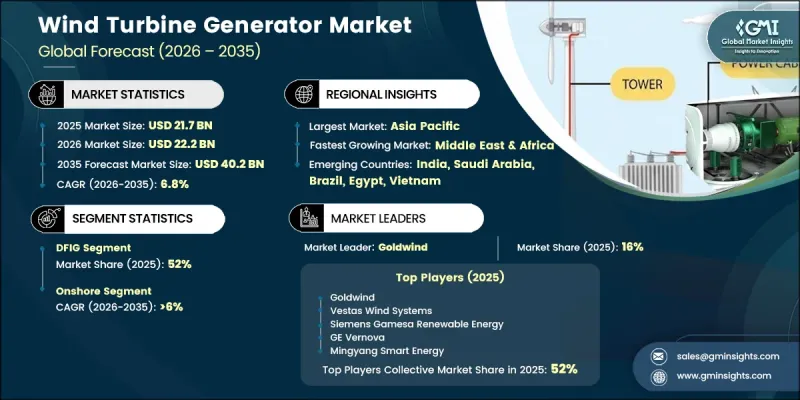
The market continues to gain momentum as countries expand renewable energy capacity and prioritize cleaner power generation technologies. Continuous investments in grid modernization, technological advancements in turbine systems, and increasing electricity demand are creating favorable conditions for industry expansion. Manufacturers are focusing on improving generator efficiency, reliability, and operational performance to meet evolving energy requirements. Rising investments in wind energy infrastructure, combined with supportive policy initiatives and the modernization of existing wind assets, are further contributing to market growth. The integration of advanced digital monitoring technologies, improved component durability, and higher-capacity turbine platforms is also strengthening the industry's outlook. Growing emphasis on energy security, decarbonization targets, and cost-effective renewable electricity generation continues to reinforce long-term demand for wind turbine generators across multiple regions, supporting sustained market development throughout the forecast period.
| Market Scope | |
|---|---|
| Start Year | 2025 |
| Forecast Year | 2026-2035 |
| Start Value | $21.7 Billion |
| Forecast Value | $40.2 Billion |
| CAGR | 6.8% |
The DFIG segment captured a 52% share in 2025 and is forecast to grow at a 4% CAGR through 2035. The segment maintains its leading position because it benefits from a well-developed supply chain, a mature servicing network, and comparatively lower converter requirements. Its capability to enable variable-speed operation while relying on a partially rated power converter helps reduce overall system costs and improves grid compatibility, supporting continued market expansion.
The onshore segment accounted for 81.1% share in 2025 and is forecast to grow at a 6% CAGR through 2035. The segment continues to lead the industry due to its lower installation expenses, established deployment infrastructure, and significant annual deployment volumes across major wind energy markets. The replacement of aging turbines with higher-capacity models and the continued deployment of advanced turbine platforms are expected to support ongoing product demand throughout the forecast period.
U.S. Wind Turbine Generator Market held a 65% share in 2025. Market growth is supported by ongoing investments in utility-scale wind energy projects, continued modernization of existing wind farms, and increasing adoption of advanced turbine technologies designed to improve power generation efficiency and operational reliability. The replacement of aging wind turbines with higher-capacity systems, coupled with growing demand for cost-effective renewable electricity, is creating favorable opportunities for equipment manufacturers and service providers. In addition, the expansion of operation and maintenance activities, driven by a growing installed wind power base, is expected to support consistent demand for wind turbine generators and related services across the U.S. throughout the forecast period.
The leading companies operating in the global wind turbine generator market include ABB, Bergey Windpower, CRRC Wind, CSIC Haizhuang, Dongfang Electric, Doosan, Eocycle Technologies, Envision Energy, Enercon, GE Vernova, Goldwind, Hitachi Energy, Inox Wind, Lagerwey, Mingyang Smart Energy, Nordex Group, Siemens Gamesa Renewable Energy, Suzlon Energy, Vestas Wind Systems, and Windey Energy. Companies participating in the global wind turbine generator market are strengthening their competitive position by prioritizing product innovation, expanding manufacturing capabilities, and improving operational efficiency. Many manufacturers are investing in advanced generator technologies that deliver higher efficiency, enhanced reliability, and lower maintenance requirements. Businesses are also increasing research and development spending to introduce higher-capacity solutions that address evolving customer requirements. Strategic collaborations with project developers, utilities, and technology providers are helping companies broaden their market reach and secure long-term business opportunities. Organizations are enhancing their after-sales services through predictive maintenance solutions, digital monitoring platforms, and comprehensive service agreements to improve customer retention. In addition, firms are expanding their regional presence, optimizing supply chains, and increasing production capacity to meet rising demand while reinforcing their long-term market foothold and improving their overall competitive position.
Table of Contents
Chapter 1 Methodology & Scope
- 1.1 Research design
- 1.1.1 Research approach
- 1.1.2 Data collection methods
- 1.1.3 Base estimates and calculations
- 1.1.4 Base year calculation
- 1.1.5 Key trends for market estimates
- 1.2 Forecast model
- 1.3 Primary research & validation
- 1.3.1 Primary sources
- 1.4 Data mining sources
- 1.5 Market definitions
Chapter 2 Executive Summary
- 2.1 Industry 360-degree synopsis, 2022 – 2035
- 2.2 Business trends
- 2.3 Generator type trends
- 2.4 Capacity trends
- 2.5 Application trends
- 2.6 End User trends
- 2.7 Installation trends
- 2.8 Drive train trends
- 2.9 Regional trends
Chapter 3 Industry Insights
- 3.1 Industry ecosystem
- 3.2 Regulatory landscape
- 3.3 Industry impact forces
- 3.3.1 Growth drivers
- 3.3.2 Industry pitfalls & challenges
- 3.4 Growth potential analysis
- 3.5 Price trend analysis
- 3.6 Porter's analysis
- 3.6.1 Bargaining power of suppliers
- 3.6.2 Bargaining power of buyers
- 3.6.3 Threat of new entrants
- 3.6.4 Threat of substitutes
- 3.7 PESTEL analysis
Chapter 4 Competitive landscape, 2026
- 4.1 Introduction
- 4.2 Company market share analysis, by region, 2025
- 4.2.1 North America
- 4.2.2 Europe
- 4.2.3 Asia Pacific
- 4.2.4 Middle East & Africa
- 4.2.5 Latin America
- 4.3 Strategic dashboard
- 4.4 Strategic initiatives
- 4.5 Company benchmarking
- 4.6 Innovation & technology landscape
Chapter 5 Market Size and Forecast, By Generator Type, 2022 – 2035 (USD Million)
- 5.1 Key trends
- 5.2 PMSG
- 5.3 DFIG
- 5.4 EESG
- 5.5 SCIG
Chapter 6 Market Size and Forecast, By Capacity, 2022 – 2035 (USD Million)
- 6.1 Key trends
- 6.2 Below 2 MW
- 6.3 2-5 MW
- 6.4 5-10 MW
- 6.5 Above 10 MW
Chapter 7 Market Size and Forecast, By Application, 2022 – 2035 (USD Million)
- 7.1 Key trends
- 7.2 Onshore
- 7.3 Offshore
Chapter 8 Market Size and Forecast, By End User, 2022 – 2035 (USD Million)
- 8.1 Key trends
- 8.2 Utilities & IPPs
- 8.3 Industrial Captive
- 8.4 Commercial & Micro Grid
- 8.5 Residential & Community wind
Chapter 9 Market Size and Forecast, By Installation, 2022 – 2035 (USD Million)
- 9.1 Key trends
- 9.2 New
- 9.3 Replacement
Chapter 10 Market Size and Forecast, By Drivetrain, 2022 – 2035 (USD Million)
- 10.1 Key trends
- 10.2 Geared drive
- 10.3 Direct drive
- 10.4 Hybrid
Chapter 11 Market Size and Forecast, By Region, 2021 – 2034 (USD Billion)
- 11.1 Key trends
- 11.2 North America
- 11.2.1 U.S.
- 11.2.2 Canada
- 11.2.3 Mexico
- 11.3 Europe
- 11.3.1 Germany
- 11.3.2 France
- 11.3.3 Sweden
- 11.3.4 UK
- 11.3.5 Spain
- 11.3.6 Italy
- 11.4 Asia Pacific
- 11.4.1 China
- 11.4.2 India
- 11.4.3 Japan
- 11.4.4 South Korea
- 11.4.5 Australia
- 11.5 Middle East & Africa
- 11.5.1 Saudi Arabia
- 11.5.2 UAE
- 11.5.3 Egypt
- 11.5.4 South Africa
- 11.6 Latin America
- 11.6.1 Brazil
- 11.6.2 Chile
- 11.6.3 Argentina
Chapter 12 Company Profiles
- 12.1 ABB
- 12.2 Bergey Windpower
- 12.3 CRRC Wind
- 12.4 CSIC Haizhuang
- 12.5 Dongfang Electric
- 12.6 Doosan
- 12.7 Eocycle Technologies
- 12.8 Envision Energy
- 12.9 Enercon
- 12.10 GE Vernova
- 12.11 Goldwind
- 12.12 Hitachi Energy
- 12.13 Inox Wind
- 12.14 Lagerwey
- 12.15 Mingyang Smart Energy
- 12.16 Nordex Group
- 12.17 Siemens Gamesa Renewable Energy
- 12.18 Suzlon Energy
- 12.19 Vestas Wind Systems
- 12.20 Windey Energy

