PUBLISHER: Global Market Insights Inc. | PRODUCT CODE: 2109206

PUBLISHER: Global Market Insights Inc. | PRODUCT CODE: 2109206
Anti-Transpirant and Crop Water-Stress Mitigation Sprays Market Opportunity, Growth Drivers, Industry Trend Analysis, and Forecast 2026 - 2035
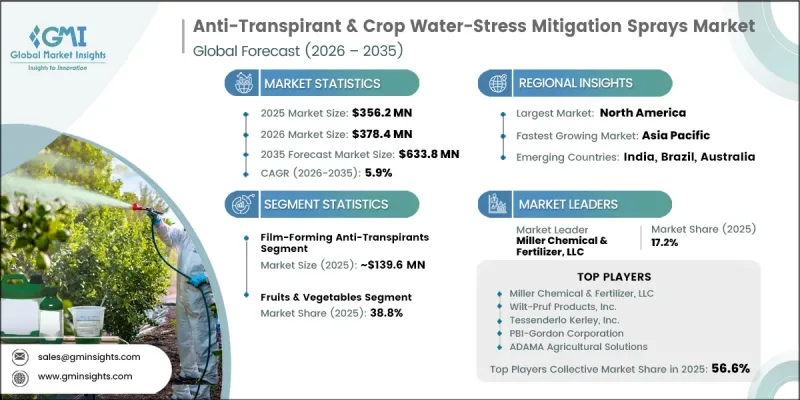
The Global Anti-Transpirant & Crop Water-Stress Mitigation Sprays Market was valued at USD 356.2 million in 2025 and is estimated to grow at a CAGR of 5.9% to reach USD 633.8 million by 2035.
The anti-transpirant & crop water-stress mitigation sprays market is expanding as agricultural producers increasingly adopt solutions that help crops withstand water scarcity and environmental stress while maintaining productivity. Growing concerns over prolonged drought conditions and rising temperatures are encouraging the wider use of anti-transpirant products as part of modern crop management strategies, particularly for high-value agricultural production. The market is also witnessing a gradual transition toward biological and plant-derived formulations as demand for sustainable farming inputs continues to increase. This trend is encouraging manufacturers to develop innovative product formulations while expanding opportunities across climate-sensitive agricultural regions. Furthermore, the integration of anti-transpirant technologies with precision agriculture practices is improving application efficiency through data-driven crop management and optimized spraying techniques. The industry is also moving away from conventional petrochemical-based formulations in favor of biotechnology-driven alternatives. Increasing regulatory emphasis on environmentally responsible agricultural products is encouraging innovation, while sustainable formulations continue to gain premium market acceptance due to growing interest in regenerative and environmentally conscious farming practices.
| Market Scope | |
|---|---|
| Start Year | 2025 |
| Forecast Year | 2026-2035 |
| Start Value | $356.2 Million |
| Forecast Value | $633.8 Million |
| CAGR | 5.9% |
The film-forming anti-transpirants segment accounted for 39.2% share generating USD 139.6 million in 2025. This segment maintains its leadership due to its proven ability to minimize foliar water loss, compatibility with existing spraying equipment, and widespread acceptance among growers. These products are extensively utilized to improve crop resilience under challenging environmental conditions while supporting overall crop quality. In addition, reflectant and particle film anti-transpirants continue to gain market traction because they help lower canopy temperatures by reflecting solar radiation, positioning the segment for strong future growth.
The fruits & vegetables segment captured 38.8% share in 2025. This segment continues to dominate because water stress can significantly affect crop quality, appearance, and overall productivity. Producers are increasingly investing in foliar treatment solutions that help preserve yield and maintain product quality throughout the growing season. Growing recognition of anti-transpirant technologies within horticultural production continues to support wider adoption across fruit and vegetable cultivation.
North America Anti-Transpirant & Crop Water-Stress Mitigation Sprays Market accounted for 32.2% share in 2025. Regional growth is supported by the widespread adoption of anti-transpirant products, well-developed agricultural supply chains, and increasing awareness of water management practices among growers. The United States continues to lead the regional market due to the broad use of advanced crop protection technologies and growing adoption of water-stress management solutions for high-value agricultural production.
Major companies operating in the global anti-transpirant & crop water-stress mitigation sprays market include Miller Chemical & Fertilizer, LLC, Wilt-Pruf Products, Inc., PBI-Gordon Corporation, AgroBest Australia Pty. Ltd., Bonide Products LLC, Tessenderlo Kerley, Inc., ADAMA Agricultural Solutions, Yates, Coastal AgroBusiness, Bio-Plex, Indogulf BioAg LLC, Ajay Biotech (I) Ltd., ConserveAwater, Coromandel International, Agreenco Bio Tech Co., Ltd., Kaoleni, Seipasa, KaMin LLC, and Serbios S.r.l. (Greenexta Group). Companies operating in the anti-transpirant & crop water-stress mitigation sprays market are strengthening their market position by investing in research and development to introduce advanced, sustainable, and high-performance formulations. Many manufacturers are focusing on biological and plant-based product innovation to address increasing demand for environmentally responsible agricultural solutions. Strategic collaborations with agricultural distributors, research organizations, and farming communities are helping expand product reach and improve customer adoption. Businesses are also increasing production capacity, enhancing formulation efficiency, and integrating their products with precision agriculture technologies to improve application effectiveness.
Table of Contents
Chapter 1 Methodology & Scope
- 1.1 Research approach
- 1.2 Quality Commitments
- 1.2.1 GMI AI policy & data integrity commitment
- 1.2.1.1 Source consistency protocol
- 1.2.1 GMI AI policy & data integrity commitment
- 1.3 Research Trail & Confidence Scoring
- 1.3.1 Research Trail Components
- 1.3.2 Scoring Components
- 1.4 Data Collection
- 1.4.1 Partial list of primary sources
- 1.5 Data mining sources
- 1.5.1 Paid sources
- 1.5.1.1 Sources, by region
- 1.5.1 Paid sources
- 1.6 Base estimates and calculations
- 1.6.1 Base year calculation for any one approach
- 1.7 Forecast model
- 1.7.1 Quantified market impact analysis
- 1.7.1.1 Mathematical impact of growth parameters on forecast
- 1.7.1 Quantified market impact analysis
- 1.8 Research transparency addendum
- 1.8.1 Source attribution framework
- 1.8.2 Quality assurance metrics
- 1.8.3 Our commitment to trust
Chapter 2 Executive Summary
- 2.1 Industry 360° synopsis
- 2.2 Key market trends
- 2.2.1 Regional
- 2.2.2 Product type
- 2.2.3 Crop type
- 2.2.4 End user
Chapter 3 Industry Insights
- 3.1 Industry ecosystem analysis
- 3.1.1 Supplier landscape
- 3.1.2 Profit margin
- 3.1.3 Value addition at each stage
- 3.1.4 Factor affecting the value chain
- 3.1.5 Disruptions
- 3.2 Industry impact forces
- 3.2.1 Growth drivers
- 3.2.2 Industry pitfalls and challenges
- 3.2.3 Market opportunities
- 3.3 Growth potential analysis
- 3.4 Regulatory landscape
- 3.4.1 North America
- 3.4.2 Europe
- 3.4.3 Asia Pacific
- 3.4.4 Latin America
- 3.4.5 Middle East & Africa
- 3.5 Porter’s analysis
- 3.6 PESTEL analysis
- 3.7 Price trends
- 3.7.1 By region
- 3.7.2 By crop type
- 3.8 Future market trends
- 3.9 Technology and innovation landscape
- 3.9.1 Current technological trends
- 3.9.2 Emerging technologies
- 3.10 Patent Landscape
- 3.11 Trade statistics (HS code)
- 3.11.1 Major importing countries
- 3.11.2 Major exporting countries
- 3.12 Sustainability and environmental aspects
- 3.12.1 Sustainable practices
- 3.12.2 Waste reduction strategies
- 3.12.3 Energy efficiency in production
- 3.12.4 Eco-friendly initiatives
- 3.13 Carbon footprint consideration
Chapter 4 Competitive Landscape, 2025
- 4.1 Introduction
- 4.2 Company market share analysis
- 4.2.1 By region
- 4.2.1.1 North America
- 4.2.1.2 Europe
- 4.2.1.3 Asia Pacific
- 4.2.1.4 LATAM
- 4.2.1.5 MEA
- 4.2.1 By region
- 4.3 Competitive analysis of major market players
- 4.4 Competitive positioning matrix
- 4.5 Key developments
- 4.5.1 Mergers & acquisitions
- 4.5.2 Partnerships & collaborations
- 4.5.3 New Product Launches
- 4.5.4 Expansion Plans
Chapter 5 Market Estimates and Forecast, By Product Type, 2022–2035 (USD Million) (Kilo Tons)
- 5.1 Key trends
- 5.2 Film-Forming Anti-Transpirants
- 5.2.1 Polymer-Based (Synthetic)
- 5.2.2 Wax & Latex-Based
- 5.2.3 Pinolene / Polyterpene-Based (Di-1-p-Menthene)
- 5.3 Reflectant / Particle Film Anti-Transpirants
- 5.3.1 Kaolin Clay-Based
- 5.3.2 Calcium Carbonate (CaCO₃) & Calcium Oxide-Based
- 5.4 Stomatal Closure / Metabolic Inhibitor Agents
- 5.4.1 Abscisic Acid (ABA)-Based
- 5.4.2 Chitosan-Based
- 5.4.3 Fulvic Acid & Potassium Fulvate-Based
- 5.4.4 Potassium Silicate-Based
- 5.5 Others
Chapter 6 Market Estimates and Forecast, By Crop Type, 2022–2035 (USD Million) (Kilo Tons)
- 6.1 Key trends
- 6.2 Fruits & Vegetables
- 6.2.1 Citrus Fruits
- 6.2.2 Grapes & Berries
- 6.2.3 Tomatoes & Cucurbits
- 6.2.4 Leafy Greens & Brassicas
- 6.2.5 Stone Fruits (Peach, Cherry, Plum)
- 6.3 Cereals & Grains
- 6.3.1 Wheat
- 6.3.2 Rice
- 6.3.3 Maize / Corn
- 6.3.4 Barley & Sorghum
- 6.4 Oilseeds & Pulses
- 6.4.1 Soybean
- 6.4.2 Canola / Rapeseed
- 6.4.3 Sunflower
- 6.4.4 Groundnut & Lentils
- 6.5 Turf & Ornamentals
- 6.5.1 Golf Courses & Sports Turf
- 6.5.2 Nursery & Cut Flowers
- 6.5.3 Landscaping & Municipal Green Spaces
- 6.6 Others
Chapter 7 Market Estimates and Forecast, By End-User, 2022–2035 (USD Million) (Kilo Tons)
- 7.1 Key trends
- 7.2 Commercial Crop Farmers
- 7.3 Horticulture & Greenhouse Growers
- 7.4 Turf Management Operators
- 7.5 Nurseries & Landscaping Professionals
- 7.6 Research Institutions
Chapter 8 Market Estimates and Forecast, By Region, 2022–2035 (USD Million) (Kilo Tons)
- 8.1 Key trends
- 8.2 North America
- 8.2.1 U.S.
- 8.2.2 Canada
- 8.3 Europe
- 8.3.1 Germany
- 8.3.2 UK
- 8.3.3 France
- 8.3.4 Spain
- 8.3.5 Italy
- 8.3.6 Rest of Europe
- 8.4 Asia Pacific
- 8.4.1 China
- 8.4.2 India
- 8.4.3 Japan
- 8.4.4 Australia
- 8.4.5 South Korea
- 8.4.6 Rest of Asia Pacific
- 8.5 Latin America
- 8.5.1 Brazil
- 8.5.2 Mexico
- 8.5.3 Argentina
- 8.5.4 Rest of Latin America
- 8.6 Middle East and Africa
- 8.6.1 Saudi Arabia
- 8.6.2 South Africa
- 8.6.3 UAE
- 8.6.4 Rest of Middle East and Africa
Chapter 9 Company Profiles
- 9.1 ADAMA Agricultural Solutions
- 9.2 Agreenco Bio Tech Co., Ltd.
- 9.3 AgroBest Australia Pty. Ltd.
- 9.4 Ajay Biotech (I) Ltd.
- 9.5 Bio-Plex
- 9.6 Bonide Products LLC
- 9.7 Coastal AgroBusiness
- 9.8 ConserveAwater
- 9.9 Coromandel International
- 9.10 Indogulf BioAg LLC
- 9.11 KaMin LLC
- 9.12 Kaoleni
- 9.13 Miller Chemical & Fertilizer, LLC
- 9.14 PBI-Gordon Corporation
- 9.15 Seipasa
- 9.16 Serbios S.r.l. (Greenexta Group)
- 9.17 Tessenderlo Kerley, Inc.
- 9.18 Wilt-Pruf Products, Inc.
- 9.19 Yates

