PUBLISHER: Mordor Intelligence | PRODUCT CODE: 2113614

PUBLISHER: Mordor Intelligence | PRODUCT CODE: 2113614
North America Agrochemical - Market Share Analysis, Industry Trends & Statistics, Growth Forecasts (2026 - 2031)
According to Mordor Intelligence, the North America agrochemical market size is expected to grow from USD 40.0 billion in 2025 to USD 41.63 billion in 2026 and is forecast to reach USD 50.85 billion by 2031 at 4.08% CAGR over 2026-2031.
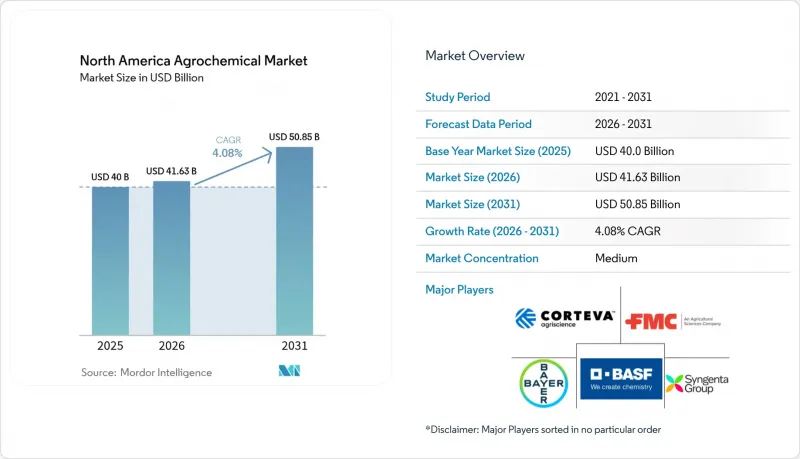
This report is Segmented by Type (Fertilizers, Pesticides, Adjuvants, and Plant Growth Regulators), by Application (Grains and Cereals, Pulses and Oilseeds, Fruits and Vegetables, Turfs and Ornamentals, and Other Applications), and by Geography (United States, Canada, Mexico, and Rest of North America). The Market Forecasts are Provided in Terms of Value (USD).
North America Agrochemical Market Trends and Insights
Rising Demand for Higher Crop Yields
The United States Department of Agriculture projects that corn productivity must increase by 1.2% annually to meet food demand by 2030. Field trials demonstrate that plant-growth regulators, specifically Ascend 2, increase corn yields by 3 bushels per acre. The combination of precision application techniques reduces nutrient losses while facilitating participation in carbon-credit programs. Agricultural producers across the Midwest United States and Canadian Prairies implement these yield-enhancing technologies, as incremental percentage improvements translate to substantial revenue increases. This market dynamic influences manufacturers to focus research and development on formulations that provide quantifiable yield improvements rather than maintaining existing productivity levels.
Government Agrochemicals Purchase Subsidy Programs
Government funding initiatives are reducing barriers to adopting modern agricultural inputs across North America. In 2024, the United States Department of Agriculture allocated USD 236 million to increase domestic fertilizer production, aiming to reduce price volatility and decrease import dependency. In Mexico, government programs support sustainable crop protection products, maintaining demand despite glyphosate limitations. Canadian provinces implement cost-sharing programs for precision agriculture technologies, including variable rate application equipment and soil testing services. These subsidies effectively reduce farmers' input costs and facilitate the adoption of advanced technologies by shortening the return on investment period for precision equipment and specialized agricultural chemicals.
Stringent Environmental Protection Agency (EPA) Re-Registration Requirements
The annual maintenance fees of USD 4,875 per product and enhanced ecological assessments increase compliance costs, affecting smaller registrants and leading to product withdrawals. The implementation of the Herbicide Strategy necessitates mitigation measures for over 900 endangered species, which include application restrictions and buffer zone requirements that impact product usage patterns. In October 2024, 131 Federal Insecticide, Fungicide, and Rodenticide Act section 3 registrations and 44 Federal Insecticide, Fungicide, and Rodenticide Act section 24(c) registrations were cancelled due to non-payment of maintenance fees. The Pesticide Registration Improvement Act of 2022 requires bilingual labeling, with Spanish translations for health and safety sections mandatory by 2025 for high-toxicity products and for all pesticide labels by 2030.
Other drivers and restraints analyzed in the detailed report include:
- Precision Farming Driving Optimized Inputs
- Carbon-Credit Linked Enhanced-Efficiency Agrochemicals
- Consumer Push for Residue-Free Produce
For complete list of drivers and restraints, kindly check the Table Of Contents.
Segment Analysis
Fertilizers hold 45.75% of the North America agrochemical market share in 2025, maintaining their essential position in nutrient management across major corn, soybean, and wheat production areas. Enhanced-efficiency fertilizers, featuring controlled-release mechanisms, gain market share through their compatibility with carbon-credit programs and precision application equipment. Digital soil-mapping enables suppliers to offer customized blends, increasing revenue per metric ton despite stable overall volumes.
Adjuvants represent the fastest-growing segment in the North American agrochemical market, with a 6.18% CAGR through 2031. This growth stems from rising demand for spray-quality enhancers that minimize drift and improve foliar absorption. The growth correlates with increased adoption of drone and autonomous sprayer technologies, which require specialized surface-active agents due to lower carrier volumes. Despite their smaller market share, adjuvants achieve mid-single-digit CAGR, exceeding pesticides and fertilizers, as regulatory requirements emphasize improved spray deposition accuracy. Pesticides maintain their position as the second-largest product category, with herbicides predominant due to widespread herbicide-tolerant crop adoption and weed control needs. Plant growth regulators remain a specialized segment, with products like WinField United's Ascend 2 delivering corn yield increases of 3 bushels per acre, supporting premium pricing despite limited market reach.
Complete Report Scope:
- By Product Type
- Fertilizers
- Nitrogenous
- Phosphatic
- Potassic
- Other Fertilizers
- Pesticides
- Herbicides
- Insecticides
- Fungicides
- Other Pesticides
- Adjuvants
- Plant Growth Regulators
- Fertilizers
- By Application
- Grains and Cereals
- Pulses and Oilseeds
- Fruits and Vegetables
- Turfs and Ornamentals
- Other Applications
- By Geography
- United States
- Canada
- Mexico
- Rest of North America
List of Companies Covered in this Report:
- Syngenta Group
- Bayer AG
- Corteva Agriscience
- BASF SE
- FMC Corporation
- UPL Limited
- Nutrien Ltd.
- The Mosaic Company
- CF Industries Holdings, Inc.
- Yara International ASA
- Sumitomo Chemical America, Inc.
- ICL Group Ltd.
- Nufarm Limited
- Haifa Chemicals Ltd.
- Helena Agri-Enterprises, LLC (Marubeni Corporation)
Additional Benefits:
- The market estimate (ME) sheet in Excel format
- 3 months of analyst support
TABLE OF CONTENTS
1 Introduction
- 1.1 Study Assumptions and Market Definition
- 1.2 Scope of the Study
2 Research Methodology
3 Executive Summary
4 Market Landscape
- 4.1 Market Overview
- 4.2 Market Drivers
- 4.2.1 Rising Demand for Higher Crop Yields
- 4.2.2 Government Agrochemicals Purchase Subsidy Programs
- 4.2.3 Precision Farming Driving Optimized Inputs
- 4.2.4 Rising Pest Resistance and Demand for Modified Solutions
- 4.2.5 Carbon-Credit Linked Enhanced-Efficiency Agrochemicals
- 4.2.6 Expansion of Specialty Micronutrient Blends
- 4.3 Market Restraints
- 4.3.1 Stringent Environmental Protection Agency (EPA) Re-Registration Requirements
- 4.3.2 Escalating Research and Development and Registration Costs
- 4.3.3 Consumer Push for Residue-Free Produce
- 4.3.4 Biological Solutions Displacing Conventional Chemicals
- 4.4 Regulatory Landscape
- 4.5 Technological Outlook
- 4.6 Porter's Five Forces Analysis
- 4.6.1 Bargaining Power of Suppliers
- 4.6.2 Bargaining Power of Buyers
- 4.6.3 Threat of Substitutes
- 4.6.4 Threat of New Entrants
- 4.6.5 Intensity of Competitive Rivalry
5 Market Size and Growth Forecasts (Value)
- 5.1 By Product Type
- 5.1.1 Fertilizers
- 5.1.1.1 Nitrogenous
- 5.1.1.2 Phosphatic
- 5.1.1.3 Potassic
- 5.1.1.4 Other Fertilizers
- 5.1.2 Pesticides
- 5.1.2.1 Herbicides
- 5.1.2.2 Insecticides
- 5.1.2.3 Fungicides
- 5.1.2.4 Other Pesticides
- 5.1.3 Adjuvants
- 5.1.4 Plant Growth Regulators
- 5.1.1 Fertilizers
- 5.2 By Application
- 5.2.1 Grains and Cereals
- 5.2.2 Pulses and Oilseeds
- 5.2.3 Fruits and Vegetables
- 5.2.4 Turfs and Ornamentals
- 5.2.5 Other Applications
- 5.3 By Geography
- 5.3.1 United States
- 5.3.2 Canada
- 5.3.3 Mexico
- 5.3.4 Rest of North America
6 Competitive Landscape
- 6.1 Market Concentration
- 6.2 Strategic Moves
- 6.3 Market Share Analysis
- 6.4 Company Profiles (Includes Global-Level Overview, Market-Level Overview, Core Segments, Financials as Available, Strategic Information, Market Rank/Share for Key Companies, Products and Services, and Recent Developments)
- 6.4.1 Syngenta Group
- 6.4.2 Bayer AG
- 6.4.3 Corteva Agriscience
- 6.4.4 BASF SE
- 6.4.5 FMC Corporation
- 6.4.6 UPL Limited
- 6.4.7 Nutrien Ltd.
- 6.4.8 The Mosaic Company
- 6.4.9 CF Industries Holdings, Inc.
- 6.4.10 Yara International ASA
- 6.4.11 Sumitomo Chemical America, Inc.
- 6.4.12 ICL Group Ltd.
- 6.4.13 Nufarm Limited
- 6.4.14 Haifa Chemicals Ltd.
- 6.4.15 Helena Agri-Enterprises, LLC (Marubeni Corporation)
7 Market Opportunities and Future Outlook

