PUBLISHER: Mordor Intelligence | PRODUCT CODE: 2113706

PUBLISHER: Mordor Intelligence | PRODUCT CODE: 2113706
Indonesia Agrochemicals - Market Share Analysis, Industry Trends & Statistics, Growth Forecasts (2026 - 2031)
According to Mordor Intelligence, the Indonesia agrochemicals market size is expected to grow from USD 4.3 billion in 2025 to USD 4.54 billion in 2026 and is forecast to reach USD 5.95 billion by 2031 at 5.55% CAGR over 2026-2031.
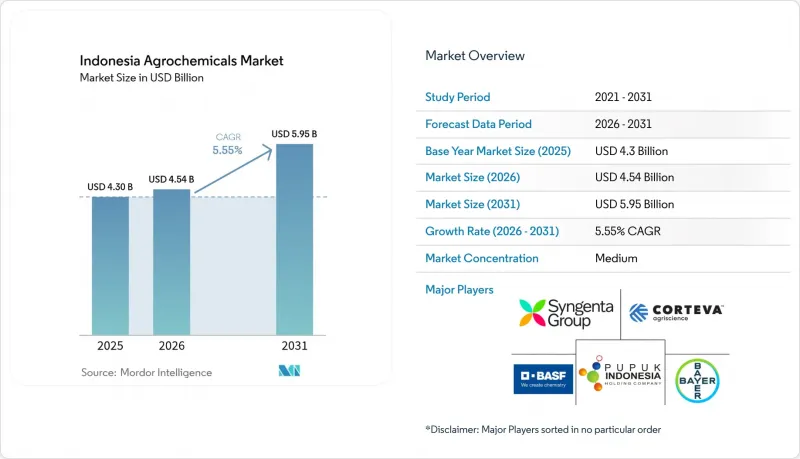
This report is Segmented by Type (Fertilizers, Pesticides, Adjuvants, and Plant Growth Regulators) and by Application (Cereals and Grains, Pulses and Oilseeds, Fruits and Vegetables, and Commercial Crops). The Market Forecasts are Provided in Terms of Value (USD).
Indonesia Agrochemicals Market Trends and Insights
Government Fertilizer Subsidies and E-voucher Distribution
Indonesia's fertilizer subsidy program has created a dual-tier market where subsidized nutrient blends compete with premium formulations. The digital delivery through mobile platforms improves targeting and transparency, allowing suppliers to match products with regional cropping requirements. This system maintains steady demand for basic fertilizers and increases farmer loyalty to domestic producers, while encouraging international companies to develop differentiated blends and enhanced coatings. East Java receives the largest share of subsidies, with distribution networks centered around major urban areas. As the subsidy focuses on staple crops like rice, suppliers of specialty inputs must modify their approaches to serve horticultural zones outside the subsidy coverage. The program maintains price stability and highlights the importance of government collaboration in the agrochemical industry.
Expansion of Domestic Fertilizer Capacity
Indonesia's significant investment in fertilizer production infrastructure includes new facilities and upgrades across various regions. This expansion aims to decrease import dependence and enhance supply chain performance, particularly to remote islands with historical logistics challenges. The higher production volume increases competition in standard fertilizer grades, encouraging manufacturers to focus on value-added formulations for better profit margins. The expansion increases demand for upstream chemical components, creating opportunities for international specialty chemical suppliers. The additional capacity will influence market dynamics by reducing production costs and promoting market segmentation into premium categories.
Counterfeit and Illegal Pesticide Inflow
The Indonesian agricultural sector faces significant challenges from unauthorized agrochemical products entering the market. These illicit pesticides, which often mimic established brands, negatively impact farmer trust and disrupt authorized distribution networks. Companies have increased their investments in protective measures, including tamper-evident packaging and digital tracking systems, to maintain brand authenticity. The country's maritime borders remain susceptible to illegal imports due to logistical complexities and enforcement limitations. While industry participants and regulatory authorities work together to strengthen controls and enforcement measures, market disruptions continue. Companies are implementing preventive strategies, including retail outlet inspections and farmer awareness programs, to maintain market confidence and protect sales.
Other drivers and restraints analyzed in the detailed report include:
- Accelerating Mechanized Paddy Conversion Drives
- Chemical Use Surge in Horticulture Export Targets
- Growing Smallholder Shift to Organic Certifications
For complete list of drivers and restraints, kindly check the Table Of Contents.
Segment Analysis
Fertilizers contributed 62.35% of Indonesia's agrochemicals market size in 2025. Government subsidies maintain consistent demand, while market commoditization has prompted manufacturers to develop coated, slow-release, and micronutrient-enriched products for improved margins. The expansion of domestic production capacity has led traditional fertilizer manufacturers to partner with specialty chemical companies to access new technologies. Pesticides remain the second-largest segment, with resistance management driving diversification in active ingredients and stewardship programs. Fungicides and adjuvants show steady growth, particularly in high-frequency application areas where performance and compatibility are essential.
Plant growth regulators, despite their small market share, demonstrate the highest growth rate at 8.05% CAGR, supported by precision farming practices and controlled cultivation methods that require hormonal products for harvest uniformity. Multinational companies now combine regulators and adjuvants with pesticide products to provide comprehensive crop management solutions. Extended registration periods create barriers to entry, benefiting established companies but limiting the introduction of new formulations. Market success requires strong regulatory compliance and adaptable research capabilities to address evolving agricultural needs.
Complete Report Scope:
- By Type
- Fertilizers
- Nitrogenous
- Phosphatic
- Potassic
- Other Fertilizers
- Pesticides
- Herbicides
- Insecticides
- Fungicides
- Other Pesticides
- Adjuvants
- Plant Growth Regulators
- Fertilizers
- By Application
- Cereals and Grains
- Pulses and Oilseeds
- Fruits and Vegetables
- Commercial Crops
List of Companies Covered in this Report:
- Bayer AG
- Syngenta Group
- Corteva Agriscience
- BASF SE
- FMC Corporation
- UPL Limited
- Yara International ASA
- PT. Sumitomo Indonesia
- PT. Pupuk Indonesia
- PT. Sentana Adidaya Pratama (Wilmar International)
- PT. Multi Mas Chemindo
- PT. Meroke Tetap Jaya
- PT. Asia Kimindo Prima
- PT. Mest Indonesiy (Mestindo Group)
- Grupa Azoty S.A. (Compo Expert)
Additional Benefits:
- The market estimate (ME) sheet in Excel format
- 3 months of analyst support
TABLE OF CONTENTS
1 Introduction
- 1.1 Study Assumptions and Market Definition
- 1.2 Scope of the Study
2 Research Methodology
3 Executive Summary
4 Market Landscape
- 4.1 Market Overview
- 4.2 Market Drivers
- 4.2.1 Government Fertilizer Subsidies and E-voucher Distribution
- 4.2.2 Expansion of Domestic Fertilizer Capacity
- 4.2.3 Accelerating Mechanized Paddy Conversion Drives
- 4.2.4 Chemical Use Surge in Horticulture Export Targets
- 4.2.5 AI-enabled Crop Advisory Apps Boosting Agrochemicals Intensity
- 4.2.6 Palm-oil By-product Plant Growth Regulators Gaining Regulatory Fast-track
- 4.3 Market Restraints
- 4.3.1 Counterfeit and Illegal Pesticide Inflow
- 4.3.2 Growing Smallholder Shift to Organic Certifications
- 4.3.3 Herbicide-resistant Weed Outbreaks
- 4.3.4 El-Nino Induced Fertilizer Price Shocks
- 4.4 Regulatory Landscape
- 4.5 Technological Outlook
- 4.6 Porter's Five Forces Analysis
- 4.6.1 Bargaining Power of Suppliers
- 4.6.2 Bargaining Power of Buyers
- 4.6.3 Threat of New Entrants
- 4.6.4 Threat of Substitutes
- 4.6.5 Intensity of Competitive Rivalry
5 Market Size and Growth Forecasts (Value)
- 5.1 By Type
- 5.1.1 Fertilizers
- 5.1.1.1 Nitrogenous
- 5.1.1.2 Phosphatic
- 5.1.1.3 Potassic
- 5.1.1.4 Other Fertilizers
- 5.1.2 Pesticides
- 5.1.2.1 Herbicides
- 5.1.2.2 Insecticides
- 5.1.2.3 Fungicides
- 5.1.2.4 Other Pesticides
- 5.1.3 Adjuvants
- 5.1.4 Plant Growth Regulators
- 5.1.1 Fertilizers
- 5.2 By Application
- 5.2.1 Cereals and Grains
- 5.2.2 Pulses and Oilseeds
- 5.2.3 Fruits and Vegetables
- 5.2.4 Commercial Crops
6 Competitive Landscape
- 6.1 Market Concentration
- 6.2 Strategic Moves
- 6.3 Market Share Analysis
- 6.4 Company Profiles (Includes Global Level Overview, Market Level Overview, Core Segments, Financials as Available, Strategic Information, Market Rank/Share for Key Companies, Products and Services, and Recent Developments)
- 6.4.1 Bayer AG
- 6.4.2 Syngenta Group
- 6.4.3 Corteva Agriscience
- 6.4.4 BASF SE
- 6.4.5 FMC Corporation
- 6.4.6 UPL Limited
- 6.4.7 Yara International ASA
- 6.4.8 PT. Sumitomo Indonesia
- 6.4.9 PT. Pupuk Indonesia
- 6.4.10 PT. Sentana Adidaya Pratama (Wilmar International)
- 6.4.11 PT. Multi Mas Chemindo
- 6.4.12 PT. Meroke Tetap Jaya
- 6.4.13 PT. Asia Kimindo Prima
- 6.4.14 PT. Mest Indonesiy (Mestindo Group)
- 6.4.15 Grupa Azoty S.A. (Compo Expert)
7 Market Opportunities and Future Outlook

