PUBLISHER: Global Market Insights Inc. | PRODUCT CODE: 2109213

PUBLISHER: Global Market Insights Inc. | PRODUCT CODE: 2109213
North America Hydrogen Fuel Cell Heavy Duty Truck Market Opportunity, Growth Drivers, Industry Trend Analysis, and Forecast 2026 - 2035
North America Hydrogen Fuel Cell Heavy Duty Truck Market was valued at USD 3.2 million in 2025 and is estimated to grow at a CAGR of 51.7% to reach USD 1.59 billion by 2035.
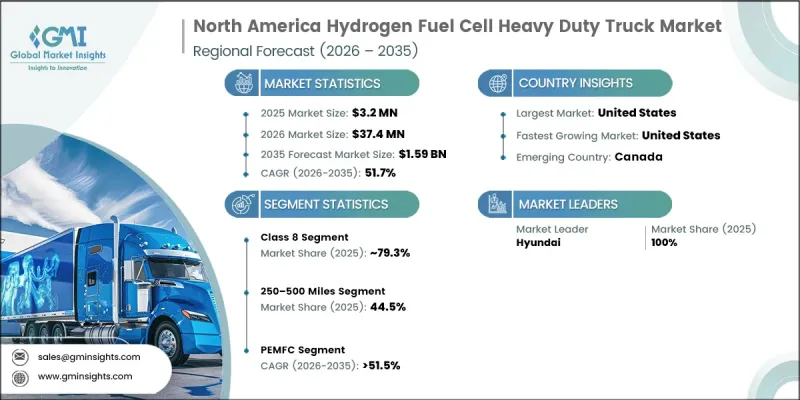
North America hydrogen fuel cell heavy duty truck industry is experiencing rapid growth as transportation companies increasingly shift toward zero-emission freight solutions in response to evolving environmental regulations and stricter emission standards. Government policies requiring lower greenhouse gas emissions are encouraging fleet operators to replace conventional diesel-powered vehicles with cleaner alternatives, making hydrogen-powered trucks an important part of long-term commercial transportation strategies. Growing investments in hydrogen production, fueling infrastructure, and clean mobility technologies are further supporting market expansion by improving the operational feasibility of hydrogen-powered fleets. In addition, rising demand for sustainable freight transportation, coupled with the need to reduce operating emissions without compromising vehicle performance, continues to strengthen market adoption. Fleet operators are also showing greater interest in integrated transportation solutions that combine vehicles with fueling services, maintenance, digital fleet management, and operational support under unified commercial agreements. Expanding hydrogen infrastructure, improving technology maturity, and increasing collaboration across the commercial transportation ecosystem are expected to create favorable growth opportunities for the North America hydrogen fuel cell heavy duty truck market throughout the forecast period.
| Market Scope | |
|---|---|
| Start Year | 2025 |
| Forecast Year | 2026-2035 |
| Start Value | $3.2 Million |
| Forecast Value | $1.59 Billion |
| CAGR | 51.7% |
The Class 8 segment held a 79.3% share in 2025 and is anticipated to grow at a CAGR of 52.4% through 2035. The segment continues to lead the market because hydrogen fuel cell technology is particularly well suited for the demanding requirements of heavy-duty freight transportation, including high payload capacity, extended driving range, and superior vehicle performance. Commercial fleet operators increasingly favor Class 8 trucks for long-distance freight movement because hydrogen-powered vehicles offer rapid refueling capabilities while maintaining operational efficiency without the added weight associated with large battery systems. The growing focus on commercial deployment of fuel cell-powered heavy-duty vehicles is expected to further reinforce the segment's market leadership over the coming years.
The 250-500 miles segment accounted for a 44.5% share in 2025. This driving range remains highly attractive for regional freight transportation and medium-distance logistics operations, where dependable vehicle performance and operational flexibility are essential. Hydrogen fuel cell trucks operating within this range are increasingly being adopted for regional freight distribution because they provide an effective balance between driving distance, refueling convenience, and fleet productivity. As hydrogen fueling networks continue to expand, this segment is expected to benefit from improved route accessibility while meeting the transportation requirements of commercial operators seeking efficient zero-emission freight solutions.
U.S. Hydrogen Fuel Cell Heavy Duty Truck Market held a 90% share, generating USD 3.2 million in 2025. The country's leadership is supported by strong investments in hydrogen infrastructure, expanding clean transportation initiatives, and the presence of extensive commercial freight networks. Continuous efforts to accelerate the adoption of zero-emission heavy-duty vehicles, combined with increasing deployment of hydrogen-powered commercial trucks across major freight corridors, continue to strengthen market growth. In addition, supportive regulatory frameworks, growing infrastructure development, and increasing industry participation are positioning the U.S. as the primary contributor to the regional hydrogen fuel cell heavy duty truck market throughout the forecast period.
Major companies operating in the North America hydrogen fuel cell heavy duty truck market include Autocar LLC, Daimler Truck North America, Elemental Trucks Inc., Hyundai Motor Company, Navistar International Corporation, PACCAR Inc., Symbio North America, Toyota Motor North America, and Volvo Trucks North America. Companies participating in the North America hydrogen fuel cell heavy duty truck market are strengthening their market position through continuous investments in fuel cell technology, vehicle innovation, and infrastructure development. Manufacturers are expanding strategic partnerships across the hydrogen value chain to improve vehicle deployment and enhance fueling accessibility for commercial fleet operators. Businesses are also focusing on increasing production capabilities, improving vehicle efficiency, and introducing advanced digital fleet management solutions that optimize operational performance. Product portfolio expansion, research and development investments, and integration of connected vehicle technologies remain key priorities for sustaining long-term competitiveness.
Table of Contents
Chapter 1 Methodology
- 1.1 Research approach
- 1.2 Quality Commitments
- 1.2.1 GMI AI policy & data integrity commitment
- 1.2.1.1 Source consistency protocol
- 1.2.1 GMI AI policy & data integrity commitment
- 1.3 Research Trail & Confidence Scoring
- 1.3.1 Research Trail Components
- 1.3.2 Scoring Components
- 1.4 Data Collection
- 1.4.1 Partial list of primary sources
- 1.5 Data mining sources
- 1.5.1 Paid sources
- 1.5.1.1 Sources, by region
- 1.5.1 Paid sources
- 1.6 Base estimates and calculations
- 1.6.1 Base year calculation
- 1.7 Forecast Model
- 1.7.1 Quantified market impact analysis
- 1.7.1.1 Mathematical impact of growth parameters on forecast
- 1.7.1 Quantified market impact analysis
- 1.8 Research transparency addendum
- 1.8.1 Source attribution framework
- 1.8.2 Quality assurance metrics
- 1.8.3 Our commitment to trust
Chapter 2 Executive Summary
- 2.1 Industry 360° synopsis, 2022 – 2035
- 2.2 Key market trends
- 2.2.1 Regional
- 2.2.2 Fuel Cell Technology
- 2.2.3 Class
- 2.2.4 Operational Range
- 2.2.5 Power Output
- 2.2.6 End Use
- 2.3 TAM Analysis, 2026-2035
- 2.4 CXO perspectives: Strategic imperatives
Chapter 3 Industry Insights
- 3.1 Industry ecosystem analysis
- 3.1.1 Supplier landscape
- 3.1.2 Profit margin analysis
- 3.1.3 Cost structure
- 3.1.4 Value addition at each stage
- 3.1.5 Factor affecting the value chain
- 3.1.6 Disruptions
- 3.2 Industry impact forces
- 3.2.1 Growth drivers
- 3.2.1.1 EPA phase 3 GHG standards (my 2027–2032) accelerating fleet electrification
- 3.2.1.2 Federal IIJA & DOE regional clean hydrogen hub funding creating infrastructure pull
- 3.2.1.3 Total cost of ownership convergence with diesel for high-utilization long-haul routes
- 3.2.1.4 Quick refueling advantage over bev sustaining fcev preference for heavy-payload duty cycles
- 3.2.2 Market Challenges
- 3.2.2.1 High upfront vehicle acquisition cost (3–4x diesel tco) constraining fleet adoption
- 3.2.2.2 Sparse heavy-duty hydrogen refueling network (54 stations nationally as of 2025)
- 3.2.3 Market Opportunities
- 3.2.3.1 Regional hydrogen hub buildout unlocking major freight corridor deployment
- 3.2.3.2 Full-service leasing & bundled H2 supply models reducing barrier for 3PL operators
- 3.2.3.3 Port drayage & captive-route applications as near-term commercial beachhead
- 3.2.1 Growth drivers
- 3.3 Growth potential analysis
- 3.4 Technology and innovation landscape
- 3.4.1 Current technological trends
- 3.4.2 Emerging technologies
- 3.5 Pricing analysis (driven by primary research)
- 3.5.1 Historical price trend analysis
- 3.5.2 Pricing strategy by player type (premium / value / cost-plus)
- 3.6 Regulatory landscape
- 3.6.1 U.S. EPA Phase 3 GHG Emissions Standards (MY 2027–2032)
- 3.6.2 NHTSA Fuel Efficiency & Greenhouse Gas Phase 2 Standards
- 3.6.3 California CARB Advanced Clean Fleets (ACF) Regulation
- 3.6.4 DOE National Clean Hydrogen Strategy & Roadmap
- 3.6.5 IIJA & IRA Federal Incentive Structures for FCEV Heavy Trucks
- 3.6.6 Canadian Federal & Provincial ZEV Regulations
- 3.7 Porter’s analysis
- 3.8 PESTEL analysis
- 3.9 Patent Landscape (Driven by Primary Research)
- 3.10 Impact of AI & Generative AI on the Market (Driven by Primary Research)
- 3.10.1 AI-driven disruption of existing business models
- 3.10.2 GenAI use cases & adoption roadmap by segment
- 3.10.3 Risks, limitations & regulatory considerations
- 3.11 Trade data analysis (driven by paid database)
- 3.11.1 Import/export volume & value trends
- 3.11.2 Key trade corridors & tariff impact
- 3.12 Capacity & production landscape (driven by primary research)
- 3.12.1 Installed capacity by region & key producer
- 3.12.2 Capacity utilization rates & expansion pipelines
- 3.13 Sustainability & ESG impact analysis
- 3.13.1 Sustainable practices
- 3.13.2 Waste reduction strategies
- 3.13.3 Energy efficiency in production
- 3.13.4 Eco-friendly initiatives
- 3.13.5 Carbon footprint considerations
- 3.14 Forecast assumptions & scenario analysis (driven by primary research)
- 3.14.1 Base Case - Key Macro & Industry Variables Driving CAGR
- 3.14.2 Optimistic Scenarios - Favourable macro and industry tailwinds
- 3.14.3 Pessimistic Scenario - Macroeconomic slowdown or industry headwinds
Chapter 4 Competitive Landscape, 2025
- 4.1 Introduction
- 4.2 Company market share analysis
- 4.2.1 US
- 4.2.2 Canada
- 4.3 Competitive analysis of major market players
- 4.4 Competitive positioning matrix
- 4.5 Key developments
- 4.5.1 Mergers & acquisitions
- 4.5.2 Partnerships & collaborations
- 4.5.3 New product launches
- 4.5.4 Expansion plans and funding
- 4.6 Company Tier Benchmarking
- 4.6.1 Tier classification criteria & qualifying thresholds
- 4.6.2 Tier positioning matrix by revenue, geography & innovation
Chapter 5 Market Estimates & Forecast, By Fuel Cell Technology, 2022 - 2035 ($Bn, Units)
- 5.1 Key trends
- 5.2 Proton exchange membrane fuel cell (PEMFC)
- 5.3 Solid oxide fuel cell (SOFC)
- 5.4 Others
Chapter 6 Market Estimates & Forecast, By Class, 2022 - 2035 ($Bn, Units)
- 6.1 Key trends
- 6.2 Class 7 (26,001–33,000 lbs)
- 6.2.1 Below 250 miles
- 6.2.2 250–500 miles
- 6.2.3 Above 500 miles
- 6.3 Class 8 (GVWR: >33,000 lbs)
- 6.3.1 Below 250 miles
- 6.3.2 250–500 miles
- 6.3.3 Above 500 miles
Chapter 7 Market Estimates & Forecast, By Operational Range, 2022 - 2035 ($Bn, Units)
- 7.1 Key trends
- 7.2 Below 250 miles
- 7.3 250–500 miles
- 7.4 Above 500 miles
Chapter 8 Market Estimates & Forecast, By Power Output, 2022 – 2035 ($Bn, Units)
- 8.1 Key trends
- 8.2 Below 250 kW
- 8.3 250–350 kW
- 8.4 Above 350 kW
Chapter 9 Market Estimates & Forecast, By End Use, 2022 – 2035 ($Bn, Units)
- 9.1 Key trends
- 9.2 Logistics & distribution
- 9.3 Municipal services
- 9.4 Construction & mining
- 9.5 Others
Chapter 10 Market Estimates & Forecast, By Region, 2022 - 2035 ($Bn, Units)
- 10.1 Key trends
- 10.2 US
- 10.2.1 California
- 10.2.2 Texas
- 10.2.3 Illinois
- 10.2.4 Georgia
- 10.2.5 Ohio
- 10.2.6 Michigan
- 10.2.7 Pennsylvania
- 10.2.8 New York
- 10.2.9 Washington
- 10.2.10 Arizona
- 10.2.11 Rest of US
- 10.3 Canada
- 10.3.1 British Columbia
- 10.3.2 Alberta
- 10.3.3 Ontario
- 10.3.4 Quebec
- 10.3.5 Rest of Canada
Chapter 11 Company Profiles
- 11.1 Autocar LLC
- 11.2 Daimler Truck North America
- 11.3 Elemental Trucks Inc.
- 11.4 Hyundai Motor Company
- 11.5 Navistar International Corporation
- 11.6 PACCAR Inc.
- 11.7 Symbio North America
- 11.8 Toyota Motor North America
- 11.9 Volvo Trucks North America

