PUBLISHER: Global Market Insights Inc. | PRODUCT CODE: 2071289

PUBLISHER: Global Market Insights Inc. | PRODUCT CODE: 2071289
Heavy Duty Trucks Market Opportunity, Growth Drivers, Industry Trend Analysis, and Forecast 2026 - 2035
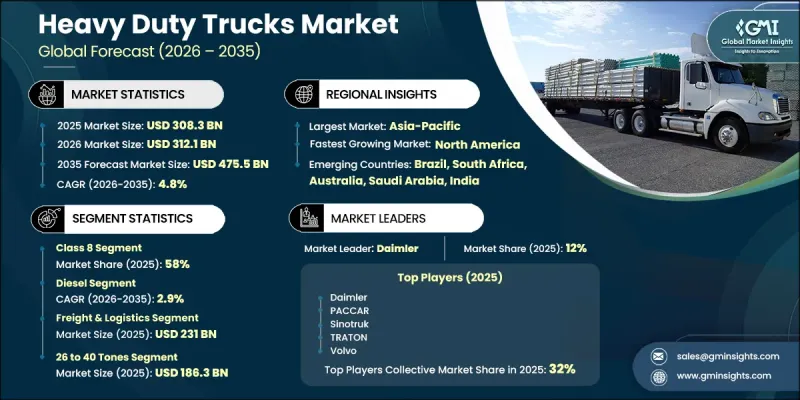
The Global Heavy Duty Trucks Market is valued at USD 308.3 billion in 2025 and is estimated to grow at a CAGR of 4.8% to reach USD 475.5 billion by 2035.
The market growth is driven by rising global freight movement, expanding industrial output, and stronger demand for long-haul transportation efficiency across domestic and cross-border logistics networks. Increasing alignment between regions on trade facilitation and transport infrastructure development is strengthening the deployment of high-capacity trucks, particularly for long-distance cargo movement. Continuous improvements in logistics connectivity and harmonization of transport regulations are also enhancing fleet utilization across key trade corridors. In addition, technological advancements in vehicle design, fuel efficiency, and safety systems are improving operational productivity and lowering total cost of ownership for fleet operators. The shift toward alternative fuel technologies, including electric and hydrogen-based propulsion systems, is reshaping the competitive landscape and accelerating sustainability adoption in freight transportation. Growing e-commerce penetration, industrial globalization, and supply chain modernization are further reinforcing demand for heavy-duty trucks worldwide. Fleet operators are increasingly prioritizing high-performance, durable, and low-emission vehicles to meet tightening environmental standards and evolving logistics requirements. These combined factors are steadily supporting long-term market expansion across developed and emerging economies.
| Market Scope | |
|---|---|
| Start Year | 2025 |
| Forecast Year | 2026-2035 |
| Start Value | $308.3 Billion |
| Forecast Value | $475.5 Billion |
| CAGR | 4.8% |
The COVID-19 pandemic significantly disrupted the industry landscape, as COVID-19 pandemic triggered production shutdowns, supply chain breakdowns, and a sharp slowdown in vehicle manufacturing activity across global markets. This was followed by a period of uneven recovery, marked by delayed deliveries and fluctuating demand patterns as logistics networks gradually stabilized. Semiconductor shortages further constrained production capacity, resulting in reduced vehicle availability and historically low replacement cycles during the disruption phase. Once supply conditions improved, the market experienced a strong rebound in order fulfillment, driven by accumulated demand across freight and logistics operators. At the same time, the transition toward electrification and alternative fuel adoption is redefining the industry structure, with manufacturers increasingly investing in cleaner propulsion systems to meet sustainability goals. These innovations are also enhancing vehicle performance, safety standards, and operational efficiency, ultimately transforming long-haul and regional freight transportation systems.
The Class 8 segment held a 58% share in 2025, and it is projected to grow at a CAGR of 19% from 2026 to 2035. This category plays a central role in long-distance freight movement, where high payload capacity, extended driving range, and superior uptime performance remain critical operational requirements. Demand within this segment continues to strengthen due to the expansion of global logistics networks and rising freight volumes across industrial and commercial sectors. The segment is also witnessing increasing integration of advanced propulsion systems, as hydrogen-based technologies gain traction for long-haul applications due to faster refueling cycles and extended operational range compared to other emerging alternatives. As fleet operators modernize their assets, Class 8 trucks are becoming increasingly aligned with next-generation mobility solutions designed to improve efficiency and reduce emissions.
The 26 to 40 tonnes category accounted for USD 186.3 billion in 2025. This segment primarily includes tractor-trailer configurations widely used for both regional and long-distance freight transportation across established logistics corridors. Growth in this category is supported by rising international trade volumes and increasing movement of bulk goods across industrial supply chains. Expanding infrastructure connectivity and higher freight density across transport routes are also contributing to sustained demand for vehicles in this weight range, making it a core component of global logistics operations.
China Heavy Duty Trucks Market generated USD 107.2 billion in 2025, owing to rapid industrial expansion, extensive infrastructure development, and continuous growth in freight transportation networks. Strong domestic manufacturing capabilities, large-scale logistics demand, and ongoing investments in transport modernization are reinforcing China's leadership position. The country is also advancing sustainability initiatives across its transportation sector, further supporting the adoption of modern and fuel-efficient heavy duty truck solutions.
Key players in the Global Heavy Duty Trucks Market include Daimler Truck, Volvo, TRATON, Iveco, DAF Trucks, Ford Trucks, TATRA Trucks, BYD, SANY, and Sinotruk. Companies operating in the heavy-duty trucks market are strengthening their position through electrification strategies, with strong investment in battery-electric and hydrogen fuel cell platforms to meet tightening emission regulations and decarbonization targets. They are also expanding global manufacturing footprints and regional assembly networks to reduce supply chain risk and improve delivery timelines. Another key approach involves integrating advanced telematics, predictive maintenance, and connected fleet management systems to enhance uptime and operational efficiency. Manufacturers are increasingly focusing on modular vehicle platforms that allow flexible customization for different freight applications. Strategic collaborations with logistics providers and energy companies are also accelerating infrastructure readiness, particularly for alternative fuel adoption. In addition, continuous R&D investment is supporting improvements in aerodynamics, lightweight materials, and powertrain efficiency.
Table of Contents
Chapter 1 Methodology & Scope
- 1.1 Research approach
- 1.2 Quality Commitments
- 1.2.1 GMI AI policy & data integrity commitment
- 1.2.1.1 Source consistency protocol
- 1.2.1 GMI AI policy & data integrity commitment
- 1.3 Research Trail & Confidence Scoring
- 1.3.1 Research Trail Components
- 1.3.2 Scoring Components
- 1.4 Data Collection
- 1.4.1 Partial list of primary sources
- 1.5 Data mining sources
- 1.5.1 Paid sources
- 1.5.1.1 Sources, by region
- 1.5.1 Paid sources
- 1.6 Base estimates and calculations
- 1.6.1 Base year calculation
- 1.7 Forecast model
- 1.7.1 Quantified market impact analysis
- 1.7.1.1 Mathematical impact of growth parameters on forecast
- 1.7.1 Quantified market impact analysis
- 1.8 Research transparency addendum
- 1.8.1 Source attribution framework
- 1.8.2 Quality assurance metrics
- 1.8.3 Our commitment to trust
Chapter 2 Executive Summary
- 2.1 Industry 360° synopsis
- 2.2 Key market trends
- 2.2.1 Truck
- 2.2.2 Tonnage Capacity
- 2.2.3 Axle
- 2.2.4 Propulsion
- 2.2.5 Horsepower
- 2.2.6 Transmission
- 2.2.7 Application
- 2.3 TAM Analysis, 2026-2035
- 2.4 CXO perspectives: Strategic imperatives
Chapter 3 Industry Insights
- 3.1 Industry ecosystem analysis
- 3.1.1 Supplier landscape
- 3.1.1.1 Raw material suppliers
- 3.1.1.2 Component suppliers
- 3.1.1.3 Manufacturers
- 3.1.1.4 Service providers
- 3.1.1.5 Distribution channel
- 3.1.1.6 End Use
- 3.1.2 Cost structure
- 3.1.3 Profit margin
- 3.1.4 Value addition at each stage
- 3.1.5 Vertical integration trends
- 3.1.6 Disruptors
- 3.1.1 Supplier landscape
- 3.2 Impact forces
- 3.2.1 Growth drivers
- 3.2.1.1 Expansion of freight corridors & global trade flows
- 3.2.1.2 Strong replacement demand from aging diesel fleets
- 3.2.1.3 Regulatory-driven fleet modernization
- 3.2.1.4 Growth of contract logistics & third-party freight operators
- 3.2.2 Industry pitfalls & challenges
- 3.2.2.1 High capital intensity of new-generation trucks
- 3.2.2.2 Lack of scalable zero-emission infrastructure
- 3.2.3 Market opportunities
- 3.2.3.1 Gradual electrification of regional haul operations
- 3.2.3.2 Rise of autonomous and semi-autonomous trucking
- 3.2.3.3 Shift toward total cost of ownership (TCO)-driven purchasing
- 3.2.3.4 Digital fleet ecosystems & uptime optimization
- 3.2.1 Growth drivers
- 3.3 Growth potential analysis
- 3.4 Pricing Analysis (Driven by Primary Research)
- 3.4.1 Historical Price Trend Analysis
- 3.4.2 Pricing Strategy by Player Type (Premium / Value / Cost-plus)
- 3.5 Regulatory landscape
- 3.5.1 North America
- 3.5.1.1 ACT Regulation
- 3.5.1.2 EPA Phase 3
- 3.5.2 Europe
- 3.5.2.1 CO2 Emission Standards
- 3.5.2.2 Euro 6/Next Generation Standards
- 3.5.3 Asia-Pacific
- 3.5.3.1 Emission Reduction Targets
- 3.5.3.2 China-6 Standard
- 3.5.4 Latin America
- 3.5.4.1 Brazil Proconve P8
- 3.5.4.2 Mexico EPA-Aligned Standards
- 3.5.5 MEA
- 3.5.5.1 Saudi Vision 2030 Green Initiatives
- 3.5.5.2 South Africa EV Tax Rebates
- 3.5.1 North America
- 3.6 Technology and Innovation landscape
- 3.6.1 Current technologies
- 3.6.2 Emerging technologies
- 3.7 Porter's analysis
- 3.8 PESTEL analysis
- 3.9 Patent analysis (Driven by Primary Research)
- 3.10 Capacity & production landscape (Driven by Primary Research)
- 3.10.1 Installed capacity by region & key producer
- 3.10.2 Capacity utilization rates & expansion pipelines
- 3.11 Trade data analysis (Driven by Paid Research)
- 3.11.1 Intra Trade Flows - Volume & Value Trends
- 3.11.2 Import/Export Corridor Analysis
- 3.12 Impact of AI & generative AI on the market
- 3.12.1 AI-Driven Disruption of Existing Business Models
- 3.12.2 Automated design optimization
- 3.12.3 Supply chain AI for demand forecasting
- 3.12.4 GenAI use cases & adoption roadmap by segment
- 3.12.5 Risks, Limitations & Regulatory Considerations
- 3.13 Forecast assumptions & scenario analysis (Driven by Primary Research)
- 3.13.1 Base Case - key macro & industry variables driving CAGR
- 3.13.2 Optimistic Scenarios - Favorable Macro and Industry Tailwinds
- 3.13.3 Pessimistic Scenario - Macroeconomic slowdown or industry headwinds
- 3.14 Sustainability and environmental aspects
- 3.14.1 Sustainable practices
- 3.14.2 Waste reduction strategies
- 3.14.3 Energy efficiency in production
- 3.14.4 Eco-friendly Initiatives
- 3.14.5 Carbon footprint considerations
Chapter 4 Competitive Landscape, 2025
- 4.1 Introduction
- 4.2 Company market share analysis
- 4.2.1 North America
- 4.2.2 Europe
- 4.2.3 Asia-Pacific
- 4.2.4 Latin America
- 4.2.5 Middle East & Africa
- 4.3 Competitive positioning matrix
- 4.4 Strategic outlook matrix
- 4.5 Key developments
- 4.5.1 Mergers & acquisitions
- 4.5.2 Partnerships & collaborations
- 4.5.3 New product launches
- 4.5.4 Expansion plans and funding
Chapter 5 Market Estimates & Forecast, By Truck, 2022 - 2035 ($Mn, Units)
- 5.1 Key trends
- 5.2 Class 7
- 5.3 Class 8
Chapter 6 Market Estimates & Forecast, By Tonnage Capacity, 2022 - 2035 ($Mn, units)
- 6.1 Key trends
- 6.2 16 to 26 tonnes
- 6.3 26 to 40 tonnes
- 6.4 Above 40 tonnes
Chapter 7 Market Estimates & Forecast, By Axle, 2022 - 2035 ($Mn, Units)
- 7.1 Key trends
- 7.2 4x2
- 7.3 6x2
- 7.4 6x4
- 7.5 6x6
- 7.6 Others
Chapter 8 Market Estimates & Forecast, By Propulsion, 2022 - 2035 ($Mn, Units)
- 8.1 Key trends
- 8.2 Diesel
- 8.3 Battery Electric Vehicles (BEV)
- 8.4 Hybrid & Plug-in Hybrid Electric Vehicles (HEV/PHEV)
- 8.5 Fuel Cell Electric Vehicles (FCEV)
- 8.6 Others
Chapter 9 Market Estimates & Forecast, By Horsepower, 2022 - 2035 ($Mn, Units)
- 9.1 Key trends
- 9.2 Below 300HP
- 9.3 300HP - 400HP
- 9.4 400HP - 500HP
- 9.5 500HP & Above
Chapter 10 Market Estimates & Forecast, By Transmission, 2022 - 2035 ($Mn, Units)
- 10.1 Key trends
- 10.2 Manual transmission
- 10.3 Automatic transmission
- 10.4 Automated Manual Transmission (AMT)
Chapter 11 Market Estimates & Forecast, By Application, 2022 - 2035 ($Mn, Units)
- 11.1 Key trends
- 11.2 Freight & Logistics
- 11.3 Construction & Mining
- 11.4 Utility Services
- 11.5 Others
Chapter 12 Market Estimates & Forecast, By Region, 2022 - 2035 ($Mn, Units)
- 12.1 North America
- 12.1.1 US
- 12.1.2 Canada
- 12.2 Europe
- 12.2.1 UK
- 12.2.2 Germany
- 12.2.3 France
- 12.2.4 Italy
- 12.2.5 Spain
- 12.2.6 Belgium
- 12.2.7 Netherlands
- 12.2.8 Sweden
- 12.2.9 Russia
- 12.3 Asia Pacific
- 12.3.1 China
- 12.3.2 India
- 12.3.3 Japan
- 12.3.4 Australia
- 12.3.5 Singapore
- 12.3.6 South Korea
- 12.3.7 Vietnam
- 12.3.8 Indonesia
- 12.3.9 Thailand
- 12.4 Latin America
- 12.4.1 Brazil
- 12.4.2 Mexico
- 12.4.3 Argentina
- 12.5 MEA
- 12.5.1 South Africa
- 12.5.2 Saudi Arabia
- 12.5.3 UAE
Chapter 13 Company Profiles
- 13.1 Global players
- 13.1.1 Daimler Truck
- 13.1.2 Volvo
- 13.1.3 TRATON
- 13.1.4 Iveco
- 13.1.5 DAF Trucks
- 13.1.6 Ford Trucks
- 13.1.7 TATRA Trucks
- 13.1.8 Hyundai Motor
- 13.1.9 Isuzu Motors
- 13.1.10 Dongfeng Motor
- 13.1.11 Hino Motors
- 13.2 Regional players
- 13.2.1 GINAF Trucks
- 13.2.2 BMC Automotive
- 13.2.3 Kamaz
- 13.2.4 Sisu Auto
- 13.2.5 BYD
- 13.2.6 SANY
- 13.2.7 Sinotruk
- 13.3 Emerging players
- 13.3.1 Einride
- 13.3.2 Windrose

