PUBLISHER: Global Market Insights Inc. | PRODUCT CODE: 2109263

PUBLISHER: Global Market Insights Inc. | PRODUCT CODE: 2109263
Wet Scrubbers Market Opportunity, Growth Drivers, Industry Trend Analysis, and Forecast 2026 - 2035
The Global Wet Scrubbers Market was valued at USD 13.8 billion in 2025 and is estimated to grow at a CAGR of 5.5% to reach USD 23.7 billion by 2035.
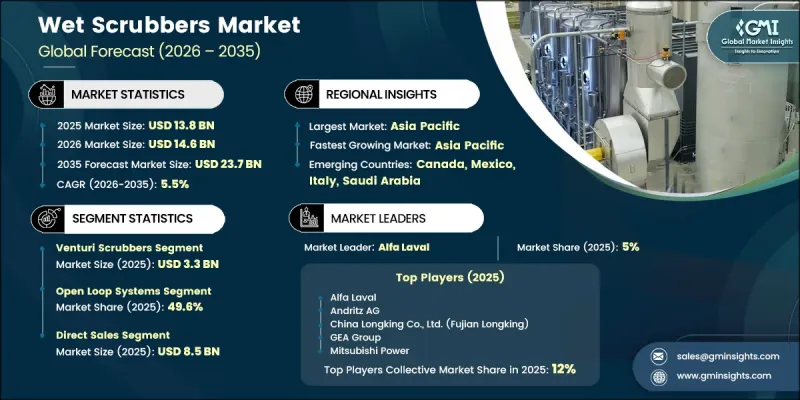
Growth in the wet scrubbers market is supported by increasingly stringent industrial emission regulations and continuous expansion of industrial production capacity across developed and emerging economies. Wet scrubber systems are widely utilized to remove harmful gases and airborne particulate matter from industrial exhaust streams, making them an essential component of modern air pollution control strategies. Various wet scrubbing technologies are designed to address diverse industrial gas treatment requirements while helping facilities comply with evolving environmental regulations. Industries are increasingly replacing conventional single-purpose emission control equipment with integrated systems capable of treating multiple pollutants simultaneously while maintaining higher operational efficiency and regulatory compliance. Demand for wet scrubbers is also being driven by ongoing modernization of existing industrial facilities and the construction of new manufacturing plants requiring advanced emission control solutions from the beginning of operations. Rising investments in cleaner production technologies, combined with greater emphasis on environmental sustainability and operational efficiency, continue to strengthen long-term growth opportunities across the global wet scrubbers market.
| Market Scope | |
|---|---|
| Start Year | 2025 |
| Forecast Year | 2026-2035 |
| Start Value | $13.8 Billion |
| Forecast Value | $23.7 Billion |
| CAGR | 5.5% |
The open loop systems segment held a 49.6% share in 2025. This segment continues to lead due to its widespread installation across industrial applications where efficient gas cleaning and cost-effective operation remain key priorities. Open loop systems are recognized for their ability to deliver effective emission control while supporting continuous large-scale industrial operations. Their established installation base and operational reliability continue to reinforce demand across multiple end-use industries.
U.S. Wet Scrubbers Market accounted for an 86.8% share, generating USD 2.6 billion in 2025. Regional demand is primarily supported by equipment replacement and upgrades required to meet evolving environmental regulations rather than by new industrial construction. The United States continues to lead the regional market due to its extensive industrial infrastructure and ongoing implementation of increasingly stringent air quality regulations, which continue to encourage investments in advanced emission control technologies.
Major companies operating in the global wet scrubbers market include CECO Environmental Corp, Andritz AG, Babcock & Wilcox (B&W), Durr AG (Megtec/Universal), GEA Group, Alfa Laval, Mitsubishi Power, Bionomic Industries, Ducon Technologies, Monroe Environmental, Tri-Mer Corporation, Korting Hannover GmbH, Thermax Limited, China Longking Co., Ltd. (Fujian Longking), Beltran Technologies, Wartsila (Exhaust Treatment), Biorem Technologies (BIOREM Inc.), Envitech Inc., Croll-Reynolds Company, Sly LLC (Sly Inc.), and CR Clean Air Group. Companies operating in the wet scrubbers market are strengthening their competitive position by investing in research and development to improve emission control efficiency, operational reliability, and system performance. Many manufacturers are expanding product portfolios with advanced multi-stage pollution control solutions that address evolving industrial and environmental requirements. Strategic collaborations with engineering firms, industrial operators, and technology providers are supporting broader market penetration and accelerating project execution. Businesses are also increasing manufacturing capabilities, enhancing customization options, and integrating digital monitoring technologies to improve equipment performance and maintenance efficiency.
Table of Contents
Chapter 1 Methodology and Scope
- 1.1 Market scope & definitions
- 1.2 Research design
- 1.2.1 Research approach
- 1.2.2 Data collection methods
- 1.3 Base estimates and calculations
- 1.3.1 Base year calculation
- 1.3.2 Market estimates & forecasts parameters
- 1.4 Forecast Model
- 1.4.1 Key trends for market estimates
- 1.4.2 Quantified market impact analysis
- 1.4.2.1 Mathematical impact of growth parameters on forecast
- 1.4.3 Scenario analysis framework
- 1.5 Primary research and validation
- 1.5.1 Some of the primary sources (but not limited to)
- 1.6 Data mining sources
- 1.6.1 Paid Sources
- 1.7 Primary research and validation
- 1.7.1 Primary sources
- 1.8 Research Trail & confidence scoring
- 1.8.1 Research trail components
- 1.8.2 Scoring components
- 1.9 Research transparency addendum
- 1.9.1 Source attribution framework
- 1.9.2 Quality assurance metrics
- 1.9.3 Our commitment to trust
Chapter 2 Executive Summary
- 2.1 Industry 360° synopsis
- 2.2 Key market trends
- 2.2.1 Regional
- 2.2.2 Product type
- 2.2.3 Pollutant type
- 2.2.4 Operation type
- 2.2.5 End use industry
- 2.2.6 Distribution channel
Chapter 3 Industry Insights
- 3.1 Industry ecosystem analysis
- 3.1.1 Supplier landscape
- 3.1.2 Profit margin
- 3.1.3 Value addition at each stage
- 3.1.4 Factor affecting the value chain
- 3.2 Industry impact forces
- 3.2.1 Growth drivers
- 3.2.1.1 Stringent air emission regulations
- 3.2.1.2 Growth of heavy industrial sectors
- 3.2.1.3 Rising focus on occupational health & safety
- 3.2.2 Industry pitfalls & challenges
- 3.2.2.1 High capital investment
- 3.2.2.2 High operating costs
- 3.2.3 Opportunities
- 3.2.3.1 Retrofit and modernization projects
- 3.2.3.2 Semiconductor and electronics manufacturing
- 3.2.1 Growth drivers
- 3.3 Growth potential analysis
- 3.4 Regulatory framework
- 3.4.1 U.S. EPA clean air act - MACT & NESHAP standards
- 3.4.2 EU Industrial Emissions Directive (IED) & BREF standards
- 3.4.3 IMO MARPOL Annex VI (Marine Sulfur Cap - 0.5% global sulfur limit)
- 3.4.4 Asia Pacific emission standards (China GB Standards, India CPCB, South Korea)
- 3.4.5 Emerging Markets Regulatory Landscape (MEA, Latin America)
- 3.5 Pricing analysis (driven by primary research)
- 3.5.1 Historical price trend analysis (2022-2025)
- 3.5.2 Pricing strategy by player type (premium / value / cost-plus)
- 3.6 Trade data analysis (driven by paid database)
- 3.6.1 Import/export volume & value trends (HS Code 842139 industrial air scrubbers)
- 3.6.2 Key trade corridors & tariff impact
- 3.7 Impact of AI & generative AI on the market
- 3.7.1 AI-driven disruption of existing scrubber business models (monitoring-as-a-service, remote diagnostics)
- 3.7.2 GenAI use cases & adoption roadmap by segment
- 3.7.3 Risks, limitations & regulatory considerations for AI in pet care
- 3.8 Capacity & production landscape (driven by primary research)
- 3.8.1 Installed manufacturing capacity by region & key producer
- 3.8.2 Capacity utilization rates & expansion pipelines
Chapter 4 Competitive Landscape, 2025
- 4.1 Introduction
- 4.2 Company market share analysis
- 4.2.1 By region
- 4.2.1.1 North America
- 4.2.1.2 Europe
- 4.2.1.3 Asia Pacific
- 4.2.1.4 Latin America
- 4.2.1.5 Middle East and Africa
- 4.2.1 By region
- 4.3 Company matrix analysis
- 4.4 Competitive analysis of major market players
- 4.5 Competitive positioning matrix
- 4.6 Key developments
- 4.6.1 Mergers & acquisitions
- 4.6.2 Partnerships & collaborations
- 4.6.3 New product launches
- 4.6.4 Expansion plans
Chapter 5 Market Estimates and Forecast, By Product Type, 2022 – 2035 (USD Billion) (Units)
- 5.1 Key trends
- 5.2 Packed bed scrubbers
- 5.3 Venturi scrubbers
- 5.4 Spray tower scrubbers
- 5.5 Cyclonic scrubbers
- 5.6 Impingement plate scrubbers
- 5.7 Others (eductor scrubbers, biological/bio scrubbers, wet electrostatic precipitators)
Chapter 6 Market Estimates and Forecast, By Pollutant Type, 2022 – 2035 (USD Billion) (Units)
- 6.1 Key trends
- 6.2 Particulate matter (PM) control
- 6.3 Acid gas control
- 6.4 Volatile organic compounds (VOC) control
- 6.5 Odor control
- 6.6 Toxic fumes & heavy metals control
- 6.7 Others (multi-pollutant control systems, CO₂ pre-treatment)
Chapter 7 Market Estimates and Forecast, By Operation Type, 2022 – 2035 (USD Billion) (Units)
- 7.1 Key trends
- 7.2 Open loop systems
- 7.3 Closed loop systems
- 7.4 Dry & wet hybrid systems
- 7.5 Others (semi-closed, hybrid-ready configurations)
Chapter 8 Market Estimates and Forecast, By End Use Industry, 2022 – 2035 (USD Billion) (Units)
- 8.1 Key trends
- 8.2 Chemical
- 8.3 Oil & gas
- 8.4 Refinery & petrochemicals
- 8.5 Mining & metallurgy
- 8.6 Pharmaceuticals
- 8.7 Others (marine, cement, power generation, Etc.)
Chapter 9 Market Estimates and Forecast, By Distribution Channel, 2022 – 2035 (USD Billion) (Units)
- 9.1 Key trends
- 9.2 Direct sales
- 9.3 Indirect sales
Chapter 10 Market Estimates and Forecast, By Region, 2022 – 2035 (USD Billion) (Units)
- 10.1 Key trends
- 10.2 North America
- 10.2.1 U.S.
- 10.2.2 Canada
- 10.3 Europe
- 10.3.1 Germany
- 10.3.2 UK
- 10.3.3 France
- 10.3.4 Italy
- 10.3.5 Spain
- 10.4 Asia Pacific
- 10.4.1 China
- 10.4.2 Japan
- 10.4.3 India
- 10.4.4 Australia
- 10.4.5 South Korea
- 10.5 Latin America
- 10.5.1 Brazil
- 10.5.2 Mexico
- 10.5.3 Argentina
- 10.6 Middle East and Africa
- 10.6.1 South Africa
- 10.6.2 Saudi Arabia
- 10.6.3 UAE
Chapter 11 Company Profiles
- 11.1 Global players
- 11.1.1 CECO Environmental Corp
- 11.1.2 Andritz AG
- 11.1.3 Babcock & Wilcox (B&W)
- 11.1.4 Durr AG (Megtec/Universal)
- 11.1.5 GEA Group
- 11.1.6 Alfa Laval
- 11.1.7 Mitsubishi Power
- 11.2 Regional players
- 11.2.1 Bionomic Industries
- 11.2.2 Ducon Technologies
- 11.2.3 Monroe Environmental
- 11.2.4 Tri-Mer Corporation
- 11.2.5 Korting Hannover GmbH
- 11.2.6 Thermax Limited
- 11.2.7 China Longking Co., Ltd. (Fujian Longking)
- 11.3 Emerging players
- 11.3.1 Beltran Technologies
- 11.3.2 Wartsila (Exhaust Treatment)
- 11.3.3 Biorem Technologies (BIOREM Inc.)
- 11.3.4 Envitech Inc.
- 11.3.5 Croll-Reynolds Company
- 11.3.6 Sly LLC (Sly Inc.)
- 11.3.7 CR Clean Air Group

