PUBLISHER: Global Market Insights Inc. | PRODUCT CODE: 2109299

PUBLISHER: Global Market Insights Inc. | PRODUCT CODE: 2109299
Location-Based Services Market Opportunity, Growth Drivers, Industry Trend Analysis, and Forecast 2026 - 2035
The Global Location-Based Services Market was valued at USD 56.4 billion in 2025 and is estimated to grow at a CAGR of 21.3% to reach USD 362.7 billion by 2035.
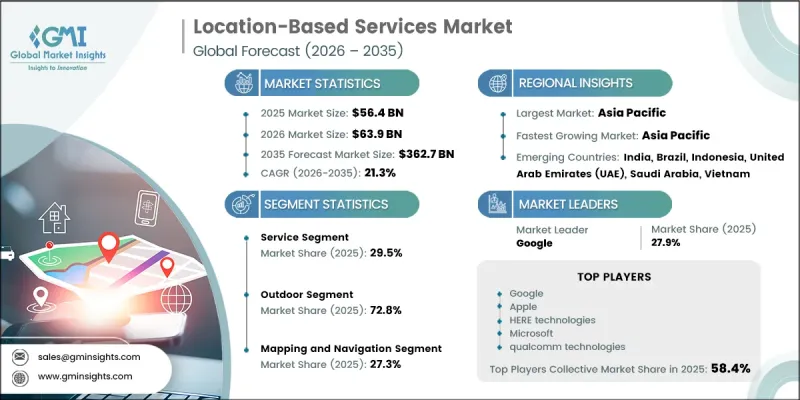
Growth in the location-based services market is being fueled by the increasing dependence of enterprises, government organizations, and consumers on real-time geospatial intelligence to improve operational efficiency, customer engagement, digital experiences, and strategic decision-making. The widespread adoption of smartphones connected devices, and location-enabled applications continues to accelerate demand for scalable, secure, and highly accurate location technologies across multiple industries. The location-based services market encompasses technologies that use geographic positioning methods, including satellite navigation, wireless positioning, cellular networks, Bluetooth connectivity, and geospatial analytics to provide location-aware information and services. Organizations are increasingly integrating LBS platforms to strengthen operational visibility, improve mobility, enhance asset monitoring, and support real-time decision-making.
| Market Scope | |
|---|---|
| Start Year | 2025 |
| Forecast Year | 2026-2035 |
| Start Value | $56.4 Billion |
| Forecast Value | $362.7 Billion |
| CAGR | 21.3% |
The services segment accounted for a 29.5% share in 2025 and is expected to grow at a CAGR of 21.2% from 2026 to 2035. Growth in this segment is driven by increasing demand for consulting, deployment, system integration, managed services, maintenance, and location data management solutions. Organizations continue to require specialized expertise to integrate location intelligence capabilities into existing enterprise systems, digital platforms, and connected technology environments. The growing adoption of digital transformation initiatives and connected infrastructure is further accelerating demand for professional LBS service providers.
The outdoor segment held a 72.8% share in 2025. This segment maintains its leading position due to widespread adoption of outdoor location technologies for mobility management, transportation optimization, logistics operations, asset monitoring, navigation, and location-aware customer engagement. Outdoor LBS solutions rely on satellite navigation systems, cellular connectivity, and advanced mapping technologies to deliver highly accurate real-time location intelligence. Increasing reliance on these technologies by enterprises, government agencies, and consumers continues to strengthen demand for outdoor location-based solutions that improve operational efficiency and user experiences.
China Location-Based Services Market held a 47.8% share, generating USD 7.1 billion in 2025. The country's market leadership is supported by widespread smartphone adoption, rapid expansion of 5G infrastructure, continuous development of digital mapping technologies, and increasing use of location intelligence across multiple industries. Businesses are increasingly adopting LBS platforms to enhance operational efficiency, improve customer engagement, and strengthen real-time business intelligence. China's extensive mobile internet user base and advanced digital ecosystem continue to create strong demand for location-enabled technologies and services.
Major companies operating in the global location-based services market include Apple, Baidu, Cisco Systems, Google, HERE Technologies, IBM, Magellan GPS, Microsoft, Oracle, and Qualcomm Technologies. Companies operating in the location-based services market are strengthening their competitive position by investing in advanced geospatial technologies, artificial intelligence, and cloud-based location intelligence platforms. Many organizations are expanding research and development efforts to improve positioning accuracy, real-time analytics, and platform scalability while supporting evolving customer requirements. Strategic collaborations with technology providers, telecommunications companies, and enterprise customers are helping accelerate innovation and broaden market reach. Businesses are also enhancing software capabilities through integration with cloud computing, edge computing, and connected device ecosystems to improve overall service performance.
Table of Contents
Chapter 1 Research Methodology
- 1.1 Research approach
- 1.2 Quality Commitments
- 1.2.1 GMI AI policy & data integrity commitment
- 1.2.1.1 Source consistency protocol
- 1.2.1 GMI AI policy & data integrity commitment
- 1.3 Research Trail & Confidence Scoring
- 1.3.1 Research Trail Components
- 1.3.2 Scoring Components
- 1.4 Data Collection
- 1.4.1 Partial list of primary sources
- 1.5 Data mining sources
- 1.5.1 Paid sources
- 1.5.1.1 Sources, by region
- 1.5.1 Paid sources
- 1.6 Base estimates and calculations
- 1.6.1 Base year calculation for any one approach
- 1.7 Forecast model
- 1.7.1 Quantified Market impact analysis
- 1.7.1.1 Mathematical impact of growth parameters on forecast
- 1.7.1 Quantified Market impact analysis
- 1.8 Research transparency addendum
- 1.8.1 Source attribution framework
- 1.8.2 Quality assurance metrics
- 1.8.3 Our commitment to trust
Chapter 2 Executive Summary
- 2.1 Industry 360° synopsis, 2022 – 2035
- 2.2 Key Market trends
- 2.2.1 Region
- 2.2.2 Component
- 2.2.3 Location
- 2.2.4 Application
- 2.2.5 Technology
- 2.2.6 End Use
- 2.3 TAM Analysis, 2026-2035
- 2.4 CXO perspectives: Strategic imperatives
Chapter 3 Industry Insights
- 3.1 Industry ecosystem analysis
- 3.1.1 Supplier landscape
- 3.1.1.1 Satellite & positioning providers (GPS, GNSS)
- 3.1.1.2 Mapping & geospatial data providers
- 3.1.1.3 Cloud & hyperscale providers
- 3.1.1.4 LBS platform & software vendors
- 3.1.1.5 Telecom operators
- 3.1.1.6 Mobile OS providers
- 3.1.1.7 System integrators
- 3.1.1.8 Application developers
- 3.1.2 Profit margin analysis
- 3.1.3 Cost structure
- 3.1.4 Value addition at each stage
- 3.1.5 Factor affecting the value chain
- 3.1.6 Disruptions
- 3.1.1 Supplier landscape
- 3.2 Industry impact forces
- 3.2.1 Growth drivers
- 3.2.1.1 Proliferation of 5G Networks Enabling Sub-Meter Positioning Accuracy
- 3.2.1.2 Exponential Growth in IoT Device Deployments Demanding Real-Time Location Visibility
- 3.2.1.3 Rising Adoption of LBS in Smart City Infrastructure & Urban Planning
- 3.2.1.4 Surging Demand for Indoor RTLS Across Healthcare, Retail & Logistics
- 3.2.2 Industry pitfalls and challenges
- 3.2.2.1 Consumer Privacy Pushback & Consent Management Complexity
- 3.2.2.2 Indoor Mapping Standardization Lag Increasing Integration Costs
- 3.2.2.3 Spectrum Allocation Uncertainty for mmWave 5G in Key Markets
- 3.2.3 Market opportunities
- 3.2.3.1 Integration of LBS with Autonomous Vehicle Navigation & V2X Communication
- 3.2.3.2 Expansion of Location-Based Advertising into Emerging Markets via Mobile-First Platforms
- 3.2.3.3 Growth of Precision Agriculture Applications Using GNSS & Sensor Fusion
- 3.2.1 Growth drivers
- 3.3 Technology and innovation landscape
- 3.3.1 Current technologies
- 3.3.1.1 Global Navigation Satellite Systems (GNSS) & GPS
- 3.3.1.2 Geographic Information Systems (GIS) and Digital Mapping
- 3.3.1.3 Wi-Fi & Cellular Network-Based Positioning
- 3.3.1.4 Bluetooth Low Energy (BLE) Beacon Technology
- 3.3.2 Emerging technologies
- 3.3.2.1 Ultra-Wideband (UWB) Precision Positioning
- 3.3.2.2 AI-Powered Location Intelligence & Spatial Analytics
- 3.3.2.3 Visual Positioning Systems (VPS) and SLAM-Based Navigation
- 3.3.2.4 Digital Twins & Spatial Computing Platforms
- 3.3.1 Current technologies
- 3.4 Growth potential analysis
- 3.5 Pricing Analysis (Driven by primary research)
- 3.5.1 Historical Price Trend Analysis, 2022-2025
- 3.5.2 Pricing Strategy by Player Type
- 3.6 Regulatory landscape
- 3.6.1 North America
- 3.6.1.1 Federal Communications Commission
- 3.6.1.2 National Telecommunications and Information Administration
- 3.6.1.3 National Institute of Standards and Technology
- 3.6.2 Europe
- 3.6.2.1 European Commission
- 3.6.2.2 European Data Protection Board
- 3.6.2.3 European Union Agency for Cybersecurity
- 3.6.3 Asia Pacific
- 3.6.3.1 Ministry of Industry and Information Technology
- 3.6.3.2 Ministry of Internal Affairs and Communications
- 3.6.3.3 Infocomm Media Development Authority
- 3.6.4 Latin America
- 3.6.4.1 Brazilian National Data Protection Authority
- 3.6.4.2 Federal Telecommunications Institute
- 3.6.4.3 National Telecommunications Agency
- 3.6.5 Middle East & Africa
- 3.6.5.1 Telecommunications and Digital Government Regulatory Authority
- 3.6.5.2 UAE Cyber Security Council
- 3.6.5.3 Information Regulator of South Africa
- 3.6.1 North America
- 3.7 Porter’s analysis
- 3.8 PESTEL analysis
- 3.9 Patent analysis (Driven by primary research)
- 3.10 Cost breakdown analysis, 2025
- 3.11 Impact of AI & generative AI on the market
- 3.11.1 AI-driven disruption of existing business models
- 3.11.2 GenAI use cases & adoption roadmap by segment
- 3.11.3 Risks, limitations & regulatory considerations
- 3.12 Forecast assumptions & scenario analysis (Driven by primary research)
- 3.12.1 Base Case key macro & industry variables driving CAGR
- 3.12.2 Optimistic Scenarios-Favorable macro and industry tailwinds
- 3.12.3 Pessimistic Scenario-Macroeconomic slowdown or industry headwinds
Chapter 4 Competitive Landscape, 2025
- 4.1 Introduction
- 4.2 Company Market share analysis
- 4.2.1 North America
- 4.2.2 Europe
- 4.2.3 Asia Pacific
- 4.2.4 LATAM
- 4.2.5 MEA
- 4.3 Competitive analysis of major market players
- 4.4 Competitive positioning matrix
- 4.5 Key developments
- 4.5.1 Mergers & acquisitions
- 4.5.2 Partnerships & collaborations
- 4.5.3 New Product Launches
- 4.5.4 Expansion Plans and funding
- 4.6 Company tier benchmarking
- 4.6.1 Tier classification criteria & qualifying thresholds
- 4.6.2 Tier positioning matrix by revenue, geography & innovation
Chapter 5 Market Estimates & Forecast, By Component, 2022 - 2035 (USD Mn)
- 5.1 Key trends
- 5.2 Hardware
- 5.2.1 GPS/GNSS Receivers & Chipsets
- 5.2.2 BLE Beacons & Tags
- 5.2.3 UWB Anchors & Tags
- 5.2.4 RFID Readers & Tags
- 5.3 Software
- 5.3.1 LBS Platforms & SDKs
- 5.3.2 GIS & Mapping Engines
- 5.3.3 Indoor Positioning & RTLS Software
- 5.3.4 Location Analytics & Intelligence Platforms
- 5.4 Services
- 5.4.1 Deployment & System Integration
- 5.4.2 Consulting & Advisory
- 5.4.3 Application Support & Maintenance
- 5.4.4 Data & Analytics Services
- 5.4.5 Managed Location Services
Chapter 6 Market Estimates & Forecast, By Location, 2022 - 2035 (USD Mn)
- 6.1 Key trends
- 6.2 Indoor
- 6.3 Outdoor
Chapter 7 Market Estimates & Forecast, By Application, 2022 - 2035 (USD Mn)
- 7.1 Key trends
- 7.2 Mapping and Navigation
- 7.3 Asset and Fleet Tracking
- 7.4 Location-Based Advertising and Marketing
- 7.5 Emergency and Public Safety Services
- 7.6 Social Networking and Entertainment
- 7.7 Location-Based Health Monitoring
- 7.8 Others
Chapter 8 Market Estimates & Forecast, By Technology, 2022 - 2035 (USD Mn)
- 8.1 Key trends
- 8.2 GPS
- 8.3 Wi‑Fi Positioning
- 8.4 Bluetooth Low Energy (BLE)
- 8.5 Ultra-Wideband (UWB)
- 8.6 RFID & NFC
- 8.7 Cellular Network Positioning
- 8.8 Hybrid Fusion Positioning
- 8.9 Others
Chapter 9 Market Estimates & Forecast, By End Use, 2022 - 2035 (USD Mn)
- 9.1 Key trends
- 9.2 Transportation and Logistics
- 9.3 Retail and E-Commerce
- 9.4 Healthcare and Life Sciences
- 9.5 Government and Defense
- 9.6 Banking, Financial Services, and Insurance (BFSI)
- 9.7 IT and Telecommunications
- 9.8 Tourism and Hospitality
- 9.9 Media and Entertainment
- 9.10 Manufacturing
- 9.11 Others
Chapter 10 Market Estimates & Forecast, By Region, 2022 - 2035 (USD Mn)
- 10.1 Key trends
- 10.2 North America
- 10.2.1 US
- 10.2.2 Canada
- 10.3 Europe
- 10.3.1 Germany
- 10.3.2 UK
- 10.3.3 France
- 10.3.4 Italy
- 10.3.5 Spain
- 10.3.6 Russia
- 10.3.7 Norway
- 10.3.8 Netherlands
- 10.3.9 Sweden
- 10.4 Asia Pacific
- 10.4.1 China
- 10.4.2 India
- 10.4.3 Japan
- 10.4.4 Australia
- 10.4.5 South Korea
- 10.4.6 Singapore
- 10.4.7 Thailand
- 10.4.8 Indonesia
- 10.4.9 Vietnam
- 10.5 Latin America
- 10.5.1 Brazil
- 10.5.2 Mexico
- 10.5.3 Argentina
- 10.6 MEA
- 10.6.1 South Africa
- 10.6.2 Saudi Arabia
- 10.6.3 UAE
- 10.6.4 Turkey
Chapter 11 Company Profiles
- 11.1 Global Players
- 11.1.1 Google
- 11.1.2 Microsoft
- 11.1.3 HERE Technologies
- 11.1.4 TomTom
- 11.1.5 Esri
- 11.1.6 Hexagon
- 11.1.7 Trimble
- 11.1.8 Verizon Connect
- 11.1.9 Zebra Technologies
- 11.1.10 Precisely
- 11.2 Regional Players
- 11.2.1 Teletrac Navman
- 11.2.2 Comarch
- 11.2.3 Zenrin
- 11.2.4 NavInfo
- 11.2.5 Inpixon
- 11.2.6 T-Map Mobility
- 11.3 Emerging Players
- 11.3.1 Foursquare
- 11.3.2 Veraset
- 11.3.3 NextNav
- 11.3.4 Mapsted

