PUBLISHER: Mordor Intelligence | PRODUCT CODE: 2119788

PUBLISHER: Mordor Intelligence | PRODUCT CODE: 2119788
ANZ Location-based Services - Market Share Analysis, Industry Trends & Statistics, Growth Forecasts (2026 - 2031)
According to Mordor Intelligence, the ANZ location-based services market size was valued at USD 2.47 billion in 2025 and estimated to grow from USD 2.93 billion in 2026 to reach USD 6.83 billion by 2031, at a CAGR of 18.46% during the forecast period (2026-2031).
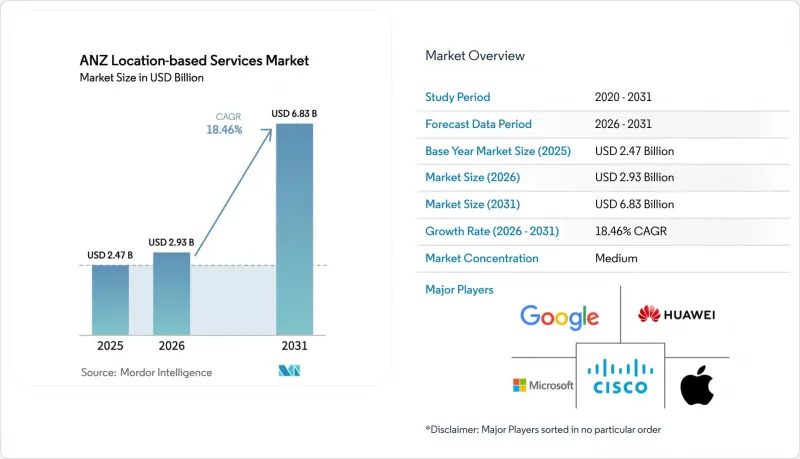
This report is Segmented by Component (Hardware, Software, and Services), Location (Indoor, and Outdoor), Application (Mapping and Navigation, Business Intelligence and Analytics, Location-Based Advertising, Social Networking and Entertainment, and Other Applications), and End-User (Transportation and Logistics, IT and Telecom, Healthcare, Government, and More).
ANZ Location-based Services Market Trends and Insights
Pervasive 5G and private-LTE roll-outs boosting indoor precision
New Zealand's decision to grant each operator 80 MHz of 3.5 GHz spectrum creates the density needed for centimeter-level positioning in warehouses and terminals; Spark's private 5G at Auckland Airport already supports drone-based inventory audits every night instead of quarterly manual counts . Australia's allocation of 6 GHz for indoor Wi-Fi further complements UWB tags, giving factories an RF toolkit that fuses bandwidth and accuracy. Integrators report that combining UWB with 5G reduces indoor location error by 70% compared with legacy Wi-Fi alone. Vendors now package 5G small-cells with RTLS middleware, shrinking deployment time from months to days. As more enterprises shift from proof-of-concept to production roll-outs, capital outlays move from pilot budgets into mainstream IT planning.
Expansion of fleet-telematics across ANZ logistics
Fuel-price volatility and a chronic driver shortage are persuading fleet owners to digitize route planning, maintenance and compliance. EROAD's FY25 interim revenue climbed to NZD 95.9 million, up 8%, driven by demand for light-vehicle road-user-charging modules that automate tax collection. Transurban's automated-truck study on Melbourne's CityLink showed that real-time road geometry reduces lane-keeping errors by 42%, illustrating location data's safety dividend. With 91% of New Zealand's light-vehicle RUC still processed manually, the addressable pool for telematics remains sizeable, reinforcing double-digit growth prospects for the ANZ Location-based Services market.
Heightened privacy legislation (Consumer Data Right, NZ Privacy Act)
Explicit consent, data-holder accreditation and mandatory deletion protocols are adding as much as 12 weeks to project timelines for start-ups, raising cash-burn rates. The ACCC's 2024 inquiry found that 84% of Australians want granular control over location sharing, prompting firms to embed new UX flows that slow onboarding . Compliance spending now averages 4% of annual revenue among mid-size location SaaS providers. Larger incumbents are weathering the cost, but smaller entrants may exit or pivot, trimming new-entrant momentum within the ANZ Location-based Services market.
Other drivers and restraints analyzed in the detailed report include:
- Retail push for hyper-local customer engagement / geomarketing
- Government open-data geospatial initiatives
- GNSS multipath errors in dense urban canyons
For complete list of drivers and restraints, kindly check the Table Of Contents.
Segment Analysis
Hardware accounted for 45.10% of 2025 revenue as enterprises raced to install 5G-ready small cells, UWB anchors and dense BLE beacons essential for sub-meter precision. Industrial buyers gravitated toward multimode gateways able to triangulate across Wi-Fi RTT, UWB and angle-of-arrival BLE, thereby prolonging asset lifecycles amid evolving standards. Demand for semiconductors optimized for low-power positioning-such as Qorvo's channel-sounding chips-helped fabless suppliers secure long-term design wins in healthcare and warehousing. In contrast, cloud-native software stacks delivered by Mapbox, Esri and GapMaps lowered entry barriers for analytic functions, letting non-GIS specialists consume advanced geofencing and isochrone APIs without heavy upfront licensing.
The services line is accelerating at a 23.55% CAGR as enterprises outsource design, calibration and life-cycle management. Managed-RTLS subscriptions include hardware swaps, firmware updates and machine-learning model retraining, converting one-off capex into predictable opex. movement's solar-powered livestock tags exemplify this pivot: ranchers pay a software-as-a-service fee that bundles connectivity, analytics and battery replacement, reducing total cost of ownership by 30% in large cattle stations. As compliance frameworks grow more intricate, consulting around Consumer Data Right audits and Spectrum-Emissions compliance is inflating the addressable pool for specialist integrators. The resulting mix positions services to overtake hardware spending midway through the forecast period, reinforcing a value-chain shift inside the ANZ Location-based Services market.
Outdoor positioning remained the mainstay with 59.85% of spending in 2025, buoyed by well-entrenched agriculture, mining and freight telematics use cases. SouthPAN's augmentation layer promises centimeter-grade accuracy across 10 million km2 of land and sea, widening adoption in variable-rate agriculture and haul-road automation. Yet the momentum is tilting indoors; UWB tag shipments into ANZ doubled during 2024, driven by hospital asset tracking and pick-to-light warehouse systems.
Indoor projects are projected to log a 19.45% CAGR through 2031, reflecting private-5G network growth and regulators' moves to harmonize 6 GHz unlicensed spectrum. In the first operational year at Sydney's Royal Prince Alfred Hospital, a Bluetooth-Angle-of-Arrival RTLS shaved 18 minutes off average asset location time, releasing 1,500 clinical hours back to patient care. Spark New Zealand's end-to-end indoor stack pairs 5G core slicing with a location middleware broker that standardizes coordinates across beacons, cameras and RFID. This multifactor approach is reducing infrastructure duplication, making ROIs attractive even in mid-sized facilities and bolstering the ANZ Location-based Services market.
Complete Report Scope:
- By Component
- Hardware
- Software
- Services
- By Location Type
- Indoor
- Outdoor
- By Application
- Mapping and Navigation
- Business Intelligence and Analytics
- Location-based Advertising
- Social Networking and Entertainment
- Other Applications
- By End-user Vertical
- Transportation and Logistics
- IT and Telecom
- Healthcare
- Government
- BFSI
- Hospitality
- Manufacturing
- Other End-users
List of Companies Covered in this Report:
- Google LLC
- Microsoft Corporation
- Apple Inc.
- HERE Technologies (HERE Global B.V.)
- Cisco Systems, Inc.
- Uber Technologies, Inc.
- GapMaps Pty Ltd
- Esri Australia Pty Ltd
- TomTom International B.V.
- Telstra Group Limited
- Spark New Zealand Limited
- Singtel Optus Pty Limited
- TPG Telecom Limited
- EROAD Limited
- Trimble Inc.
- Nearmap Ltd
- Mapbox Inc.
- Ubisense Ltd
- BlueCats Pty Ltd
- Hexagon AB (HxGN)
Additional Benefits:
- The market estimate (ME) sheet in Excel format
- 3 months of analyst support
TABLE OF CONTENTS
1 INTRODUCTION
- 1.1 Study Assumptions and Market Definition
- 1.2 Scope of the Study
2 RESEARCH METHODOLOGY
3 EXECUTIVE SUMMARY
4 MARKET LANDSCAPE
- 4.1 Market Overview
- 4.2 Market Drivers
- 4.2.1 Pervasive 5G and private-LTE roll-outs boosting indoor precision
- 4.2.2 Expansion of fleet-telematics across ANZ logistics
- 4.2.3 Retail push for hyper-local customer engagement/geomarketing
- 4.2.4 Government open-data geospatial initiatives
- 4.2.5 Mining and agri-digital twins requiring sub-meter accuracy (under-reported)
- 4.2.6 Smart-hospital way-finding and asset tracking pilots (under-reported)
- 4.3 Market Restraints
- 4.3.1 Heightened privacy legislation (Consumer Data Right, NZ Privacy Act)
- 4.3.2 GNSS multipath errors in dense urban canyons
- 4.3.3 Fragmented spectrum policy for indoor UWB/BLE (under-reported)
- 4.3.4 Skills shortage in geo-AI model development (under-reported)
- 4.4 Evaluation of Critical Regulatory Framework
- 4.5 Value Chain Analysis
- 4.6 Technological Outlook
- 4.7 Porter's Five Forces
- 4.7.1 Bargaining Power of Suppliers
- 4.7.2 Bargaining Power of Buyers
- 4.7.3 Threat of New Entrants
- 4.7.4 Threat of Substitutes
- 4.7.5 Competitive Rivalry
- 4.8 Key Use Cases and Case Studies
- 4.9 Impact on Macroeconomic Factors of the Market
- 4.10 Investment Analysis
5 MARKET SEGMENTATION
- 5.1 By Component
- 5.1.1 Hardware
- 5.1.2 Software
- 5.1.3 Services
- 5.2 By Location Type
- 5.2.1 Indoor
- 5.2.2 Outdoor
- 5.3 By Application
- 5.3.1 Mapping and Navigation
- 5.3.2 Business Intelligence and Analytics
- 5.3.3 Location-based Advertising
- 5.3.4 Social Networking and Entertainment
- 5.3.5 Other Applications
- 5.4 By End-user Vertical
- 5.4.1 Transportation and Logistics
- 5.4.2 IT and Telecom
- 5.4.3 Healthcare
- 5.4.4 Government
- 5.4.5 BFSI
- 5.4.6 Hospitality
- 5.4.7 Manufacturing
- 5.4.8 Other End-users
6 COMPETITIVE LANDSCAPE
- 6.1 Market Concentration
- 6.2 Strategic Moves
- 6.3 Market Share Analysis
- 6.4 Company Profiles {(includes Global level Overview, Market level overview, Core Segments, Financials as available, Strategic Information, Market Rank/Share for key companies, Products and Services, and Recent Developments)}
- 6.4.1 Google LLC
- 6.4.2 Microsoft Corporation
- 6.4.3 Apple Inc.
- 6.4.4 HERE Technologies (HERE Global B.V.)
- 6.4.5 Cisco Systems, Inc.
- 6.4.6 Uber Technologies, Inc.
- 6.4.7 GapMaps Pty Ltd
- 6.4.8 Esri Australia Pty Ltd
- 6.4.9 TomTom International B.V.
- 6.4.10 Telstra Group Limited
- 6.4.11 Spark New Zealand Limited
- 6.4.12 Singtel Optus Pty Limited
- 6.4.13 TPG Telecom Limited
- 6.4.14 EROAD Limited
- 6.4.15 Trimble Inc.
- 6.4.16 Nearmap Ltd
- 6.4.17 Mapbox Inc.
- 6.4.18 Ubisense Ltd
- 6.4.19 BlueCats Pty Ltd
- 6.4.20 Hexagon AB (HxGN)
7 MARKET OPPORTUNITIES AND FUTURE OUTLOOK
- 7.1 White-space and Unmet-Need Assessment

