PUBLISHER: Mordor Intelligence | PRODUCT CODE: 2119736

PUBLISHER: Mordor Intelligence | PRODUCT CODE: 2119736
US Location-based Services - Market Share Analysis, Industry Trends & Statistics, Growth Forecasts (2026 - 2031)
According to Mordor Intelligence, US location-based services market size in 2026 is estimated at USD 27.33 billion, growing from 2025 value of USD 23.82 billion with 2031 projections showing USD 54.32 billion, growing at 14.72% CAGR over 2026-2031.
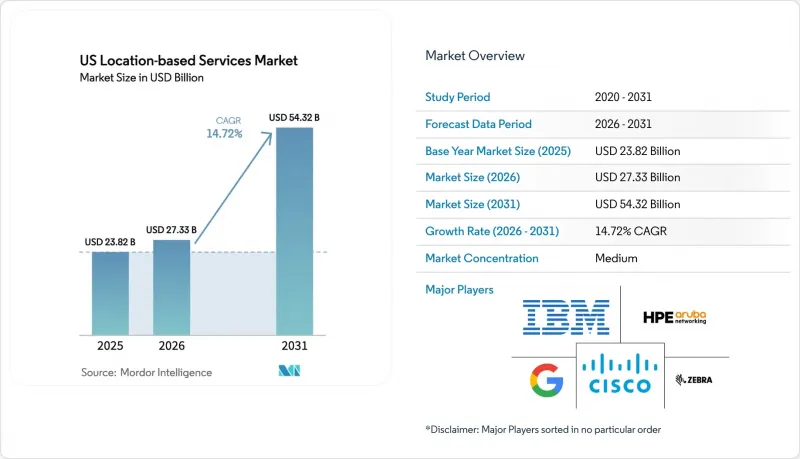
This report Segments the Industry Into by Component (Hardware, Software, and Services), Location (Indoor, and Outdoor), Application (Mapping and Navigation, Business Intelligence and Analytics, Location-Based Advertising, Social Networking and Entertainment, and Other Applications), and by End-User (Transportation and Logistics, IT and Telecom, Healthcare, Government, and More).
US Location-based Services Market Trends and Insights
Smartphone penetration and 5G rollout
Wide-area 5G now provides low-band coverage to more than 300 million Americans and supports sub-meter positioning when paired with advanced multilateration algorithms. Qualcomm's X85 5G Modem-RF integrates an on-chip AI engine that enhances time-of-arrival calculations for location accuracy inside large venues. Fixed-wireless access (FWA) rollouts to 9 million premises show 5G's potential beyond mobility, opening opportunities for geofencing-based home automation and rural asset tracking. Carriers now package "premium positioning" subscriptions; surveys indicate 35% of 5G users will pay extra for enhanced indoor navigation in airports and arenas. These monetization signals underpin long-run revenue confidence for providers in the US location-based services market.
Geo-marketing spend surge
Retailers are pivoting budgets toward proximity-driven campaigns because real-time offers lift in-store conversion rates above demographic-only targeting benchmarks. Cisco Meraki cameras now fuse anonymized WiFi probing with computer vision to segment shoppers by visit frequency and dwell time, feeding that data into dynamic ad platforms. Forty-seven percent of mobile consumers opt in to receive store-triggered coupons when within 100 meters, according to Cisco's 2025 retail analytics survey. AI-powered demand forecasts allow marketers to pre-buy inventory programmatically when foot-traffic spikes are predicted, converting location data from a descriptive to a predictive asset. The outcome is double-digit budget reallocation to location-targeted formats that accelerates revenue for the US location-based services market.
High installation and maintenance cost
Predictive WiFi surveys start at USD 395 but full on-site validation climbs to USD 1,450, and end-to-end enterprise deployments average USD 2,000 for every 10,000 square-feet before hardware . Fiber backhauls adds as much as USD 33,900 for 300-meter digs and takes three to four months to permit and trench. Healthcare installations must pass electromagnetic compatibility tests, raising commissioning budgets and elongate timelines. While Bluetooth low-energy and ultra-wideband can ride existing Ethernet, organizations still face software licensing, security patching, and analytics-platform subscriptions across the life cycle. These cumulative costs stall adoption among mid-tier retailers and community hospitals, tempering near-term growth in the US location-based services market.
Other drivers and restraints analyzed in the detailed report include:
- Demand for real-time asset visibility (RTLS)
- Growth of indoor mapping for retail and venues
- Privacy and data-protection compliance burden
For complete list of drivers and restraints, kindly check the Table Of Contents.
Segment Analysis
Services own 41.32% of 2025 revenues and are forecast to record a 17.12% CAGR because enterprises require end-to-end delivery from RF survey through analytics dashboard. Managed services bundles now incorporate location-based data-quality SLAs, proactive sensor-battery replacement, and quarterly analytics tuning. Simultaneously, hardware demand remains steady for IoT tags, beacons, and multi-band antennas that underpin physical capture layers, while software licenses scale in line with sensor counts and data-analytics workloads. CenTrak's turnkey deployments illustrate why hospitals choose outsourced integration to align RTLS with electronic medical records and nurse-call systems without over-loading internal IT teams . Qualcomm's Aware enterprise platform further blurs the line between hardware and services by offering device-agnostic APIs that still necessitate solution architects for optimal edge-to-cloud configuration.
In contrast, self-build strategies inside retail and manufacturing operations increasingly combine open-source mapping SDKs with off-the-shelf WiFi analytics, but hidden maintenance overhead often negates up-front savings. As a result, the services segment continues to capture the highest margin profile in the US location-based services market.
Outdoor GPS solutions retained 55.47% revenue share in 2025 thanks to the entrenched role of navigation and last-mile delivery in e-commerce logistics. Yet indoor positioning is projected to grow at a 20.46% CAGR as hospitals, airports, and big-box retailers chase sub-meter accuracy for staff workflows and shopper engagement. Silicon Labs' BG22 Bluetooth System-on-Chip enables low-power asset tags that report through dense RF environments typical of medical facilities. Apple's standardized Indoor Maps data model is speeding venue adoption by removing bespoke map-creation steps. This combination of chipset innovation and ecosystem standardization is enlarging the indoor slice of the US location-based services market.
Legacy structures still suffer multipath interference from metallic fixtures, so solution providers deploy AI-assisted calibration routines that auto-tune beacon placement. These advances shrink commissioning windows from weeks to days, helping indoor deployments gain parity with mature outdoor services and setting the stage for future indoor-outdoor handoff use cases that will dominate the US location-based services industry.
Complete Report Scope:
- By Component
- Hardware
- Software
- Services
- By Location Type
- Indoor
- Outdoor
- By Application
- Mapping and Navigation
- Business Intelligence and Analytics
- Location-based Advertising
- Social Networking and Entertainment
- Other Applications
- By End-user Vertical
- Transportation and Logistics
- IT and Telecom
- Healthcare
- Government
- BFSI
- Hospitality
- Manufacturing
- Other End-users
List of Companies Covered in this Report:
- Alphabet Inc. (Google LLC)
- Apple Inc.
- Cisco Systems, Inc.
- International Business Machines Corporation (IBM)
- Microsoft Corporation
- Hewlett-Packard Enterprise Company (Aruba Networks)
- Zebra Technologies Corporation
- Qualcomm Incorporated
- Esri, Inc.
- Maxar Technologies Inc. (DigitalGlobe)
- CenTrak, Inc.
- Foursquare Labs, Inc.
- HERE Global B.V.
- TomTom N.V.
- Mapbox, Inc.
- Trimble Inc.
- Gimbal, Inc.
- Inpixon
- iSpace, Inc.
- CartoDB, Inc.
Additional Benefits:
- The market estimate (ME) sheet in Excel format
- 3 months of analyst support
TABLE OF CONTENTS
1 INTRODUCTION
- 1.1 Study Assumptions and Market Definition
- 1.2 Scope of the Study
2 RESEARCH METHODOLOGY
3 EXECUTIVE SUMMARY
4 MARKET LANDSCAPE
- 4.1 Market Overview
- 4.2 Market Drivers
- 4.2.1 Smartphone penetration and 5G rollout
- 4.2.2 Geo-marketing spend surge
- 4.2.3 Demand for real-time asset visibility (RTLS)
- 4.2.4 Growth of indoor mapping for retail and venues
- 4.2.5 Federal Transit LBS datasets unlocking new use-cases
- 4.2.6 Generative-AI powered spatial analytics
- 4.3 Market Restraints
- 4.3.1 High installation and maintenance cost
- 4.3.2 Privacy and data-protection compliance burden
- 4.3.3 Indoor RF interference in legacy buildings
- 4.3.4 State-level data-sovereignty legislation
- 4.4 Evaluation of Critical Regulatory Framework
- 4.5 Value Chain Analysis
- 4.6 Technological Outlook
- 4.7 Porter's Five Forces
- 4.7.1 Bargaining Power of Suppliers
- 4.7.2 Bargaining Power of Buyers
- 4.7.3 Threat of New Entrants
- 4.7.4 Threat of Substitutes
- 4.7.5 Competitive Rivalry
- 4.8 Key Use Cases and Case Studies
- 4.9 Impact on Macroeconomic Factors of the Market
- 4.10 Investment Analysis
5 MARKET SEGMENTATION
- 5.1 By Component
- 5.1.1 Hardware
- 5.1.2 Software
- 5.1.3 Services
- 5.2 By Location Type
- 5.2.1 Indoor
- 5.2.2 Outdoor
- 5.3 By Application
- 5.3.1 Mapping and Navigation
- 5.3.2 Business Intelligence and Analytics
- 5.3.3 Location-based Advertising
- 5.3.4 Social Networking and Entertainment
- 5.3.5 Other Applications
- 5.4 By End-user Vertical
- 5.4.1 Transportation and Logistics
- 5.4.2 IT and Telecom
- 5.4.3 Healthcare
- 5.4.4 Government
- 5.4.5 BFSI
- 5.4.6 Hospitality
- 5.4.7 Manufacturing
- 5.4.8 Other End-users
6 COMPETITIVE LANDSCAPE
- 6.1 Market Concentration
- 6.2 Strategic Moves
- 6.3 Market Share Analysis
- 6.4 Company Profiles {(includes Global level Overview, Market level overview, Core Segments, Financials as available, Strategic Information, Market Rank/Share for key companies, Products and Services, and Recent Developments)}
- 6.4.1 Alphabet Inc. (Google LLC)
- 6.4.2 Apple Inc.
- 6.4.3 Cisco Systems, Inc.
- 6.4.4 International Business Machines Corporation (IBM)
- 6.4.5 Microsoft Corporation
- 6.4.6 Hewlett-Packard Enterprise Company (Aruba Networks)
- 6.4.7 Zebra Technologies Corporation
- 6.4.8 Qualcomm Incorporated
- 6.4.9 Esri, Inc.
- 6.4.10 Maxar Technologies Inc. (DigitalGlobe)
- 6.4.11 CenTrak, Inc.
- 6.4.12 Foursquare Labs, Inc.
- 6.4.13 HERE Global B.V.
- 6.4.14 TomTom N.V.
- 6.4.15 Mapbox, Inc.
- 6.4.16 Trimble Inc.
- 6.4.17 Gimbal, Inc.
- 6.4.18 Inpixon
- 6.4.19 iSpace, Inc.
- 6.4.20 CartoDB, Inc.
7 MARKET OPPORTUNITIES AND FUTURE OUTLOOK
- 7.1 White-space and Unmet-Need Assessment

