PUBLISHER: Global Market Insights Inc. | PRODUCT CODE: 2109303

PUBLISHER: Global Market Insights Inc. | PRODUCT CODE: 2109303
Hydropower Turbine Replacement Market Opportunity, Growth Drivers, Industry Trend Analysis, and Forecast 2026 - 2035
The Global Hydropower Turbine Replacement Market was valued at USD 5.2 billion in 2025 and is estimated to grow at a CAGR of 6.9% to reach USD 10.1 billion by 2035.
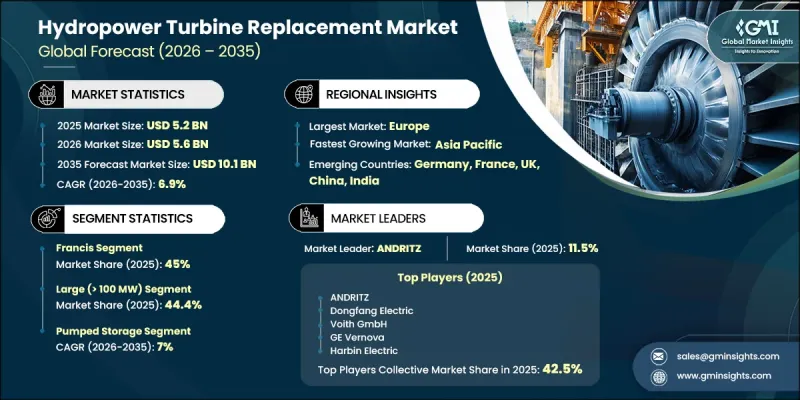
The market assessment is based on a comprehensive bottom-up evaluation of turbine replacement projects and investment activity across more than 30 countries, supported by analysis of hydropower capacity expansion, refurbishment programs, utility procurement patterns, and company revenue performance. Rising investments in upgrading aging hydroelectric infrastructure are driving demand for modern turbine replacement solutions that improve operational efficiency, enhance system reliability, and increase generation flexibility. Utilities are increasingly replacing obsolete turbine equipment with advanced technologies designed to maximize energy output, extend plant operating life, and support compliance with evolving environmental standards. The hydropower turbine replacement market encompasses equipment supply, engineering, installation, commissioning, and modernization services associated with replacing outdated or inefficient turbines with higher-performance alternatives. Growing electricity consumption, combined with increasing demand for dependable renewable energy generation, continues to encourage power producers to modernize existing hydropower assets, creating sustained growth opportunities for the global hydropower turbine replacement market throughout the forecast period.
| Market Scope | |
|---|---|
| Start Year | 2025 |
| Forecast Year | 2026-2035 |
| Start Value | $5.2 Billion |
| Forecast Value | $10.1 Billion |
| CAGR | 6.9% |
The Francis turbine segment accounted for a 45% share in 2025 and is anticipated to register a CAGR of 6.5% through 2035. Increasing modernization of medium- and high-head hydroelectric facilities is supporting demand for advanced Francis turbine technologies that improve operational efficiency, increase power generation, reduce maintenance requirements, and extend equipment service life while maximizing the value of existing hydropower infrastructure. Continued investment in hydropower refurbishment projects and rising renewable energy development costs are further supporting growth within this segment.
The medium-capacity segment was valued at USD 2 billion in 2025. The segment continues to experience stable growth as plant operators replace aging turbine systems with modern technologies that deliver higher efficiency, improved operational reliability, lower maintenance requirements, and longer equipment life cycles while enhancing the overall performance of existing hydroelectric assets.
North America Hydropower Turbine Replacement Market held a 76% share, generating USD 563.8 million in 2025. Ongoing modernization initiatives, increasing investments in hydropower asset upgrades, and evolving environmental compliance requirements continue to accelerate turbine replacement projects across the country, strengthening long-term market demand for advanced replacement technologies.
Key players operating in the global hydropower turbine replacement market include ANDRITZ, ALSTOM, Bharat Heavy Electricals Limited, Canadian Hydro Components, Canyon Hydro, Dongfang Electric, GE Vernova, Gilbert Gilkes & Gordon Ltd., Global Hydro, Harbin Electric Machinery Company, Hitachi Energy, HNAC Technology Co., IMPSA, INTPOW, LITOSTROJ POWER, Mavel, MITSUBISHI HEAVY INDUSTRIES, LTD., Natel Energy, Scotta, Toshiba Corporation, Voith GmbH & Co. KGaA, and WWS Wasserkraft. Companies operating in the hydropower turbine replacement market are strengthening their competitive position by investing in advanced turbine technologies, expanding modernization capabilities, and delivering comprehensive refurbishment solutions for aging hydroelectric facilities. Manufacturers are prioritizing research and development to improve turbine efficiency, operational reliability, environmental performance, and equipment lifespan. Strategic partnerships with utilities, engineering firms, and project developers are helping companies secure long-term contracts and expand their market reach. Businesses are also enhancing engineering expertise, digital monitoring capabilities, and lifecycle maintenance services to provide greater value throughout project execution.
Table of Contents
Chapter 1 Methodology & Scope
- 1.1 Research approach
- 1.2 Quality commitments
- 1.2.1 GMI AI policy & data integrity commitment
- 1.2.1.1 Source consistency protocol
- 1.2.1 GMI AI policy & data integrity commitment
- 1.3 Research trail & confidence scoring
- 1.3.1 Research trail components
- 1.3.2 Scoring components
- 1.4 Data collection
- 1.4.1 Partial list of primary sources
- 1.5 Data mining sources
- 1.5.1 Paid sources
- 1.5.1.1 Sources, by region
- 1.5.1 Paid sources
- 1.6 Base estimates and calculations
- 1.6.1 Base year calculation for any one approach
- 1.7 Market estimates & forecasts parameters
- 1.8 Forecast model
- 1.8.1 Quantified market impact analysis
- 1.8.1.1 Mathematical impact of growth parameters on forecast
- 1.8.1 Quantified market impact analysis
- 1.9 Research transparency addendum
- 1.9.1 Source attribution framework
- 1.9.2 Quality assurance metrics
- 1.9.3 Our commitment to trust
- 1.10 Market definitions
Chapter 2 Executive Summary
- 2.1 Industry synopsis, 2022 - 2035
- 2.1.1 Business trends
- 2.1.2 Turbine trends
- 2.1.3 Replacement trends
- 2.1.4 Capacity trends
- 2.1.5 Plant trends
- 2.1.6 Regional trends
Chapter 3 Industry Insights
- 3.1 Industry ecosystem analysis
- 3.1.1 Raw material availability & sourcing analysis
- 3.1.2 Manufacturing capacity assessment
- 3.1.3 Supply chain resilience & risk factors
- 3.1.4 Distribution network analysis
- 3.2 Industry impact forces
- 3.2.1 Growth drivers
- 3.2.2 Industry pitfalls & challenges
- 3.3 Regulatory landscape
- 3.4 Growth potential analysis
- 3.5 Porter's analysis
- 3.5.1 Bargaining power of suppliers
- 3.5.2 Bargaining power of buyers
- 3.5.3 Threat of new entrants
- 3.5.4 Threat of substitutes
- 3.6 PESTEL analysis
- 3.6.1 Political factors
- 3.6.2 Economic factors
- 3.6.3 Social factors
- 3.6.4 Technological factors
- 3.6.5 Legal factors
- 3.6.6 Environmental factors
- 3.7 Cost structure analysis of hydropower turbine replacement
- 3.8 Emerging opportunities in hydropower modernization & turbine replacement
- 3.9 Digitalization, smart monitoring & predictive maintenance in turbine replacement
- 3.10 Growth opportunities across aging hydropower assets & emerging regions
- 3.11 Investment trends & future outlook for hydropower turbine replacement projects
- 3.12 Impact of AI & Generative AI on the market (Driven by Primary Research)
- 3.12.1 AI-Driven production optimization (Driven by Primary Research)
- 3.12.2 Predictive maintenance & fault detection (Driven by Primary Research)
Chapter 4 Competitive Landscape, 2026
- 4.1 Introduction
- 4.2 Company market share analysis, by region, 2025
- 4.2.1 North America
- 4.2.2 Europe
- 4.2.3 Asia Pacific
- 4.2.4 Middle East & Africa
- 4.2.5 Latin America
- 4.3 Competitive analysis of major market players
- 4.4 Competitive positioning matrix
- 4.5 Key developments
- 4.5.1 Mergers & acquisitions
- 4.5.2 Partnerships & collaborations
- 4.5.3 New product launches
- 4.5.4 Expansion plans & funding
- 4.6 Company tier benchmarking
- 4.6.1 Tier classification criteria & qualifying thresholds
- 4.6.2 Tier positioning matrix by revenue, geography & innovation
Chapter 5 Market Size and Forecast, By Turbine, 2022 - 2035 (USD Million)
- 5.1 Key trends
- 5.2 Francis
- 5.3 Kaplan
- 5.4 Pelton
- 5.5 Bulb
- 5.6 Others
Chapter 6 Market Size and Forecast, By Replacement, 2022 - 2035 (USD Million)
- 6.1 Key trends
- 6.2 Complete
- 6.3 Partial
- 6.4 Component
Chapter 7 Market Size and Forecast, By Capacity, 2022 - 2035 (USD Million)
- 7.1 Key trends
- 7.2 Small (≤ 10 MW)
- 7.3 Medium (> 10 - 100 MW)
- 7.4 Large (> 100 MW)
Chapter 8 Market Size and Forecast, By Plant, 2022 - 2035 (USD Million)
- 8.1 Key trends
- 8.2 Run-of-river
- 8.3 Reservoir
- 8.4 Pumped storage
Chapter 9 Market Size and Forecast, By Region, 2022 - 2035 (USD Million)
- 9.1 Key trends
- 9.2 North America
- 9.2.1 U.S.
- 9.2.2 Canada
- 9.2.3 Mexico
- 9.3 Europe
- 9.3.1 Germany
- 9.3.2 France
- 9.3.3 UK
- 9.3.4 Italy
- 9.3.5 Spain
- 9.3.6 Norway
- 9.3.7 Sweden
- 9.3.8 Switzerland
- 9.3.9 Austria
- 9.4 Asia Pacific
- 9.4.1 China
- 9.4.2 India
- 9.4.3 Japan
- 9.4.4 Australia
- 9.4.5 South Korea
- 9.4.6 Vietnam
- 9.4.7 Indonesia
- 9.4.8 Malaysia
- 9.4.9 Philippines
- 9.4.10 New Zealand
- 9.5 Middle East & Africa
- 9.5.1 Saudi Arabia
- 9.5.2 UAE
- 9.5.3 South Africa
- 9.5.4 Egypt
- 9.5.5 Turkey
- 9.5.6 Ghana
- 9.5.7 Morocco
- 9.5.8 Kenya
- 9.6 Latin America
- 9.6.1 Brazil
- 9.6.2 Chile
- 9.6.3 Argentina
- 9.6.4 Peru
Chapter 10 Company Profiles
- 10.1 ANDRITZ
- 10.2 ALSTOM
- 10.3 Bharat Heavy Electricals Limited
- 10.4 Canadian Hydro Components
- 10.5 Canyon Hydro
- 10.6 Dongfang Electric
- 10.7 GE Vernova
- 10.8 Gilbert Gilkes & Gordon Ltd.
- 10.9 Global Hydro
- 10.10 Harbin Electric Machinery Company
- 10.11 Hitachi Energy
- 10.12 HNAC Technology Co.
- 10.13 IMPSA
- 10.14 INTPOW
- 10.15 LITOSTROJ POWER
- 10.16 Mavel
- 10.17 MITSUBISHI HEAVY INDUSTRIES, LTD.
- 10.18 Natel Energy
- 10.19 Scotta
- 10.20 Toshiba Corporation
- 10.21 Voith GmbH & Co. KGaA
- 10.22 WWS Wasserkraft

