PUBLISHER: Mordor Intelligence | PRODUCT CODE: 2113397

PUBLISHER: Mordor Intelligence | PRODUCT CODE: 2113397
Europe Hydro Turbine - Market Share Analysis, Industry Trends & Statistics, Growth Forecasts (2026 - 2031)
According to Mordor Intelligence, the Europe hydro turbine market size was valued at USD 755.79 million in 2025 and is estimated to grow from USD 767.20 million in 2026 to reach USD 837.13 million by 2031, at a CAGR of 1.76% during the forecast period (2026-2031).
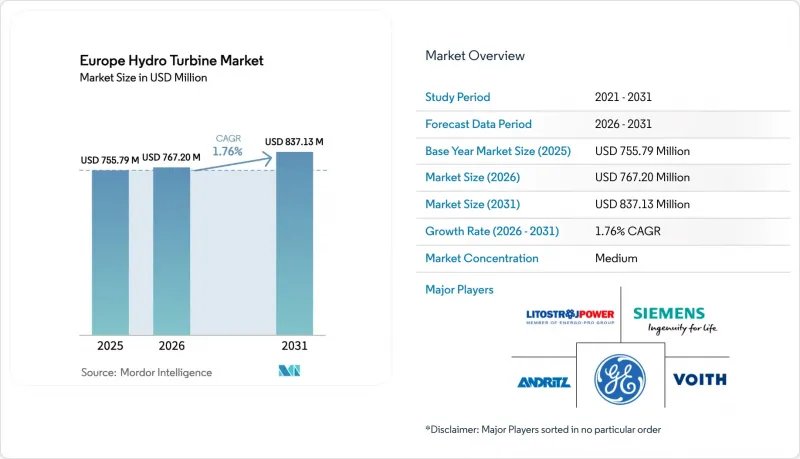
This report is Segmented by Technology (Reaction Turbines and Impulse Turbines), Capacity (Large Hydro, Medium Hydro, and Small and Micro Hydro), Installation Type (New Build and Refurbishment/Modernisation), Component (Runner and Blades, Draft Tube and Mechanical Parts, Generator, Control and Digital Systems, and Others), and Geography (Germany, United Kingdom, France, Italy, NORDIC Countries, and More).
Europe Hydro Turbine Market Trends and Insights
EU Green Deal Targets Accelerating Refurbishment & Greenfield Capacity
The REPowerEU plan, updated in 2024, mandates 42.5% renewable energy in final consumption by 2030 and explicitly highlights hydropower for flexibility services. Grid-infrastructure spending of EUR 584 billion through 2030 is channeling funds toward pumped-storage interconnections and turbine replacements that strengthen frequency response. Refurbishment enjoys preferential treatment under the EU Taxonomy, provided projects meet ecological-flow standards. Greece's 680 MW Amfilochia scheme, approved in 2024, and Austria's 150 MW Ebensee modernization showcase how recovery funds are fast-tracking lifecycle extensions. Variable-speed upgrades at Ebensee now deliver full-load-to-reserve transitions in under 90 seconds, a service currently priced at EUR 15 to EUR 20 per MWh in ancillary-service auctions. As these policy levers mature, the European hydro turbine market will see a sustained flow of refurbishment contracts across core EU economies.
Retirement of Thermal Plants Creating Demand for Pumped-Storage Stability
Coal and nuclear shutdowns removed 12 GW of synchronous capacity across Germany, the UK, Belgium, and Spain between 2024 and 2025. Pumped-storage hydropower, with 46 GW already installed, is the only proven technology capable of delivering multi-hour discharge without cycle-life degradation. The UK's 600 MW Cruachan 2 and Spain's 200 MW Salto de Chira schemes underscore renewed investor appetite. Portugal's 1,158 MW Tamega complex, commissioned in 2024, already provides 40% of national balancing reserves. As utilities chase grid-stability revenue, the European hydro turbine market gains a dependable growth avenue anchored in long-duration storage.
Lengthy Environmental Impact Assessments and Permitting
Full EIAs for greenfield dams can stretch five to seven years, especially where projects intersect Natura 2000 zones or trigger Espoo Convention consultations. Austria's proposed 900 MW Kuhtai expansion has been in litigation since 2021, illustrating how biodiversity challenges stall investments. Switzerland's revised Water Protection Act now demands net-positive biodiversity outcomes, steering funds toward refurbishments that qualify for expedited 18- to 24-month reviews. Although refurbishment enjoys shorter timelines, public consultations on downstream flow regimes can still delay schedules.
Other drivers and restraints analyzed in the detailed report include:
- Carbon Pricing & Green Finance Improving Hydro ROI
- Fish-Friendly Turbine Designs Easing Biodiversity Approvals
- Price Competitiveness of Utility-Scale Solar + Battery Storage
For complete list of drivers and restraints, kindly check the Table Of Contents.
Segment Analysis
Reaction designs accounted for 74.9% of the European hydro turbine market in 2025, supported by variable-speed generators that unlock higher ancillary revenue. This segment is projected to expand at a 1.99% CAGR, assuring a stable anchor for the European hydro turbine market size through 2031. Impulse turbines, led by Pelton wheels in high-head Alpine projects, are regaining momentum as melting-glacier inflows shift seasonal profiles. Suppliers report that 30% of 2024-2025 Francis orders already include full-converter drives, a sharp rise from 10% in 2020, underlining how digital upgrades are redefining performance baselines.
Variable-speed controls allow operators to fine-tune efficiency across fluctuating heads, double participation in frequency-response markets, and extend maintenance intervals. Kaplan variants now integrate fish-friendly blades that reduce blade-strike mortality below 5%, easing Natura 2000 compliance. Turgo turbines are penetrating sub-5 MW community projects where their compact footprint and sediment tolerance offer economic advantages. As grid operators valorize rapid ramping and inertia services, reaction technology remains the backbone of the European hydro turbine market, yet niche impulse units will outpace average growth from a smaller base.
Installations above 100 MW retained 50.1% of 2025 revenue, but sub-10 MW assets are forecast to expand at a 3.33% CAGR, outpacing legacy giants by nearly two-to-one. Revised EU rules waive full EIAs for projects below 10 MW, slashing soft costs and accelerating build cycles. Community cooperatives in Germany, Austria, and Switzerland raised EUR 180 million between 2024 and 2025 to back run-of-river ventures that repay in under 12 years, a trend that anchors the grassroots tier of the European hydro turbine market.
Modular turbine-generator skids now ship factory-tested, reducing on-site works from 18 months to 6 months and de-risking loans. Medium facilities from 10 MW to 100 MW are thriving on refurbishment contracts that pair existing dams with lower-reservoir additions for hybrid storage. Large projects such as Scotland's 1,500 MW Coire Glas remain rare but critical, adding 30 GWh of storage to smooth offshore-wind swings. In aggregate, scale diversity ensures the European hydro turbine market continues growing even as prime large-dam sites vanish.
Complete Report Scope:
- By Technology
- Reaction Turbines
- Impulse Turbines
- By Capacity
- Large Hydro (Above 100 MW)
- Medium Hydro (10 to 100 MW)
- Small and Micro Hydro (Below 10 MW)
- By Installation Type
- New Build
- Refurbishment/Modernisation
- By Component
- Runner and Blades
- Draft Tube and Mechanical Parts
- Generator
- Control & Digital Systems
- Others
- By Geography
- Germany
- United Kingdom
- France
- Italy
- Spain
- NORDIC Countries
- Russia
- Rest of Europe
List of Companies Covered in this Report:
- Andritz AG
- Voith GmbH & Co. KGaA
- General Electric Co. (GE Vernova)
- Siemens Energy AG
- Litostroj Power Group
- Toshiba Energy Systems
- Alstom Hydro France
- Rainpower (SnPower)
- Canadian Hydro Components
- Norcan Hydraulic Turbine
- Gilkes & Co.
- Kirloskar Brothers
- IMPSA
- Harbin Electric Machinery
- BHEL
- CJ Turbines
- Hidrostal AG
- Voith Hydro Ocean Current
- Global Hydro Energy
- Energy Namibia Hydro
Additional Benefits:
- The market estimate (ME) sheet in Excel format
- 3 months of analyst support
TABLE OF CONTENTS
1 Introduction
- 1.1 Scope of the Study
- 1.2 Study Assumptions & Market Definition
2 Research Methodology
3 Executive Summary
4 Market Landscape
- 4.1 Market Overview
- 4.2 Market Drivers
- 4.2.1 EU Green Deal targets accelerating refurbishment & greenfield capacity
- 4.2.2 Retirement of thermal plants -> demand for pumped-storage stability
- 4.2.3 Carbon pricing & green finance improving hydro ROI
- 4.2.4 Fish-friendly turbine designs easing biodiversity approvals
- 4.2.5 Digital-twin O&M lowering OPEX for small utilities
- 4.2.6 Corporate renewable PPAs from data-center operators
- 4.3 Market Restraints
- 4.3.1 Lengthy Environmental Impact Assessments (EIA) and permitting
- 4.3.2 Price competitiveness of utility-scale solar + battery storage
- 4.3.3 Litigation against Alpine dam expansions
- 4.3.4 Specialty-steel supply shocks raising CAPEX volatility
- 4.4 Supply-Chain Analysis
- 4.5 Regulatory Landscape (EU Water Framework, taxonomy, etc.)
- 4.6 Technological Outlook (variable-speed, additive manufacturing)
- 4.7 Porter's Five Forces
- 4.7.1 Bargaining Power of Suppliers
- 4.7.2 Bargaining Power of Buyers
- 4.7.3 Threat of New Entrants
- 4.7.4 Threat of Substitutes
- 4.7.5 Intensity of Competitive Rivalry
5 Market Size & Growth Forecasts
- 5.1 By Technology
- 5.1.1 Reaction Turbines
- 5.1.2 Impulse Turbines
- 5.2 By Capacity
- 5.2.1 Large Hydro (Above 100 MW)
- 5.2.2 Medium Hydro (10 to 100 MW)
- 5.2.3 Small and Micro Hydro (Below 10 MW)
- 5.3 By Installation Type
- 5.3.1 New Build
- 5.3.2 Refurbishment/Modernisation
- 5.4 By Component
- 5.4.1 Runner and Blades
- 5.4.2 Draft Tube and Mechanical Parts
- 5.4.3 Generator
- 5.4.4 Control & Digital Systems
- 5.4.5 Others
- 5.5 By Geography
- 5.5.1 Germany
- 5.5.2 United Kingdom
- 5.5.3 France
- 5.5.4 Italy
- 5.5.5 Spain
- 5.5.6 NORDIC Countries
- 5.5.7 Russia
- 5.5.8 Rest of Europe
6 Competitive Landscape
- 6.1 Market Concentration
- 6.2 Strategic Moves (M&A, Partnerships, PPAs)
- 6.3 Market Share Analysis (Market Rank/Share for key companies)
- 6.4 Company Profiles (includes Global level Overview, Market level overview, Core Segments, Financials as available, Strategic Information, Products & Services, and Recent Developments)
- 6.4.1 Andritz AG
- 6.4.2 Voith GmbH & Co. KGaA
- 6.4.3 General Electric Co. (GE Vernova)
- 6.4.4 Siemens Energy AG
- 6.4.5 Litostroj Power Group
- 6.4.6 Toshiba Energy Systems
- 6.4.7 Alstom Hydro France
- 6.4.8 Rainpower (SnPower)
- 6.4.9 Canadian Hydro Components
- 6.4.10 Norcan Hydraulic Turbine
- 6.4.11 Gilkes & Co.
- 6.4.12 Kirloskar Brothers
- 6.4.13 IMPSA
- 6.4.14 Harbin Electric Machinery
- 6.4.15 BHEL
- 6.4.16 CJ Turbines
- 6.4.17 Hidrostal AG
- 6.4.18 Voith Hydro Ocean Current
- 6.4.19 Global Hydro Energy
- 6.4.20 Energy Namibia Hydro
7 Market Opportunities & Future Outlook
- 7.1 White-space & Unmet-Need Assessment

