PUBLISHER: Global Market Insights Inc. | PRODUCT CODE: 2109318

PUBLISHER: Global Market Insights Inc. | PRODUCT CODE: 2109318
Disposable Tableware Market Opportunity, Growth Drivers, Industry Trend Analysis, and Forecast 2026 - 2035
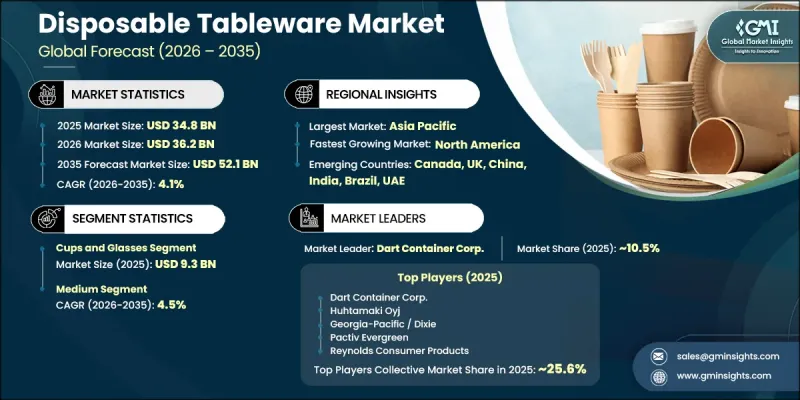
The Global Disposable Tableware Market was valued at USD 34.8 billion in 2025 and is estimated to grow at a CAGR of 4.1% to reach USD 52.1 billion by 2035.
Market expansion is influenced by the rapid growth of online food ordering services, increasing regulatory efforts promoting sustainable material adoption, and stronger hygiene requirements across commercial and institutional environments. The wider adoption of delivery-based food models and cloud kitchen operations is creating a consistent requirement for disposable tableware solutions across multiple end-use channels. Foodservice providers, quick-service restaurants, and convenience-focused delivery platforms are increasingly seeking reliable packaging products such as secure beverage containers, functional meal packaging, and ready-to-use cutlery solutions that support safe handling and transportation. At the same time, restrictions on conventional single-use plastic products are encouraging manufacturers and buyers to transition toward recyclable, compostable, and biodegradable alternatives, reshaping product development strategies throughout the disposable tableware value chain.
| Market Scope | |
|---|---|
| Start Year | 2025 |
| Forecast Year | 2026-2035 |
| Start Value | $34.8 Billion |
| Forecast Value | $52.1 Billion |
| CAGR | 4.1% |
The cups and glasses segment generated USD 9.3 billion in 2025. Growth within this category is primarily supported by consistent demand from beverage service operations, food delivery businesses, and institutional beverage consumption programs. The segment continues to benefit from established product offerings from major manufacturers, including Dart Container Corporation's SOLO cup portfolio and Huhtamaki Oyj's HotCup and TriWall solutions, which maintain strong adoption across foodservice and retail applications.
The medium-priced category accounted for 41.4% share in 2025. This segment is gaining traction as foodservice operators and dining businesses increasingly move beyond basic low-cost products while seeking a balance between affordability, performance, and sustainability requirements. Although economy-priced products are gradually losing market share, they continue to generate substantial demand in large-volume institutional applications where cost efficiency remains a primary purchasing factor and waste management capabilities are still developing.
North America Disposable Tableware Market generated USD 9.1 billion in 2025. The region's market growth is supported by increasing attention toward sustainable packaging practices, evolving regulations related to single-use products, and continued demand from foodservice establishments. Growing initiatives focused on improving waste management systems and encouraging environmentally responsible packaging solutions are further influencing procurement decisions across the region.
Major players operating in the global disposable tableware industry are Berry Global Inc., Sabert Corporation, Dart Container Corporation, Huhtamaki Oyj, Duni AB, Pactiv Evergreen Inc., Novolex Holdings / Eco-Products, Georgia-Pacific LLC - Dixie Brand, Reynolds Consumer Products - Hefty Brand, Vegware Ltd., DOPla S.p.A., Hotpack Global, CKF Inc., BioPak Pty Ltd, World Centric, Karat Packaging Inc. - Karat Earth, Fuling Technology Co., and Ecoware India. Companies operating in the disposable tableware market are focusing on product innovation, sustainable material development, strategic partnerships, and expansion of manufacturing capabilities to strengthen their competitive positions. Key players are investing in recyclable and compostable product portfolios to align with changing environmental regulations and customer preferences. Manufacturers are also improving production efficiency through advanced technologies to reduce costs while maintaining product quality. Expanding distribution networks, entering emerging markets, and developing customized solutions for foodservice operators are additional strategies being adopted to increase market reach. Companies are emphasizing brand differentiation through eco-friendly certifications, improved packaging performance, and solutions designed for evolving food delivery trends.
Table of Contents
Chapter 1 Methodology & Scope
- 1.1 Market scope and definition
- 1.2 Research design
- 1.2.1 Research approach
- 1.2.2 Data collection methods
- 1.3 Data mining sources
- 1.3.1 Global
- 1.3.2 Regional/Country
- 1.4 Base estimates and calculations
- 1.4.1 Base year calculation
- 1.4.2 Key trends for market estimation
- 1.5 Primary research and validation
- 1.5.1 Primary sources
- 1.6 Forecast model
- 1.7 Research assumptions and limitations
Chapter 2 Executive Summary
- 2.1 Industry 360° synopsis
- 2.2 Key market trends
- 2.2.1 Regional
- 2.2.2 Product type
- 2.2.3 Material type
- 2.2.4 Price
- 2.2.5 Application/end-user
- 2.2.6 Distribution channel
Chapter 3 Industry Insights
- 3.1 Industry ecosystem analysis
- 3.1.1 Supplier landscape
- 3.1.2 Profit margin
- 3.1.3 Value addition at each stage
- 3.1.4 Factor affecting the value chain
- 3.2 Industry impact forces
- 3.2.1 Growth drivers
- 3.2.1.1 Rapid expansion of food delivery, QSR & quick-commerce platforms
- 3.2.1.2 Global regulatory push accelerating shift to biodegradable alternatives
- 3.2.1.3 Urbanization & evolving food consumption habits in emerging economies
- 3.2.1.4 Rising demand for hygienic single-use products across institutional & healthcare sectors
- 3.2.2 Industry pitfalls & challenges
- 3.2.2.1 Regulatory fragmentation across jurisdictions creating compliance complexity
- 3.2.2.2 Raw material price volatility
- 3.2.2.3 Consumer greenwashing scrutiny & certification credibility challenges
- 3.2.3 Opportunities
- 3.2.3.1 Material innovation in next-gen biodegradables
- 3.2.3.2 Premiumization in upscale foodservice, hospitality & branded event catering
- 3.2.3.3 E-commerce & direct B2B supply channel growth for institutional bulk procurement
- 3.2.1 Growth drivers
- 3.3 Growth potential analysis
- 3.4 Future market trends
- 3.5 Technology and innovation landscape
- 3.5.1 Current technological trends
- 3.5.2 Emerging technologies
- 3.6 Regulatory landscape
- 3.6.1 Standards and compliance requirements
- 3.6.2 Regional regulatory frameworks
- 3.6.3 Certification standards
- 3.7 Trade data analysis (HS Code 3924.10)
- 3.7.1 Import/export volume & value trends
- 3.7.2 Key trade corridors & tariff impact
- 3.8 Pricing analysis
- 3.8.1 Historical price trend analysis (driven by primary research)
- 3.8.2 Pricing strategy by player type (premium / value / mass market)
- 3.9 Impact of AI & generative AI on the market
- 3.9.1 AI-driven disruption of existing business models
- 3.9.2 GenAI use cases & adoption roadmap by segment
- 3.9.3 Risks, limitations & regulatory considerations
- 3.10 Porter's analysis
- 3.11 PESTEL analysis
Chapter 4 Competitive Landscape, 2025
- 4.1 Introduction
- 4.2 Company market share analysis
- 4.2.1 By Region
- 4.2.1.1 North America
- 4.2.1.2 Europe
- 4.2.1.3 Asia Pacific
- 4.2.1.4 Latin America
- 4.2.1.5 Middle East & Africa
- 4.2.1 By Region
- 4.3 Company matrix analysis
- 4.4 Competitive analysis of major market players
- 4.5 Competitive positioning matrix
- 4.6 Key developments
- 4.6.1 Mergers & acquisitions
- 4.6.2 Partnerships & collaborations
- 4.6.3 New product launches
- 4.6.4 Expansion plans
Chapter 5 Market Estimates & Forecast, By Product Type, 2022 - 2035, (USD Billion) (Million Units)
- 5.1 Key trends
- 5.2 Plates & dishes
- 5.3 Cups & glasses
- 5.4 Bowls
- 5.5 Cutlery & silverware
- 5.6 Trays & containers
- 5.7 Napkins & table covers
- 5.8 Others (straws, stirrers, skewers, serving accessories)
Chapter 6 Market Estimates & Forecast, By Material Type, 2022 - 2035, (USD Billion) (Million Units)
- 6.1 Key trends
- 6.2 Plastic
- 6.3 Paper & paperboard
- 6.4 Biodegradable & compostable
- 6.5 Aluminum & foil
- 6.6 Foam (EPS/EPE)
Chapter 7 Market Estimates & Forecast, By Price, 2022 - 2035, (USD Billion) (Million Units)
- 7.1 Key trends
- 7.2 Low
- 7.3 Medium
- 7.4 High
Chapter 8 Market Estimates & Forecast, By Application/End-User, 2022 - 2035, (USD Billion) (Million Units)
- 8.1 Key trends
- 8.2 Food service
- 8.2.1 Quick service restaurants (QSR) & fast food chains
- 8.2.2 Full service restaurants & cafes
- 8.2.3 Food trucks & street food vendors
- 8.2.4 Cloud kitchens & food delivery platforms
- 8.3 Catering & events
- 8.3.1 Corporate & business event catering
- 8.3.2 Social & wedding catering
- 8.3.3 Outdoor festivals, sports events & concerts
- 8.4 Residential/household
- 8.4.1 Everyday convenience
- 8.4.2 Home parties & gatherings
- 8.4.3 Outdoor, camping & leisure
- 8.5 Institutional
- 8.5.1 Healthcare (hospitals, clinics, care homes)
- 8.5.2 Educational institutions (schools, universities)
- 8.5.3 Corporate cafeterias & office facilities
- 8.6 Hospitality & travel
- 8.6.1 Hotels & resorts
- 8.6.2 Airlines
- 8.6.3 Cruise lines & railways
Chapter 9 Market Estimates & Forecast, By Distribution Channel, 2022 - 2035, (USD Billion) (Million Units)
- 9.1 Key trends
- 9.2 Online
- 9.2.1 E-Commerce website
- 9.2.2 Company Website
- 9.3 Offline
- 9.3.1 Specialty stores
- 9.3.2 Mega retail stores
- 9.3.3 Others
Chapter 10 Market Estimates & Forecast, By Region, 2022 - 2035, (USD Billion) (Million Units)
- 10.1 Key trends
- 10.2 North America
- 10.2.1 U.S.
- 10.2.2 Canada
- 10.3 Europe
- 10.3.1 Germany
- 10.3.2 UK
- 10.3.3 France
- 10.3.4 Italy
- 10.3.5 Spain
- 10.4 Asia Pacific
- 10.4.1 China
- 10.4.2 India
- 10.4.3 Japan
- 10.4.4 South Korea
- 10.4.5 Australia
- 10.4.6 Indonesia
- 10.4.7 Malaysia
- 10.5 Latin America
- 10.5.1 Brazil
- 10.5.2 Mexico
- 10.5.3 Argentina
- 10.6 MEA
- 10.6.1 Saudi Arabia
- 10.6.2 UAE
- 10.6.3 South Africa
Chapter 11 Company Profiles
- 11.1 Top Global Players
- 11.1.1 Dart Container Corporation
- 11.1.2 Huhtamaki Oyj
- 11.1.3 Pactiv Evergreen Inc.
- 11.1.4 Novolex Holdings / Eco-Products
- 11.1.5 Georgia-Pacific LLC
- 11.1.6 Berry Global Inc.
- 11.1.7 Reynolds Consumer Products
- 11.2 Regional Champions
- 11.2.1 Duni AB
- 11.2.2 Sabert Corporation
- 11.2.3 Vegware Ltd.
- 11.2.4 DOPla S.p.A.
- 11.2.5 Hotpack Global
- 11.2.6 CKF Inc.
- 11.3 Emerging Players
- 11.3.1 BioPak Pty Ltd
- 11.3.2 World Centric
- 11.3.3 Karat Packaging Inc. - Karat Earth
- 11.3.4 Fuling Technology Co.
- 11.3.5 Ecoware India

