PUBLISHER: Mordor Intelligence | PRODUCT CODE: 2124778

PUBLISHER: Mordor Intelligence | PRODUCT CODE: 2124778
Italy Disposable Tableware - Market Share Analysis, Industry Trends & Statistics, Growth Forecasts (2026 - 2031)
According to Mordor Intelligence, the Italy disposable tableware market size was valued at USD 18.12 billion in 2025 and estimated to grow from USD 19.24 billion in 2026 to reach USD 25.96 billion by 2031, at a CAGR of 6.18% during the forecast period (2026-2031).
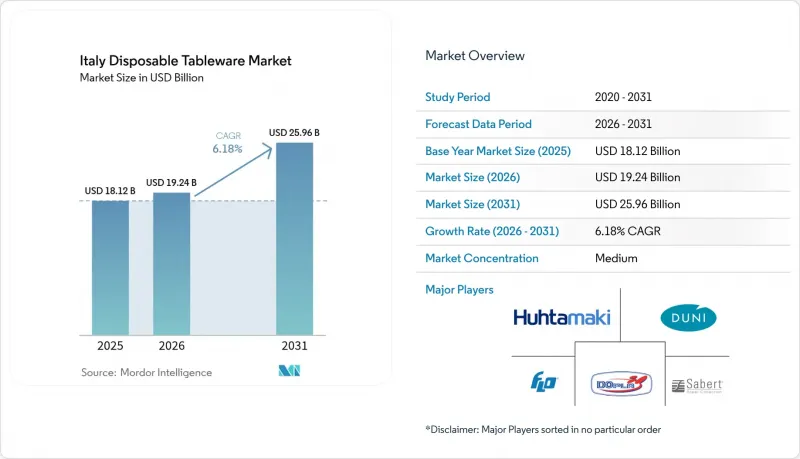
This report Segments the Industry Into by Product Type (Disposable Cups, Disposable Plates, Disposable Bowls, Disposable Silverware, and Other), by Application (Residential, Commercial), by Distribution Channel (Hypermarkets and Supermarkets, Convenience Stores, Online, Other Distribution Channels), by Geography (Northwest Italy, and Other). The Market Forecasts are Provided in Terms of Value (USD).
Italy Disposable Tableware Market Trends and Insights
EU Single-Use Plastics Directive Enforcement Accelerates Material Transition
Italy's transposition of the EU Single-Use Plastics Directive bans expanded polystyrene food containers and widens producer responsibility, making virgin plastics uneconomic relative to compostable substrates. Simultaneous application of the MACSI tax tightens margins for legacy resin users, pushing distributors and foodservice chains toward PLA, bagasse, and paper-pulp options. Domestic biopolymer leader Novamont reported double-digit order growth for Mater-Bi compounds in 2025, evidencing early-mover advantage. Northern municipalities supervise enforcement more strictly, creating a geographic pull for compliant inventory. Firms investing ahead of the curve secure shelf space and lock in price premiums, whereas laggards encounter immediate share erosion.
Post-COVID Surge in Outdoor Catering and Food Delivery Transforms Consumption Patterns
The persistence of restaurant terraces, kiosks, and delivery formats, initially implemented to comply with distancing mandates, highlights a significant shift in consumer preferences even after the removal of restrictions. FIPE reported a notable increase in take-away concepts between 2024 and 2025, reflecting the growing demand for convenient dining options. Concurrently, foodservice distributor MARR maintained stable revenue levels in Q3 2024, despite experiencing a minor decline in traditional dine-in services. Industry operators have strategically adapted by incorporating innovative packaging solutions, such as heat-retaining lids, tamper-evident seals, and durable fiber bowls, to enhance the efficiency and reliability of food transport. Furthermore, key tourist destinations, including Rome, Florence, and coastal resorts, have extended outdoor-seating permits, effectively integrating disposable tableware into routine operations. This shift has resulted in the Italian disposable tableware market achieving a sustained increase in baseline volume, even as consumer traffic returns to indoor dining establishments.
Biopolymer Feedstock Price Volatility Constrains Market Expansion
During the forecast period of 2024-2025, the costs of corn-based PLA and sugarcane bagasse exhibited significant fluctuations, driven by crop cycle variations and persistent logistical disruptions. Larger Italian converters adopted risk mitigation strategies such as supplier diversification and inventory pre-purchasing to manage these cost swings effectively. However, smaller firms faced heightened financial strain due to limited cash flow, leaving them more vulnerable to market volatility. The imposition of sudden surcharges often impacted caterers, occasionally delaying planned menu enhancements. In response, industrial buyers increasingly sought extended price lock agreements, effectively transferring the financial risk to producers. To address these challenges and stabilize supply chain dynamics, Novamont announced plans to expand its Mater-Bi production capacity in Terni. This strategic initiative aims to reduce transportation distances and achieve improved economies of scale, thereby mitigating cost volatility and enhancing operational efficiency.
Other drivers and restraints analyzed in the detailed report include:
- HoReCa Premiumization Drives Eco-Friendly Tableware Adoption
- Agritourism Growth in Central and Southern Italy Creates Niche Demand
- Limited Industrial Composting Infrastructure South of Rome Impedes Circular Economy
For complete list of drivers and restraints, kindly check the Table Of Contents.
Segment Analysis
Disposable plates retained a 37.05% share of the Italy disposable tableware market in 2025, underscoring their ubiquity for pizza slices, antipasti, and buffet service. Bowls, however, post the fastest 8.76% CAGR because salad bars, poke outlets, and soup kiosks favour deep-walled formats that prevent spillage during delivery. The Italy disposable tableware market for plates is projected to experience steady growth by 2025, driven by the decreasing costs of molded-fiber tooling. This reduction in production costs is anticipated to enhance market accessibility and encourage broader adoption of disposable plates across various end-user segments. Demand for bowls benefits from health-forward menus and convenience meals popular among urban professionals.
Manufacturers differentiate through geometry, vented lids for hot broths, compartment designs for grain bowls, and through coatings that eliminate PFAS while maintaining grease resistance. Silverware growth stays moderate because reusable cutlery rentals gain share at corporate cafeterias, yet bundled sets remain essential for takeaway. Specialty items such as compartment trays, clamshells, and micro-ovenable dishes address niche catering requirements, supporting incremental revenue. High-volume manufacturing facilities located in Lombardy and Veneto utilize advanced automated pulp-molding presses, which significantly reduce cycle times. This operational efficiency enhances the cost-effectiveness of producing sustainable substrates, aligning with the growing demand for environmentally friendly materials in the market.
Complete Report Scope:
- By Product Type
- Disposable Cups
- Disposable Plates
- Disposable Bowls
- Disposable Silverware
- Other Product Types
- By Application
- Residential
- Commercial
- By Distribution Channel
- Hypermarkets and Supermarkets
- Convenience Stores
- Online
- Other Distribution Channels
- By Geography
- Northwest Italy
- Northeast Italy
- Central Italy
- South & Islands
List of Companies Covered in this Report:
- Huhtamaki Oyj
- Duni AB
- Dart Container Corporation
- Vegware Ltd
- Bibo Italia SpA
- Flo SpA
- DOpla SpA
- Novamont SpA
- Sabert Corporation
- Biopac UK Ltd
- Ecoware Solutions Srl
- Paclan Italia
- Abena A/S
- Papelera Reunidas Srl
- Ecozema (Volpak SpA)
- Coveris Holdings SA
- PAPSTAR GmbH
- Graphic Packaging International
- Poppies Europe
- Texpan
Additional Benefits:
- The market estimate (ME) sheet in Excel format
- 3 months of analyst support
TABLE OF CONTENTS
1 Introduction
- 1.1 Study Assumptions & Market Definition
- 1.2 Scope of the Study
2 Research Methodology
3 Executive Summary
4 Market Landscape
- 4.1 Market Overview
- 4.2 Market Drivers
- 4.2.1 EU single-use plastics (SUP) directive enforcement
- 4.2.2 Surge in outdoor catering & food-delivery occasions post-COVID-19
- 4.2.3 Premiumisation of eco-friendly tableware in HoReCa channel
- 4.2.4 Growth of agritourism & open-air events in Central & Southern Italy
- 4.2.5 Retailer private-label expansion in compostable SKUs
- 4.2.6 Automated thermoforming & pulp-molding lines lowering unit costs
- 4.3 Market Restraints
- 4.3.1 Volatile biopolymer feedstock prices (PLA, bagasse)
- 4.3.2 Limited industrial composting capacity south of Rome
- 4.3.3 Consumer push-back on perceived "green-washing" claims
- 4.3.4 Rising penetration of reusable rental tableware services
- 4.4 Value / Supply-Chain Analysis
- 4.5 Regulatory Landscape
- 4.6 Technological Outlook
- 4.7 Porter's Five Forces
- 4.7.1 Threat of New Entrants
- 4.7.2 Bargaining Power of Suppliers
- 4.7.3 Bargaining Power of Buyers
- 4.7.4 Threat of Substitutes
- 4.7.5 Competitive Rivalry
5 Market Size & Growth Forecasts
- 5.1 By Product Type
- 5.1.1 Disposable Cups
- 5.1.2 Disposable Plates
- 5.1.3 Disposable Bowls
- 5.1.4 Disposable Silverware
- 5.1.5 Other Product Types
- 5.2 By Application
- 5.2.1 Residential
- 5.2.2 Commercial
- 5.3 By Distribution Channel
- 5.3.1 Hypermarkets and Supermarkets
- 5.3.2 Convenience Stores
- 5.3.3 Online
- 5.3.4 Other Distribution Channels
- 5.4 By Geography
- 5.4.1 Northwest Italy
- 5.4.2 Northeast Italy
- 5.4.3 Central Italy
- 5.4.4 South & Islands
6 Competitive Landscape
- 6.1 Market Concentration
- 6.2 Strategic Moves
- 6.3 Market Share Analysis
- 6.4 Company Profiles (includes Global level Overview, Market level overview, Core Segments, Financials as available, Strategic Information, Market Rank/Share for key companies, Products & Services, and Recent Developments)
- 6.4.1 Huhtamaki Oyj
- 6.4.2 Duni AB
- 6.4.3 Dart Container Corporation
- 6.4.4 Vegware Ltd
- 6.4.5 Bibo Italia SpA
- 6.4.6 Flo SpA
- 6.4.7 DOpla SpA
- 6.4.8 Novamont SpA
- 6.4.9 Sabert Corporation
- 6.4.10 Biopac UK Ltd
- 6.4.11 Ecoware Solutions Srl
- 6.4.12 Paclan Italia
- 6.4.13 Abena A/S
- 6.4.14 Papelera Reunidas Srl
- 6.4.15 Ecozema (Volpak SpA)
- 6.4.16 Coveris Holdings SA
- 6.4.17 PAPSTAR GmbH
- 6.4.18 Graphic Packaging International
- 6.4.19 Poppies Europe
- 6.4.20 Texpan
7 Market Opportunities & Future Outlook
- 7.1 Growth of closed-loop compostable packaging programs in Italian stadiums & festivals
- 7.2 Integration of smart RFID/NFC tags for end-of-life tracking & consumer engagement

