PUBLISHER: MarketsandMarkets | PRODUCT CODE: 1944730

PUBLISHER: MarketsandMarkets | PRODUCT CODE: 1944730
Synchronous Condenser Market by Cooling Type (Hydrogen-cooled, Air-Cooled, Water-Cooled), Type (New & Refurbished), Starting Method (Static Frequency Converter, Pony Motor), End User, Reactive Power Rating, and Region - Global Forecast to 2030
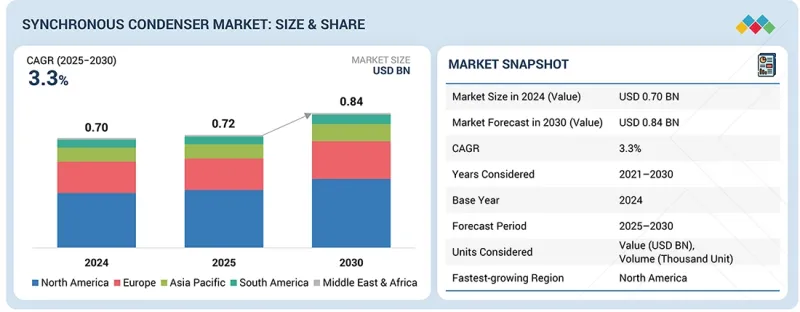
The synchronous condenser market is estimated to grow from USD 0.72 billion in 2025 to USD 0.84 billion by 2030, at a CAGR of 3.3% during the forecast period. The acceleration of infrastructure development and the expansion of transmission networks in major economies are significantly increasing the demand for synchronous condensers to enhance grid stability and reliability.
| Scope of the Report | |
|---|---|
| Years Considered for the Study | 2021-2030 |
| Base Year | 2024 |
| Forecast Period | 2025-2030 |
| Units Considered | Value (USD Million/Billion) |
| Segments | By Cooling Type, Type, Starting Method, End User, Reactive Power Rating |
| Regions covered | Asia Pacific, North America, South America, Middle East & Africa, Europe |
In India, this demand is driven by ambitious national initiatives, such as the Revamped Distribution Sector Scheme (RDSS), as well as substantial investments in ultra-high-voltage transmission corridors, renewable energy corridors, and smart grid programs. These projects require advanced reactive power management and inertia support, placing synchronous condensers at the forefront of efforts to eliminate voltage instability, ensure fault ride-through, and facilitate secure and efficient power flow in rapidly growing high-voltage networks.
In the US, extensive federal programs, including major funding under the Bipartisan Infrastructure Law and the Inflation Reduction Act, are aimed at modernizing the grid, connecting remote renewable energy sources, and improving resilience to extreme weather events. This encourages the widespread use of synchronous condensers, which provide critical momentary circuit strength, dynamic voltage control, and artificial inertia in established transmission systems. These advancements enable the significant integration of variable generation sources while reducing curtailment and ensuring reliable delivery of clean energy across interconnected grids, addressing the limitations of traditional infrastructure.
"By cooling technology, the hydrogen-cooled synchronous condenser segment is expected to be the largest cooling technology segment in the synchronous condenser market during the forecast period."
The hydrogen-cooled segment is expected to account for the largest share of the synchronous condenser market during the forecast period, as it offers superior thermal conductivity, enhanced heat dissipation, and the ability to support high-capacity operations in large-scale utility and transmission projects. Hydrogen-cooled synchronous condensers offer high power density, low energy loss, and higher performance under heavy loads, and are suitable for grids with high inertia requirements and high demand for high-MVAR-rated units (usually above 200 MVAR). These systems offer reduced windage loss, enhanced overall efficiency, longer equipment lifespan, and better thermal control than air-cooled or water-cooled systems, which are typically chosen for smaller ratings or cost-sensitive installations. The shift to hydrogen-cooled synchronous condensers has become a key trend in modern power system designs. This is particularly important for large-scale renewable energy integration and high-voltage direct current (HVDC) interconnection, as utilities and grid operators prioritize reliable, high-performance solutions for voltage regulation and grid stability.
"By starting method, the static frequency converter segment is projected to register the fastest growth in the synchronous condenser market during the forecast period."
The static frequency converter segment is expected to be the fastest-growing starting method in the synchronous condenser market throughout the forecast period as a result of a broad combination of growing demands in efficient and reliable grid stabilization solutions, development of power electronics technologies, and compliance with global trends in the direction of modernized transmission infrastructure and integration of renewable energy. The static frequency converter offers very accurate, independent control of starting frequency and voltage, can be started smoothly without relying on grid conditions or load changes, has a lower noise level, requires less space, and is more reliable than pony motor methods. These properties contribute to the fact that SFCs are especially well adapted to large-scale utility use with high capacity synchronous condensers, in which they can be used to provide increased inertia, respond to reactive power requirements, and control voltages in grids with high levels of renewable penetration better than pony motor options which in most cases have a limited range of applications to simpler and smaller locations.
"By region, Europe is estimated to account for the second-largest market share during the forecast period."
Europe is expected to become the second-largest market for synchronous condensers during the forecast period. This expectation is supported by aggressive renewable energy targets, significant investments in grid modernization, and the need for improved grid stability due to the high penetration of intermittent energy sources like wind and solar. Synchronous condensers can provide essential services such as inertia, reactive power compensation, and voltage regulation, aligning with Europe's decarbonization goals and the need for a reliable power supply in an evolving energy landscape. The robust policy framework in Europe, including the EU Green Deal, ambitious renewable integration targets, and initiatives to support grid upgrades and high-voltage direct current (HVDC) expansions, drives the demand for synchronous condensers. These systems help minimize transmission losses, manage voltage fluctuations, and enhance the resilience of utility networks and transmission infrastructure.
In-depth interviews have been conducted with key industry participants, subject-matter experts, C-level executives of leading market players, and industry consultants, among others, to obtain and verify critical qualitative and quantitative information and to assess future market prospects. The distribution of primary interviews is as follows:
By Company Type: Tier 1 - 65%, Tier 2 - 24%, and Tier 3 - 11%
By Designation: C-level Executives - 30%, Directors - 25%, and Others - 45%
By Region: North America - 33%, Europe - 27%, Asia Pacific - 20%, Middle East & Africa - 8%, and South America - 12%
Notes: The tiers of the companies are defined based on their total revenues as of 2024. Tier 1: > USD 1 billion, Tier 2: USD 500 million to USD 1 billion, and Tier 3: < USD 500 million.
Other designations include sales managers, engineers, and regional managers.
ABB (Switzerland), Siemens Energy (Germany), GE Vernova (US), Eaton (Ireland), and WEG (Brazil) are some of the major players in the synchronous condenser market. The study includes an in-depth competitive analysis of these key players, including their company profiles, recent developments, and key market strategies.
Research Coverage:
The report defines, describes, and forecasts the global synchronous condenser market by type, reactive power rating, cooling technology, starting method, end user, and region. It also offers a detailed qualitative and quantitative analysis of the market. The report comprehensively reviews the major market drivers, restraints, opportunities, and challenges. It also covers various important aspects of the market. These include an analysis of the competitive landscape, market dynamics, market estimates in terms of value, and future trends in the synchronous condenser market.
Key Benefits of Buying the Report
- It provides an analysis of key drivers (rapid expansion of renewable energy and grid-scale capacity additions, increasing emphasis on modernization aging grid infrastructure), restraints (technical and Integration challenges in modern power grids), opportunities (conversion of synchronous generators into synchronous condensers, rising adoption of high-voltage direct current systems), challenges (availability of low-cost substitutes) influencing the growth of the synchronous condenser market.
- Market Development: Comprehensive information about lucrative markets - the report analyses the synchronous condenser market across varied regions.
- Market Diversification: Exhaustive information about new products and services, untapped geographies, recent developments, and investments in the synchronous condenser market.
- Competitive Assessment: In-depth assessment of market shares, growth strategies, and service offerings of leading players like ABB (Switzerland), Eaton (Ireland), Siemens Energy (Germany), GE Vernova (US), WEG (Brazil), Mitsubishi Electric Power Products, Inc. (US), Andritz (Austria), Ansaldo Energia (Italy), Voith GmbH & Co. KGaA (Germany), Bharat Heavy Electricals Limited (India), Doosan Skoda Power (Czech Republic), Baker Hughes (US), IDEAL ELECTRIC POWER CO. (US), Power Systems & Controls, Inc. (US), Electromechanical Engineering Associates, Inc. (US), Anhui Zhongdian Electric Co., Ltd. (China), Shanghai Electric (China), Ingeteam (Spain), Hitachi Energy Ltd. (Switzerland), and Wolong Electric Group (China), among others, in the synchronous condenser market.
- Product Innovation/Development: The synchronous condenser market is witnessing high product introduction and upgrades, especially with the introduction of digital control systems and predictive maintenance functionalities. With more use cases in renewable energy integration, smart grids, and high-voltage transmission networks, sustainable advancements such as hydrogen-cooled systems, advanced materials for greater efficiency, and modular/compact designs are gaining significant traction. The evolution of hybrid solutions (synchronous condensers with power electronics such as STATCOMs or battery energy storage) is also moving forward, as in solutions from the advanced energy producers such as Siemens Energy and GE Vernova, which feature enhanced digital controls, artificial intelligence (AI)-enabled predictive maintenance, and optimized rotor/insulation designs to simplify deployment, reduce footprints, and provide enhanced inertia and reactive power supports for modern power systems.
TABLE OF CONTENTS
1 INTRODUCTION
- 1.1 STUDY OBJECTIVES
- 1.2 MARKET DEFINITION
- 1.3 STUDY SCOPE
- 1.3.1 MARKETS COVERED AND REGIONAL SCOPE
- 1.3.2 INCLUSIONS AND EXCLUSIONS
- 1.3.3 YEARS CONSIDERED
- 1.4 CURRENCY CONSIDERED
- 1.5 UNITS CONSIDERED
- 1.6 STAKEHOLDERS
- 1.7 SUMMARY OF CHANGES
2 EXECUTIVE SUMMARY
- 2.1 MARKET HIGHLIGHTS AND KEY INSIGHTS
- 2.2 KEY MARKET PARTICIPANTS: MAPPING OF STRATEGIC DEVELOPMENTS
- 2.3 DISRUPTIVE TRENDS IN SYNCHRONOUS CONDENSER MARKET
- 2.4 HIGH-GROWTH SEGMENTS
- 2.5 REGIONAL SNAPSHOT: MARKET SIZE, GROWTH RATE, AND FORECAST
3 PREMIUM INSIGHTS
- 3.1 ATTRACTIVE OPPORTUNITIES FOR PLAYERS IN SYNCHRONOUS CONDENSER MARKET
- 3.2 SYNCHRONOUS CONDENSER MARKET, BY TYPE AND REGION
- 3.3 SYNCHRONOUS CONDENSER MARKET, BY TYPE
- 3.4 SYNCHRONOUS CONDENSER MARKET, BY COOLING TECHNOLOGY
- 3.5 SYNCHRONOUS CONDENSER MARKET, BY STARTING METHOD
- 3.6 SYNCHRONOUS CONDENSER MARKET, BY REACTIVE POWER RATING
- 3.7 SYNCHRONOUS CONDENSER MARKET, BY END USER
- 3.8 SYNCHRONOUS CONDENSER MARKET, BY COUNTRY
4 MARKET OVERVIEW
- 4.1 INTRODUCTION
- 4.2 MARKET DYNAMICS
- 4.2.1 DRIVERS
- 4.2.1.1 Rapid expansion of renewable energy and grid-scale capacity additions
- 4.2.1.2 Rising emphasis on modernizing aging grid infrastructure
- 4.2.2 RESTRAINTS
- 4.2.2.1 High capital costs and complex deployment requirements
- 4.2.3 OPPORTUNITIES
- 4.2.3.1 Conversion of synchronous generators into synchronous condensers
- 4.2.3.2 Rising adoption of high-voltage direct current (HVDC) systems
- 4.2.4 CHALLENGES
- 4.2.4.1 Availability of low-cost substitutes
- 4.2.1 DRIVERS
- 4.3 UNMET NEEDS AND WHITE SPACES
- 4.3.1 UNMET NEEDS IN SYNCHRONOUS CONDENSER MARKET
- 4.3.2 WHITE SPACE OPPORTUNITIES
- 4.4 INTERCONNECTED MARKETS AND CROSS-SECTOR OPPORTUNITIES
- 4.4.1 INTERCONNECTED MARKETS
- 4.4.2 CROSS-SECTOR OPPORTUNITIES
- 4.5 STRATEGIC MOVES BY TIER-1/2/3 PLAYERS
- 4.5.1 KEY MOVES AND STRATEGIC FOCUS
5 INDUSTRY TRENDS
- 5.1 PORTER'S FIVE FORCES ANALYSIS
- 5.1.1 BARGAINING POWER OF SUPPLIERS
- 5.1.2 BARGAINING POWER OF BUYERS
- 5.1.3 THREAT OF NEW ENTRANTS
- 5.1.4 THREAT OF SUBSTITUTES
- 5.1.5 INTENSITY OF COMPETITIVE RIVALRY
- 5.2 MACROECONOMIC OUTLOOK
- 5.2.1 INTRODUCTION
- 5.2.2 GDP TRENDS AND FORECAST
- 5.2.3 INFLATION
- 5.2.4 MANUFACTURING VALUE ADDED (% OF GDP)
- 5.2.5 TRENDS IN GLOBAL ELECTRICAL INDUSTRY
- 5.2.6 TRENDS IN GLOBAL AUTOMOTIVE INDUSTRY
- 5.3 VALUE CHAIN ANALYSIS
- 5.3.1 COST ANALYSIS FOR SYNCHRONOUS CONDENSER (HYDROGEN, AIR, AND WATER COOLED)
- 5.3.2 ANALYSIS ON ADDITIONAL EQUIPMENT REQUIRED FOR SYNCHRONOUS CONDENSER
- 5.4 ECOSYSTEM ANALYSIS
- 5.5 PRICING ANALYSIS
- 5.5.1 INDICATIVE SELLING PRICE TREND, BY REACTIVE POWER RATING, 2024
- 5.5.2 AVERAGE SELLING PRICE TREND, BY REGION, 2022-2024
- 5.6 TRADE ANALYSIS
- 5.6.1 EXPORT SCENARIO (HS CODE 8501)
- 5.6.2 IMPORT SCENARIO (HS CODE 8501)
- 5.7 KEY CONFERENCES AND EVENTS, 2025-2026
- 5.8 TRENDS/DISRUPTIONS IMPACTING CUSTOMER BUSINESS
- 5.9 INVESTMENT AND FUNDING SCENARIO
- 5.10 CASE STUDY ANALYSIS
- 5.10.1 CASE STUDY 1: USE OF GE'S SYNCHRONOUS CONDENSERS IN NORTHWEST VERMONT RELIABILITY PROJECT
- 5.10.2 CASE STUDY 2: REFURBISHMENT OF SYNCHRONOUS GENERATORS TO SYNCHRONOUS CONDENSERS
- 5.11 IMPACT OF 2025 US TARIFFS-SYNCHRONOUS CONDENSER MARKET
- 5.11.1 INTRODUCTION
- 5.11.2 KEY TARIFF RATES
- 5.11.3 PRICE IMPACT ANALYSIS
- 5.11.4 IMPACT ON COUNTRIES/REGIONS
- 5.11.4.1 US
- 5.11.4.2 Europe
- 5.11.4.3 Asia Pacific
- 5.11.5 IMPACT ON END-USE INDUSTRIES
6 TECHNOLOGICAL ADVANCEMENTS, AI-DRIVEN IMPACT, PATENTS, INNOVATIONS, AND FUTURE APPLICATIONS
- 6.1 KEY EMERGING TECHNOLOGIES
- 6.1.1 HYBRID SYNCHRONOUS CONDENSER WITH FLYWHEEL ENERGY STORAGE
- 6.2 ADJACENT TECHNOLOGIES
- 6.2.1 STATCOM (STATIC SYNCHRONOUS COMPENSATOR)
- 6.2.2 GRID-SCALE BATTERY ENERGY STORAGE SYSTEMS (BESS)
- 6.3 TECHNOLOGY ROADMAP
- 6.4 PATENT ANALYSIS
- 6.5 FUTURE APPLICATIONS
- 6.6 IMPACT OF AI/GEN AI ON SYNCHRONOUS CONDENSER MARKET
- 6.6.1 BEST TOP USE CASES AND MARKET POTENTIAL
- 6.6.2 BEST PRACTICES FOLLOWED BY MANUFACTURERS
- 6.6.3 CASE STUDIES OF AI IMPLEMENTATION
- 6.6.4 INTERCONNECTED ADJACENT ECOSYSTEMS AND IMPACT ON MARKET PLAYERS
- 6.6.5 CLIENTS' READINESS TO ADOPT GENERATIVE AI
7 SUSTAINABILITY AND REGULATORY LANDSCAPE
- 7.1 REGIONAL REGULATIONS AND COMPLIANCE
- 7.1.1 REGULATORY BODIES, GOVERNMENT AGENCIES, AND OTHER ORGANIZATIONS
- 7.1.2 INDUSTRY STANDARDS
- 7.1.2.1 Codes and regulations related to synchronous condensers
- 7.2 SUSTAINABILITY INITIATIVES
- 7.2.1 INTRODUCTION
- 7.2.2 SUSTAINABILITY INITIATIVES
- 7.2.3 IMPACT OF REGULATORY POLICIES ON SUSTAINABILITY INITIATIVES
8 CUSTOMER LANDSCAPE & BUYER BEHAVIOR
- 8.1 INTRODUCTION
- 8.2 DECISION-MAKING PROCESS (SYNCHRONOUS CONDENSER VS STATCOM)
- 8.3 BUYER STAKEHOLDERS AND BUYING EVALUATION CRITERIA
- 8.3.1 KEY STAKEHOLDERS IN BUYING PROCESS
- 8.3.2 BUYING CRITERIA
- 8.4 ADOPTION BARRIERS & INTERNAL CHALLENGES
- 8.5 UNMET NEEDS OF VARIOUS END-USE INDUSTRIES
- 8.6 MARKET OPPORTUNITIES
9 SYNCHRONOUS CONDENSER MARKET, BY TYPE
- 9.1 INTRODUCTION
- 9.2 NEW SYNCHRONOUS CONDENSERS
- 9.2.1 RISING EXPANSION OF HVDC NETWORKS TO INCREASE INSTALLATION OF NEW SYNCHRONOUS CONDENSERS
- 9.3 REFURBISHED SYNCHRONOUS CONDENSERS
- 9.3.1 LOW COST OF REFURBISHED CONDENSERS TO FUEL DEMAND
10 SYNCHRONOUS CONDENSER MARKET, BY REACTIVE POWER RATING
- 10.1 INTRODUCTION
- 10.2 UP TO 100 MVAR
- 10.2.1 RISING USE OF LOCALIZED GRID STABILIZATION AND POWER QUALITY IMPROVEMENT TO FUEL MARKET GROWTH
- 10.3 101-200 MVAR
- 10.3.1 INCREASING REQUIREMENT FOR FLEXIBLE, HIGH-PERFORMANCE VOLTAGE SUPPORT SOLUTIONS TO FUEL MARKET GROWTH
- 10.4 ABOVE 200 MVAR
- 10.4.1 HIGH-CAPACITY GRID REINFORCEMENT DRIVING DEMAND FOR ABOVE 200 MVAR SYNCHRONOUS CONDENSERS
11 SYNCHRONOUS CONDENSER MARKET, BY COOLING TECHNOLOGY
- 11.1 INTRODUCTION
- 11.2 HYDROGEN-COOLED SYNCHRONOUS CONDENSERS
- 11.2.1 RISING GRID STABILITY REQUIREMENTS TO FUEL MARKET GROWTH
- 11.3 AIR-COOLED SYNCHRONOUS CONDENSERS
- 11.3.1 EXCELLENT COOLING EFFICACY TO PROPEL DEMAND
- 11.4 WATER-COOLED SYNCHRONOUS CONDENSERS
- 11.4.1 HIGHER EFFICIENCY THAN HYDROGEN-COOLED CONDENSERS TO FUEL DEMAND
12 SYNCHRONOUS CONDENSER MARKET, BY STARTING METHOD
- 12.1 INTRODUCTION
- 12.2 STATIC FREQUENCY CONVERTER
- 12.2.1 LOW INSTALLATION COST OF STATIC FREQUENCY CONVERTER TO FUEL DEMAND
- 12.3 PONY MOTOR
- 12.3.1 LOW COST AND ABILITY TO START LOW-CAPACITY SYNCHRONOUS CONDENSERS TO FUEL DEMAND GROWTH
- 12.4 OTHER STARTING METHODS
13 SYNCHRONOUS CONDENSER MARKET, BY END USER
- 13.1 INTRODUCTION
- 13.2 ELECTRICAL UTILITIES
- 13.2.1 RISING NEED TO MAINTAIN GRID STABILITY AMID RISING PENETRATION OF INVERTER-BASED RENEWABLE ENERGY SOURCES TO FUEL THE MARKET
- 13.3 INDUSTRIAL SECTOR
- 13.3.1 GOVERNMENT EXPANSION OF ENERGY-INTENSIVE OPERATIONS TO BOOST MARKET GROWTH
14 SYNCHRONOUS CONDENSER MARKET, BY REGION
- 14.1 INTRODUCTION
- 14.2 NORTH AMERICA
- 14.2.1 US
- 14.2.1.1 Transition toward inverter-dominated power systems to boost demand
- 14.2.2 CANADA
- 14.2.2.1 Hydro-dominated and renewable-heavy networks drive long-term adoption
- 14.2.1 US
- 14.3 EUROPE
- 14.3.1 DENMARK
- 14.3.1.1 Government-led initiatives and world-leading wind integration to fuel demand for synchronous condensers
- 14.3.2 ITALY
- 14.3.2.1 Terna's advanced synchronous condenser fleet and southern grid reinforcement strategy fueling market growth
- 14.3.3 GERMANY
- 14.3.3.1 Energiewende acceleration, massive solar/wind expansion, and TSO inertia procurement boosting market growth
- 14.3.4 NORWAY
- 14.3.4.1 Hydropower-rich backbone combined with growing offshore wind requiring enhanced grid inertia solutions
- 14.3.5 REST OF EUROPE
- 14.3.1 DENMARK
- 14.4 ASIA PACIFIC
- 14.4.1 CHINA
- 14.4.1.1 Rising advanced grid modernization programs to fuel market growth
- 14.4.2 AUSTRALIA
- 14.4.2.1 Rise of domestic mineral processing and battery-material refining to fuel market growth
- 14.4.3 REST OF ASIA PACIFIC
- 14.4.1 CHINA
- 14.5 SOUTH AMERICA
- 14.5.1 BRAZIL
- 14.5.1.1 Expanding hydropower, wind, and solar projects to offer growth opportunities
- 14.5.2 REST OF SOUTH AMERICA
- 14.5.1 BRAZIL
- 14.6 MIDDLE EAST & AFRICA
- 14.6.1 KENYA
- 14.6.1.1 High renewable penetration and KETRACO's transmission upgrades driving demand for synchronous condensers
- 14.6.2 REST OF MIDDLE EAST & AFRICA
- 14.6.1 KENYA
15 COMPETITIVE LANDSCAPE
- 15.1 OVERVIEW
- 15.2 KEY PLAYER STRATEGIES/RIGHT TO WIN, 2021-2026
- 15.3 MARKET SHARE ANALYSIS, 2024
- 15.4 REVENUE ANALYSIS, 2020-2024
- 15.5 PRODUCT COMPARISON
- 15.6 COMPANY EVALUATION MATRIX: KEY PLAYERS, 2024
- 15.6.1 STARS
- 15.6.2 EMERGING LEADERS
- 15.6.3 PERVASIVE PLAYERS
- 15.6.4 PARTICIPANTS
- 15.6.5 COMPANY FOOTPRINT: KEY PLAYERS, 2024
- 15.6.5.1 Company footprint
- 15.6.5.2 Region footprint
- 15.6.5.3 End-user footprint
- 15.6.5.4 Cooling technology footprint
- 15.6.5.5 Reactive Power rating footprint
- 15.7 COMPANY VALUATION AND FINANCIAL METRICS
- 15.8 COMPETITIVE SCENARIO
- 15.8.1 DEALS
- 15.8.2 EXPANSIONS
- 15.8.3 OTHER DEVELOPMENTS
16 COMPANY PROFILES
- 16.1 KEY PLAYERS
- 16.1.1 ABB
- 16.1.1.1 Business overview
- 16.1.1.2 Products/Solutions/Services offered
- 16.1.1.3 Recent developments
- 16.1.1.3.1 Deals
- 16.1.1.3.2 Other developments
- 16.1.1.4 MnM view
- 16.1.1.4.1 Key strengths/Right to win
- 16.1.1.4.2 Strategic choices
- 16.1.1.4.3 Weaknesses/Competitive threats
- 16.1.2 SIEMENS ENERGY
- 16.1.2.1 Business overview
- 16.1.2.2 Products/Solutions/Services offered
- 16.1.2.3 Recent developments
- 16.1.2.3.1 Deals
- 16.1.2.3.2 Other developments
- 16.1.2.4 MnM view
- 16.1.2.4.1 Key strengths/Right to win
- 16.1.2.4.2 Strategic choices
- 16.1.2.4.3 Weaknesses/Competitive threats
- 16.1.3 GE VERNOVA
- 16.1.3.1 Business overview
- 16.1.3.2 Products/Solutions/Services offered
- 16.1.3.3 Recent developments
- 16.1.3.3.1 Other developments
- 16.1.3.4 MnM view
- 16.1.3.4.1 Key strengths
- 16.1.3.4.2 Strategic choices
- 16.1.3.4.3 Weaknesses/Competitive threats
- 16.1.4 WEG
- 16.1.4.1 Business overview
- 16.1.4.2 Products/Services/Solutions offered
- 16.1.4.3 Recent developments
- 16.1.4.3.1 Deals
- 16.1.4.3.2 Other developments
- 16.1.4.3.3 Expansions
- 16.1.4.4 MnM view
- 16.1.4.4.1 Key strengths/Right to win
- 16.1.4.4.2 Strategic choices
- 16.1.4.4.3 Weaknesses/Competitive threats
- 16.1.5 EATON
- 16.1.5.1 Business overview
- 16.1.5.2 Products/Solutions/Services offered
- 16.1.5.3 Recent developments
- 16.1.5.3.1 Deals
- 16.1.5.4 MnM view
- 16.1.5.4.1 Key strengths/Right to win
- 16.1.5.4.2 Strategic choices
- 16.1.5.4.3 Weaknesses/Competitive threats
- 16.1.6 ANDRITZ
- 16.1.6.1 Business overview
- 16.1.6.2 Products/Solutions/Services offered
- 16.1.6.3 Recent developments
- 16.1.6.3.1 Other developments
- 16.1.7 ANSALDO ENERGIA
- 16.1.7.1 Business overview
- 16.1.7.2 Products/Services/Solutions offered
- 16.1.7.3 Recent developments
- 16.1.7.3.1 Other developments
- 16.1.7.3.2 Expansions
- 16.1.8 VOITH GMBH & CO. KGAA
- 16.1.8.1 Business overview
- 16.1.8.2 Products/Services/Solutions offered
- 16.1.9 MITSUBISHI ELECTRIC POWER PRODUCTS, INC.
- 16.1.9.1 Business overview
- 16.1.9.2 Products/Solutions/Services offered
- 16.1.9.3 Recent developments
- 16.1.9.3.1 Deals
- 16.1.9.3.2 Other developments
- 16.1.10 BHARAT HEAVY ELECTRICALS LIMITED
- 16.1.10.1 Business overview
- 16.1.10.2 Products/Solutions/Services offered
- 16.1.11 DOOSAN SKODA POWER
- 16.1.11.1 Business overview
- 16.1.11.2 Products/Solutions/Services offered
- 16.1.12 SHANGHAI ELECTRIC
- 16.1.12.1 Business overview
- 16.1.12.2 Products/Solutions/Services offered
- 16.1.12.3 Recent developments
- 16.1.12.3.1 Other developments
- 16.1.13 BAKER HUGHES COMPANY
- 16.1.13.1 Business overview
- 16.1.13.2 Products/Solutions/Services offered
- 16.1.13.3 Recent developments
- 16.1.13.3.1 Deals
- 16.1.14 HITACHI ENERGY LTD
- 16.1.14.1 Business overview
- 16.1.14.2 Products/Solutions/Services offered
- 16.1.14.3 Recent developments
- 16.1.14.3.1 Other developments
- 16.1.15 WOLONG ELECTRIC GROUP
- 16.1.15.1 Business overview
- 16.1.15.2 Products/Solutions/Services offered
- 16.1.1 ABB
- 16.2 OTHER PLAYERS
- 16.2.1 INGETEAM
- 16.2.2 ANHUI ZHONGDIAN ELECTRIC CO., LTD.
- 16.2.3 IDEAL ELECTRIC POWER CO.
- 16.2.4 POWER SYSTEMS & CONTROLS, INC.
- 16.2.5 ELECTROMECHANICAL ENGINEERING ASSOCIATES, INC.
17 RESEARCH METHODOLOGY
- 17.1 RESEARCH DATA
- 17.2 SECONDARY AND PRIMARY RESEARCH
- 17.2.1 SECONDARY DATA
- 17.2.1.1 List of key secondary sources
- 17.2.1.2 Key data from secondary sources
- 17.2.2 PRIMARY DATA
- 17.2.2.1 List of primary interview participants
- 17.2.2.2 Key industry insights
- 17.2.2.3 Breakdown of primaries
- 17.2.2.4 Key data from primary sources
- 17.2.1 SECONDARY DATA
- 17.3 MARKET SIZE ESTIMATION METHODOLOGY
- 17.3.1 BOTTOM-UP APPROACH
- 17.3.2 TOP-DOWN APPROACH
- 17.3.3 DEMAND-SIDE ANALYSIS
- 17.3.3.1 Demand-side assumptions
- 17.3.3.2 Demand-side calculations
- 17.3.4 SUPPLY-SIDE ANALYSIS
- 17.3.4.1 Supply-side assumptions
- 17.3.4.2 Supply-side calculations
- 17.4 FORECAST
- 17.5 MARKET BREAKDOWN AND DATA TRIANGULATION
- 17.6 RESEARCH LIMITATIONS
- 17.7 RISK ANALYSIS
18 APPENDIX
- 18.1 DISCUSSION GUIDE
- 18.2 KNOWLEDGESTORE: MARKETSANDMARKETS' SUBSCRIPTION PORTAL
- 18.3 CUSTOMIZATION OPTIONS
- 18.4 RELATED REPORTS
- 18.5 AUTHOR DETAILS
List of Tables
- TABLE 1 SYNCHRONOUS CONDENSER MARKET: INCLUSIONS AND EXCLUSIONS
- TABLE 2 COMPARISON BETWEEN SYNCHRONOUS CONDENSER AND ITS SUBSTITUTES
- TABLE 3 PORTER'S FIVE FORCES ANALYSIS
- TABLE 4 WORLDWIDE GDP GROWTH PROJECTION, 2021-2028 (USD TRILLION)
- TABLE 5 INFLATION RATE, AVERAGE CONSUMER PRICES, ANNUAL PERCENT CHANGE (2024%)
- TABLE 6 MANUFACTURING, VALUE ADDED (% OF GDP), BY COUNTRY, 2023
- TABLE 7 COST ANALYSIS FOR COOLING TECHNOLOGY
- TABLE 8 ROLE OF COMPANIES IN SYNCHRONOUS CONDENSER ECOSYSTEM
- TABLE 9 INDICATIVE SELLING PRICE TREND OF SYNCHRONOUS CONDENSERS, BY REACTIVE POWER RATING, 2024 (USD MILLION)
- TABLE 10 AVERAGE SELLING PRICE TREND OF SYNCHRONOUS CONDENSERS, BY REGION, 2022-2024 (USD/KVAR)
- TABLE 11 EXPORT DATA FOR HS CODE 8501-COMPLIANT PRODUCTS, BY COUNTRY, 2021-2024 (USD THOUSAND)
- TABLE 12 IMPORT DATA FOR HS CODE 8501-COMPLIANT PRODUCTS, BY COUNTRY, 2021-2024 (USD THOUSAND)
- TABLE 13 KEY CONFERENCES AND EVENTS, 2025-2026
- TABLE 14 US-ADJUSTED RECIPROCAL TARIFF RATES, 2024 (USD BILLION)
- TABLE 15 LIST OF KEY PATENTS RELATED TO SYNCHRONOUS CONDENSER TECHNOLOGY, 2020-2025
- TABLE 16 NORTH AMERICA: LIST OF REGULATORY BODIES, GOVERNMENT AGENCIES, AND OTHER ORGANIZATIONS
- TABLE 17 EUROPE: LIST OF REGULATORY BODIES, GOVERNMENT AGENCIES, AND OTHER ORGANIZATIONS
- TABLE 18 ASIA PACIFIC: LIST OF REGULATORY BODIES, GOVERNMENT AGENCIES, AND OTHER ORGANIZATIONS
- TABLE 19 REST OF THE WORLD: LIST OF REGULATORY BODIES, GOVERNMENT AGENCIES, AND OTHER ORGANIZATIONS
- TABLE 20 GLOBAL: LIST OF REGULATORY BODIES, GOVERNMENT AGENCIES, AND OTHER ORGANIZATIONS
- TABLE 21 SYNCHRONOUS CONDENSER MARKET: CODES AND REGULATIONS
- TABLE 22 TECHNICAL COMPARISON: SYNCHRONOUS CONDENSER VS. STATCOM
- TABLE 23 INFLUENCE OF STAKEHOLDERS ON BUYING PROCESS FOR END USERS
- TABLE 24 KEY BUYING CRITERIA FOR TOP END USERS
- TABLE 25 SYNCHRONOUS CONDENSER MARKET, BY TYPE, 2021-2024 (USD MILLION)
- TABLE 26 SYNCHRONOUS CONDENSER MARKET, BY TYPE, 2025-2030 (USD MILLION)
- TABLE 27 NEW SYNCHRONOUS CONDENSER MARKET, BY REGION, 2021-2024 (USD MILLION)
- TABLE 28 NEW SYNCHRONOUS CONDENSER MARKET, BY REGION, 2025-2030 (USD MILLION)
- TABLE 29 REFURBISHED SYNCHRONOUS CONDENSER MARKET, BY REGION, 2021-2024 (USD MILLION)
- TABLE 30 REFURBISHED SYNCHRONOUS CONDENSER MARKET, BY REGION, 2025-2030 (USD MILLION)
- TABLE 31 SYNCHRONOUS CONDENSER MARKET, BY REACTIVE POWER RATING, 2021-2024 (USD MILLION)
- TABLE 32 SYNCHRONOUS CONDENSER MARKET, BY REACTIVE POWER RATING, 2025-2030 (USD MILLION)
- TABLE 33 UP TO 100 MVAR: SYNCHRONOUS CONDENSER MARKET, BY REGION, 2021-2024 (USD MILLION)
- TABLE 34 UP TO 100 MVAR: SYNCHRONOUS CONDENSER MARKET, BY REGION, 2025-2030 (USD MILLION)
- TABLE 35 101-200 MVAR: SYNCHRONOUS CONDENSER MARKET, BY REGION, 2021-2024 (USD MILLION)
- TABLE 36 101-200 MVAR: SYNCHRONOUS CONDENSER MARKET, BY REGION, 2025-2030 (USD MILLION)
- TABLE 37 ABOVE 200 MVAR: SYNCHRONOUS CONDENSER MARKET, BY REGION, 2021-2024 (USD MILLION)
- TABLE 38 ABOVE 200 MVAR: SYNCHRONOUS CONDENSER MARKET, BY REGION, 2025-2030 (USD MILLION)
- TABLE 39 SYNCHRONOUS CONDENSER MARKET, BY COOLING TECHNOLOGY, 2021-2024 (USD MILLION)
- TABLE 40 SYNCHRONOUS CONDENSER MARKET, BY COOLING TECHNOLOGY, 2025-2030 (USD MILLION)
- TABLE 41 HYDROGEN-COOLED SYNCHRONOUS CONDENSER MARKET, BY REGION, 2021-2024 (USD MILLION)
- TABLE 42 HYDROGEN-COOLED SYNCHRONOUS CONDENSER MARKET, BY REGION, 2025-2030 (USD MILLION)
- TABLE 43 AIR-COOLED SYNCHRONOUS CONDENSER MARKET, BY REGION, 2021-2024 (USD MILLION)
- TABLE 44 AIR-COOLED SYNCHRONOUS CONDENSER MARKET, BY REGION, 2025-2030 (USD MILLION)
- TABLE 45 WATER-COOLED SYNCHRONOUS CONDENSER MARKET, BY REGION, 2021-2024 (USD MILLION)
- TABLE 46 WATER-COOLED SYNCHRONOUS CONDENSER MARKET, BY REGION, 2025-2030 (USD MILLION)
- TABLE 47 SYNCHRONOUS CONDENSER MARKET, BY STARTING METHOD, 2021-2024 (USD MILLION)
- TABLE 48 SYNCHRONOUS CONDENSER MARKET, BY STARTING METHOD, 2025-2030 (USD MILLION)
- TABLE 49 STATIC FREQUENCY CONVERTER: SYNCHRONOUS CONDENSER MARKET, BY REGION, 2021-2024 (USD MILLION)
- TABLE 50 STATIC FREQUENCY CONVERTER: SYNCHRONOUS CONDENSER MARKET, BY REGION, 2025-2030 (USD MILLION)
- TABLE 51 PONY MOTOR: SYNCHRONOUS CONDENSER MARKET, BY REGION, 2021-2024 (USD MILLION)
- TABLE 52 PONY MOTOR: SYNCHRONOUS CONDENSER MARKET, BY REGION, 2025-2030 (USD MILLION)
- TABLE 53 OTHER STARTING METHODS: SYNCHRONOUS CONDENSER MARKET, BY REGION, 2021-2024 (USD MILLION)
- TABLE 54 OTHER STARTING METHODS: SYNCHRONOUS CONDENSER MARKET, BY REGION, 2025-2030 (USD MILLION)
- TABLE 55 SYNCHRONOUS CONDENSER MARKET, BY END USER, 2021-2024 (USD MILLION)
- TABLE 56 SYNCHRONOUS CONDENSER MARKET, BY END USER, 2025-2030 (USD MILLION)
- TABLE 57 ELECTRICAL UTILITIES: SYNCHRONOUS CONDENSER MARKET, BY REGION, 2021-2024 (USD MILLION)
- TABLE 58 ELECTRICAL UTILITIES: SYNCHRONOUS CONDENSER MARKET, BY REGION, 2025-2030 (USD MILLION)
- TABLE 59 INDUSTRIAL SECTOR: SYNCHRONOUS CONDENSER MARKET, BY REGION, 2021-2024 (USD MILLION)
- TABLE 60 INDUSTRIAL SECTOR: SYNCHRONOUS CONDENSER MARKET, BY REGION, 2025-2030 (USD MILLION)
- TABLE 61 SYNCHRONOUS CONDENSER MARKET, BY REGION, 2021-2024 (USD MILLION)
- TABLE 62 SYNCHRONOUS CONDENSER MARKET, BY REGION, 2025-2030 (USD MILLION)
- TABLE 63 SYNCHRONOUS CONDENSER MARKET, BY REGION, 2021-2024 (UNITS)
- TABLE 64 SYNCHRONOUS CONDENSER MARKET, BY REGION, 2025-2030 (UNITS)
- TABLE 65 NORTH AMERICA: SYNCHRONOUS CONDENSER MARKET, BY TYPE, 2021-2024 (USD MILLION)
- TABLE 66 NORTH AMERICA: SYNCHRONOUS CONDENSER MARKET, BY TYPE, 2025-2030 (USD MILLION)
- TABLE 67 NORTH AMERICA: SYNCHRONOUS CONDENSER MARKET, BY COOLING TECHNOLOGY, 2021-2024 (USD MILLION)
- TABLE 68 NORTH AMERICA: SYNCHRONOUS CONDENSER MARKET, BY COOLING TECHNOLOGY, 2025-2030 (USD MILLION)
- TABLE 69 NORTH AMERICA: SYNCHRONOUS CONDENSER MARKET, BY STARTING METHOD, 2021-2024 (USD MILLION)
- TABLE 70 NORTH AMERICA: SYNCHRONOUS CONDENSER MARKET, BY STARTING METHOD, 2025-2030 (USD MILLION)
- TABLE 71 NORTH AMERICA: SYNCHRONOUS CONDENSER MARKET, BY REACTIVE POWER RATING, 2021-2024 (USD MILLION)
- TABLE 72 NORTH AMERICA: SYNCHRONOUS CONDENSER MARKET, BY REACTIVE POWER RATING, 2025-2030 (USD MILLION)
- TABLE 73 NORTH AMERICA: SYNCHRONOUS CONDENSER MARKET, BY END USER 2021-2024 (USD MILLION)
- TABLE 74 NORTH AMERICA: SYNCHRONOUS CONDENSER MARKET, BY END USER, 2025-2030 (USD MILLION)
- TABLE 75 NORTH AMERICA: SYNCHRONOUS CONDENSER MARKET, BY COUNTRY, 2021-2024 (USD MILLION)
- TABLE 76 NORTH AMERICA: SYNCHRONOUS CONDENSER MARKET, BY COUNTRY, 2025-2030 (USD MILLION)
- TABLE 77 US: SYNCHRONOUS CONDENSER MARKET, BY END USER, 2021-2024 (USD MILLION)
- TABLE 78 US: SYNCHRONOUS CONDENSER MARKET, BY END USER, 2025-2030 (USD MILLION)
- TABLE 79 CANADA: SYNCHRONOUS CONDENSER MARKET, BY END USER, 2021-2024 (USD MILLION)
- TABLE 80 CANADA: SYNCHRONOUS CONDENSER MARKET, BY END USER, 2025-2030 (USD MILLION)
- TABLE 81 EUROPE: SYNCHRONOUS CONDENSER MARKET, BY TYPE, 2021-2024 (USD MILLION)
- TABLE 82 EUROPE: SYNCHRONOUS CONDENSER MARKET, BY TYPE, 2025-2030 (USD MILLION)
- TABLE 83 EUROPE: SYNCHRONOUS CONDENSER MARKET, BY COOLING TECHNOLOGY, 2021-2024 (USD MILLION)
- TABLE 84 EUROPE: SYNCHRONOUS CONDENSER MARKET, BY COOLING TECHNOLOGY, 2025-2030 (USD MILLION)
- TABLE 85 EUROPE: SYNCHRONOUS CONDENSER MARKET, BY STARTING METHOD, 2021-2024 (USD MILLION)
- TABLE 86 EUROPE: SYNCHRONOUS CONDENSER MARKET, BY STARTING METHOD, 2025-2030 (USD MILLION)
- TABLE 87 EUROPE: SYNCHRONOUS CONDENSER MARKET, BY REACTIVE POWER RATING, 2021-2024 (USD MILLION)
- TABLE 88 EUROPE: SYNCHRONOUS CONDENSER MARKET, BY REACTIVE POWER RATING, 2025-2030 (USD MILLION)
- TABLE 89 EUROPE: SYNCHRONOUS CONDENSER MARKET, BY END USER, 2021-2024 (USD MILLION)
- TABLE 90 EUROPE: SYNCHRONOUS CONDENSER MARKET, BY END USER, 2025-2030 (USD MILLION)
- TABLE 91 EUROPE: SYNCHRONOUS CONDENSER MARKET, BY COUNTRY, 2021-2024 (USD MILLION)
- TABLE 92 EUROPE: SYNCHRONOUS CONDENSER MARKET, BY COUNTRY, 2025-2030 (USD MILLION)
- TABLE 93 DENMARK: SYNCHRONOUS CONDENSER MARKET, BY END USER, 2021-2024 (USD MILLION)
- TABLE 94 DENMARK: SYNCHRONOUS CONDENSER MARKET, BY END USER, 2025-2030 (USD MILLION)
- TABLE 95 ITALY: SYNCHRONOUS CONDENSER MARKET, BY END USER, 2021-2024 (USD MILLION)
- TABLE 96 ITALY: SYNCHRONOUS CONDENSER MARKET, BY END USER, 2025-2030 (USD MILLION)
- TABLE 97 GERMANY: SYNCHRONOUS CONDENSER MARKET, BY END USER, 2021-2024 (USD MILLION)
- TABLE 98 GERMANY: SYNCHRONOUS CONDENSER MARKET, BY END USER, 2025-2030 (USD MILLION)
- TABLE 99 NORWAY: SYNCHRONOUS CONDENSER MARKET, BY END USER, 2021-2024 (USD MILLION)
- TABLE 100 NORWAY: SYNCHRONOUS CONDENSER MARKET, BY END USER, 2025-2030 (USD MILLION)
- TABLE 101 REST OF EUROPE: SYNCHRONOUS CONDENSER MARKET, BY END USER, 2021-2024 (USD MILLION)
- TABLE 102 REST OF EUROPE: SYNCHRONOUS CONDENSER MARKET, BY END USER, 2025-2030 (USD MILLION)
- TABLE 103 ASIA PACIFIC: SYNCHRONOUS CONDENSER MARKET, BY TYPE, 2021-2024 (USD MILLION)
- TABLE 104 ASIA PACIFIC: SYNCHRONOUS CONDENSER MARKET, BY TYPE, 2025-2030 (USD MILLION)
- TABLE 105 ASIA PACIFIC: SYNCHRONOUS CONDENSER MARKET, BY COOLING TECHNOLOGY, 2021-2024 (USD MILLION)
- TABLE 106 ASIA PACIFIC: SYNCHRONOUS CONDENSER MARKET, BY COOLING TECHNOLOGY, 2025-2030 (USD MILLION)
- TABLE 107 ASIA PACIFIC: SYNCHRONOUS CONDENSER MARKET, BY STARTING METHOD, 2021-2024 (USD MILLION)
- TABLE 108 ASIA PACIFIC: SYNCHRONOUS CONDENSER MARKET, BY STARTING METHOD, 2025-2030 (USD MILLION)
- TABLE 109 ASIA PACIFIC: SYNCHRONOUS CONDENSER MARKET, BY REACTIVE POWER RATING, 2021-2024 (USD MILLION)
- TABLE 110 ASIA PACIFIC: SYNCHRONOUS CONDENSER MARKET, BY REACTIVE POWER RATING, 2025-2030 (USD MILLION)
- TABLE 111 ASIA PACIFIC: SYNCHRONOUS CONDENSER MARKET, BY END USER, 2021-2024 (USD MILLION)
- TABLE 112 ASIA PACIFIC: SYNCHRONOUS CONDENSER MARKET, BY END USER, 2025-2030 (USD MILLION)
- TABLE 113 ASIA PACIFIC: INDUCTION HEATING MARKET, BY COUNTRY, 2021-2024 (USD MILLION)
- TABLE 114 ASIA PACIFIC: INDUCTION MARKET, BY COUNTRY, 2025-2030 (USD MILLION)
- TABLE 115 CHINA: SYNCHRONOUS CONDENSER MARKET, BY END USER, 2021-2024 (USD MILLION)
- TABLE 116 CHINA: SYNCHRONOUS CONDENSER MARKET, BY END USER, 2025-2030 (USD MILLION)
- TABLE 117 AUSTRALIA: SYNCHRONOUS CONDENSER MARKET, BY END USER, 2021-2024 (USD MILLION)
- TABLE 118 AUSTRALIA: SYNCHRONOUS CONDENSER MARKET, BY END USER, 2025-2030 (USD MILLION)
- TABLE 119 REST OF ASIA PACIFIC: SYNCHRONOUS CONDENSER MARKET, BY END USER, 2021-2024 (USD MILLION)
- TABLE 120 REST OF ASIA PACIFIC: SYNCHRONOUS CONDENSER MARKET, BY END USER, 2025-2030 (USD MILLION)
- TABLE 121 SOUTH AMERICA: SYNCHRONOUS CONDENSER MARKET, BY TYPE, 2021-2024 (USD MILLION)
- TABLE 122 SOUTH AMERICA: SYNCHRONOUS CONDENSER MARKET, BY TYPE, 2025-2030 (USD MILLION)
- TABLE 123 SOUTH AMERICA: SYNCHRONOUS CONDENSER MARKET, BY COOLING TECHNOLOGY, 2021-2024 (USD MILLION)
- TABLE 124 SOUTH AMERICA: SYNCHRONOUS CONDENSER MARKET, BY COOLING TECHNOLOGY, 2025-2030 (USD MILLION)
- TABLE 125 SOUTH AMERICA: SYNCHRONOUS CONDENSER MARKET, BY STARTING METHOD, 2021-2024 (USD MILLION)
- TABLE 126 SOUTH AMERICA: SYNCHRONOUS CONDENSER MARKET, BY STARTING METHOD, 2025-2030 (USD MILLION)
- TABLE 127 SOUTH AMERICA: SYNCHRONOUS CONDENSER MARKET, BY REACTIVE POWER RATING, 2021-2024 (USD MILLION)
- TABLE 128 SOUTH AMERICA: SYNCHRONOUS CONDENSER MARKET, BY REACTIVE POWER RATING, 2025-2030 (USD MILLION)
- TABLE 129 SOUTH AMERICA: SYNCHRONOUS CONDENSER MARKET, BY END USER, 2021-2024 (USD MILLION)
- TABLE 130 SOUTH AMERICA: SYNCHRONOUS CONDENSER MARKET, BY END USER, 2025-2030 (USD MILLION)
- TABLE 131 SOUTH AMERICA: SYNCHRONOUS CONDENSER MARKET, BY COUNTRY, 2021-2024 (USD MILLION)
- TABLE 132 SOUTH AMERICA: SYNCHRONOUS CONDENSER MARKET, BY COUNTRY, 2025-2030 (USD MILLION)
- TABLE 133 BRAZIL: SYNCHRONOUS CONDENSER MARKET, BY END USER, 2021-2024 (USD MILLION)
- TABLE 134 BRAZIL: SYNCHRONOUS CONDENSER MARKET, BY END USER, 2025-2030 (USD MILLION)
- TABLE 135 REST OF SOUTH AMERICA: SYNCHRONOUS CONDENSER MARKET, BY END USER, 2021-2024 (USD MILLION)
- TABLE 136 REST OF SOUTH AMERICA: SYNCHRONOUS CONDENSER MARKET, BY END USER, 2025-2030 (USD MILLION)
- TABLE 137 MIDDLE EAST & AFRICA: SYNCHRONOUS CONDENSER MARKET, BY TYPE, 2021-2024 (USD MILLION)
- TABLE 138 MIDDLE EAST & AFRICA: SYNCHRONOUS CONDENSER MARKET, BY TYPE, 2025-2030 (USD MILLION)
- TABLE 139 MIDDLE EAST & AFRICA: SYNCHRONOUS CONDENSER MARKET, BY COOLING TECHNOLOGY, 2021-2024 (USD MILLION)
- TABLE 140 MIDDLE EAST & AFRICA: SYNCHRONOUS CONDENSER MARKET, BY COOLING TECHNOLOGY, 2025-2030 (USD MILLION)
- TABLE 141 MIDDLE EAST & AFRICA: SYNCHRONOUS CONDENSER MARKET, BY STARTING METHOD, 2021-2024 (USD MILLION)
- TABLE 142 MIDDLE EAST & AFRICA: SYNCHRONOUS CONDENSER MARKET, BY STARTING METHOD, 2025-2030 (USD MILLION)
- TABLE 143 MIDDLE EAST & AFRICA: SYNCHRONOUS CONDENSER MARKET, BY REACTIVE POWER RATING, 2021-2024 (USD MILLION)
- TABLE 144 MIDDLE EAST & AFRICA: SYNCHRONOUS CONDENSER MARKET, BY REACTIVE POWER RATING, 2025-2030 (USD MILLION)
- TABLE 145 MIDDLE EAST & AFRICA: SYNCHRONOUS CONDENSER MARKET, BY END USER, 2021-2024 (USD MILLION)
- TABLE 146 MIDDLE EAST & AFRICA: SYNCHRONOUS CONDENSER MARKET, BY END USER, 2025-2030 (USD MILLION)
- TABLE 147 MIDDLE EAST & AFRICA: SYNCHRONOUS CONDENSER MARKET, BY COUNTRY, 2021-2024 (USD MILLION)
- TABLE 148 MIDDLE EAST & AFRICA: SYNCHRONOUS CONDENSER MARKET, BY COUNTRY, 2025-2030 (USD MILLION)
- TABLE 149 KENYA: SYNCHRONOUS CONDENSER MARKET, BY END USER, 2021-2024 (USD MILLION)
- TABLE 150 KENYA: SYNCHRONOUS CONDENSER MARKET, BY END USER, 2025-2030 (USD MILLION)
- TABLE 151 REST OF MIDDLE EAST & AFRICA: SYNCHRONOUS CONDENSER MARKET, BY END USER, 2021-2024 (USD MILLION)
- TABLE 152 REST OF MIDDLE EAST & AFRICA: SYNCHRONOUS CONDENSER MARKET, BY END USER, 2025-2030 (USD MILLION)
- TABLE 153 OVERVIEW OF KEY STRATEGIES ADOPTED BY KEY PLAYERS, 2021-2026
- TABLE 154 SYNCHRONOUS CONDENSER MARKET: DEGREE OF COMPETITION
- TABLE 155 SYNCHRONOUS CONDENSER MARKET: REGION FOOTPRINT
- TABLE 156 SYNCHRONOUS CONDENSER MARKET: END-USER FOOTPRINT
- TABLE 157 SYNCHRONOUS CONDENSER MARKET: COOLING TECHNOLOGY FOOTPRINT
- TABLE 158 SYNCHRONOUS CONDENSER MARKET: REACTIVE POWER RATING FOOTPRINT
- TABLE 159 SYNCHRONOUS CONDENSER MARKET: DEALS, JANUARY 2021-JANUARY 2026
- TABLE 160 SYNCHRONOUS CONDENSER MARKET: EXPANSIONS, JANUARY 2021-JANUARY 2026
- TABLE 161 SYNCHRONOUS CONDENSER MARKET: OTHER DEVELOPMENTS, JANUARY 2021-JANUARY 2026
- TABLE 162 ABB: COMPANY OVERVIEW
- TABLE 163 ABB: PRODUCTS/SOLUTIONS/SERVICES OFFERED
- TABLE 164 ABB: DEALS
- TABLE 165 ABB: OTHER DEVELOPMENTS
- TABLE 166 SIEMENS ENERGY: COMPANY OVERVIEW
- TABLE 167 SIEMENS ENERGY: PRODUCTS/SOLUTIONS/SERVICES OFFERED
- TABLE 168 SIEMENS ENERGY: DEALS
- TABLE 169 SIEMENS ENERGY: OTHER DEVELOPMENTS
- TABLE 170 GE VERNOVA: COMPANY OVERVIEW
- TABLE 171 GE VERNOVA: PRODUCTS/SOLUTIONS/SERVICES OFFERED
- TABLE 172 GE VERNOVA: OTHER DEVELOPMENTS
- TABLE 173 WEG: COMPANY OVERVIEW
- TABLE 174 WEG: PRODUCTS/SERVICES/SOLUTIONS OFFERED
- TABLE 175 WEG: DEALS
- TABLE 176 WEG: OTHER DEVELOPMENTS
- TABLE 177 WEG: EXPANSIONS
- TABLE 178 EATON: COMPANY OVERVIEW
- TABLE 179 EATON: PRODUCTS/SOLUTIONS/SERVICES OFFERED
- TABLE 180 EATON: DEALS
- TABLE 181 ANDRITZ: COMPANY OVERVIEW
- TABLE 182 ANDRITZ: PRODUCTS/SOLUTIONS/SERVICES OFFERED
- TABLE 183 ANDRITZ: OTHER DEVELOPMENTS
- TABLE 184 ANSALDO ENERGIA: COMPANY OVERVIEW
- TABLE 185 ANSALDO ENERGIA: PRODUCTS/SERVICES/SOLUTIONS OFFERED
- TABLE 186 ANSALDO ENERGIA: OTHER DEVELOPMENTS
- TABLE 187 ANSALDO ENERGIA: EXPANSIONS
- TABLE 188 VOITH GMBH & CO. KGAA: COMPANY OVERVIEW
- TABLE 189 VOITH GMBH & CO. KGAA: PRODUCTS/SERVICES/SOLUTIONS OFFERED
- TABLE 190 MITSUBISHI ELECTRIC POWER PRODUCTS, INC.: COMPANY OVERVIEW
- TABLE 191 MITSUBISHI ELECTRIC POWER PRODUCTS, INC.: PRODUCTS/SOLUTIONS/SERVICES OFFERED
- TABLE 192 MITSUBISHI ELECTRIC POWER PRODUCTS, INC.: DEALS
- TABLE 193 MITSUBISHI ELECTRIC POWER PRODUCTS, INC.: OTHER DEVELOPMENTS
- TABLE 194 BHARAT HEAVY ELECTRICALS LIMITED: COMPANY OVERVIEW
- TABLE 195 BHARAT HEAVY ELECTRICALS LIMITED: PRODUCTS/SOLUTIONS/ SERVICES OFFERED
- TABLE 196 DOOSAN SKODA POWER: COMPANY OVERVIEW
- TABLE 197 DOOSAN SKODA POWER: PRODUCTS/SOLUTIONS/SERVICES OFFERED
- TABLE 198 SHANGHAI ELECTRIC: COMPANY OVERVIEW
- TABLE 199 SHANGHAI ELECTRIC: PRODUCTS/SOLUTIONS/SERVICES OFFERED
- TABLE 200 SHANGHAI ELECTRIC: OTHER DEVELOPMENTS
- TABLE 201 BAKER HUGHES COMPANY: COMPANY OVERVIEW
- TABLE 202 BAKER HUGHES COMPANY: PRODUCTS/SOLUTIONS/SERVICES OFFERED
- TABLE 203 BAKER HUGHES COMPANY: DEALS
- TABLE 204 HITACHI ENERGY LTD: COMPANY OVERVIEW
- TABLE 205 HITACHI ENERGY LTD.: PRODUCTS/SOLUTIONS/SERVICES OFFERED
- TABLE 206 HITACHI ENERGY LTD: OTHER DEVELOPMENTS
- TABLE 207 WOLONG ELECTRIC GROUP: COMPANY OVERVIEW
- TABLE 208 WOLONG ELECTRIC GROUP: PRODUCTS/SOLUTIONS/SERVICES OFFERED
- TABLE 209 LIST OF PRIMARY INTERVIEW PARTICIPANTS
- TABLE 210 DATA OBTAINED FROM PRIMARY SOURCES
List of Figures
- FIGURE 1 SYNCHRONOUS CONDENSER MARKET SEGMENTATION AND REGIONAL SCOPE
- FIGURE 2 MARKET SCENARIO
- FIGURE 3 GLOBAL SYNCHRONOUS CONDENSER MARKET, 2021-2030
- FIGURE 4 MAJOR STRATEGIES ADOPTED BY KEY PLAYERS IN SYNCHRONOUS CONDENSER MARKET, 2021-2025
- FIGURE 5 DISRUPTIONS INFLUENCING SYNCHRONOUS CONDENSER MARKET GROWTH
- FIGURE 6 HIGH-GROWTH SEGMENTS IN SYNCHRONOUS CONDENSER MARKET, 2024
- FIGURE 7 NORTH AMERICA TO REGISTER HIGHEST CAGR DURING FORECAST PERIOD
- FIGURE 8 EXPANDING RENEWABLE ENERGY & GRID MODERNIZATION TO OFFER GROWTH OPPORTUNITIES
- FIGURE 9 NEW SYNCHRONOUS CONDENSER TYPE SEGMENT AND NORTH AMERICA ACCOUNTED FOR LARGEST MARKET SHARES IN 2024
- FIGURE 10 NEW SYNCHRONOUS CONDENSERS TO HOLD DOMINANT MARKET SHARE
- FIGURE 11 HYDROGEN-COOLED CONDENSERS TO HOLD LARGEST MARKET SHARE TILL 2030
- FIGURE 12 STATIC FREQUENCY CONVERTERS TO EMERGE AS LARGEST MARKET SEGMENT
- FIGURE 13 ABOVE 200 MVAR SEGMENT TO REGISTER HIGHEST DEMAND DURING FORECAST PERIOD
- FIGURE 14 ELECTRICAL UTILITIES FORM THE LARGER END-USER SEGMENT
- FIGURE 15 NORWAY TO REGISTER HIGHEST CAGR DURING FORECAST PERIOD
- FIGURE 16 SYNCHRONOUS CONDENSER MARKET: DRIVERS, RESTRAINTS, OPPORTUNITIES, AND CHALLENGES
- FIGURE 17 INSTALLED RENEWABLE ELECTRICITY GENERATING CAPACITY, 2025-2035
- FIGURE 18 SYNCHRONOUS CONDENSER MARKET: PORTER'S FIVE FORCES ANALYSIS
- FIGURE 19 SYNCHRONOUS CONDENSER MARKET: VALUE CHAIN ANALYSIS
- FIGURE 20 SYNCHRONOUS CONDENSER MARKET: ECOSYSTEM ANALYSIS
- FIGURE 21 AVERAGE SELLING PRICE TREND OF SYNCHRONOUS CONDENSERS, BY REGION, 2022-2024
- FIGURE 22 EXPORT SCENARIO FOR HS CODE 8501-COMPLIANT PRODUCTS IN TOP 5 COUNTRIES, 2021-2024
- FIGURE 23 IMPORT SCENARIO FOR HS CODE 8501-COMPLIANT PRODUCTS IN TOP 5 COUNTRIES, 2021-2024
- FIGURE 24 TRENDS/DISRUPTIONS INFLUENCING CUSTOMER BUSINESS
- FIGURE 25 INVESTMENT AND FUNDING SCENARIO, BY COMPANY
- FIGURE 26 SYNCHRONOUS CONDENSER MARKET: PATENTS APPLIED AND GRANTED, 2015-2024
- FIGURE 27 DECISION-MAKING PROCESS
- FIGURE 28 INFLUENCE OF STAKEHOLDERS ON BUYING PROCESS OF SYNCHRONOUS CONDENSER MARKET
- FIGURE 29 KEY BUYING CRITERIA FOR END USERS
- FIGURE 30 SYNCHRONOUS CONDENSER MARKET, BY TYPE, 2024
- FIGURE 31 SYNCHRONOUS CONDENSER MARKET, BY REACTIVE POWER RATING, 2024
- FIGURE 32 SYNCHRONOUS CONDENSER MARKET, BY COOLING TECHNOLOGY, 2024
- FIGURE 33 SYNCHRONOUS CONDENSER MARKET, BY STARTING METHOD, 2024
- FIGURE 34 SYNCHRONOUS CONDENSER MARKET, BY END USER, 2024
- FIGURE 35 NORWAY TO REGISTER THE HIGHEST CAGR IN SYNCHRONOUS CONDENSER MARKET DURING FORECAST PERIOD
- FIGURE 36 NORTH AMERICA HELD LARGEST MARKET SHARE IN 2024
- FIGURE 37 NORTH AMERICA: SYNCHRONOUS CONDENSER MARKET SNAPSHOT
- FIGURE 38 EUROPE: SYNCHRONOUS CONDENSER MARKET SNAPSHOT
- FIGURE 39 MARKET SHARE ANALYSIS OF COMPANIES OFFERING SYNCHRONOUS CONDENSERS, 2024
- FIGURE 40 REVENUE ANALYSIS OF KEY PLAYERS IN SYNCHRONOUS CONDENSER MARKET, 2020-2024
- FIGURE 41 SYNCHRONOUS CONDENSER MARKET: PRODUCT COMPARISON
- FIGURE 42 SYNCHRONOUS CONDENSER MARKET: COMPANY EVALUATION MATRIX (KEY PLAYERS), 2024
- FIGURE 43 SYNCHRONOUS CONDENSER MARKET: COMPANY FOOTPRINT
- FIGURE 44 COMPANY VALUATION
- FIGURE 45 FINANCIAL METRICS
- FIGURE 46 ABB: COMPANY SNAPSHOT
- FIGURE 47 SIEMENS ENERGY: COMPANY SNAPSHOT
- FIGURE 48 GE VERNOVA: COMPANY SNAPSHOT
- FIGURE 49 WEG: COMPANY SNAPSHOT
- FIGURE 50 EATON: COMPANY SNAPSHOT
- FIGURE 51 ANDRITZ: COMPANY SNAPSHOT
- FIGURE 52 ANSALDO ENERGIA: COMPANY SNAPSHOT
- FIGURE 53 BHARAT HEAVY ELECTRICALS LIMITED: COMPANY SNAPSHOT
- FIGURE 54 DOOSAN SKODA POWER: COMPANY SNAPSHOT
- FIGURE 55 SHANGHAI ELECTRIC: COMPANY SNAPSHOT
- FIGURE 56 BAKER HUGHES COMPANY: COMPANY SNAPSHOT
- FIGURE 57 HITACHI ENERGY LTD: COMPANY SNAPSHOT
- FIGURE 58 SYNCHRONOUS CONDENSER MARKET: RESEARCH DESIGN
- FIGURE 59 KEY DATA FROM SECONDARY SOURCES
- FIGURE 60 INSIGHTS FROM INDUSTRY EXPERTS
- FIGURE 61 SYNCHRONOUS CONDENSER MARKET: BOTTOM-UP APPROACH
- FIGURE 62 SYNCHRONOUS CONDENSER MARKET: TOP-DOWN APPROACH
- FIGURE 63 KEY METRICS CONSIDERED TO ANALYZE DEMAND FOR SYNCHRONOUS CONDENSER
- FIGURE 64 KEY METRICS CONSIDERED TO ASSESS SUPPLY OF SYNCHRONOUS CONDENSER
- FIGURE 65 SYNCHRONOUS CONDENSER MARKET: SUPPLY-SIDE ANALYSIS
- FIGURE 66 INDUSTRY CONCENTRATION, 2024
- FIGURE 67 SYNCHRONOUS CONDENSER MARKET: DATA TRIANGULATION
- FIGURE 68 SYNCHRONOUS CONDENSER MARKET: RESEARCH LIMITATIONS

