PUBLISHER: MarketsandMarkets | PRODUCT CODE: 2066267

PUBLISHER: MarketsandMarkets | PRODUCT CODE: 2066267
Inline Camera Inspection System Market for Food & Beverage and Pharmaceutical Industries by Component (Cameras, Lighting Systems, Lenses & Optics, Processing Units/Processors, Frame Grabbers, Vision Inspection Software) - Global Forecast to 2032
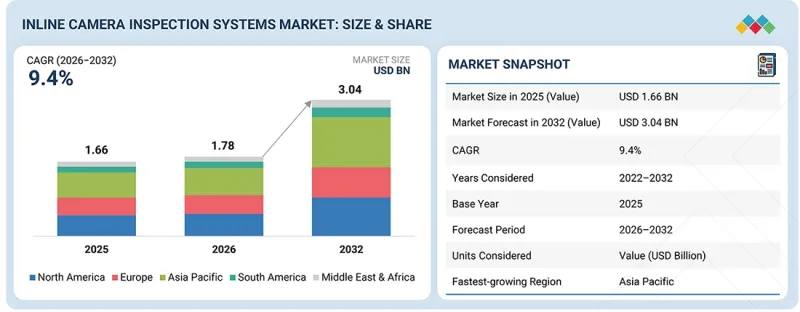
The global inline camera inspection systems market is projected to grow from USD 1.78 billion in 2026 to USD 3.04 billion by 2032, reflecting a CAGR of 9.4% over the forecast period. Market expansion is supported by the growing deployment of automated machine vision inspection systems across food & beverage and pharmaceutical manufacturing facilities, as manufacturers prioritize product quality, packaging accuracy, traceability, and operational efficiency.
| Scope of the Report | |
|---|---|
| Years Considered for the Study | 2021-2032 |
| Base Year | 2025 |
| Forecast Period | 2026-2032 |
| Units Considered | Value (USD Billion) |
| Segments | By Component, End User, Application and Region |
| Regions covered | North America, Europe, APAC, RoW |
Production facilities are increasingly adopting inline camera inspection systems to enable real-time defect detection, label verification, OCR/OCV inspection, and foreign material identification, while reducing reliance on manual inspection and lowering product recall risks. Growing demand for high-speed production automation, smart factory infrastructure, and regulatory-compliant packaging operations is accelerating market adoption. Continued advancements in AI-enabled image processing, industrial imaging technologies, embedded vision systems, and intelligent inspection software are improving inspection precision and production throughput. Increasing investments in automated packaging lines, serialization compliance, and digital manufacturing technologies are reinforcing the role of inline camera inspection systems as critical components within next-generation food & beverage and pharmaceutical production environments.
"Vision Inspection Software Segment to grow at the Highest CAGR during the Forecast Period."
The vision inspection software segment is expected to post the highest CAGR in the Global inline camera inspection systems market over the forecast period, driven by rising demand for AI-enabled inspection analytics, intelligent defect recognition, and automated quality monitoring across food & beverage and pharmaceutical manufacturing environments. These software platforms support real-time image processing, OCR/OCV verification, label inspection, barcode validation, and production analytics, enabling manufacturers to improve inspection accuracy and operational efficiency across high-speed production lines. The growing adoption of smart manufacturing infrastructure and automated packaging operations is accelerating the deployment of advanced vision inspection software integrated with industrial cameras and embedded processing systems. Manufacturers are increasingly investing in machine learning algorithms, deep learning-based defect detection, and cloud-connected inspection platforms to improve traceability, reduce false rejection rates, and strengthen regulatory compliance. Advancements in AI-based image analytics, intelligent automation, and real-time production monitoring are further reinforcing demand for vision inspection software across modern inline quality inspection operations.
"Food & Beverages segment to grow with the highest CAGR during the forecast period."
The food & beverages segment is expected to post the highest CAGR in the global inline camera inspection systems market over the forecast period, driven by rising demand for automated quality inspection, packaging verification, and contamination detection in high-speed food processing and beverage production environments. Manufacturers are increasingly deploying inline camera inspection systems to enable real-time label inspection, fill-level verification, seal inspection, barcode validation, and foreign material detection, while improving product quality and operational efficiency. A growing focus on food safety regulations, packaging accuracy, and reducing product recalls is accelerating the adoption of AI-enabled machine vision inspection technologies across food & beverage manufacturing facilities. Companies are also investing in automated production lines, smart packaging operations, and intelligent quality monitoring systems to strengthen traceability and maintain compliance with evolving regulatory standards. Advancements in industrial imaging technologies, embedded vision systems, and automated inspection analytics are further reinforcing demand for inline camera inspection solutions across modern food & beverage production operations.
"Asia Pacific region to grow with the highest CAGR during the forecast period."
The Asia Pacific region is expected to post the highest CAGR in the global inline camera inspection systems market over the forecast period, driven by rapid expansion of the food processing and pharmaceutical manufacturing industries across China, India, Japan, South Korea, and Southeast Asia. Rising investments in industrial automation, smart factory infrastructure, and high-speed packaging operations are accelerating the deployment of advanced inline camera inspection systems across regional manufacturing facilities. Manufacturers are increasingly adopting AI-enabled machine vision technologies to improve defect detection accuracy, packaging verification, serialization compliance, and production efficiency across automated production lines. A growing focus on food safety regulations, pharmaceutical traceability requirements, and export quality standards is further strengthening demand for real-time inline inspection technologies across the region. Advancements in industrial imaging systems, intelligent vision software, and embedded processing technologies are supporting wider adoption of automated quality inspection platforms across modern manufacturing environments in Asia Pacific.
Breakdown of primaries
A variety of executives from key organizations operating in the inline camera inspection systems market were interviewed in-depth, including CEOs, marketing directors, and innovation and technology directors.
- By Company Type: Tier 1 -40%, Tier 2 - 35%, and Tier 3 - 25%
- By Designation: C-level Executives - 48%, Directors - 33%, and Others - 19%
- By Region: North America - 35%, Europe - 18%, Asia Pacific - 40%, and RoW - 7%
Note: Other designations include product managers, sales managers, and marketing managers.
Three tiers of companies have been defined based on their total revenue as of 2025: tier 3: revenue less than USD 500 million; tier 2: revenue between USD 500 million and USD 1 billion; and tier 1: revenue more than USD 1 billion.
RoW mainly includes South America, Africa and the Middle East.
Major players profiled in this report are as follows: KEYENCE CORPORATION (Japan), Teledyne Technologies Incorporated (US), Cognex (US), OMRON Corporation (Japan), and Mettler Toledo (Switzerland). These companies lead through strong portfolios of machine vision systems, industrial cameras, AI-enabled inspection software, and automated inline quality inspection platforms designed for food & beverage and pharmaceutical manufacturing environments. Their solutions are widely deployed across high-speed production and packaging lines to improve defect detection accuracy, packaging verification, serialization compliance, and operational efficiency. Their strategies focus on advancing intelligent imaging technologies, expanding AI-based inspection capabilities, and strengthening smart manufacturing integration to support next-generation automated quality inspection operations across global manufacturing industries.
The study provides a detailed competitive analysis of these key players in the inline camera inspection systems market, presenting their company profiles, recent developments, and key market strategies.
Research Coverage
The inline camera inspection systems market is segmented by component, application, end user, and region. The component segment includes hardware and vision inspection software, driven by the growing adoption of automated machine vision technologies in high-speed manufacturing environments. The application segment comprises foreign material inspection of raw materials, visual defect detection, tablet printing error detection, packaging defect inspection, label inspection and OCR verification, and content defect detection, reflecting a growing focus on product quality, packaging accuracy, traceability, and regulatory compliance across production lines. The industry segment includes food & beverages and pharmaceuticals, supported by rising investments in smart manufacturing infrastructure, automated packaging operations, and AI-enabled quality inspection technologies. Regionally, the market is segmented into North America, Europe, Asia Pacific, South America, and the Middle East & Africa, with growth supported by the increasing deployment of industrial automation systems, intelligent inspection platforms, and real-time production monitoring technologies across global manufacturing facilities.
Reasons to buy the report
The report will provide market leaders and new entrants with the closest approximations of revenue figures for the overall global inline camera inspection systems market for the food & beverage and pharmaceutical industries and their subsegments. It will help stakeholders understand the competitive landscape and gain insights to position their businesses more effectively and plan suitable go-to-market strategies. The report also helps stakeholders understand the market dynamics and provides information on key market drivers, restraints, challenges, and opportunities influencing the adoption of inline camera inspection systems across food & beverage and pharmaceutical manufacturing environments globally.
Key Benefits of Buying the Report
- Analysis of key drivers, restraints, opportunities, and challenges influencing the growth of the inline camera inspection systems market for food & beverage and pharmaceutical industries
- Product Development/Innovation: Detailed insights on AI-enabled machine vision technologies, intelligent inspection software, embedded vision systems, and new product launches in the inline camera inspection systems market
- Market Development: Comprehensive information about lucrative markets as the report analyzes the inline camera inspection systems market across North America, Europe, Asia Pacific, South America, and Middle East & Africa
- Market Diversification: Exhaustive information about new inspection technologies, untapped manufacturing opportunities, recent developments, and investments in automated quality inspection and smart manufacturing infrastructure
- Competitive Assessment: In-depth assessment of market shares, growth strategies, and product offerings of leading players, including KEYENCE CORPORATION (Japan), Teledyne Technologies Incorporated (US), Cognex (US), OMRON Corporation (Japan), and Mettler Toledo (Switzerland)
TABLE OF CONTENTS
1 PROJECT SCOPE
2 EXECUTIVE SUMMARY
3 MARKET OVERVIEW
- 3.1 INTRODUCTION
- 3.2 MARKET DYNAMICS
- 3.2.1 DRIVERS
- 3.2.2 RESTRAINTS
- 3.2.3 OPPORTUNITIES
- 3.2.4 CHALLENGES
4 INLINE CAMERA INSPECTION SYSTEMS MARKET, BY COMPONENT (MARKET SIZE & FORECAST TO 2032 - USD MILLION)
- 4.1 INTRODUCTION
- 4.2 HARDWARE
- 4.3 VISION INSPECTION SOFTWARE
5 INLINE CAMERA INSPECTION SYSTEMS MARKET, BY APPLICATION (MARKET SIZE & FORECAST TO 2032 - USD MILLION)
- 5.1 INTRODUCTION
- 5.2 FOREIGN MATERIAL INSPECTION OF RAW MATERIALS
- 5.3 VISUAL DEFECT DETECTION
- 5.4 TABLET PRINTING ERROR DETECTION
- 5.5 PACKAGING DEFECT INSPECTION
- 5.6 LABEL INSPECTION & OCR VERIFICATION
- 5.7 CONTENT DEFECT DETECTION
6 INLINE CAMERA INSPECTION SYSTEMS MARKET, BY INDUSTRY (MARKET SIZE & FORECAST TO 2032 - USD MILLION)
- 6.1 INTRODUCTION
- 6.2 FOOD & BEVERAGES
- 6.3 PHARMACEUTICALS
7 INLINE CAMERA INSPECTION SYSTEMS MARKET, BY REGION (MARKET SIZE & FORECAST TO 2032 - USD MILLION)
- 7.1 INTRODUCTION
- 7.2 NORTH AMERICA
- 7.2.1 US
- 7.2.2 CANADA
- 7.2.3 MEXICO
- 7.3 EUROPE
- 7.3.1 GERMANY
- 7.3.2 UK
- 7.3.3 FRANCE
- 7.3.4 REST OF EUROPE
- 7.4 ASIA PACIFIC
- 7.4.1 CHINA
- 7.4.2 JAPAN
- 7.4.3 SOUTH KOREA
- 7.4.4 REST OF ASIA PACIFIC
- 7.5 SOUTH AMERICA
- 7.4.1 BRAZIL
- 7.4.2 ARGENTINA
- 7.4.3 OTHER SOUTH AMERICAN COUNTRIES
- 7.6 MIDDLE EAST & AFRICA
8 COMPETITIVE INSIGHTS
- 8.1 INLINE CAMERA INSPECTION SYSTEMS MARKET, COMPANY PROFILES
- 8.1.1 KEY PLAYERS
- 8.1.1.1 KEYENCE CORPORATION
- 8.1.1.2 Cognex
- 8.1.1.3 Teledyne Technologies Incorporated
- 8.1.1.4 OMRON Corporation
- 8.1.1.5 METTLER TOLEDO
- 8.1.2 OTHER PLAYERS
- 8.1.1 KEY PLAYERS
- 8.2 INLINE CAMERA INSPECTION SYSTEMS MARKET, COMPETITIVE LANDSCAPE
- 8.2.1 INTRODUCTION
- 8.2.2 MARKET SHARE ANALYSIS, 2025
9 RESEARCH METHODOLOGY
10 APPENDIX
- 10.1 DISCUSSION GUIDE
- 10.2 KNOWLEDGESTORE: MARKETSANDMARKETS' SUBSCRIPTION PORTAL
- 10.3 CUSTOMIZATION OPTIONS
- 10.4 RELATED REPORTS
- 10.5 AUTHOR DETAILS

