PUBLISHER: Mordor Intelligence | PRODUCT CODE: 2114431

PUBLISHER: Mordor Intelligence | PRODUCT CODE: 2114431
Machine Vision Camera - Market Share Analysis, Industry Trends & Statistics, Growth Forecasts (2026 - 2031)
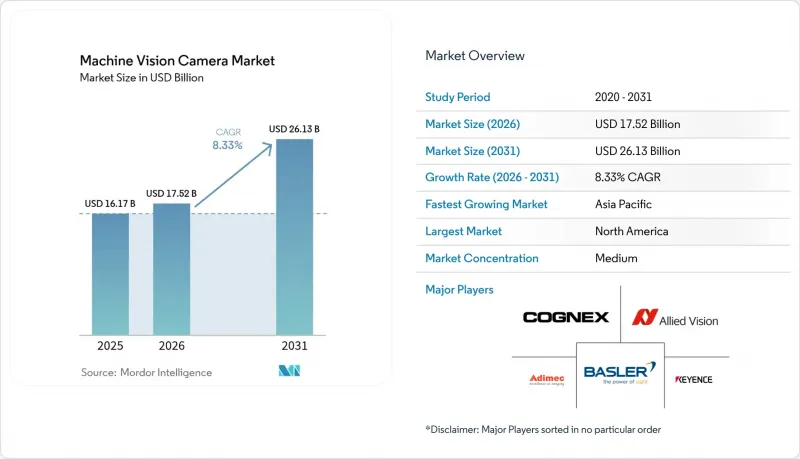
According to Mordor Intelligence, the machine vision camera market size is expected to grow from USD 16.17 billion in 2025 to USD 17.52 billion in 2026 and is forecast to reach USD 26.13 billion by 2031 at 8.33% CAGR over 2026-2031.
This report is Segmented by Type (Area Scan and Line Scan), Interface Standard (USB3 Vision, and More), Sensor Technology (Global-Shutter CMOS, and More), End-User Industry (Electronics and Semiconductor, Automotive and EV Battery, and More), Application (Quality Inspection and Defect Detection, and More), and Geography. The Market Forecasts are Provided in Terms of Value (USD).
Global Machine Vision Camera Market Trends and Insights
Rapid Factory-Floor Automation Wave
Labor shortages and uniform-quality goals are pushing manufacturers to adopt vision-guided robotics at scale. Taiwan Semiconductor Manufacturing Company broadened automated optical inspection to 16 fabs in 2024, shortening feedback loops for sub-10 nm nodes. Food processors now rely on vision to isolate contaminants, aligning with stricter safety codes. Small-batch producers are also moving in, as collaborative robots paired with compact cameras cut changeover losses. This breadth of adoption lifts the machine vision camera market across both high-volume and custom production lines.
Falling Camera ASPs with CMOS and USB3 Adoption
Global-shutter CMOS output has grown quickly, driving 15-20% annual price drops since 2024. Standardized USB3 Vision connectors remove frame-grabber fees and simplify cabling, making entry-level deployments viable for mid-tier factories. In Southeast Asia, first-time buyers are equipping SMT lines with USB3 cameras priced below USD 800. Margin pressure is steering legacy brands toward differentiating through device-side AI and specialty optics rather than raw hardware.
Shortage of Skilled Machine-Vision Engineers
Vacancy rates for advanced vision roles top 40% in North America and Europe. Universities struggle to update curricula that merge optics, AI frameworks, and real-time protocol stacks. As a result, plants outsource projects to turnkey integrators, trading flexibility for quicker deployment. The talent gap is more acute in emerging fields like SWIR spectroscopy and 3D time-of-flight, lengthening project schedules and dampening the overall machine vision camera market growth.
Other drivers and restraints analyzed in the detailed report include:
- Tightening Quality-Control Mandates in 3C and EV
- Edge-AI Cameras Slashing Bandwidth Costs
- Fragmented Interface Standards Inflate BOM
For complete list of drivers and restraints, kindly check the Table Of Contents.
Segment Analysis
Line scan cameras address continuous materials such as rolled steel, textiles, and photovoltaic ribbons and are forecast to compound at 9.27% through 2031. High-resolution arrays paired with multi-spectral filters uncover sub-surface defects during blister-pack production and grain-level anomalies in pharmaceutical tablets. Continuous web processes, once reliant on stroboscopic lighting, now leverage faster line rates that match conveyor speeds above 500 m per minute, underscoring why this niche is climbing inside the broader machine vision camera market.
Area scan units still command 63.88% of 2025 revenue. Recent sensor shifts to global-shutter exposure removed motion-blur, unlocking inspection of fast-moving bottle caps, PCB solder joints, and EV power-module leads. Integrating polarizing filters enables detection of stress patterns in molded plastic, while embedded time-of-flight modules extend capability into basic 3D gauging. Vendors thereby safeguard area scan relevance even as line scan adoption widens.
USB3 Vision delivers 41.08% of 2025 shipments owing to universal PC compatibility. In low-cost electronics assembly, plug-and-play driver stacks and power-over-cable set-ups slash installation hours. Price-sensitive buyers equate standard USB components with serviceability, which helps sustain top-line volume for this interface within the machine vision camera market size.
CoaXPress addresses the opposite end of the bandwidth spectrum and is rising at 9.05% CAGR. Single-cable links now stream 25 Gbps while powering a 65 MP sensor, crucial for inspecting micro-via diameters on advanced PCBs. Automotive battery cell plants adopt CoaXPress to image electrode coatings at 700 fps, a feat beyond USB3. Meanwhile, GigE Vision and its 5 Gig and 10 Gig variants remain relevant where in-plant Ethernet backbones already exist, trading lower frame rates for easy network routing.
Complete Report Scope:
- By Type
- Area Scan
- Line Scan
- By Interface Standard
- USB3 Vision
- GigE / 5-10 GigE Vision
- Camera Link / HS
- CoaXPress
- Other / Emerging (MIPI, Thunderbolt)
- By Sensor Technology
- Global-shutter CMOS
- Rolling-shutter CMOS
- CCD
- SWIR / MWIR
- Time-of-Flight 3D
- By End-user Industry
- Electronics and Semiconductor
- Automotive and EV Battery
- Healthcare and Life-science
- Food and Beverage Processing
- Aerospace and Defence
- Logistics and Warehousing
- Other Industries
- By Application
- Quality Inspection and Defect Detection
- Measurement and Metrology
- Identification / OCR and Traceability
- Vision-Guided Robotics
- Predictive / Condition Monitoring
- By Geography
- North America
- South America
- Europe
- Asia Pacific
- Middle East and Africa
Geography Analysis
North America recorded 39.32% of 2025 revenue, capitalizing on early adoption in aerospace, medical devices, and advanced driver-assistance systems. Federal incentives for domestic semiconductor fabs sustain camera retrofits that verify 300 mm wafer uniformity. The machine vision camera market size in the region is projected to keep pace as carmakers shift to local battery cell production lines.
Asia Pacific is advancing at a 8.93% CAGR, underpinned by China's smart-manufacturing subsidies and South Korea's semiconductor clean-room expansions. ASEAN incentives for SME digitization broaden the customer base, while Japan doubles down on high-speed CoaXPress cameras for 3D IC inspection. The cluster effect of component suppliers, integrators, and academic labs accelerates cycle times for pilot projects and bolsters collective know-how, deepening the machine vision camera market penetration.
Europe maintains balanced momentum rooted in stringent regulatory frameworks. Pharma plants install serialization-ready cameras to meet EU Falsified Medicines Directive renewal, and automakers roll out combined 2D-plus-3D stations to validate laser-weld seams on battery enclosures. Sustainability targets spur vision-based scrap sorting in metal recycling, underscoring green mandates as a secondary driver. Emerging economies in South America and the Middle East begin to deploy vision-aided logistics hubs, foreshadowing gradual expansion beyond core manufacturing heartlands.
- Allied Vision Technologies GmbH
- Basler AG
- Cognex Corporation
- Keyence Corporation
- Teledyne DALSA Inc.
- Omron Microscan Systems, Inc.
- SICK AG
- LMI Technologies Inc.
- Adimec Advanced Image Systems BV
- JAI A/S
- IDS Imaging Development Systems GmbH
- FLIR Systems LLC
- Sony Semiconductor Solutions Corp.
- Hikrobot Technology Co., Ltd.
- Daheng Imaging Co., Ltd.
- Baumer Optronic GmbH
- Matrox Imaging, a division of Matrox Electronic Systems Ltd.
- Zebra Technologies Corp. (Machine-Vision Division)
- ISRA Vision AG
- TKH Group NV (Allied Vision and NET)
- Tordivel AS
- STEMMER IMAGING AG
- Opt Machine Vision Tech Co., Ltd.
- Datalogic S.p.A.
Additional Benefits:
- The market estimate (ME) sheet in Excel format
- 3 months of analyst support
TABLE OF CONTENTS
1 INTRODUCTION
- 1.1 Study Assumptions and Market Definition
- 1.2 Scope of the Study
2 RESEARCH METHODOLOGY
3 EXECUTIVE SUMMARY
4 MARKET LANDSCAPE
- 4.1 Market Overview
- 4.2 Market Drivers
- 4.2.1 Rapid factory-floor automation wave
- 4.2.2 Falling camera ASPs with CMOS and USB3 adoption
- 4.2.3 Tightening quality-control mandates in 3C and EV
- 4.2.4 Edge-AI cameras slashing bandwidth costs
- 4.2.5 Subsidised "smart factory" loans in ASEAN
- 4.2.6 On-robot SWIR vision for lithium-battery QC
- 4.3 Market Restraints
- 4.3.1 Shortage of skilled machine-vision engineers
- 4.3.2 Fragmented interface standards inflate BOM
- 4.3.3 Rising export controls on high-speed sensors
- 4.3.4 Thermal design limits for onboard AI SoCs
- 4.4 Industry Value Chain Analysis
- 4.5 Regulatory Landscape
- 4.6 Technological Outlook
- 4.7 Porter's Five Forces Analysis
- 4.7.1 Threat of New Entrants
- 4.7.2 Bargaining Power of Buyers
- 4.7.3 Bargaining Power of Suppliers
- 4.7.4 Threat of Substitutes
- 4.7.5 Intensity of Competitive Rivalry
5 MARKET SIZE AND GROWTH FORECASTS (VALUE)
- 5.1 By Type
- 5.1.1 Area Scan
- 5.1.2 Line Scan
- 5.2 By Interface Standard
- 5.2.1 USB3 Vision
- 5.2.2 GigE / 5-10 GigE Vision
- 5.2.3 Camera Link / HS
- 5.2.4 CoaXPress
- 5.2.5 Other / Emerging (MIPI, Thunderbolt)
- 5.3 By Sensor Technology
- 5.3.1 Global-shutter CMOS
- 5.3.2 Rolling-shutter CMOS
- 5.3.3 CCD
- 5.3.4 SWIR / MWIR
- 5.3.5 Time-of-Flight 3D
- 5.4 By End-user Industry
- 5.4.1 Electronics and Semiconductor
- 5.4.2 Automotive and EV Battery
- 5.4.3 Healthcare and Life-science
- 5.4.4 Food and Beverage Processing
- 5.4.5 Aerospace and Defence
- 5.4.6 Logistics and Warehousing
- 5.4.7 Other Industries
- 5.5 By Application
- 5.5.1 Quality Inspection and Defect Detection
- 5.5.2 Measurement and Metrology
- 5.5.3 Identification / OCR and Traceability
- 5.5.4 Vision-Guided Robotics
- 5.5.5 Predictive / Condition Monitoring
- 5.6 By Geography
- 5.6.1 North America
- 5.6.2 South America
- 5.6.3 Europe
- 5.6.4 Asia Pacific
- 5.6.5 Middle East and Africa
6 COMPETITIVE LANDSCAPE
- 6.1 Market Concentration
- 6.2 Strategic Moves
- 6.3 Market Share Analysis
- 6.4 Company Profiles (includes Global level Overview, Market level overview, Core Segments, Financials as available, Strategic Information, Market Rank/Share for key companies, Products and Services, and Recent Developments)
- 6.4.1 Allied Vision Technologies GmbH
- 6.4.2 Basler AG
- 6.4.3 Cognex Corporation
- 6.4.4 Keyence Corporation
- 6.4.5 Teledyne DALSA Inc.
- 6.4.6 Omron Microscan Systems, Inc.
- 6.4.7 SICK AG
- 6.4.8 LMI Technologies Inc.
- 6.4.9 Adimec Advanced Image Systems BV
- 6.4.10 JAI A/S
- 6.4.11 IDS Imaging Development Systems GmbH
- 6.4.12 FLIR Systems LLC
- 6.4.13 Sony Semiconductor Solutions Corp.
- 6.4.14 Hikrobot Technology Co., Ltd.
- 6.4.15 Daheng Imaging Co., Ltd.
- 6.4.16 Baumer Optronic GmbH
- 6.4.17 Matrox Imaging, a division of Matrox Electronic Systems Ltd.
- 6.4.18 Zebra Technologies Corp. (Machine-Vision Division)
- 6.4.19 ISRA Vision AG
- 6.4.20 TKH Group NV (Allied Vision and NET)
- 6.4.21 Tordivel AS
- 6.4.22 STEMMER IMAGING AG
- 6.4.23 Opt Machine Vision Tech Co., Ltd.
- 6.4.24 Datalogic S.p.A.
7 MARKET OPPORTUNITIES AND FUTURE OUTLOOK
- 7.1 White-space and Unmet-need Assessment

