PUBLISHER: MarketsandMarkets | PRODUCT CODE: 2111249
PUBLISHER: MarketsandMarkets | PRODUCT CODE: 2111249
EV Connector Market by Connector Type (Wire-to-Wire, Wire-to-Board, Board-to-Board, Others), Propulsion (BEV, PHEV, HEV), Application, System, Voltage, Component, and Region - Global Forecast to 2033
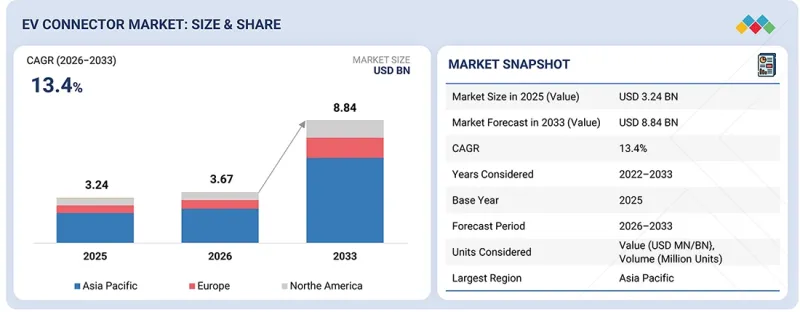
The EV connector market is projected to reach USD 8.84 billion by 2033, up from USD 3.67 billion in 2026, at a CAGR of 13.4%.
| Scope of the Report | |
|---|---|
| Years Considered for the Study | 2026-2033 |
| Base Year | 2025 |
| Forecast Period | 2026-2033 |
| Units Considered | USD billion |
| Segments | EV Connector Market by Connector Type, Propulsion, Application, System, Voltage, Component, and Region - Global Forecast to 2033 |
| Regions covered | Asia Pacific, Europe, North America |
EVs require dedicated connectors to safely transfer power across battery packs, inverters, onboard chargers, eAxles, and power distribution systems. As OEMs adopt higher-voltage platforms and software-defined architectures, connector content per vehicle is increasing, driving demand for high-current, liquid-cooled, and smart connectors that can withstand high current, heat, vibration, and moisture while ensuring reliable power and data transmission.
"Board-to-board connector type to hold largest share in the EV connector market in 2026."
Board-to-board connectors lead the EV connector market as the primary interface between printed circuit boards in the electronics-intensive architecture of modern electric vehicles. They are widely used across various vehicle applications, including battery management systems, ADAS and safety systems, infotainment, power distribution units, body control modules, and vehicle control units, especially in battery electric vehicles (BEVs) and high-end PHEVs. These connectors also support the ongoing consolidation of vehicle electronics architecture into fewer, more powerful control units in electric vehicles. In addition, they enable high-speed data transfer, compact packaging, and reliable signal integrity. EV architectures continue to become more centralized and feature-rich; board-to-board connectors are well suited for next-generation EV platforms. Thus, by enabling compact, high-density, and high-speed PCB interconnections while reducing wiring complexity, installation space, and vehicle weight, board-to-board connectors are expected to remain the preferred choice among EV OEMs as electronic content and system integration continue to increase in the years to come.
"Sealed connectors are expected to be the fastest-growing segment in the EV connector market during the forecast period."
Sealed connectors are expected to grow faster than unsealed connectors as EV manufacturers prioritize durability, safety, and long-term reliability in harsh operating environments. These connectors are widely used in battery management systems (BMS) to ensure reliable high-voltage connections within battery packs. They are also used in powertrain systems, including traction motors, inverters, and onboard chargers, where protection against moisture, dust, vibration, and thermal cycling is essential. Sealed connectors are most widely deployed in battery electric vehicles and are seeing rising demand in hybrid electric vehicles (HEVs) and plug-in hybrid electric vehicles (PHEVs) as these platforms use more electrified powertrain and battery systems. They are also expanding beyond high-voltage powertrain applications into battery management systems, ADAS, and power electronics, as OEMs prioritize reliability and environmental protection across more vehicle systems. Demand is particularly strong in high-voltage battery electric SUVs and premium passenger cars from OEMs such as Tesla, Hyundai, Kia, Mercedes-Benz, BMW, and Porsche, where sealed connectors help prevent moisture ingress, corrosion, electrical leakage, and short circuits, improving the safety, reliability, and long-term performance of high-voltage battery and power electronics systems. The rising focus on improving vehicle reliability, safety, and warranty performance is expected to drive demand for sealed connectors in electric vehicles. As EV platforms become more electrified and electronically complex, sealed connectors are becoming the preferred choice across critical vehicle systems due to their ability to improve safety, reliability, and durability. Their expanding use across BEVs, HEVs, and PHEVs, coupled with increasing adoption in high-voltage architectures and safety-critical applications, is expected to sustain strong market growth over the forecast period.
"Asia Pacific to account for largest market share in the EV connector market in 2026."
Asia Pacific is expected to account for the largest share of the EV connector market because it remains the world's largest EV production and sales hub, representing more than 60% of global electric car sales in 2026. China alone contributes around 80% of regional EV demand and is expected to retain its leadership through 2033. The region's market is supported by a balanced mix of high-volume economy EVs, which account for nearly 60% of sales and are led by OEMs such as BYD, SAIC GM Wuling, Chery, and Geely; mid-priced EVs, representing about 30% of sales, from OEMs including BYD, Geely, Xpeng, GAC AION, and Li Auto; and premium EVs, contributing around 10% through brands such as NIO, Zeekr, Tesla, BMW, Mercedes-Benz, Audi, and Xiaomi. While economy EVs primarily require connectors for battery management systems, powertrain, lighting, charging, and body electronics, mid- and premium vehicles incorporate substantially higher connector content through ADAS, autonomous driving hardware, intelligent cockpits, high-speed infotainment, domain controllers, zonal architectures, and multiple sensor systems, resulting in significantly higher connector demand per vehicle. This demand is further strengthened by regional OEMs' years of developing dedicated EV platforms, including BYD e Platform 3.0, Geely SEA, SAIC Nebula, Xpeng SEPA 2.0, Hyundai E GMP, and GAC AEP, enabling modular vehicle architectures with higher electrical integration, standardized interfaces, and greater connector density across successive vehicle models.
At the same time, rapid adoption of 800-volt electrical architectures, silicon carbide power electronics, ultra-fast charging, software-defined vehicles, centralized computing, and zonal E/E architectures is increasing demand for advanced sealed high-voltage connectors capable of higher current, faster data transmission, and improved thermal performance. Beyond China, Japan continues to emphasize HEVs through Toyota, Honda, and Nissan, creating stable demand for low- and medium-voltage connectors, while South Korea is expanding both BEVs and HEVs through Hyundai and Kia, with increasing deployment of 800-volt platforms. India is witnessing strong growth in BEVs through Tata Motors, Mahindra, MG Motor, BYD, and Hyundai, supported by government incentives, localization, and charging infrastructure expansion. Going forward, rising EV penetration across all price segments, increasing deployment of intelligent vehicle technologies, continued platform-based vehicle development, localization of EV supply chains, and the transition toward high-voltage and software-defined vehicle architectures will continue to increase both connector content per vehicle and overall connector demand, ensuring Asia Pacific maintains its leadership in the global EV connector market through 2033.
The break-up of the profile of primary participants in the EV connector market:
- By Company Type: OEMs - 20%, EV Connector Manufacturers - 45%, Wiring Harness Manufacturers - 35%
- By Designation: Director Level - 15%, C-Level - 20%, and Others - 65%
- By Region: North America - 30%, Europe - 20%, and Asia Pacific - 50%
The EV connector market is dominated by established players such as TE Connectivity (Ireland), Aptiv (Ireland), Yazaki Corporation (Japan), Molex (US), and Hirose Electric Co., Ltd. (Japan).
Research Coverage:
The market study covers the EV connector market by system (sealed and unsealed), connection type (wire-to-wire, wire-to-board, board-to-board, and other connection types), propulsion (BEV, PHEV, and HEV), application (ADAS & safety systems, body control & interiors, infotainment systems, engine management & powertrain, battery management systems, vehicle lighting, and other applications), voltage (low, medium, and high), component (terminal, housing, lock, and other components), and region (North America, Europe, and Asia Pacific). It also covers the competitive landscape and company profiles of the major players in the EV connector market.
The report comprehensively examines key factors shaping the growth of the EV connector market, including drivers, constraints, challenges, and opportunities. It provides detailed analyses of major industry players, offering insights into their business profiles, solutions, services, key strategies, contracts, partnerships, agreements, new product and service launches, mergers and acquisitions, recession impacts, and recent developments. Additionally, the report includes a competitive analysis of key players in the automotive EV connector market ecosystem.
Reasons to buy this report:
This report provides comprehensive analyses of market share and supply chains, along with detailed information on component manufacturers. It is designed to aid market leaders and new entrants by offering precise revenue estimates for the overall automotive EV connector market. Additionally, the report helps stakeholders understand market dynamics by highlighting key drivers, restraints, challenges, and opportunities.
The report provides insights into the following pointers:
- Analysis of key drivers (transition to high-voltage EV architectures accelerating demand for high-power connectors, rising vehicle electrification content and distributed E/E architectures increasing connector density), restraints (prolonged dependence on hybrid vehicles limiting high-voltage connector demand), opportunities (megawatt charging systems (MCS) commercialization creating a new high-value connector segment), and challenges (strict qualification requirements delaying new connector launches, high cost of advanced automotive connectors) influencing the growth of the EV connector market
- Product Development/Innovation: Detailed insights into upcoming technologies, R&D activities, and product launches in the EV connector market
- Market Development: Comprehensive information about lucrative markets - the report analyzes the EV connector market across various regions
- Market Diversification: Exhaustive information about new products, untapped geographies, recent developments, and investments in the EV connector market
- Competitive Assessment: In-depth assessment of market shares, growth strategies, and service offerings of leading players such as TE Connectivity (Ireland), Aptiv (Ireland), Yazaki Corporation (Japan), Molex (US), and Hirose Electric Co., Ltd. (Japan) in the EV connector market
TABLE OF CONTENTS
1 INTRODUCTION
- 1.1 STUDY OBJECTIVES
- 1.2 MARKET DEFINITION
- 1.3 STUDY SCOPE
- 1.3.1 MARKET SEGMENTATION AND REGIONAL SCOPE
- 1.3.2 INCLUSIONS AND EXCLUSIONS
- 1.3.3 YEARS CONSIDERED
- 1.4 CURRENCY CONSIDERED
- 1.5 UNIT CONSIDERED
- 1.6 STAKEHOLDERS
- 1.7 SUMMARY OF CHANGES
2 EXECUTIVE SUMMARY
- 2.1 MARKET HIGHLIGHTS AND KEY INSIGHTS
- 2.2 KEY MARKET PARTICIPANTS: MAPPING OF STRATEGIC DEVELOPMENTS
- 2.3 DISRUPTIVE TRENDS IN EV CONNECTOR MARKET
- 2.4 HIGH GROWTH SEGMENTS
- 2.5 REGIONAL SNAPSHOT: MARKET SIZE, GROWTH RATE, AND FORECAST
3 PREMIUM INSIGHTS
- 3.1 ATTRACTIVE OPPORTUNITIES FOR PLAYERS IN EV CONNECTOR MARKET
- 3.2 EV CONNECTOR MARKET, BY APPLICATION
- 3.3 EV CONNECTOR MARKET, BY CONNECTOR TYPE
- 3.4 EV CONNECTOR MARKET, BY PROPULSION
- 3.5 EV CONNECTOR MARKET, BY VOLTAGE
- 3.6 EV CONNECTOR MARKET, BY SYSTEM
- 3.7 EV CONNECTOR MARKET, BY REGION
4 MARKET OVERVIEW
- 4.1 INTRODUCTION
- 4.2 MARKET DYNAMICS
- 4.2.1 DRIVERS
- 4.2.1.1 Transition to high-voltage EV architectures
- 4.2.1.2 Rising vehicle electrification content and distributed E/E architectures
- 4.2.2 RESTRAINTS
- 4.2.2.1 Prolonged dependence on hybrid vehicles
- 4.2.3 OPPORTUNITIES
- 4.2.3.1 Commercialization of Megawatt Charging System (MCS)
- 4.2.4 CHALLENGES
- 4.2.4.1 Strict qualification requirements
- 4.2.4.2 High cost of advanced automotive connectors
- 4.2.4.2.1 Cost comparison of conventional connectors vs advanced connectors
- 4.2.1 DRIVERS
- 4.3 UNMET NEEDS AND WHITE SPACES
- 4.4 INTERCONNECTED MARKETS AND CROSS-SECTOR OPPORTUNITIES
- 4.5 STRATEGIC MOVES BY TIER-1/2/3 SUPPLIERS
5 INDUSTRY TRENDS
- 5.1 MACROECONOMIC INDICATORS
- 5.1.1 GDP TRENDS AND FORECAST
- 5.1.2 TRENDS IN EV CONNECTOR MARKET
- 5.2 SUPPLY CHAIN ANALYSIS
- 5.3 ECOSYSTEM ANALYSIS
- 5.3.1 RAW MATERIAL SUPPLIERS
- 5.3.2 COMPONENT PROVIDERS
- 5.3.3 EV CONNECTOR MANUFACTURERS
- 5.3.4 WIRING HARNESS MANUFACTURERS
- 5.3.5 ELECTRIC VEHICLE OEMS
- 5.3.6 TESTING, CERTIFICATION, AND STANDARDS ORGANIZATIONS
- 5.3.7 BENCHMARKING OF GLOBAL EV CHARGING CONNECTOR STANDARDS
- 5.3.7.1 Combined Charging System (CCS)
- 5.3.7.2 North American Charging Standard (NACS)
- 5.3.7.3 GB/T
- 5.3.7.4 CHAdeMO
- 5.3.7.5 Megawatt Charging System (MCS)
- 5.4 PRICING ANALYSIS
- 5.4.1 ASIA PACIFIC
- 5.4.2 EUROPE
- 5.4.3 NORTH AMERICA
- 5.5 TRADE ANALYSIS
- 5.5.1 IMPORT SCENARIO (HS CODE 853670)
- 5.5.2 EXPORT SCENARIO (HS CODE 853670)
- 5.6 KEY CONFERENCES AND EVENTS, 2026-2027
- 5.7 TRENDS/DISRUPTIONS IMPACTING CUSTOMER BUSINESS
- 5.8 INVESTMENT AND FUNDING SCENARIO
- 5.9 CASE STUDY ANALYSIS
- 5.9.1 TE CONNECTIVITY ENABLES HIGH-PERFORMANCE CONNECTIVITY FOR SOFTWARE-DEFINED EVS
- 5.9.2 APTIV ADVANCES HIGH VOLTAGE INTERCONNECTS FOR EV PLATFORMS
- 5.9.3 MOLEX SUPPORTS ELECTRIFIED VEHICLES THROUGH ADVANCED CONNECTIVITY SOLUTIONS
- 5.9.4 YAZAKI CORPORATION STRENGTHENS HIGH VOLTAGE CONNECTIVITY FOR ELECTRIC VEHICLES
- 5.9.5 HIROSE ELECTRIC DEVELOPS COMPACT HIGH VOLTAGE CONNECTORS FOR EV POWERTRAINS
- 5.10 STRATEGIC POSITIONING OF CHINESE EXPORTERS AND FOREIGN ENTRANTS IN CHINA'S EV CONNECTOR ECOSYSTEM
- 5.10.1 CHINESE CONNECTOR EXPORTERS
- 5.10.2 FOREIGN CONNECTOR FIRMS IN CHINA
- 5.11 EVOLUTION OF EV CONNECTORS IN AUTONOMOUS VEHICLES
- 5.11.1 SIGNIFICANCE OF EV CONNECTORS IN AUTONOMOUS VEHICLE ARCHITECTURE
- 5.11.2 REQUIREMENTS OF EV CONNECTORS IN AUTONOMOUS VEHICLES
- 5.11.3 STRATEGIC ALIGNMENT BY EV CONNECTOR MANUFACTURERS
- 5.11.4 HIGH-VOLTAGE ARCHITECTURE EVOLUTION
- 5.11.4.1 Transition of EVs toward high-voltage architecture
- 5.11.4.2 Impact of higher voltage platforms on EV connectors
- 5.11.5 CONNECTOR CONTENT PER VEHICLE ANALYSIS
- 5.11.5.1 Technology priorities influencing OEM connector selection
- 5.12 OEM WISE STRATEGIES FOR EV CONNECTOR MARKET
- 5.12.1 STRATEGIC MOVES BY EV CONNECTOR OEMS
- 5.12.2 CONNECTOR ADOPTION STRATEGIES OF LEADING AUTOMOTIVE OEMS
- 5.12.3 OEM MIGRATION STRATEGIES
- 5.13 IMPACT OF EU-INDIA FTA TRADE DEAL ON AUTOMOTIVE AND TRANSPORTATION INDUSTRY
- 5.13.1 IMPACT OF EU-INDIA FTA ON EV CONNECTOR MARKET
- 5.14 IMPACT OF ISRAEL-IRAN CONFLICT ON AUTOMOTIVE AND TRANSPORTATION INDUSTRY
- 5.14.1 IMPACT OF ISRAEL-IRAN WAR ON EV CONNECTOR MARKET
- 5.14.1.1 Impact on EV connector manufacturers
- 5.14.1.2 Regional impact
- 5.14.1.2.1 Middle East
- 5.14.1.2.2 Europe
- 5.14.1.2.3 China
- 5.14.1.2.4 India
- 5.14.1.2.5 North America
- 5.14.1 IMPACT OF ISRAEL-IRAN WAR ON EV CONNECTOR MARKET
6 TECHNOLOGICAL ADVANCEMENTS, AI-DRIVEN IMPACT, PATENTS, INNOVATIONS, AND FUTURE APPLICATIONS
- 6.1 KEY TECHNOLOGIES
- 6.1.1 HIGH-FREQUENCY AND HIGH-SPEED CONNECTORS
- 6.1.2 MINIATURIZED CONNECTORS
- 6.1.3 TERMINAL CONTACT AND SURFACE-PLATING TECHNOLOGY
- 6.2 COMPLEMENTARY TECHNOLOGIES
- 6.2.1 AUTOMOTIVE ETHERNET NETWORKS
- 6.2.1.1 Advanced EMC and EMI suppression technologies
- 6.2.1.2 Power delivery and management
- 6.2.2 ADJACENT TECHNOLOGIES
- 6.2.2.1 Electric Powertrain Systems
- 6.2.2.2 Thermal management systems
- 6.2.1 AUTOMOTIVE ETHERNET NETWORKS
- 6.3 TECHNOLOGY/PRODUCT ROADMAP
- 6.3.1 TECHNOLOGY TRENDS
- 6.3.1.1 Liquid-cooled connectors
- 6.3.1.2 High-current terminals
- 6.3.1.3 Smart connectors with embedded sensors
- 6.3.1.4 Optical connectors
- 6.3.1.5 AI-enabled diagnostics
- 6.3.2 TECHNOLOGY ROADMAP
- 6.3.3 SHORT-TERM ROADMAP
- 6.3.4 MID-TERM ROADMAP
- 6.3.5 LONG-TERM ROADMAP
- 6.3.1 TECHNOLOGY TRENDS
- 6.4 PATENT ANALYSIS
- 6.5 FUTURE APPLICATIONS
- 6.6 IMPACT OF AI/GEN AI ON EV CONNECTOR MARKET
- 6.6.1 TOP USE CASES AND MARKET POTENTIAL
- 6.6.2 BEST PRACTICES
- 6.6.3 CASE STUDIES OF AI IMPLEMENTATION
- 6.6.4 INTERCONNECTED ECOSYSTEM AND IMPACT ON MARKET PLAYERS
- 6.6.5 CLIENTS' READINESS TO ADOPT AI/GEN AI IN EV CONNECTOR MARKET
7 REGULATORY LANDSCAPE
- 7.1 REGULATORY BODIES, GOVERNMENT AGENCIES, AND OTHER ORGANIZATIONS
- 7.1.1 KEY REGULATIONS
- 7.1.1.1 QC/T1067-2017
- 7.1.1.2 USCAR-2
- 7.1.1.3 GMW3191-2012
- 7.1.2 QUALITY STANDARDS
- 7.1.2.1 IEC 62196 Series
- 7.1.2.2 IEC 61851 Series
- 7.1.2.3 ISO 6469 Series
- 7.1.2.4 ISO 16750 Series
- 7.1.2.5 SAE J1772
- 7.1.2.6 SAE J3271
- 7.1.2.7 LV 216
- 7.1.1 KEY REGULATIONS
8 CUSTOMER LANDSCAPE AND BUYER BEHAVIOR
- 8.1 DECISION-MAKING PROCESS
- 8.2 KEY STAKEHOLDERS IN BUYING PROCESS AND THEIR EVALUATION CRITERIA
- 8.2.1 KEY STAKEHOLDERS IN BUYING PROCESS
- 8.2.2 BUYING CRITERIA
- 8.3 ADOPTION BARRIERS AND INTERNAL CHALLENGES
- 8.4 UNMET NEEDS FROM VARIOUS END-USE INDUSTRIES
- 8.5 MARKET PROFITABILITY
- 8.5.1 REVENUE POTENTIAL
- 8.5.2 COST DYNAMICS
- 8.5.3 MARGIN OPPORTUNITIES
9 EV CONNECTOR MARKET, BY CONNECTOR TYPE
- 9.1 INTRODUCTION
- 9.2 WIRE-TO-WIRE
- 9.2.1 INTEGRATION WITH POWER ELECTRONICS AND LIGHTING SYSTEMS TO DRIVE MARKET
- 9.3 WIRE-TO-BOARD
- 9.3.1 DEPLOYMENT IN ELECTRONIC CONTROL UNITS AND INFOTAINMENT SYSTEMS TO DRIVE MARKET
- 9.4 BOARD-TO-BOARD
- 9.4.1 FACILITATES MODULAR DESIGN, MINIMAL SIGNAL LOSS, AND HIGH-SPEED DATA TRANSMISSION
- 9.5 OTHER CONNECTOR TYPES
- 9.6 INDUSTRY INSIGHTS
10 EV CONNECTOR MARKET, BY APPLICATION
- 10.1 INTRODUCTION
- 10.2 ADAS & SAFETY SYSTEMS
- 10.2.1 RAPID INTEGRATION OF AUTONOMOUS AND SEMI-AUTONOMOUS FUNCTIONS TO DRIVE MARKET
- 10.3 BODY CONTROL & INTERIORS
- 10.3.1 RISE OF ADVANCED AND AUTONOMOUS ELECTRIC VEHICLES TO DRIVE MARKET
- 10.4 INFOTAINMENT SYSTEMS
- 10.4.1 SURGE IN DEMAND FOR CONSOLIDATED IN-VEHICLE ENTERTAINMENT SYSTEMS TO DRIVE MARKET
- 10.5 ENGINE MANAGEMENT & POWERTRAIN
- 10.5.1 INCREASED COMPLEXITY OF PLUG-IN HYBRID ELECTRIC VEHICLES TO DRIVE MARKET
- 10.6 BATTERY MANAGEMENT SYSTEMS
- 10.6.1 TREND OF GREEN ENERGY IN AUTOMOTIVE INDUSTRY TO DRIVE MARKET
- 10.7 VEHICLE LIGHTING
- 10.7.1 LARGE-SCALE ADOPTION OF DYNAMIC AND CUSTOMIZABLE LIGHTING IN ELECTRIC VEHICLES TO DRIVE MARKET
- 10.8 OTHER APPLICATIONS
- 10.9 INDUSTRY INSIGHTS
11 EV CONNECTOR MARKET, BY SYSTEM
- 11.1 INTRODUCTION
- 11.2 SEALED
- 11.2.1 ONGOING LAUNCHES OF APPLICATION-FOCUSED PRODUCTS
- 11.3 UNSEALED
- 11.3.1 EXTENSIVE USE IN IN-CABIN APPLICATIONS
- 11.4 INDUSTRY INSIGHTS
12 EV CONNECTOR MARKET, BY VOLTAGE
- 12.1 INTRODUCTION
- 12.2 LOW VOLTAGE
- 12.2.1 INCREASED PREFERENCE DUE TO COMPACT SIZE AND COST SAVINGS TO DRIVE MARKET
- 12.3 MEDIUM VOLTAGE
- 12.3.1 SHIFT TOWARD ELECTRIC AND HYBRID VEHICLES TO DRIVE MARKET
- 12.4 HIGH VOLTAGE
- 12.4.1 LARGE-SCALE INTEGRATION OF ADVANCED ONBOARD ELECTRONICS TO DRIVE MARKET
- 12.5 INDUSTRY INSIGHTS
13 EV CONNECTOR MARKET, BY PROPULSION
- 13.1 INTRODUCTION
- 13.2 BEV
- 13.2.1 IMPLEMENTATION OF STRICT EMISSION REGULATIONS TO DRIVE MARKET
- 13.3 PHEV
- 13.3.1 HEIGHTENED DEMAND FOR HIGH-VOLTAGE APPLICATIONS TO DRIVE MARKET
- 13.4 HEV
- 13.4.1 INCREASING ADOPTION OF ADVANCED HYBRID POWERTRAIN TECHNOLOGIES TO DRIVE MARKET
- 13.5 PRIMARY INSIGHTS
14 EV CONNECTOR MARKET, BY COMPONENT
- 14.1 INTRODUCTION
- 14.2 TERMINAL
- 14.3 HOUSING
- 14.4 LOCK
- 14.5 OTHER COMPONENTS
15 EV CONNECTOR MARKET, BY REGION
- 15.1 INTRODUCTION
- 15.2 ASIA PACIFIC
- 15.2.1 CHINA
- 15.2.1.1 Rise in domestic EV production and sales to drive market
- 15.2.2 INDIA
- 15.2.2.1 Localization of EV connectors to drive market
- 15.2.3 JAPAN
- 15.2.3.1 Strong OEM base and advanced electrification strategies to drive market
- 15.2.4 SOUTH KOREA
- 15.2.4.1 Growing incorporation of smart cockpit features in local EV models to drive market
- 15.2.1 CHINA
- 15.3 EUROPE
- 15.3.1 GERMANY
- 15.3.1.1 Leadership in premium EV manufacturing and large-scale electronics integration to drive market
- 15.3.2 FRANCE
- 15.3.2.1 Collaborations between OEMs and EV connector manufacturers to drive market
- 15.3.3 NORWAY
- 15.3.3.1 Integration of smart-diagnostic-ready connectors in EVs to drive market
- 15.3.4 SPAIN
- 15.3.4.1 Strong EV production capacity to drive market
- 15.3.5 UK
- 15.3.5.1 Significant presence of local EV connector manufacturers to drive market
- 15.3.6 NETHERLANDS
- 15.3.6.1 Continuous innovations in connector technologies to drive market
- 15.3.7 AUSTRIA
- 15.3.7.1 Focus on development and prototyping of advanced EV connectors to drive market
- 15.3.8 DENMARK
- 15.3.8.1 Advanced electrification agenda to drive market
- 15.3.9 SWEDEN
- 15.3.9.1 National objective of fossil-free transportation to drive market
- 15.3.10 SWITZERLAND
- 15.3.10.1 Elevated demand for miniaturized and climate-resistant connectors to drive market
- 15.3.1 GERMANY
- 15.4 NORTH AMERICA
- 15.4.1 US
- 15.4.1.1 Integration of ADAS, V2X, and platform-specific high-voltage architectures to drive market
- 15.4.2 CANADA
- 15.4.2.1 Regulatory push for full electrification to drive market
- 15.4.1 US
16 COMPETITIVE LANDSCAPE
- 16.1 OVERVIEW
- 16.2 KEY PLAYER COMPETITIVE STRATEGIES/RIGHT TO WIN, 2022-JULY 2026
- 16.3 REVENUE ANALYSIS, 2021-2025
- 16.4 MARKET SHARE ANALYSIS, 2025
- 16.5 BRAND/PRODUCT COMPARISON
- 16.6 COMPANY EVALUATION MATRIX: KEY PLAYERS, 2025
- 16.6.1 STARS
- 16.6.2 EMERGING LEADERS
- 16.6.3 PERVASIVE PLAYERS
- 16.6.4 PARTICIPANTS
- 16.6.5 COMPANY FOOTPRINT: KEY PLAYERS, 2025
- 16.6.5.1 Company footprint
- 16.6.5.2 Region footprint
- 16.6.5.3 System footprint
- 16.6.5.4 Connector type footprint
- 16.7 COMPANY EVALUATION MATRIX: STARTUPS/SMES, 2024
- 16.7.1 PROGRESSIVE COMPANIES
- 16.7.2 RESPONSIVE COMPANIES
- 16.7.3 DYNAMIC COMPANIES
- 16.7.4 STARTING BLOCKS
- 16.7.5 COMPETITIVE BENCHMARKING: STARTUPS/SMES, 2025
- 16.7.5.1 Detailed list of key startups/SMEs
- 16.7.5.2 Competitive benchmarking of key startups/SMEs
- 16.8 COMPANY VALUATION AND FINANCIAL METRICS
- 16.9 COMPETITIVE SCENARIO
- 16.9.1 PRODUCT LAUNCHES/DEVELOPMENTS
- 16.9.2 DEALS
- 16.9.3 EXPANSIONS
17 COMPANY PROFILES
- 17.1 KEY PLAYERS
- 17.1.1 TE CONNECTIVITY
- 17.1.1.1 Business overview
- 17.1.1.2 Products offered
- 17.1.1.3 Recent developments
- 17.1.1.3.1 Product launches/developments
- 17.1.1.3.2 Deals
- 17.1.1.3.3 Expansions
- 17.1.1.3.4 Other developments
- 17.1.1.4 MnM view
- 17.1.1.4.1 Key strengths
- 17.1.1.4.2 Strategic choices
- 17.1.1.4.3 Weaknesses and competitive threats
- 17.1.2 APTIV
- 17.1.2.1 Business overview
- 17.1.2.2 Products offered
- 17.1.2.3 Recent developments
- 17.1.2.3.1 Product launches/developments
- 17.1.2.3.2 Deals
- 17.1.2.3.3 Expansions
- 17.1.2.3.4 Other developments
- 17.1.2.4 MnM view
- 17.1.2.4.1 Key strengths
- 17.1.2.4.2 Strategic choices
- 17.1.2.4.3 Weaknesses and competitive threats
- 17.1.3 YAZAKI CORPORATION
- 17.1.3.1 Business overview
- 17.1.3.2 Products offered
- 17.1.3.3 Recent developments
- 17.1.3.3.1 Deals
- 17.1.3.3.2 Expansions
- 17.1.3.4 MnM view
- 17.1.3.4.1 Key strengths
- 17.1.3.4.2 Strategic choices
- 17.1.3.4.3 Weaknesses and competitive threats
- 17.1.4 SUMITOMO ELECTRIC INDUSTRIES, LTD.
- 17.1.4.1 Business overview
- 17.1.4.2 Products offered
- 17.1.4.3 Recent developments
- 17.1.4.3.1 Expansions
- 17.1.4.3.2 Other developments
- 17.1.4.4 MnM view
- 17.1.4.4.1 Key strengths
- 17.1.4.4.2 Strategic choices
- 17.1.4.4.3 Weaknesses and competitive threats
- 17.1.5 AMPHENOL CORPORATION
- 17.1.5.1 Business overview
- 17.1.5.2 Products offered
- 17.1.5.3 Recent developments
- 17.1.5.3.1 Product launches/developments
- 17.1.5.4 MnM view
- 17.1.5.4.1 Key strengths
- 17.1.5.4.2 Strategic choices
- 17.1.5.4.3 Weaknesses and competitive threats
- 17.1.6 MOLEX
- 17.1.6.1 Business overview
- 17.1.6.2 Products offered
- 17.1.6.3 Recent developments
- 17.1.6.3.1 Product launches/developments
- 17.1.6.3.2 Deals
- 17.1.6.3.3 Expansions
- 17.1.7 HIROSE ELECTRIC CO., LTD.
- 17.1.7.1 Business overview
- 17.1.7.2 Products offered
- 17.1.7.3 Recent developments
- 17.1.7.3.1 Product launches/developments
- 17.1.7.3.2 Deals
- 17.1.7.3.3 Expansions
- 17.1.8 JAPAN AVIATION ELECTRONICS INDUSTRY, LTD.
- 17.1.8.1 Business overview
- 17.1.8.2 Products offered
- 17.1.8.3 Recent developments
- 17.1.8.3.1 Product launches/developments
- 17.1.8.3.2 Expansions
- 17.1.8.3.3 Other developments
- 17.1.9 ROSENBERGER GROUP
- 17.1.9.1 Business overview
- 17.1.9.2 Products offered
- 17.1.9.3 Recent developments
- 17.1.9.3.1 Deals
- 17.1.9.3.2 Expansions
- 17.1.10 KYOCERA CORPORATION
- 17.1.10.1 Business overview
- 17.1.10.2 Products offered
- 17.1.10.3 Recent developments
- 17.1.10.3.1 Product launches/developments
- 17.1.10.3.2 Deals
- 17.1.10.3.3 Other developments
- 17.1.11 FURUKAWA ELECTRIC CO., LTD.
- 17.1.11.1 Business overview
- 17.1.11.2 Products offered
- 17.1.11.3 Recent developments
- 17.1.11.3.1 Deals
- 17.1.11.3.2 Expansions
- 17.1.12 LUXSHARE PRECISION INDUSTRY CO., LTD.
- 17.1.12.1 Business overview
- 17.1.12.2 Products offered
- 17.1.12.3 Recent developments
- 17.1.12.3.1 Deals
- 17.1.12.3.2 Expansions
- 17.1.12.3.3 Other developments
- 17.1.1 TE CONNECTIVITY
- 17.2 OTHER PLAYERS
- 17.2.1 JST MFG. CO., LTD.
- 17.2.2 LITTELFUSE, INC.
- 17.2.3 SHENGLAN TECHNOLOGY CO., LTD.
- 17.2.4 KINSUN INDUSTRIES INC.
- 17.2.5 TXGA LLC
- 17.2.6 THB GROUP
- 17.2.7 LUMBERG HOLDINGS, INC.
- 17.2.8 LEONI AG
- 17.2.9 SAMTEC
- 17.2.10 FUJIKURA LTD.
- 17.2.11 ITT INC.
- 17.2.12 WURTH ELEKTRONIK EISOS GMBH & CO. KG
- 17.2.13 HUBER+SUHNER
18 RESEARCH METHODOLOGY
- 18.1 RESEARCH DATA
- 18.1.1 SECONDARY DATA
- 18.1.1.1 List of secondary sources
- 18.1.1.2 Key data from secondary sources
- 18.1.2 PRIMARY DATA
- 18.1.2.1 List of primary participants
- 18.1.2.2 Breakdown of primary interviews
- 18.1.3 SAMPLING TECHNIQUES AND DATA COLLECTION METHODS
- 18.1.1 SECONDARY DATA
- 18.2 MARKET SIZE ESTIMATION
- 18.2.1 BOTTOM-UP APPROACH
- 18.2.2 TOP-DOWN APPROACH
- 18.3 DATA TRIANGULATION
- 18.4 RESEARCH LIMITATIONS
- 18.5 RESEARCH ASSUMPTIONS AND RISK ASSESSMENT
19 APPENDIX
- 19.1 INSIGHTS FROM INDUSTRY EXPERTS
- 19.2 DISCUSSION GUIDE
- 19.3 KNOWLEDGESTORE: MARKETSANDMARKETS' SUBSCRIPTION PORTAL
- 19.4 CUSTOMIZATION OPTIONS
- 19.4.1 EV CONNECTOR MARKET, BY CONNECTOR TYPE, AT THE COUNTRY LEVEL
- 19.4.1.1 Wire-to-Wire
- 19.4.1.2 Wire-to-Board
- 19.4.1.3 Board-to-Board
- 19.4.1.4 Other Connector Types
- 19.4.2 EV CONNECTOR MARKET, BY APPLICATION, AT THE COUNTRY LEVEL
- 19.4.2.1 ADAS & Safety Systems
- 19.4.2.2 Body Control & Interiors
- 19.4.2.3 Infotainment Systems
- 19.4.2.4 Engine Management & Powertrain
- 19.4.2.5 Battery Management Systems
- 19.4.2.6 Vehicle Lighting
- 19.4.2.7 Other Applications
- 19.4.1 EV CONNECTOR MARKET, BY CONNECTOR TYPE, AT THE COUNTRY LEVEL
- 19.5 RELATED REPORTS
- 19.6 AUTHOR DETAILS
List of Tables
- TABLE 1 MARKET DEFINITION, BY APPLICATION
- TABLE 2 MARKET DEFINITION, BY CONNECTOR TYPE
- TABLE 3 CURRENCY EXCHANGE RATES
- TABLE 4 TECHNOLOGY EVOLUTION IN HIGH-VOLTAGE EV CONNECTORS
- TABLE 5 KEY TRENDS ADOPTED BY LEADING COMPANIES
- TABLE 6 800 V AND HIGHER VOLTAGE PLATFORMS, BY OEM
- TABLE 7 ADOPTION OF SOFTWARE-DEFINED VEHICLES (SDVS) AND ZONAL E/E ARCHITECTURES, BY OEM
- TABLE 8 OEM-WISE STRATEGIES FOR HYBRID VEHICLES
- TABLE 9 OPPORTUNITIES FOR EV CONNECTOR MARKET DUE TO MCS
- TABLE 10 KEY QUALIFICATION STANDARDS FOR EV CONNECTORS
- TABLE 11 COST OF CONVENTIONAL CONNECTORS
- TABLE 12 COST COMPARISON OF ADVANCED CONNECTORS
- TABLE 13 STRATEGIC MOVES BY TIER-1/2/3 SUPPLIERS
- TABLE 14 GDP PERCENTAGE CHANGE, BY COUNTRY, 2021-2031
- TABLE 15 ROLE OF COMPANIES IN ECOSYSTEM
- TABLE 16 GLOBAL EV CHARGING CONNECTOR STANDARDS
- TABLE 17 ASIA PACIFIC: AVERAGE SELLING PRICE OF EV CONNECTORS, BY APPLICATION, 2025 (USD)
- TABLE 18 EUROPE: AVERAGE SELLING PRICE OF EV CONNECTORS, BY APPLICATION, 2025 (USD)
- TABLE 19 NORTH AMERICA: AVERAGE SELLING PRICE OF EV CONNECTORS, BY APPLICATION, 2025 (USD)
- TABLE 20 IMPORT DATA FOR HS CODE 853670-COMPLIANT PRODUCTS, BY COUNTRY, 2022-2025 (USD THOUSAND)
- TABLE 21 EXPORT DATA FOR HS CODE 853670-COMPLIANT PRODUCTS, BY COUNTRY, 2022-2025 (USD THOUSAND)
- TABLE 22 EV CONNECTOR MARKET: LIST OF KEY CONFERENCES AND EVENTS, 2026-2027
- TABLE 23 LIST OF FUNDINGS, 2025-2026
- TABLE 24 TECHNOLOGY DIFFERENTIATION: CHINESE MANUFACTURERS VS. FOREIGN MANUFACTURERS IN CHINA
- TABLE 25 CONNECTOR CONTENT PER VEHICLE ANALYSIS FOR BEV & PHEV, 2025
- TABLE 26 TECHNOLOGY PRIORITIES INFLUENCING OEM CONNECTOR SELECTION
- TABLE 27 STRATEGIC MOVES BY EV CONNECTOR OEMS
- TABLE 28 CONNECTOR ADOPTION STRATEGIES OF LEADING AUTOMOTIVE OEMS
- TABLE 29 OEM MIGRATION STRATEGIES
- TABLE 30 VEHICLE AUTOMATION LEVEL AND CONNECTOR REQUIREMENTS
- TABLE 31 KEY APPLICATIONS DRIVING MINIATURIZED CONNECTOR DEMAND IN EVS
- TABLE 32 SURFACE-PLATING TYPES USED IN EV CONNECTOR
- TABLE 33 KEY EMC AND EMI SUPPRESSION TECHNOLOGIES USED IN EV CONNECTORS
- TABLE 34 IMPACT OF ELECTRIC POWERTRAIN SYSTEMS ON EV CONNECTOR TECHNOLOGY
- TABLE 35 THERMAL MANAGEMENT SYSTEMS
- TABLE 36 TECHNOLOGY TRENDS SHAPING THE EV CONNECTOR MARKET
- TABLE 37 EV CONNECTOR MARKET: PATENT ANALYSIS, 2016-2026
- TABLE 38 NORTH AMERICA: LIST OF REGULATORY BODIES, GOVERNMENT AGENCIES, AND OTHER ORGANIZATIONS
- TABLE 39 EUROPE: LIST OF REGULATORY BODIES, GOVERNMENT AGENCIES, AND OTHER ORGANIZATIONS
- TABLE 40 ASIA PACIFIC: LIST OF REGULATORY BODIES, GOVERNMENT AGENCIES, AND OTHER ORGANIZATIONS
- TABLE 41 QC/T-1067 TEMPERATURE CLASSIFICATION
- TABLE 42 QC/T-1067 VIBRATION CLASSIFICATION
- TABLE 43 QC/T-1067 SEALING CLASSIFICATION
- TABLE 44 USCAR-2 TEMPERATURE CLASSIFICATION
- TABLE 45 USCAR-2 VIBRATION CLASSIFICATION
- TABLE 46 USCAR-2 SEALING CLASSIFICATION
- TABLE 47 GMW-3191 TEMPERATURE CLASSIFICATION
- TABLE 48 GMW-3191 VIBRATION CLASSIFICATION
- TABLE 49 GMW-3191 SEALING CLASSIFICATION
- TABLE 50 IEC 62196 SERIES
- TABLE 51 IEC 61851 SERIES
- TABLE 52 ISO 6469 SERIES
- TABLE 53 ISO 16750 SERIES
- TABLE 54 SAE J1772
- TABLE 55 SAE J3271
- TABLE 56 LV 216
- TABLE 57 INFLUENCE OF STAKEHOLDERS ON BUYING PROCESS, BY CONNECTOR TYPE (%)
- TABLE 58 KEY BUYING CRITERIA, BY CONNECTOR TYPE
- TABLE 59 UNMET NEEDS IN EV CONNECTOR MARKET, BY END-USE INDUSTRY
- TABLE 60 EV CONNECTOR MARKET: BY CONNECTOR TYPE, 2022-2025 (MILLION UNITS)
- TABLE 61 EV CONNECTOR MARKET: BY CONNECTOR TYPE, 2026-2033 (MILLION UNITS)
- TABLE 62 EV CONNECTOR MARKET: BY CONNECTOR TYPE, 2022-2025 (USD MILLION)
- TABLE 63 EV CONNECTOR MARKET: BY CONNECTOR TYPE, 2026-2033 (USD MILLION)
- TABLE 64 WIRE-TO-WIRE: EV CONNECTOR MARKET, BY REGION, 2022-2025 (MILLION UNITS)
- TABLE 65 WIRE-TO-WIRE: EV CONNECTOR MARKET, BY REGION, 2026-2033 (MILLION UNITS)
- TABLE 66 WIRE-TO-WIRE: EV CONNECTOR MARKET, BY REGION, 2022-2025 (USD MILLION)
- TABLE 67 WIRE-TO-WIRE: EV CONNECTOR MARKET, BY REGION, 2026-2033 (USD MILLION)
- TABLE 68 WIRE-TO-BOARD: EV CONNECTOR MARKET, BY REGION, 2022-2025 (MILLION UNITS)
- TABLE 69 WIRE-TO-BOARD: EV CONNECTOR MARKET, BY REGION, 2026-2033 (MILLION UNITS)
- TABLE 70 WIRE-TO-BOARD: EV CONNECTOR MARKET, BY REGION, 2022-2025 (USD MILLION)
- TABLE 71 WIRE-TO-BOARD: EV CONNECTOR MARKET, BY REGION, 2026-2033 (USD MILLION)
- TABLE 72 BOARD-TO-BOARD: EV CONNECTOR MARKET, BY REGION, 2022-2025 (MILLION UNITS)
- TABLE 73 BOARD-TO-BOARD: EV CONNECTOR MARKET, BY REGION, 2026-2033 (MILLION UNITS)
- TABLE 74 BOARD-TO-BOARD: EV CONNECTOR MARKET, BY REGION, 2022-2025 (USD MILLION)
- TABLE 75 BOARD-TO-BOARD: EV CONNECTOR MARKET, BY REGION, 2026-2033 (USD MILLION)
- TABLE 76 OTHER CONNECTOR TYPES: EV CONNECTOR MARKET, BY REGION, 2022-2025 (MILLION UNITS)
- TABLE 77 OTHER CONNECTOR TYPES: EV CONNECTOR MARKET, BY REGION, 2026-2033 (MILLION UNITS)
- TABLE 78 OTHER CONNECTOR TYPES: EV CONNECTOR MARKET, BY REGION, 2022-2025 (USD MILLION)
- TABLE 79 OTHER CONNECTOR TYPES: EV CONNECTOR MARKET, BY REGION, 2026-2033 (USD MILLION)
- TABLE 80 EV CONNECTOR MARKET, BY APPLICATION, 2022-2025 (MILLION UNITS)
- TABLE 81 EV CONNECTOR MARKET, BY APPLICATION, 2026-2033 (MILLION UNITS)
- TABLE 82 EV CONNECTOR MARKET, BY APPLICATION, 2022-2025 (USD MILLION)
- TABLE 83 EV CONNECTOR MARKET, BY APPLICATION, 2026-2033 (USD MILLION)
- TABLE 84 ADAS & SAFETY SYSTEMS: EV CONNECTOR MARKET, BY REGION, 2022-2025 (MILLION UNITS)
- TABLE 85 ADAS & SAFETY SYSTEMS: EV CONNECTOR MARKET, BY REGION, 2026-2033 (MILLION UNITS)
- TABLE 86 ADAS & SAFETY SYSTEMS: EV CONNECTOR MARKET, BY REGION, 2022-2025 (USD MILLION)
- TABLE 87 ADAS & SAFETY SYSTEMS: EV CONNECTOR MARKET, BY REGION, 2026-2033 (USD MILLION)
- TABLE 88 BODY CONTROL & INTERIORS: EV CONNECTOR MARKET, BY REGION, 2022-2025 (MILLION UNITS)
- TABLE 89 BODY CONTROL & INTERIORS: EV CONNECTOR MARKET, BY REGION, 2026-2033 (MILLION UNITS)
- TABLE 90 BODY CONTROL & INTERIORS: EV CONNECTOR MARKET, BY REGION, 2022-2025 (USD MILLION)
- TABLE 91 BODY CONTROL & INTERIORS: EV CONNECTOR MARKET, BY REGION, 2026-2033 (USD MILLION)
- TABLE 92 INFOTAINMENT SYSTEMS: EV CONNECTOR MARKET, BY REGION, 2022-2025 (MILLION UNITS)
- TABLE 93 INFOTAINMENT SYSTEMS: EV CONNECTOR MARKET, BY REGION, 2026-2033 (MILLION UNITS)
- TABLE 94 INFOTAINMENT SYSTEMS: EV CONNECTOR MARKET, BY REGION, 2022-2025 (USD MILLION)
- TABLE 95 INFOTAINMENT SYSTEMS: EV CONNECTOR MARKET, BY REGION, 2026-2033 (USD MILLION)
- TABLE 96 ENGINE MANAGEMENT & POWERTRAIN: EV CONNECTOR MARKET, BY REGION, 2022-2025 (MILLION UNITS)
- TABLE 97 ENGINE MANAGEMENT & POWERTRAIN: EV CONNECTOR MARKET, BY REGION, 2026-2033 (MILLION UNITS)
- TABLE 98 ENGINE MANAGEMENT & POWERTRAIN: EV CONNECTOR MARKET, BY REGION, 2022-2025 (USD MILLION)
- TABLE 99 ENGINE MANAGEMENT & POWERTRAIN: EV CONNECTOR MARKET, BY REGION, 2026-2033 (USD MILLION)
- TABLE 100 BATTERY MANAGEMENT SYSTEMS: EV CONNECTOR MARKET, BY REGION, 2022-2025 (MILLION UNITS)
- TABLE 101 BATTERY MANAGEMENT SYSTEMS: EV CONNECTOR MARKET, BY REGION, 2026-2033 (MILLION UNITS)
- TABLE 102 BATTERY MANAGEMENT SYSTEMS: EV CONNECTOR MARKET, BY REGION, 2022-2025 (USD MILLION)
- TABLE 103 BATTERY MANAGEMENT SYSTEMS: EV CONNECTOR MARKET, BY REGION, 2026-2033 (USD MILLION)
- TABLE 104 VEHICLE LIGHTING: EV CONNECTOR MARKET, BY REGION, 2022-2025 (MILLION UNITS)
- TABLE 105 VEHICLE LIGHTING: EV CONNECTOR MARKET, BY REGION, 2026-2033 (MILLION UNITS)
- TABLE 106 VEHICLE LIGHTING: EV CONNECTOR MARKET, BY REGION, 2022-2025 (USD MILLION)
- TABLE 107 VEHICLE LIGHTING: EV CONNECTOR MARKET, BY REGION, 2026-2033 (USD MILLION)
- TABLE 108 OTHER APPLICATIONS: EV CONNECTOR MARKET, BY REGION, 2022-2025 (MILLION UNITS)
- TABLE 109 OTHER APPLICATIONS: EV CONNECTOR MARKET, BY REGION, 2026-2033 (MILLION UNITS)
- TABLE 110 OTHER APPLICATIONS: EV CONNECTOR MARKET, BY REGION, 2022-2025 (USD MILLION)
- TABLE 111 OTHER APPLICATIONS: EV CONNECTOR MARKET, BY REGION, 2026-2033 (USD MILLION)
- TABLE 112 EV CONNECTOR MARKET, BY SYSTEM, 2022-2025 (MILLION UNITS)
- TABLE 113 EV CONNECTOR MARKET, BY SYSTEM, 2026-2033 (MILLION UNITS)
- TABLE 114 EV CONNECTOR MARKET, BY SYSTEM, 2022-2025 (USD MILLION)
- TABLE 115 EV CONNECTOR MARKET, BY SYSTEM, 2026-2033 (USD MILLION)
- TABLE 116 SEALED: EV CONNECTOR MARKET, BY REGION, 2022-2025 (MILLION UNITS)
- TABLE 117 SEALED: EV CONNECTOR MARKET, BY REGION, 2026-2033 (MILLION UNITS)
- TABLE 118 SEALED: EV CONNECTOR MARKET, BY REGION, 2022-2025 (USD MILLION)
- TABLE 119 SEALED: EV CONNECTOR MARKET, BY REGION, 2026-2033 (USD MILLION)
- TABLE 120 UNSEALED: EV CONNECTOR MARKET, BY REGION, 2022-2025 (MILLION UNITS)
- TABLE 121 UNSEALED: EV CONNECTOR MARKET, BY REGION, 2026-2033 (MILLION UNITS)
- TABLE 122 UNSEALED: EV CONNECTOR MARKET, BY REGION, 2022-2025 (USD MILLION)
- TABLE 123 UNSEALED: EV CONNECTOR MARKET, BY REGION, 2026-2033 (USD MILLION)
- TABLE 124 EV CONNECTOR MARKET, BY VOLTAGE, 2022-2025 (MILLION UNITS)
- TABLE 125 EV CONNECTOR MARKET, BY VOLTAGE, 2026-2033 (MILLION UNITS)
- TABLE 126 EV CONNECTOR MARKET, BY VOLTAGE, 2022-2025 (USD MILLION)
- TABLE 127 EV CONNECTOR MARKET, BY VOLTAGE, 2026-2033 (USD MILLION)
- TABLE 128 LOW VOLTAGE: EV CONNECTOR MARKET, BY REGION, 2022-2025 (MILLION UNITS)
- TABLE 129 LOW VOLTAGE: EV CONNECTOR MARKET, BY REGION, 2026-2033 (MILLION UNITS)
- TABLE 130 LOW VOLTAGE: EV CONNECTOR MARKET, BY REGION, 2022-2025 (USD MILLION)
- TABLE 131 LOW VOLTAGE: EV CONNECTOR MARKET, BY REGION, 2026-2033 (USD MILLION)
- TABLE 132 MEDIUM VOLTAGE: EV CONNECTOR MARKET, BY REGION, 2022-2025 (MILLION UNITS)
- TABLE 133 MEDIUM VOLTAGE: EV CONNECTOR MARKET, BY REGION, 2026-2033 (MILLION UNITS)
- TABLE 134 MEDIUM VOLTAGE: EV CONNECTOR MARKET, BY REGION, 2022-2025 (USD MILLION)
- TABLE 135 MEDIUM VOLTAGE: EV CONNECTOR MARKET, BY REGION, 2026-2033 (USD MILLION)
- TABLE 136 HIGH VOLTAGE: EV CONNECTOR MARKET, BY REGION, 2022-2025 (MILLION UNITS)
- TABLE 137 HIGH VOLTAGE: EV CONNECTOR MARKET, BY REGION, 2026-2033 (MILLION UNITS)
- TABLE 138 HIGH VOLTAGE: EV CONNECTOR MARKET, BY REGION, 2022-2025 (USD MILLION)
- TABLE 139 HIGH VOLTAGE: EV CONNECTOR MARKET, BY REGION, 2026-2033 (USD MILLION)
- TABLE 140 EV CONNECTOR MARKET, BY PROPULSION, 2022-2025 (MILLION UNITS)
- TABLE 141 EV CONNECTOR MARKET, BY PROPULSION, 2026-2033 (MILLION UNITS)
- TABLE 142 EV CONNECTOR MARKET, BY PROPULSION, 2022-2025 (USD MILLION)
- TABLE 143 EV CONNECTOR MARKET, BY PROPULSION, 2026-2033 (USD MILLION)
- TABLE 144 BEV CONNECTOR MARKET, BY REGION, 2022-2025 (MILLION UNITS)
- TABLE 145 BEV CONNECTOR MARKET, BY REGION, 2026-2033 (MILLION UNITS)
- TABLE 146 BEV CONNECTOR MARKET, BY REGION, 2022-2025 (USD MILLION)
- TABLE 147 BEV CONNECTOR MARKET, BY REGION, 2026-2033 (USD MILLION)
- TABLE 148 PHEV CONNECTOR MARKET, BY REGION, 2022-2025 (MILLION UNITS)
- TABLE 149 PHEV CONNECTOR MARKET, BY REGION, 2026-2033 (MILLION UNITS)
- TABLE 150 PHEV CONNECTOR MARKET, BY REGION, 2022-2025 (USD MILLION)
- TABLE 151 PHEV CONNECTOR MARKET, BY REGION, 2026-2033 (USD MILLION)
- TABLE 152 HEV CONNECTOR MARKET, BY REGION, 2022-2025 (THOUSAND UNITS)
- TABLE 153 HEV CONNECTOR MARKET, BY REGION, 2026-2033 (THOUSAND UNITS)
- TABLE 154 HEV CONNECTOR MARKET, BY REGION, 2022-2025 (USD MILLION)
- TABLE 155 HEV CONNECTOR MARKET, BY REGION, 2026-2033 (USD MILLION)
- TABLE 156 FEATURES OF EV CONNECTOR COMPONENTS
- TABLE 157 EV CONNECTOR MARKET, BY REGION, 2022-2025 (MILLION UNITS)
- TABLE 158 EV CONNECTOR MARKET, BY REGION, 2026-2033 (MILLION UNITS)
- TABLE 159 EV CONNECTOR MARKET, BY REGION, 2022-2025 (USD MILLION)
- TABLE 160 EV CONNECTOR MARKET, BY REGION, 2026-2033 (USD MILLION)
- TABLE 161 ASIA PACIFIC: EV CONNECTOR MARKET, BY COUNTRY, 2022-2025 (MILLION UNITS)
- TABLE 162 ASIA PACIFIC: EV CONNECTOR MARKET, BY COUNTRY, 2026-2033 (MILLION UNITS)
- TABLE 163 ASIA PACIFIC: EV CONNECTOR MARKET, BY COUNTRY, 2022-2025 (USD MILLION)
- TABLE 164 ASIA PACIFIC: EV CONNECTOR MARKET, BY COUNTRY, 2026-2033 (USD MILLION)
- TABLE 165 CHINA: TOP 10 SELLING EV MODELS, 2025
- TABLE 166 CHINA: EV CONNECTOR MARKET, BY APPLICATION, 2022-2025 (MILLION UNITS)
- TABLE 167 CHINA: EV CONNECTOR MARKET, BY APPLICATION, 2026-2033 (MILLION UNITS)
- TABLE 168 CHINA: EV CONNECTOR MARKET, BY APPLICATION, 2022-2025 (USD MILLION)
- TABLE 169 CHINA: EV CONNECTOR MARKET, BY APPLICATION, 2026-2033 (USD MILLION)
- TABLE 170 INDIA: TOP 10 SELLING EV MODELS, 2025
- TABLE 171 INDIA: EV CONNECTOR MARKET, BY APPLICATION, 2022-2025 (THOUSAND UNITS)
- TABLE 172 INDIA: EV CONNECTOR MARKET, BY APPLICATION, 2026-2033 (THOUSAND UNITS)
- TABLE 173 INDIA: EV CONNECTOR MARKET, BY APPLICATION, 2022-2025 (USD MILLION)
- TABLE 174 INDIA: EV CONNECTOR MARKET, BY APPLICATION, 2026-2033 (USD MILLION)
- TABLE 175 JAPAN: TOP 10 SELLING EV MODELS, 2025
- TABLE 176 JAPAN: EV CONNECTOR MARKET, BY APPLICATION, 2022-2025 (THOUSAND UNITS)
- TABLE 177 JAPAN: EV CONNECTOR MARKET, BY APPLICATION, 2026-2033 (THOUSAND UNITS)
- TABLE 178 JAPAN: EV CONNECTOR MARKET, BY APPLICATION, 2022-2025 (USD MILLION)
- TABLE 179 JAPAN: EV CONNECTOR MARKET, BY APPLICATION, 2026-2033 (USD MILLION)
- TABLE 180 SOUTH KOREA: TOP 10 SELLING EV MODELS, 2025
- TABLE 181 SOUTH KOREA: EV CONNECTOR MARKET, BY APPLICATION, 2022-2025 (MILLION UNITS)
- TABLE 182 SOUTH KOREA: EV CONNECTOR MARKET, BY APPLICATION, 2026-2033 (MILLION UNITS)
- TABLE 183 SOUTH KOREA: EV CONNECTOR MARKET, BY APPLICATION, 2022-2025 (USD MILLION)
- TABLE 184 SOUTH KOREA: EV CONNECTOR MARKET, BY APPLICATION, 2026-2033 (USD MILLION)
- TABLE 185 EUROPE: EV CONNECTOR MARKET, BY COUNTRY, 2022-2025 (MILLION UNITS)
- TABLE 186 EUROPE: EV CONNECTOR MARKET, BY COUNTRY, 2026-2033 (MILLION UNITS)
- TABLE 187 EUROPE: EV CONNECTOR MARKET, BY COUNTRY, 2022-2025 (USD MILLION)
- TABLE 188 EUROPE: EV CONNECTOR MARKET, BY COUNTRY, 2026-2033 (USD MILLION)
- TABLE 189 GERMANY: TOP 10 SELLING EV MODELS, 2025
- TABLE 190 GERMANY: EV CONNECTOR MARKET, BY APPLICATION, 2022-2025 (MILLION UNITS)
- TABLE 191 GERMANY: EV CONNECTOR MARKET, BY APPLICATION, 2026-2033 (MILLION UNITS)
- TABLE 192 GERMANY: EV CONNECTOR MARKET, BY APPLICATION, 2022-2025 (USD MILLION)
- TABLE 193 GERMANY: EV CONNECTOR MARKET, BY APPLICATION, 2026-2033 (USD MILLION)
- TABLE 194 FRANCE: TOP 10 SELLING EV MODELS, 2025
- TABLE 195 FRANCE: EV CONNECTOR MARKET, BY APPLICATION, 2022-2025 (MILLION UNITS)
- TABLE 196 FRANCE: EV CONNECTOR MARKET, BY APPLICATION, 2026-2033 (MILLION UNITS)
- TABLE 197 FRANCE: EV CONNECTOR MARKET, BY APPLICATION, 2022-2025 (USD MILLION)
- TABLE 198 FRANCE: EV CONNECTOR MARKET, BY APPLICATION, 2026-2033 (USD MILLION)
- TABLE 199 NORWAY: TOP 10 SELLING EV MODELS, 2025
- TABLE 200 NORWAY: EV CONNECTOR MARKET, BY APPLICATION, 2022-2025 (MILLION UNITS)
- TABLE 201 NORWAY: EV CONNECTOR MARKET, BY APPLICATION, 2026-2033 (MILLION UNITS)
- TABLE 202 NORWAY: EV CONNECTOR MARKET, BY APPLICATION, 2022-2025 (USD MILLION)
- TABLE 203 NORWAY: EV CONNECTOR MARKET, BY APPLICATION, 2026-2033 (USD MILLION)
- TABLE 204 SPAIN: TOP 10 SELLING EV MODELS, 2025
- TABLE 205 SPAIN: EV CONNECTOR MARKET, BY APPLICATION, 2022-2025 (THOUSAND UNITS)
- TABLE 206 SPAIN: EV CONNECTOR MARKET, BY APPLICATION, 2026-2033 (THOUSAND UNITS)
- TABLE 207 SPAIN: EV CONNECTOR MARKET, BY APPLICATION, 2022-2025 (USD MILLION)
- TABLE 208 SPAIN: EV CONNECTOR MARKET, BY APPLICATION, 2026-2033 (USD MILLION)
- TABLE 209 UK: TOP 10 SELLING EV MODELS, 2025
- TABLE 210 UK: EV CONNECTOR MARKET, BY APPLICATION, 2022-2025 (MILLION UNITS)
- TABLE 211 UK: EV CONNECTOR MARKET, BY APPLICATION, 2026-2033 (MILLION UNITS)
- TABLE 212 UK: EV CONNECTOR MARKET, BY APPLICATION, 2022-2025 (USD MILLION)
- TABLE 213 UK: EV CONNECTOR MARKET, BY APPLICATION, 2026-2033 (USD MILLION)
- TABLE 214 NETHERLANDS: TOP 10 SELLING EV MODELS, 2025
- TABLE 215 NETHERLANDS: EV CONNECTOR MARKET, BY APPLICATION, 2022-2025 (MILLION UNITS)
- TABLE 216 NETHERLANDS: EV CONNECTOR MARKET, BY APPLICATION, 2026-2033 (MILLION UNITS)
- TABLE 217 NETHERLANDS: EV CONNECTOR MARKET, BY APPLICATION, 2022-2025 (USD MILLION)
- TABLE 218 NETHERLANDS: EV CONNECTOR MARKET, BY APPLICATION, 2026-2033 (USD MILLION)
- TABLE 219 AUSTRIA: TOP 10 SELLING EV MODELS, 2025
- TABLE 220 AUSTRIA: EV CONNECTOR MARKET, BY APPLICATION, 2022-2025 (THOUSAND UNITS)
- TABLE 221 AUSTRIA: EV CONNECTOR MARKET, BY APPLICATION, 2026-2033 (THOUSAND UNITS)
- TABLE 222 AUSTRIA: EV CONNECTOR MARKET, BY APPLICATION, 2022-2025 (USD MILLION)
- TABLE 223 AUSTRIA: EV CONNECTOR MARKET, BY APPLICATION, 2026-2033 (USD MILLION)
- TABLE 224 DENMARK: TOP 10 SELLING EV MODELS, 2025
- TABLE 225 DENMARK: EV CONNECTOR MARKET, BY APPLICATION, 2022-2025 (THOUSAND UNITS)
- TABLE 226 DENMARK: EV CONNECTOR MARKET, BY APPLICATION, 2026-2033 (THOUSAND UNITS)
- TABLE 227 DENMARK: EV CONNECTOR MARKET, BY APPLICATION, 2022-2025 (USD MILLION)
- TABLE 228 DENMARK: EV CONNECTOR MARKET, BY APPLICATION, 2026-2033 (USD MILLION)
- TABLE 229 SWEDEN: TOP 10 SELLING EV MODELS, 2025
- TABLE 230 SWEDEN: EV CONNECTOR MARKET, BY APPLICATION, 2022-2025 (MILLION UNITS)
- TABLE 231 SWEDEN: EV CONNECTOR MARKET, BY APPLICATION, 2026-2033 (MILLION UNITS)
- TABLE 232 SWEDEN: EV CONNECTOR MARKET, BY APPLICATION, 2022-2025 (USD MILLION)
- TABLE 233 SWEDEN: EV CONNECTOR MARKET, BY APPLICATION, 2026-2033 (USD MILLION)
- TABLE 234 SWITZERLAND: TOP 10 SELLING EV MODELS, 2025
- TABLE 235 SWITZERLAND: EV CONNECTOR MARKET, BY APPLICATION, 2022-2025 (THOUSAND UNITS)
- TABLE 236 SWITZERLAND: EV CONNECTOR MARKET, BY APPLICATION, 2026-2033 (THOUSAND UNITS)
- TABLE 237 SWITZERLAND: EV CONNECTOR MARKET, BY APPLICATION, 2022-2025 (USD MILLION)
- TABLE 238 SWITZERLAND: EV CONNECTOR MARKET, BY APPLICATION, 2026-2033 (USD MILLION)
- TABLE 239 NORTH AMERICA: EV CONNECTOR MARKET, BY COUNTRY, 2022-2025 (MILLION UNITS)
- TABLE 240 NORTH AMERICA: EV CONNECTOR MARKET, BY COUNTRY, 2026-2033 (MILLION UNITS)
- TABLE 241 NORTH AMERICA: EV CONNECTOR MARKET, BY COUNTRY, 2022-2025 (USD MILLION)
- TABLE 242 NORTH AMERICA: EV CONNECTOR MARKET, BY COUNTRY, 2026-2033 (USD MILLION)
- TABLE 243 US: TOP 10 SELLING EV MODELS, 2025
- TABLE 244 US: EV CONNECTOR MARKET, BY APPLICATION, 2022-2025 (MILLION UNITS)
- TABLE 245 US: EV CONNECTOR MARKET, BY APPLICATION, 2026-2033 (MILLION UNITS)
- TABLE 246 US: EV CONNECTOR MARKET, BY APPLICATION, 2022-2025 (USD MILLION)
- TABLE 247 US: EV CONNECTOR MARKET, BY APPLICATION, 2026-2033 (USD MILLION)
- TABLE 248 CANADA: TOP 10 SELLING EV MODELS, 2025
- TABLE 249 CANADA: EV CONNECTOR MARKET, BY APPLICATION, 2022-2025 (MILLION UNITS)
- TABLE 250 CANADA: EV CONNECTOR MARKET, BY APPLICATION, 2026-2033 (MILLION UNITS)
- TABLE 251 CANADA: EV CONNECTOR MARKET, BY APPLICATION, 2022-2025 (USD MILLION)
- TABLE 252 CANADA: EV CONNECTOR MARKET, BY APPLICATION, 2026-2033 (USD MILLION)
- TABLE 253 EV CONNECTOR MARKET: OVERVIEW OF STRATEGIES ADOPTED BY KEY PLAYERS, 2022-JULY 2026
- TABLE 254 EV CONNECTOR MARKET: DEGREE OF COMPETITION
- TABLE 255 EV CONNECTOR MARKET: REGION FOOTPRINT
- TABLE 256 EV CONNECTOR MARKET: SYSTEM FOOTPRINT
- TABLE 257 EV CONNECTOR MARKET: CONNECTOR TYPE FOOTPRINT
- TABLE 258 EV CONNECTOR MARKET: LIST OF KEY STARTUPS/SMES
- TABLE 259 EV CONNECTOR MARKET: COMPETITIVE BENCHMARKING OF KEY STARTUPS/SMES
- TABLE 260 EV CONNECTOR MARKET: PRODUCT LAUNCHES/DEVELOPMENT, 2022-JULY 2026
- TABLE 261 EV CONNECTOR MARKET: DEALS, 2022-JULY 2026
- TABLE 262 EV CONNECTOR MARKET: EXPANSIONS, 2022-JULY 2026
- TABLE 263 TE CONNECTIVITY: COMPANY OVERVIEW
- TABLE 264 TE CONNECTIVITY: PRODUCTS OFFERED
- TABLE 265 TE CONNECTIVITY: PRODUCT LAUNCHES/DEVELOPMENTS
- TABLE 266 TE CONNECTIVITY: DEALS
- TABLE 267 TE CONNECTIVITY: EXPANSIONS
- TABLE 268 TE CONNECTIVITY: OTHER DEVELOPMENTS
- TABLE 269 APTIV: COMPANY OVERVIEW
- TABLE 270 APTIV: PRODUCTS OFFERED
- TABLE 271 APTIV: PRODUCT LAUNCHES/DEVELOPMENTS
- TABLE 272 APTIV: DEALS
- TABLE 273 APTIV: EXPANSIONS
- TABLE 274 APTIV: OTHER DEVELOPMENTS
- TABLE 275 YAZAKI CORPORATION: COMPANY OVERVIEW
- TABLE 276 YAZAKI CORPORATION: PRODUCTS OFFERED
- TABLE 277 YAZAKI CORPORATION: DEALS
- TABLE 278 YAZAKI CORPORATION: EXPANSIONS
- TABLE 279 SUMITOMO ELECTRIC INDUSTRIES, LTD.: COMPANY OVERVIEW
- TABLE 280 SUMITOMO ELECTRIC INDUSTRIES, LTD.: PRODUCTS OFFERED
- TABLE 281 SUMITOMO ELECTRIC INDUSTRIES LTD.: EXPANSIONS
- TABLE 282 SUMITOMO ELECTRIC INDUSTRIES, LTD.: OTHER DEVELOPMENTS
- TABLE 283 AMPHENOL CORPORATION: COMPANY OVERVIEW
- TABLE 284 AMPHENOL CORPORATION: PRODUCTS OFFERED
- TABLE 285 AMPHENOL CORPORATION: PRODUCT LAUNCHES/DEVELOPMENTS
- TABLE 286 MOLEX: COMPANY OVERVIEW
- TABLE 287 MOLEX: PRODUCTS OFFERED
- TABLE 288 MOLEX: PRODUCT LAUNCHES/DEVELOPMENTS
- TABLE 289 MOLEX: DEALS
- TABLE 290 MOLEX: EXPANSIONS
- TABLE 291 HIROSE ELECTRIC CO., LTD.: COMPANY OVERVIEW
- TABLE 292 HIROSE ELECTRIC CO., LTD.: PRODUCTS OFFERED
- TABLE 293 HIROSE ELECTRIC CO., LTD.: PRODUCT LAUNCHES/DEVELOPMENTS
- TABLE 294 HIROSE ELECTRIC CO., LTD.: DEALS
- TABLE 295 HIROSE ELECTRIC CO., LTD.: EXPANSIONS
- TABLE 296 JAPAN AVIATION ELECTRONICS INDUSTRY, LTD.: COMPANY OVERVIEW
- TABLE 297 JAPAN AVIATION ELECTRONICS INDUSTRY, LTD.: PRODUCTS OFFERED
- TABLE 298 JAPAN AVIATION ELECTRONICS INDUSTRY, LTD.: PRODUCT LAUNCHES/DEVELOPMENTS
- TABLE 299 JAPAN AVIATION ELECTRONICS INDUSTRY, LTD.: EXPANSIONS
- TABLE 300 JAPAN AVIATION ELECTRONICS INDUSTRY, LTD.: OTHER DEVELOPMENTS
- TABLE 301 ROSENBERGER GROUP: COMPANY OVERVIEW
- TABLE 302 ROSENBERGER GROUP: PRODUCTS OFFERED
- TABLE 303 ROSENBERGER GROUP: DEALS
- TABLE 304 ROSENBERGER GROUP: EXPANSIONS
- TABLE 305 KYOCERA CORPORATION: COMPANY OVERVIEW
- TABLE 306 KYOCERA CORPORATION: PRODUCTS OFFERED
- TABLE 307 KYOCERA CORPORATION: PRODUCT LAUNCHES/DEVELOPMENTS
- TABLE 308 KYOCERA CORPORATION: DEALS
- TABLE 309 KYOCERA CORPORATION: OTHER DEVELOPMENTS
- TABLE 310 FURUKAWA ELECTRIC CO., LTD.: COMPANY OVERVIEW
- TABLE 311 FURUKAWA ELECTRIC CO., LTD.: PRODUCTS OFFERED
- TABLE 312 FURUKAWA ELECTRIC CO., LTD.: DEALS
- TABLE 313 FURUKAWA ELECTRIC CO., LTD.: EXPANSIONS
- TABLE 314 LUXSHARE PRECISION INDUSTRY CO., LTD.: COMPANY OVERVIEW
- TABLE 315 LUXSHARE PRECISION INDUSTRY CO., LTD.: PRODUCTS OFFERED
- TABLE 316 LUXSHARE PRECISION INDUSTRY CO., LTD.: DEALS
- TABLE 317 LUXSHARE PRECISION INDUSTRY CO., LTD.: EXPANSIONS
- TABLE 318 LUXSHARE PRECISION INDUSTRY CO., LTD.: OTHER DEVELOPMENTS
- TABLE 319 JST MFG. CO., LTD.: COMPANY OVERVIEW
- TABLE 320 LITTELFUSE, INC.: COMPANY OVERVIEW
- TABLE 321 SHENGLAN TECHNOLOGY CO., LTD.: COMPANY OVERVIEW
- TABLE 322 KINSUN INDUSTRIES INC.: COMPANY OVERVIEW
- TABLE 323 TXGA LLC: COMPANY OVERVIEW
- TABLE 324 THB GROUP: COMPANY OVERVIEW
- TABLE 325 LUMBERG HOLDINGS, INC.: COMPANY OVERVIEW
- TABLE 326 LEONI AG: COMPANY OVERVIEW
- TABLE 327 SAMTEC: COMPANY OVERVIEW
- TABLE 328 FUJIKURA LTD.: COMPANY OVERVIEW
- TABLE 329 ITT INC.: COMPANY OVERVIEW
- TABLE 330 WURTH ELEKTRONIK EISOS GMBH & CO. KG: COMPANY OVERVIEW
- TABLE 331 HUBER+SUHNER: COMPANY OVERVIEW
List of Figures
- FIGURE 1 MARKET SCENARIO
- FIGURE 2 EV CONNECTOR MARKET, 2022-2033
- FIGURE 3 MAJOR STRATEGIES ADOPTED BY KEY PLAYERS IN EV CONNECTOR MARKET
- FIGURE 4 DISRUPTIONS INFLUENCING GROWTH OF EV CONNECTOR MARKET
- FIGURE 5 HIGH-GROWTH SEGMENTS IN EV CONNECTOR MARKET, 2026-2033
- FIGURE 6 ASIA PACIFIC TO EXPERIENCE RAPID GROWTH DURING FORECAST PERIOD
- FIGURE 7 INTEGRATION OF ADVANCED TECHNOLOGIES IN EV CONNECTORS TO DRIVE MARKET
- FIGURE 8 BATTERY MANAGEMENT SYSTEMS SEGMENT TO RECORD FASTEST CAGR DURING FORECAST PERIOD
- FIGURE 9 BOARD-TO-BOARD SEGMENT TO HOLD LARGEST MARKET SHARE IN 2026
- FIGURE 10 BEV SEGMENT TO SECURE LEADING POSITION DURING FORECAST PERIOD
- FIGURE 11 HIGH VOLTAGE SEGMENT TO EXHIBIT FASTEST GROWTH DURING FORECAST PERIOD
- FIGURE 12 SEALED SEGMENT TO DOMINATE MARKET DURING FORECAST PERIOD
- FIGURE 13 ASIA PACIFIC TO ACCOUNT FOR LARGEST MARKET IN 2026
- FIGURE 14 EV CONNECTOR MARKET: DRIVERS, RESTRAINTS, OPPORTUNITIES, AND CHALLENGES
- FIGURE 15 ZONAL ELECTRICAL/ELECTRONIC (E/E) ARCHITECTURE
- FIGURE 16 HYBRID MODEL AVAILABILITY BY POWERTRAIN, 2022-2029
- FIGURE 17 MONTHLY AVERAGE COPPER PRICES (USD/TONNE)
- FIGURE 18 SUPPLY CHAIN ANALYSIS
- FIGURE 19 ECOSYSTEM ANALYSIS
- FIGURE 20 IMPORT SCENARIO FOR HS CODE 853670-COMPLIANT PRODUCTS, BY COUNTRY, 2022-2025 (USD THOUSAND)
- FIGURE 21 EXPORT SCENARIO FOR HS CODE 853670-COMPLIANT PRODUCTS, BY COUNTRY, 2021-2024
- FIGURE 22 TRENDS/DISRUPTIONS IMPACTING CUSTOMER BUSINESS
- FIGURE 23 INVESTMENT AND FUNDING SCENARIO, 2022-2025
- FIGURE 24 CHINESE VS. FOREIGN PLAYERS IN CHINA'S EV CONNECTOR MARKET
- FIGURE 25 TRANSITION TOWARD ZONAL E/E ARCHITECTURE
- FIGURE 26 STRATEGIES BY LEADING EV CONNECTOR MANUFACTURERS FOR AUTONOMOUS VEHICLES
- FIGURE 27 ELECTRICAL ARCHITECTURE: 400 V AND 800 V, 2022-2025
- FIGURE 28 SECTORS IMPACTED BY EU-INDIA FTA TRADE DEAL
- FIGURE 29 IMPACT ON AUTOMOTIVE COMPONENT TRADE DUE TO EU-INDIA FTA
- FIGURE 30 CRUDE OIL PRICE SURGE FOLLOWING ISRAEL-IRAN CONFLICT, 2026
- FIGURE 31 INCREASE IN PETROL PRICES ACROSS KEY COUNTRIES, 2026
- FIGURE 32 HIGH-FREQUENCY AND HIGH-SPEED CONNECTORS
- FIGURE 33 MINIATURIZED CONNECTOR SYSTEM APPLICATIONS
- FIGURE 34 ADVANTAGES OF AUTOMOTIVE ETHERNET
- FIGURE 35 TECHNOLOGY ROADMAP
- FIGURE 36 PATENTS APPLIED AND GRANTED, 2016-2026
- FIGURE 37 FUTURE APPLICATIONS
- FIGURE 38 INFLUENCE OF STAKEHOLDERS ON BUYING PROCESS, BY CONNECTOR TYPE
- FIGURE 39 KEY BUYING CRITERIA, BY CONNECTOR TYPE
- FIGURE 40 EV CONNECTOR MARKET, BY CONNECTOR TYPE, 2026 VS. 2033 (USD MILLION)
- FIGURE 41 EV CONNECTOR MARKET, BY APPLICATION, 2026 VS. 2033 (USD MILLION)
- FIGURE 42 EV CONNECTOR MARKET, BY SYSTEM, 2026 VS. 2033 (USD MILLION)
- FIGURE 43 EV CONNECTOR MARKET, BY VOLTAGE, 2026 VS. 2033 (USD MILLION)
- FIGURE 44 EV CONNECTOR MARKET, BY PROPULSION, 2026 VS. 2033 (USD MILLION)
- FIGURE 45 COMPONENTS OF EV CONNECTORS
- FIGURE 46 EV CONNECTOR MARKET, BY REGION, 2026 VS. 2033 (USD MILLION)
- FIGURE 47 ASIA PACIFIC: EV CONNECTOR MARKET SNAPSHOT
- FIGURE 48 EV SALES IN CHINA, 2022-2025
- FIGURE 49 EUROPE: EV CONNECTOR MARKET SNAPSHOT
- FIGURE 50 NORTH AMERICA: EV CONNECTOR MARKET SNAPSHOT
- FIGURE 51 EV CONNECTOR MARKET: REVENUE ANALYSIS OF KEY PLAYERS, 2021-2025
- FIGURE 52 MARKET SHARE ANALYSIS OF KEY PLAYERS, 2025
- FIGURE 53 BRAND/PRODUCT COMPARISON
- FIGURE 54 EV CONNECTOR MARKET: COMPANY EVALUATION MATRIX (KEY PLAYERS), 2025
- FIGURE 55 EV CONNECTOR MARKET: COMPANY FOOTPRINT
- FIGURE 56 EV CONNECTOR MARKET: COMPANY EVALUATION MATRIX (STARTUPS/SMES), 2025
- FIGURE 57 COMPANY VALUATION (USD BILLION)
- FIGURE 58 FINANCIAL METRICS (EV/EBITDA)
- FIGURE 59 TE CONNECTIVITY: COMPANY SNAPSHOT
- FIGURE 60 APTIV: COMPANY SNAPSHOT
- FIGURE 61 YAZAKI CORPORATION: COMPANY SNAPSHOT
- FIGURE 62 SUMITOMO ELECTRIC INDUSTRIES, LTD.: COMPANY SNAPSHOT
- FIGURE 63 AMPHENOL CORPORATION: COMPANY SNAPSHOT
- FIGURE 64 HIROSE ELECTRIC CO., LTD.: COMPANY SNAPSHOT
- FIGURE 65 JAPAN AVIATION ELECTRONICS INDUSTRY, LTD.: COMPANY SNAPSHOT
- FIGURE 66 ROSENBERGER GROUP: COMPANY SNAPSHOT
- FIGURE 67 KYOCERA CORPORATION: COMPANY SNAPSHOT
- FIGURE 68 FURUKAWA ELECTRIC CO., LTD.: COMPANY SNAPSHOT
- FIGURE 69 LUXSHARE PRECISION INDUSTRY CO., LTD.: COMPANY SNAPSHOT
- FIGURE 70 RESEARCH DESIGN
- FIGURE 71 RESEARCH DESIGN MODEL
- FIGURE 72 RESEARCH METHODOLOGY: HYPOTHESIS BUILDING
- FIGURE 73 BOTTOM-UP APPROACH
- FIGURE 74 TOP-DOWN APPROACH
- FIGURE 75 FACTOR ANALYSIS FOR MARKET SIZING: DEMAND AND SUPPLY SIDES
- FIGURE 76 Data triangulation

