PUBLISHER: MarketsandMarkets | PRODUCT CODE: 2129358
PUBLISHER: MarketsandMarkets | PRODUCT CODE: 2129358
Laminated Busbar Market by Conductor Material (Copper, Aluminium), Insulation Material, Voltage, Current Rating, Application, End User Industry (Utilities & Grid Infrastructure, Industrial Equipment, Data Centers), and Region - Global Forecast to 2035
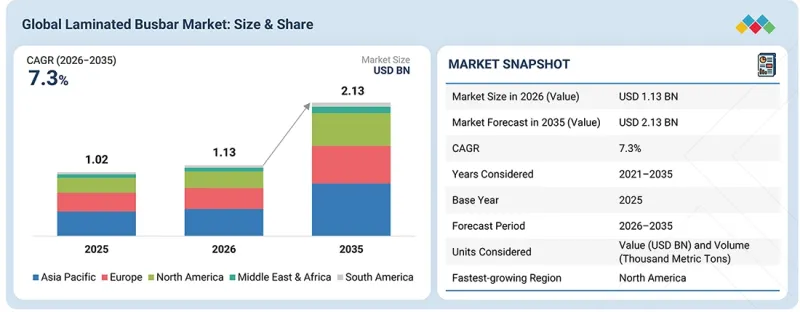
The global laminated busbar market is estimated to grow from USD 1.02 billion in 2025 to USD 1.13 billion in 2026 and reach USD 2.13 billion by 2035, registering a CAGR of 7.3%. The growth of the market is primarily driven by the rising electrification of transportation and industrial systems, along with continued investments in renewable energy, energy storage, and digital infrastructure. These developments are increasing the deployment of power converters, inverters, battery systems, and other high-power equipment that require efficient and reliable electrical interconnection solutions.
| Scope of the Report | |
|---|---|
| Years Considered for the Study | 2021-2035 |
| Base Year | 2025 |
| Forecast Period | 2026-2035 |
| Units Considered | Value, Volume ( Thousand Metric Tons) |
| Segments | by Conductor Material, Insulation Material, Voltage, Current Rating, Application, End User Industry, Region |
| Regions covered | Asia Pacific, North America, Europe, Middle East & Africa, South America |
The broader growth in global electricity demand from industry, electric vehicles, and data centers further supports the expansion of power-intensive electrical infrastructure.
The global laminated busbar market is also undergoing a significant transformation as equipment manufacturers increasingly prioritize higher power density, system miniaturization, and improved electrical performance. The growing adoption of advanced power electronics is creating greater demand for customized laminated busbars designed to meet specific requirements related to current carrying capacity, thermal management, insulation, and equipment configuration. Manufacturers are increasingly collaborating with OEMs and system developers at the design stage, making engineering capabilities and application-specific product development important competitive factors. At the same time, continued expansion of renewable generation, electric mobility, industrial electrification, and data center capacity is accelerating the transition toward more sophisticated power architectures, creating sustained opportunities for laminated busbar manufacturers.
"Epoxy powder coating held the second-largest share of the global laminated busbar market, by insulation material, in 2025."
Epoxy powder coating held the second-largest share of the global laminated busbar market in 2025, owing to its strong dielectric properties, high mechanical strength, and resistance to heat, chemicals, and harsh operating conditions. The material provides reliable electrical insulation and can be applied to complex busbar geometries, making it suitable for a wide range of high-power applications. Its cost-effectiveness and established manufacturing processes further support its widespread adoption across industrial equipment, power electronics, energy infrastructure, transportation, and other electrical systems.
The segment is also supported by the increasing demand for compact and high-power-density electrical architectures, where insulation performance and reliability are critical. Epoxy powder-coated busbars can provide durable dielectric protection while supporting efficient system integration and space optimization. Major laminated busbar suppliers, including Mersen and Rogers, offer epoxy powder-coated busbar solutions for demanding applications, highlighting their established role across transportation, industrial, communication, and power-distribution equipment.
"Low voltage segment accounted for the largest market share in 2025."
Low voltage laminated busbars accounted for the largest share of the global laminated busbar market in 2025, supported by their extensive adoption across a broad range of power-electronic and electrical equipment. These busbars are widely used in electric vehicles, battery systems, renewable energy inverters, industrial equipment, data center power systems, and other applications that operate within the low voltage range. Their ability to provide efficient current distribution, low inductance, compact design, and effective thermal management makes them particularly suitable for equipment where space optimization and electrical performance are critical.
The continued expansion of electrified transportation, distributed energy systems, battery energy storage, and digital infrastructure is further strengthening demand for low-voltage laminated busbars. Increasing deployment of power converters, inverters, battery packs, and high-density power electronics is creating a large volume of applications requiring compact and customized electrical interconnection solutions. This broad applicability across multiple end-user industries supports the continued dominance of the low voltage segment in the global laminated busbar market.
Breakdown of Primaries:
In-depth interviews with key industry participants, subject-matter experts, C-level executives of key market players, and industry consultants, among other experts, were conducted to obtain and verify critical qualitative and quantitative information, as well as to assess future market prospects. The primary interviews were distributed as follows:
By Company Type: Tier 1 - 40%, Tier 2 - 35%, and Tier 3 - 25%
By Designation: C-Level Executives - 30%, Directors - 25%, and Managers - 45%
By Region: Asia Pacific - 35%, North America - 25%, Middle East & Africa - 12%, Europe - 20% and South America - 4%,
Notes: Managers include sales managers, production managers, and regional managers.
Tier 1 company: revenue >USD 5 billion; tier 2 company: revenue between USD 1 and USD 5 billion; and tier 3 company: revenue <USD 1 billion in 2025
Well-established global leaders predominantly govern the global laminated busbar market. Notable players in the global laminated busbar market include Amphenol Corporation (US), Methode Electronics, Inc. (US), Mersen Group (France), Rogers Corporation (US), Sun.King Technology Group Limited (China), Zhuzhou CRRC Times Electric Co., Ltd. (China), and Ryoden Kasei Co., Ltd. (Japan).
Research Coverage:
The report offers a detailed definition, description, and forecast of the global laminated busbar market, focusing on conductor material (copper, aluminum, copper-aluminum hybrid), insulation material (polyester, polyimide, epoxy powder coating, Nomex), voltage (low voltage, medium voltage, and high voltage), current rating (Below 250 A, 250-1,000 A, 1,001-3,000 A, above 3,000 A ), application (switchgear & power distribution, power conversion systems, inverters & converters, UPS & battery packs, busways, generator systems, EV chargers, DC power distribution), end user industry (utilities & grid infrastructure, industrial equipment, data centers (enterprise, colocation, hyperscale & AI/HPC, edge), commercial & residential buildings, battery energy storage systems (BESS), renewable energy, rail & transportation, electric mobility & charging infrastructure, others (telecom, aerospace & defense, medical equipment)), and region. It provides a qualitative and quantitative analysis of market drivers, restraints, opportunities, and challenges.
Key Benefits of Buying the Report
The report is thoughtfully designed to benefit both established industry leaders and newcomers in the global laminated busbar market. It provides reliable revenue forecasts for the entire market as well as its individual sub-segments. This data is a valuable resource for stakeholders, enabling them to gain a comprehensive understanding of the competitive landscape and formulate effective market strategies for their businesses. Furthermore, the report serves as a channel for stakeholders to grasp the current state of the market, providing essential insights into market drivers, limitations, challenges, and growth opportunities. By incorporating these insights, stakeholders can make well-informed decisions and stay informed about the constantly evolving dynamics of the global laminated busbar market.
- Analysis of key: drivers (Growing demand for safe and secure electrical distribution systems, Strong emphasis on renewables), restraints (High initial cost of laminated busbars, Growing competition from local firms or unorganized sector), opportunities (Aging electrical infrastructure and rising electricity demand, Increasing adoption of HVDC technology, Ongoing advancements in insulation materials), and challenges (Volatility in raw material prices, especially copper, environmental impact of improper disposal) influencing the growth of global laminated busbar market.
- Product Development/Innovation: Product development in the global laminated busbar market is increasingly focused on higher power density, lower inductance, improved thermal performance, and greater component integration. Manufacturers are developing customized and application-specific busbar designs for electric vehicles, battery energy storage systems, renewable energy converters, industrial drives, and data center power infrastructure. Innovation is also extending toward advanced dielectric materials, high-temperature busbars for wide-bandgap semiconductor applications, and compact multilayer designs that support higher current and voltage requirements. Mersen, for example, offers high-temperature busbars designed for elevated operating temperatures and integrated busbar assemblies incorporating functions such as cooling, fuses, and monitoring sensors
- Market Development: The global laminated busbar market is evolving toward higher-performance, compact, and application-specific electrical interconnection solutions, driven by the rapid expansion of electric mobility, renewable energy, battery energy storage, industrial automation, and data center infrastructure. Increasing power density requirements and the growing use of advanced power electronics are creating demand for laminated busbars with improved thermal management, lower inductance, enhanced insulation performance, and greater current-carrying capabilities. This is encouraging manufacturers to expand their engineering and production capabilities while working more closely with OEMs to develop customized solutions for specific equipment architectures. At the same time, advancements in conductor materials, insulation technologies, multilayer designs, and automated manufacturing are supporting the development of more efficient and reliable busbar systems. Market development is therefore shifting from conventional electrical interconnection toward integrated, compact, and technologically advanced laminated busbar solutions designed to meet the evolving requirements of global end-use industries.
- Market Diversification: The global laminated busbar market is becoming increasingly diversified across utilities & grid infrastructure, electric mobility, renewable energy, energy storage, industrial, and data center industries, reducing its dependence on any single application area. The rapid expansion of EV production, battery manufacturing, renewable power installations, and energy storage is creating new demand for compact and efficient electrical interconnection solutions. At the same time, increasing investments in industrial automation and digital infrastructure are broadening the application base for laminated busbars. This diversification is encouraging manufacturers to develop application-specific products with varying current ratings, conductor materials, insulation systems, and thermal management capabilities. As a result, market opportunities are expanding across a wider range of power-electronic and electrical equipment, creating a more diversified demand base for laminated busbar manufacturers globally
Competitive Assessment: A comprehensive evaluation has been conducted to scrutinize the market presence, growth strategies, and service offerings of key players in the global laminated busbar market. These prominent companies include Amphenol Corporation (US), Methode Electronics, Inc. (US), Mersen Group (France), Rogers Corporation (US), Sun.King Technology Group Limited (China), Zhuzhou CRRC Times Electric Co., Ltd. (China), Ryoden Kasei Co., Ltd. (Japan), and several others. This analysis provides in-depth insights into the competitive positions of these major players, their approaches to driving market growth, top companies' market shares within the global laminated busbar market.
TABLE OF CONTENTS
1 INTRODUCTION
- 1.1 STUDY OBJECTIVES
- 1.2 MARKET DEFINITION
- 1.3 STUDY SCOPE
- 1.3.1 MARKETS COVERED AND REGIONAL SCOPE
- 1.3.2 INCLUSIONS AND EXCLUSIONS
- 1.3.3 YEARS CONSIDERED
- 1.4 CURRENCY CONSIDERED
- 1.5 UNIT CONSIDERED
- 1.6 LIMITATIONS
- 1.7 STAKEHOLDERS
- 1.8 SUMMARY OF CHANGES
2 EXECUTIVE SUMMARY
- 2.1 MARKET HIGHLIGHTS AND KEY INSIGHTS
- 2.2 KEY MARKET PARTICIPANTS: MAPPING OF STRATEGIC DEVELOPMENTS
- 2.3 DISRUPTIVE TRENDS IN LAMINATED BUSBAR MARKET
- 2.4 HIGH GROWTH SEGMENTS
- 2.5 REGIONAL SNAPSHOT: MARKET SIZE, GROWTH RATE, AND FORECAST
3 PREMIUM INSIGHTS
- 3.1 ATTRACTIVE OPPORTUNITIES FOR PLAYERS IN LAMINATED BUSBAR MARKET
- 3.2 LAMINATED BUSBAR MARKET, BY REGION
- 3.3 LAMINATED BUSBAR MARKET IN ASIA PACIFIC, BY CONDUCTOR MATERIAL AND COUNTRY
- 3.4 LAMINATED BUSBAR MARKET, BY VOLTAGE
- 3.5 LAMINATED BUSBAR MARKET, BY INSULATION MATERIAL
- 3.6 LAMINATED BUSBAR MARKET, BY END-USE INDUSTRY
- 3.7 LAMINATED BUSBAR MARKET, BY REGION
4 MARKET OVERVIEW
- 4.1 INTRODUCTION
- 4.2 MARKET DYNAMICS
- 4.2.1 DRIVERS
- 4.2.1.1 Mounting adoption of power distribution systems and electric vehicles
- 4.2.1.2 Increasing investment in renewable energy storage infrastructure
- 4.2.1.3 Burgeoning demand for compact, energy-efficient, and reliable electrical devices
- 4.2.2 RESTRAINTS
- 4.2.2.1 High initial costs and raw material price volatility
- 4.2.2.2 Complex manufacturing process
- 4.2.3 OPPORTUNITIES
- 4.2.3.1 Rapid expansion of EV charging infrastructure
- 4.2.3.2 Increasing development of data centers and AI infrastructure
- 4.2.4 CHALLENGES
- 4.2.4.1 Issues in maintaining thermal and electrical reliability at high power densities
- 4.2.1 DRIVERS
- 4.3 UNMET NEEDS AND WHITE SPACES
- 4.4 INTERCONNECTED MARKETS AND CROSS-SECTOR OPPORTUNITIES
- 4.5 STRATEGIC MOVES BY TIER-1/2/3 PLAYERS
5 INDUSTRY TRENDS
- 5.1 PORTER'S FIVE FORCES ANALYSIS
- 5.1.1 INTENSITY OF COMPETITIVE RIVALRY
- 5.1.2 THREAT OF NEW ENTRANTS
- 5.1.3 BARGAINING POWER OF SUPPLIERS
- 5.1.4 BARGAINING POWER OF BUYERS
- 5.1.5 THREATS OF SUBSTITUTES
- 5.2 MACROECONOMIC OUTLOOK
- 5.2.1 INTRODUCTION
- 5.2.2 GDP TRENDS AND FORECAST
- 5.2.3 TRENDS IN GLOBAL ELECTRICAL EQUIPMENT & POWER DISTRIBUTION INDUSTRY
- 5.2.4 TRENDS IN GLOBAL DATA CENTERS INDUSTRY
- 5.3 VALUE CHAIN ANALYSIS
- 5.4 ECOSYSTEM ANALYSIS
- 5.5 PRICING ANALYSIS
- 5.5.1 AVERAGE SELLING PRICE TREND OF LAMINATED BUSBARS, BY VOLTAGE, 2022-2025
- 5.5.2 AVERAGE SELLING PRICE TREND OF LAMINATED BUSBARS, BY REGION, 2022-2025
- 5.6 TRADE ANALYSIS
- 5.6.1 IMPORT SCENARIO (HS CODE 853690)
- 5.6.2 EXPORT SCENARIO (HS CODE 853690)
- 5.7 KEY CONFERENCES AND EVENTS, 2026-2027
- 5.8 TRENDS/DISRUPTION IMPACTING CUSTOMER BUSINESS
- 5.9 CASE STUDY ANALYSIS
- 5.9.1 AUTOMOTIVE CELLS COMPANY SELECTS MERSEN TO SUPPLY SMART LAMINATED BUSBARS FOR NEXT-GENERATION EV BATTERIES
- 5.9.2 MOLEX DEVELOPS LIQUID-COOLED BUSBAR SOLUTION TO ADDRESS RISING POWER AND THERMAL MANAGEMENT DEMANDS IN AI DATA CENTERS
- 5.9.3 MERSEN PARTNERS WITH F&K DELVOTEC TO DEVELOP INFINI CELL BATTERY ASSEMBLY SOLUTION FOR HIGH-SPEED EV BATTERY ASSEMBLY
- 5.10 INVESTMENT AND FUNDING SCENARIO
- 5.11 IMPACT OF US TARIFFS - GLOBAL LAMINATED BUSBAR MARKET
- 5.11.1 INTRODUCTION
- 5.11.2 KEY TARIFF RATES
- 5.11.3 PRICE IMPACT ANALYSIS
- 5.11.4 IMPACT ON COUNTRIES/REGIONS
- 5.11.4.1 US
- 5.11.4.2 Europe
- 5.11.4.3 Asia Pacific
- 5.11.5 IMPACT ON APPLICATIONS
6 TECHNOLOGICAL ADVANCEMENTS, AI-DRIVEN IMPACT, PATENTS, INNOVATIONS, AND FUTURE APPLICATIONS
- 6.1 KEY TECHNOLOGIES
- 6.1.1 LOW-INDUCTANCE LAMINATED BUSBAR
- 6.1.2 ADVANCED INSULATION AND HIGH-TEMPERATURE LAMINATION
- 6.2 COMPLEMENTARY TECHNOLOGIES
- 6.2.1 SIC AND GAN
- 6.2.2 ADVANCED THERMAL-MANAGEMENT AND COOLING
- 6.3 ADJACENT TECHNOLOGIES
- 6.3.1 INTEGRATED DC-LINK/BUSBAR-CAPACITOR SYSTEMS
- 6.3.2 3D/EMBEDDED POWER-MODULE INTERCONNECTION
- 6.4 TECHNOLOGY/PRODUCT ROADMAP
- 6.4.1 SHORT-TERM (2026-2028) | MATERIAL DEVELOPMENT & PRODUCT ENHANCEMENT
- 6.4.2 MID-TERM (2028-2031) | HIGH-POWER DENSITY & ADVANCED POWER ELECTRONICS
- 6.4.3 LONG-TERM (2031-2035+) | SMART, INTEGRATED & NEXT-GENERATION POWER DISTRIBUTION
- 6.5 PATENT ANALYSIS
- 6.6 FUTURE APPLICATIONS
- 6.7 IMPACT OF AI/GEN AI ON LAMINATED BUSBAR MARKET
- 6.7.1 TOP USE CASES AND MARKET POTENTIAL
- 6.7.2 BEST PRACTICES FOLLOWED BY OEMS IN LAMINATED BUSBAR MARKET
- 6.7.3 CASE STUDIES RELATED TO AI/GEN AI IMPLEMENTATION IN LAMINATED BUSBAR MARKET
- 6.7.4 INTERCONNECTED ECOSYSTEM AND IMPACT ON MARKET PLAYERS
- 6.7.5 CLIENTS' READINESS TO ADOPT AI/GEN AI-INTEGRATED LAMINATED BUSBARS
- 6.8 SUCCESS STORIES AND REAL-WORLD APPLICATIONS
7 REGULATORY LANDSCAPE AND SUSTAINABILITY INITIATIVES
- 7.1 REGIONAL REGULATIONS AND COMPLIANCE
- 7.1.1 REGULATORY BODIES, GOVERNMENT AGENCIES, AND OTHER ORGANIZATIONS
- 7.1.2 INDUSTRY STANDARDS
- 7.2 SUSTAINABILITY INITIATIVES
- 7.3 IMPACT OF REGULATORY POLICIES ON SUSTAINABILITY INITIATIVES
- 7.4 CERTIFICATIONS, LABELING, AND ECO-STANDARDS
8 CUSTOMER LANDSCAPE AND BUYER BEHAVIOR
- 8.1 DECISION-MAKING PROCESS
- 8.2 KEY STAKEHOLDERS INVOLVED IN BUYING PROCESS AND THEIR EVALUATION CRITERIA
- 8.2.1 KEY STAKEHOLDERS IN BUYING PROCESS
- 8.2.2 BUYING CRITERIA
- 8.3 ADOPTION BARRIERS AND INTERNAL CHALLENGES
- 8.4 UNMET NEEDS OF VARIOUS END-USE INDUSTRIES
- 8.5 MARKET PROFITABILITY
9 LAMINATED BUSBAR MARKET, BY CONDUCTOR MATERIAL
- 9.1 INTRODUCTION
- 9.2 COPPER
- 9.2.1 SUPERIOR ELECTRICAL AND THERMAL CONDUCTIVITY TO CONTRIBUTE TO SEGMENTAL GROWTH
- 9.3 ALUMINUM
- 9.3.1 LIGHTWEIGHT AND IMPROVED EFFICIENCY TO ACCELERATE SEGMENTAL GROWTH
- 9.4 COPPER-ALUMINUM HYBRID
- 9.4.1 NEED TO OPTIMIZE ELECTRICAL PERFORMANCE, WEIGHT, AND MATERIAL UTILIZATION TO FOSTER SEGMENTAL GROWTH
10 LAMINATED BUSBAR MARKET, BY INSULATION MATERIAL
- 10.1 INTRODUCTION
- 10.2 POLYESTER
- 10.2.1 COST-EFFECTIVE THIN-FILM INSULATION AND BROAD APPLICATION COMPATIBILITY TO AUGMENT SEGMENTAL GROWTH
- 10.3 POLYIMIDE
- 10.3.1 ABILITY TO OPERATE UNDER HIGHER TEMPERATURES, GREATER ELECTRICAL STRESS, AND COMPACT SYSTEM ARCHITECTURES TO FUEL SEGMENTAL GROWTH
- 10.4 EPOXY POWDER COATING
- 10.4.1 SUPERIOR SURFACE PROTECTION AND COMPACT EQUIPMENT DESIGN TO BOLSTER SEGMENTAL GROWTH
- 10.5 NOMEX
- 10.5.1 LONG-TERM THERMAL ENDURANCE AND HIGH-RELIABILITY PERFORMANCE TO CONTRIBUTE TO SEGMENTAL GROWTH
11 LAMINATED BUSBAR MARKET, BY VOLTAGE
- 11.1 INTRODUCTION
- 11.2 LOW
- 11.2.1 EXPANDING ELECTRIC MOBILITY AND BATTERY STORAGE DEPLOYMENTS TO EXPEDITE SEGMENTAL GROWTH
- 11.3 MEDIUM
- 11.3.1 RISING POWER REQUIREMENT OF DIGITAL, RENEWABLE, AND TRANSPORT INFRASTRUCTURE TO ACCELERATE SEGMENTAL GROWTH
12 LAMINATED BUSBAR MARKET, BY CURRENT
- 12.1 INTRODUCTION
- 12.2 BELOW 250 A
- 12.2.1 RISING INDUSTRIAL AUTOMATION AND DEMAND FOR COMPACT POWER ELECTRONICS TO FACILITATE SEGMENTAL GROWTH
- 12.3 250-1,000 A
- 12.3.1 INCREASING MODERNIZATION OF TELECOMMUNICATIONS AND DISTRIBUTED POWER INFRASTRUCTURE TO BOOST SEGMENTAL GROWTH
- 12.4 1,001-3,000 A
- 12.4.1 RAPID EXPANSION OF SEMICONDUCTOR MANUFACTURING AND OTHER ADVANCED INDUSTRIAL FACILITIES TO AUGMENT SEGMENTAL GROWTH
- 12.5 ABOVE 3,000 A
- 12.5.1 RISING POWER DENSITY ACROSS DATA CENTERS AND LARGE-SCALE ELECTRICAL INFRASTRUCTURE TO FUEL SEGMENTAL GROWTH
13 LAMINATED BUSBAR MARKET, BY APPLICATION
- 13.1 INTRODUCTION
- 13.2 SWITCHGEAR & POWER DISTRIBUTION
- 13.2.1 INCREASING GRID MODERNIZATION AND POWER INFRASTRUCTURE INVESTMENT TO FOSTER SEGMENTAL GROWTH
- 13.3 POWER CONVERSION SYSTEMS
- 13.3.1 RAPID EXPANSION OF RENEWABLE ENERGY AND ENERGY STORAGE INFRASTRUCTURE TO BOLSTER SEGMENTAL GROWTH
- 13.4 INVERTERS & CONVERTERS
- 13.4.1 GROWING INTEGRATION OF SOLAR SYSTEMS WITH BATTERY STORAGE TO CONTRIBUTE TO SEGMENTAL GROWTH
- 13.5 UPS & BATTERY PACKS
- 13.5.1 RISING DEVELOPMENT OF TELECOMMUNICATION INFRASTRUCTURE TO EXPEDITE SEGMENTAL GROWTH
- 13.6 BUSWAYS
- 13.6.1 EXPANDING POWER-DENSE FACILITIES TO CONTRIBUTE TO SEGMENTAL GROWTH
- 13.7 GENERATOR SYSTEMS
- 13.7.1 GROWING POWER RESILIENCE REQUIREMENTS IN DATA CENTERS AND INDUSTRIAL SECTORS TO DRIVE MARKET
- 13.8 EV CHARGERS
- 13.8.1 RAPID EXPANSION OF HIGH-POWER CHARGING INFRASTRUCTURE TO AUGMENT SEGMENTAL GROWTH
- 13.9 DC POWER DISTRIBUTION
- 13.9.1 MOUNTING DEPLOYMENT OF BATTERY-BASED SYSTEMS TO FOSTER SEGMENTAL GROWTH
14 LAMINATED BUSBAR MARKET, BY END-USE INDUSTRY
- 14.1 INTRODUCTION
- 14.2 UTILITIES & GRID INFRASTRUCTURE
- 14.2.1 RAPID MODERNIZATION AND EXPANSION OF TRANSMISSION AND DISTRIBUTION NETWORKS TO BOOST SEGMENTAL GROWTH
- 14.3 INDUSTRIAL EQUIPMENT
- 14.3.1 RISING ELECTRIFICATION AND POWER DENSITY OF INDUSTRIAL MACHINERY TO ACCELERATE SEGMENTAL GROWTH
- 14.4 DATA CENTERS
- 14.4.1 INCREASING COMPUTE DENSITY AND AI INFRASTRUCTURE INVESTMENT TO EXPEDITE SEGMENTAL GROWTH
- 14.5 ELECTRIC MOBILITY & CHARGING INFRASTRUCTURE
- 14.5.1 EXPANDING EV FLEETS, HIGHER-POWER CHARGING, AND ELECTRIFIED TRANSPORT ARCHITECTURES TO FOSTER SEGMENTAL GROWTH
- 14.6 BATTERY ENERGY STORAGE SYSTEM
- 14.6.1 GROWING SCALE AND POWER DENSITY OF BATTERY SYSTEMS TO ACCELERATE SEGMENTAL GROWTH
- 14.7 RENEWABLE ENERGY
- 14.7.1 INCREASING SOLAR PV CAPACITY ADDITIONS AND INVERTER-BASED POWER GENERATION TO CONTRIBUTE TO SEGMENTAL GROWTH
- 14.8 COMMERCIAL & RESIDENTIAL BUILDINGS
- 14.8.1 RISING ELECTRIFICATION AND POWER-MANAGEMENT REQUIREMENTS OF BUILDINGS TO FUEL SEGMENTAL GROWTH
- 14.9 RAIL & TRANSPORTATION
- 14.9.1 CONTINUED TRANSITION TOWARD ELECTRIFIED SYSTEMS TO EXPEDITE SEGMENTAL GROWTH
- 14.10 OTHERS
15 LAMINATED BUSBAR MARKET, BY REGION
- 15.1 INTRODUCTION
- 15.2 ASIA PACIFIC
- 15.2.1 CHINA
- 15.2.1.1 Large-scale EV production and rapid energy storage deployment to boost market growth
- 15.2.2 INDIA
- 15.2.2.1 Accelerating power-capacity additions strengthen demand for high-current distribution and conversion systems
- 15.2.3 JAPAN
- 15.2.3.1 Increasing electrification and investment in semiconductor and advanced electronics manufacturing to drive market
- 15.2.4 AUSTRALIA
- 15.2.4.1 Rapid deployment of utility-scale battery storage systems to expedite market growth
- 15.2.5 SOUTH KOREA
- 15.2.5.1 Rising advanced semiconductor manufacturing and AI computing infrastructure development to fuel market growth
- 15.2.6 REST OF ASIA PACIFIC
- 15.2.1 CHINA
- 15.3 EUROPE
- 15.3.1 GERMANY
- 15.3.1.1 Substantial grid expansion, industrial automation, and energy-transition investments to foster market growth
- 15.3.2 UK
- 15.3.2.1 Increasing grid modernization, renewable-energy integration, and data center growth to drive market
- 15.3.3 FRANCE
- 15.3.3.1 Rising development of electricity infrastructure, industrial base, and nuclear and renewable-energy systems to support market growth
- 15.3.4 ITALY
- 15.3.4.1 Expanding industrial base, renewable energy and rail infrastructure, and grid modernization needs to boost market growth
- 15.3.5 SPAIN
- 15.3.5.1 Increasing renewable energy development, EV manufacturing, and industrial electrification to accelerate market growth
- 15.3.6 REST OF EUROPE
- 15.3.1 GERMANY
- 15.4 NORTH AMERICA
- 15.4.1 US
- 15.4.1.1 Rapid expansion of AI and hyperscale data centers to contribute to market growth
- 15.4.2 CANADA
- 15.4.2.1 Rising clean electricity generation and industrial electrification infrastructure development to expedite market growth
- 15.4.3 MEXICO
- 15.4.3.1 Thriving automotive industry ecosystem and manufacturing capacity expansion to bolster market growth
- 15.4.1 US
- 15.5 MIDDLE EAST & AFRICA
- 15.5.1 GCC
- 15.5.1.1 Saudi Arabia
- 15.5.1.1.1 Increasing investment in power infrastructure and expansion of installed generation capacity to drive market
- 15.5.1.2 UAE
- 15.5.1.2.1 Rapid expansion of transmission network and grid capacity to bolster market growth
- 15.5.1.3 Rest of GCC
- 15.5.1.1 Saudi Arabia
- 15.5.2 SOUTH AFRICA
- 15.5.2.1 Rising implementation of ambitious transmission expansion plans to augment market growth
- 15.5.3 REST OF MIDDLE EAST & AFRICA
- 15.5.1 GCC
- 15.6 SOUTH AMERICA
- 15.6.1 BRAZIL
- 15.6.1.1 Continued expansion of renewable generation and transmission infrastructure to expedite market growth
- 15.6.2 ARGENTINA
- 15.6.2.1 Increasing development of battery energy storage and renewable-energy infrastructure to drive market
- 15.6.3 CHILE
- 15.6.3.1 Mounting adoption of utility-scale solar generation and battery energy storage systems to fuel market growth
- 15.6.4 REST OF SOUTH AMERICA
- 15.6.1 BRAZIL
16 COMPETITIVE LANDSCAPE
- 16.1 OVERVIEW
- 16.2 KEY PLAYER COMPETITIVE STRATEGIES/RIGHT TO WIN, 2023-2026
- 16.3 MARKET SHARE ANALYSIS, 2025
- 16.4 REVENUE ANALYSIS, 2021-2025
- 16.5 COMPANY EVALUATION MATRIX: KEY PLAYERS, 2025
- 16.5.1 STARS
- 16.5.2 EMERGING LEADERS
- 16.5.3 PERVASIVE PLAYERS
- 16.5.4 PARTICIPANTS
- 16.5.5 COMPANY FOOTPRINT: KEY PLAYERS, 2025
- 16.5.5.1 Region footprint
- 16.5.5.2 Conductor material footprint
- 16.5.5.3 End-use industry footprint
- 16.5.5.4 Application footprint
- 16.5.5.5 Voltage footprint
- 16.5.5.6 Current footprint
- 16.6 COMPANY EVALUATION MATRIX: STARTUPS/SMES, 2025
- 16.6.1 PROGRESSIVE COMPANIES
- 16.6.2 RESPONSIVE COMPANIES
- 16.6.3 DYNAMIC COMPANIES
- 16.6.4 STARTING BLOCKS
- 16.6.5 COMPETITIVE BENCHMARKING: STARTUPS/SMES, 2025
- 16.6.5.1 Detailed list of key startups/SMEs
- 16.6.5.2 Competitive benchmarking of key startups/SMEs
- 16.7 COMPANY VALUATION AND FINANCIAL METRICS
- 16.8 BRAND COMPARISON
- 16.8.1 AMPHENOL CORPORATION (US)
- 16.8.2 METHODE ELECTRONICS (US)
- 16.8.3 MERSEN (FRANCE)
- 16.8.4 ROGERS CORPORATION (US)
- 16.8.5 SUN.KING TECHNOLOGY GROUP LIMITED (CHINA)
- 16.9 COMPETITIVE SCENARIO
- 16.9.1 PRODUCT LAUNCHES
- 16.9.2 DEALS
- 16.9.3 EXPANSIONS
17 COMPANY PROFILES
- 17.1 KEY PLAYERS
- 17.1.1 AMPHENOL CORPORATION
- 17.1.1.1 Business overview
- 17.1.1.2 Products/Solutions/Services offered
- 17.1.1.3 Recent developments
- 17.1.1.3.1 Deals
- 17.1.1.3.2 Expansions
- 17.1.1.4 MnM view
- 17.1.1.4.1 Key strengths/Right to win
- 17.1.1.4.2 Strategic choices
- 17.1.1.4.3 Weaknesses/Competitive threats
- 17.1.2 METHODE ELECTRONICS
- 17.1.2.1 Business overview
- 17.1.2.2 Products/Solutions/Services offered
- 17.1.2.3 Recent developments
- 17.1.2.3.1 Deals
- 17.1.2.4 MnM view
- 17.1.2.4.1 Key strengths/Right to win
- 17.1.2.4.2 Strategic choices
- 17.1.2.4.3 Weaknesses/Competitive threats
- 17.1.3 MERSEN
- 17.1.3.1 Business overview
- 17.1.3.2 Products/Solutions/Services offered
- 17.1.3.3 Recent developments
- 17.1.3.3.1 Product launches
- 17.1.3.3.2 Deals
- 17.1.3.4 MnM view
- 17.1.3.4.1 Key strengths/Right to win
- 17.1.3.4.2 Strategic choices
- 17.1.3.4.3 Weaknesses/Competitive threats
- 17.1.4 ROGERS CORPORATION
- 17.1.4.1 Business overview
- 17.1.4.2 Products/Solutions/Services offered
- 17.1.4.3 Recent developments
- 17.1.4.3.1 Deals
- 17.1.4.3.2 Expansions
- 17.1.4.4 MnM view
- 17.1.4.4.1 Key strengths/Right to win
- 17.1.4.4.2 Strategic choices
- 17.1.4.4.3 Weaknesses/Competitive threats
- 17.1.5 SUN.KING TECHNOLOGY GROUP LIMITED
- 17.1.5.1 Business overview
- 17.1.5.2 Products/Solutions/Services offered
- 17.1.5.3 MnM view
- 17.1.5.3.1 Key strengths/Right to win
- 17.1.5.3.2 Strategic choices
- 17.1.5.3.3 Weaknesses/Competitive threats
- 17.1.6 ZHUZHOU CRRC TIMES ELECTRIC CO., LTD.
- 17.1.6.1 Business overview
- 17.1.6.2 Products/Solutions/Services offered
- 17.1.7 RYODEN KASEI CO., LTD.
- 17.1.7.1 Business overview
- 17.1.7.2 Products/Solutions/Services offered
- 17.1.8 EAE ELECTRIC
- 17.1.8.1 Business overview
- 17.1.8.2 Products/Solutions/Services offered
- 17.1.9 SHANGHAI EAGTOP ELECTRONIC TECHNOLOGY CO., LTD.
- 17.1.9.1 Business overview
- 17.1.9.2 Products/Solutions/Services offered
- 17.1.10 SHENZHEN BUSBAR SCI-TECH DEVELOPMENT CO., LTD.
- 17.1.10.1 Business overview
- 17.1.10.2 Products/Solutions/Services offered
- 17.1.11 STORM POWER COMPONENTS
- 17.1.11.1 Business overview
- 17.1.11.2 Products/Solutions/Services offered
- 17.1.12 SUZHOU WEST DEANE MACHINERY INC.
- 17.1.12.1 Business overview
- 17.1.12.2 Products/Solutions/Services offered
- 17.1.13 ELECTRONIC SYSTEMS PACKAGING LLC
- 17.1.13.1 Business overview
- 17.1.13.2 Products/Solutions/Services offered
- 17.1.14 RAYCHEM RPG PRIVATE LIMITED
- 17.1.14.1 Business overview
- 17.1.14.2 Products/Solutions/Services offered
- 17.1.15 MOLEX
- 17.1.15.1 Business overview
- 17.1.15.2 Products/Solutions/Services offered
- 17.1.16 SHENZHEN WOER ELECTRIC TECHNOLOGY CO., LTD.
- 17.1.16.1 Business overview
- 17.1.16.2 Products/Solutions/Services offered
- 17.1.1 AMPHENOL CORPORATION
- 17.2 OTHER PLAYERS
- 17.2.1 ZHEJIANG RHI ELECTRIC CO., LTD.
- 17.2.2 SEGUE ELECTRONICS, INC.
- 17.2.3 KINTO GROUP
- 17.2.4 TULING
- 17.2.5 CARSAI PRECISION PARTS
- 17.2.6 ERIE INDUSTRIAL PRODUCTS
- 17.2.7 XIAMEN APOLLO STAMPING WELDING TECHNOLOGY CO., LTD.
- 17.2.8 XIAMEN NEER ELECTRONIC TECHNOLOGY CO., LTD.
- 17.2.9 DRAMETAL
18 RESEARCH METHODOLOGY
- 18.1 RESEARCH DATA
- 18.1.1 SECONDARY DATA
- 18.1.1.1 List of key secondary sources
- 18.1.1.2 Key data from secondary sources
- 18.1.2 PRIMARY DATA
- 18.1.2.1 Key data from primary sources
- 18.1.2.2 List of primary interview participants
- 18.1.2.3 Key industry insights
- 18.1.2.4 Breakdown of primary interviews
- 18.1.1 SECONDARY DATA
- 18.2 MARKET SIZE ESTIMATION
- 18.2.1 BOTTOM-UP APPROACH
- 18.2.2 TOP-DOWN APPROACH
- 18.2.3 MARKET SIZE CALCULATION FOR BASE YEAR
- 18.2.3.1 Demand-side analysis
- 18.2.3.1.1 Demand-side assumptions
- 18.2.3.1.2 Demand-side calculations
- 18.2.3.2 Supply-side analysis
- 18.2.3.2.1 Supply-side assumptions
- 18.2.3.2.2 Supply-side calculations
- 18.2.3.1 Demand-side analysis
- 18.3 MARKET FORECAST APPROACH
- 18.3.1 DEMAND SIDE
- 18.3.2 SUPPLY SIDE
- 18.4 DATA TRIANGULATION
- 18.5 FACTOR ANALYSIS
- 18.6 RESEARCH ASSUMPTIONS AND LIMITATIONS
- 18.7 RISK ANALYSIS
19 APPENDIX
- 19.1 INSIGHTS FROM INDUSTRY EXPERTS
- 19.2 DISCUSSION GUIDE
- 19.3 KNOWLEDGESTORE: MARKETSANDMARKETS' SUBSCRIPTION PORTAL
- 19.4 CUSTOMIZATION OPTIONS
- 19.5 RELATED REPORTS
- 19.6 AUTHOR DETAILS
List of Tables
- TABLE 1 LAMINATED BUSBAR MARKET: INCLUSIONS AND EXCLUSIONS
- TABLE 2 LAMINATED BUSBAR MARKET: SUMMARY OF CHANGES
- TABLE 3 INTERCONNECTED MARKETS
- TABLE 4 KEY MOVES AND STRATEGIC FOCUS OF TIER-1/2/3 PLAYERS
- TABLE 5 IMPACT OF PORTER'S FIVE FORCES
- TABLE 6 ROLE OF COMPANIES IN LAMINATED BUSBAR ECOSYSTEM
- TABLE 7 AVERAGE SELLING PRICE TREND OF LAMINATED BUSBARS, BY VOLTAGE, 2022-2025 (USD/KG)
- TABLE 8 AVERAGE SELLING PRICE TREND OF LAMINATED BUSBARS, BY REGION, 2022-2025 (USD/KG)
- TABLE 9 IMPORT DATA FOR HS CODE 853690-COMPLIANT PRODUCTS, BY COUNTRY, 2021-2025 (USD THOUSAND)
- TABLE 10 EXPORT DATA FOR HS CODE 853690-COMPLIANT PRODUCTS, BY COUNTRY, 2021-2025 (USD THOUSAND)
- TABLE 11 LIST OF KEY CONFERENCES AND EVENTS, 2026-2027
- TABLE 12 MERSEN GROUP DEVELOPS SMART LAMINATED BUSBARS FOR NEXT-GENERATION EV BATTERIES OF AUTOMOTIVE CELLS COMPANY
- TABLE 13 MOLEX PROVIDES LIQUID-COOLED BUSBAR TO SUPPORT EFFICIENT POWER DISTRIBUTION IN HIGH-POWER AI DATA CENTERS
- TABLE 14 MERSEN UNITES WITH F&K DELVOTEC TO DEVELOP INFINI CELL BATTERY ASSEMBLY SOLUTION TO OPTIMIZE EV BATTERY ASSEMBLY
- TABLE 15 US-ADJUSTED RECIPROCAL TARIFF RATES
- TABLE 16 EXPECTED CHANGE IN PRICES AND POTENTIAL IMPACT ON MARKET PLAYERS DUE TO TARIFFS
- TABLE 17 LIST OF KEY PATENTS, 2025-2026
- TABLE 18 AI-DRIVEN DATA CENTERS & HIGH-DENSITY COMPUTING
- TABLE 19 RENEWABLE ENERGY & POWER CONVERSION SYSTEMS
- TABLE 20 MICROGRIDS & VIRTUAL POWER PLANTS (VPPS)
- TABLE 21 GRID-SCALE ENERGY STORAGE & BATTERY SYSTEMS
- TABLE 22 NEXT-GENERATION INDUSTRIAL & POWER ELECTRONICS
- TABLE 23 MAJOR USE CASES AND MARKET POTENTIAL
- TABLE 24 BEST PRACTICES FOLLOWED BY COMPANIES
- TABLE 25 CASE STUDIES RELATED TO AI/GEN AI IMPLEMENTATION
- TABLE 26 INTERCONNECTED ECOSYSTEM AND IMPACT ON LAMINATED BUSBAR MARKET PLAYERS
- TABLE 27 NORTH AMERICA: REGULATORY BODIES, GOVERNMENT AGENCIES, AND OTHER ORGANIZATIONS
- TABLE 28 EUROPE: REGULATORY BODIES, GOVERNMENT AGENCIES, AND OTHER ORGANIZATIONS
- TABLE 29 ASIA PACIFIC: REGULATORY BODIES, GOVERNMENT AGENCIES, AND OTHER ORGANIZATIONS
- TABLE 30 SOUTH AMERICA: REGULATORY BODIES, GOVERNMENT AGENCIES, AND OTHER ORGANIZATIONS
- TABLE 31 MIDDLE EAST & AFRICA: REGULATORY BODIES, GOVERNMENT AGENCIES, AND OTHER ORGANIZATIONS
- TABLE 32 GLOBAL INDUSTRY STANDARDS
- TABLE 33 CERTIFICATIONS, LABELING, AND ECO-STANDARDS IN LAMINATED BUSBAR MARKET
- TABLE 34 INFLUENCE OF STAKEHOLDERS ON BUYING PROCESS FOR THREE MAJOR END-USE INDUSTRIES (%)
- TABLE 35 BUYING CRITERIA FOR THREE MAJOR END-USE INDUSTRIES
- TABLE 36 UNMET NEEDS, BY END-USE INDUSTRY
- TABLE 37 LAMINATED BUSBAR MARKET, BY CONDUCTOR MATERIAL, 2021-2025 (USD MILLION)
- TABLE 38 LAMINATED BUSBAR MARKET, BY CONDUCTOR MATERIAL, 2026-2035 (USD MILLION)
- TABLE 39 COPPER: LAMINATED BUSBAR MARKET, BY REGION, 2021-2025 (USD MILLION)
- TABLE 40 COPPER: LAMINATED BUSBAR MARKET, BY REGION, 2026-2035 (USD MILLION)
- TABLE 41 ALUMINUM: LAMINATED BUSBAR MARKET, BY REGION, 2021-2025 (USD MILLION)
- TABLE 42 ALUMINUM: LAMINATED BUSBAR MARKET, BY REGION, 2026-2035 (USD MILLION)
- TABLE 43 COPPER-ALUMINUM HYBRID: LAMINATED BUSBAR MARKET, BY REGION, 2021-2025 (USD MILLION)
- TABLE 44 COPPER-ALUMINUM HYBRID: LAMINATED BUSBAR MARKET, BY REGION, 2026-2035 (USD MILLION)
- TABLE 45 LAMINATED BUSBAR MARKET, BY INSULATION MATERIAL, 2021-2025 (USD MILLION)
- TABLE 46 LAMINATED BUSBAR MARKET, BY INSULATION MATERIAL, 2026-2035 (USD MILLION)
- TABLE 47 POLYESTER: LAMINATED BUSBAR MARKET, BY REGION, 2021-2025 (USD MILLION)
- TABLE 48 POLYESTER: LAMINATED BUSBAR MARKET, BY REGION, 2026-2035 (USD MILLION)
- TABLE 49 POLYIMIDE: LAMINATED BUSBAR MARKET, BY REGION, 2021-2025 (USD MILLION)
- TABLE 50 POLYIMIDE: LAMINATED BUSBAR MARKET, BY REGION, 2026-2035 (USD MILLION)
- TABLE 51 EPOXY POWDER COATING: LAMINATED BUSBAR MARKET, BY REGION, 2021-2025 (USD MILLION)
- TABLE 52 EPOXY POWDER COATING: LAMINATED BUSBAR MARKET, BY REGION, 2026-2035 (USD MILLION)
- TABLE 53 NOMEX: LAMINATED BUSBAR MARKET, BY REGION, 2021-2025 (USD MILLION)
- TABLE 54 NOMEX: LAMINATED BUSBAR MARKET, BY REGION, 2026-2035 (USD MILLION)
- TABLE 55 LAMINATED BUSBAR MARKET, BY VOLTAGE, 2021-2025 (USD MILLION)
- TABLE 56 LAMINATED BUSBAR MARKET, BY VOLTAGE, 2026-2035 (USD MILLION)
- TABLE 57 LOW: LAMINATED BUSBAR MARKET, BY REGION, 2021-2025 (USD MILLION)
- TABLE 58 LOW: LAMINATED BUSBAR MARKET, BY REGION, 2026-2035 (USD MILLION)
- TABLE 59 MEDIUM: LAMINATED BUSBAR MARKET, BY REGION, 2021-2025 (USD MILLION)
- TABLE 60 MEDIUM: LAMINATED BUSBAR MARKET, BY REGION, 2026-2035 (USD MILLION)
- TABLE 61 LAMINATED BUSBAR MARKET, BY CURRENT, 2021-2025 (USD MILLION)
- TABLE 62 LAMINATED BUSBAR MARKET, BY CURRENT, 2026-2035 (USD MILLION)
- TABLE 63 BELOW 250 A: LAMINATED BUSBAR MARKET, BY REGION, 2021-2025 (USD MILLION)
- TABLE 64 BELOW 250 A: LAMINATED BUSBAR MARKET, BY REGION, 2026-2035 (USD MILLION)
- TABLE 65 250-1,000 A: LAMINATED BUSBAR MARKET, BY REGION, 2021-2025 (USD MILLION)
- TABLE 66 250-1,000 A: LAMINATED BUSBAR MARKET, BY REGION, 2026-2035 (USD MILLION)
- TABLE 67 1,001-3,000 A: LAMINATED BUSBAR MARKET, BY REGION, 2021-2025 (USD MILLION)
- TABLE 68 1,001-3,000 A: LAMINATED BUSBAR MARKET, BY REGION, 2026-2035 (USD MILLION)
- TABLE 69 ABOVE 3,000 A: LAMINATED BUSBAR MARKET, BY REGION, 2021-2025 (USD MILLION)
- TABLE 70 ABOVE 3,000 A: LAMINATED BUSBAR MARKET, BY REGION, 2026-2035 (USD MILLION)
- TABLE 71 LAMINATED BUSBAR MARKET, BY APPLICATION, 2021-2025 (USD MILLION)
- TABLE 72 LAMINATED BUSBAR MARKET, BY APPLICATION, 2026-2035 (USD MILLION)
- TABLE 73 SWITCHGEAR & POWER DISTRIBUTION: LAMINATED BUSBAR MARKET, BY REGION, 2021-2025 (USD MILLION)
- TABLE 74 SWITCHGEAR & POWER DISTRIBUTION: LAMINATED BUSBAR MARKET, BY REGION, 2026-2035 (USD MILLION)
- TABLE 75 POWER CONVERSION SYSTEMS: LAMINATED BUSBAR MARKET, BY REGION, 2021-2025 (USD MILLION)
- TABLE 76 POWER CONVERSION SYSTEMS: LAMINATED BUSBAR MARKET, BY REGION, 2026-2035 (USD MILLION)
- TABLE 77 INVERTERS & CONVERTERS: LAMINATED BUSBAR MARKET, BY REGION, 2021-2025 (USD MILLION)
- TABLE 78 INVERTERS & CONVERTERS: LAMINATED BUSBAR MARKET, BY REGION, 2026-2035 (USD MILLION)
- TABLE 79 UPS & BATTERY PACKS: LAMINATED BUSBAR MARKET, BY REGION, 2021-2025 (USD MILLION)
- TABLE 80 UPS & BATTERY PACKS: LAMINATED BUSBAR MARKET, BY REGION, 2026-2035 (USD MILLION)
- TABLE 81 BUSWAYS: LAMINATED BUSBAR MARKET, BY REGION, 2021-2025 (USD MILLION)
- TABLE 82 BUSWAYS: LAMINATED BUSBAR MARKET, BY REGION, 2026-2035 (USD MILLION)
- TABLE 83 GENERATOR SYSTEMS: LAMINATED BUSBAR MARKET, BY REGION, 2021-2025 (USD MILLION)
- TABLE 84 GENERATOR SYSTEMS: LAMINATED BUSBAR MARKET, BY REGION, 2026-2035 (USD MILLION)
- TABLE 85 EV CHARGERS: LAMINATED BUSBAR MARKET, BY REGION, 2021-2025 (USD MILLION)
- TABLE 86 EV CHARGERS: LAMINATED BUSBAR MARKET, BY REGION, 2026-2035 (USD MILLION)
- TABLE 87 DC POWER DISTRIBUTION: LAMINATED BUSBAR MARKET, BY REGION, 2021-2025 (USD MILLION)
- TABLE 88 DC POWER DISTRIBUTION: LAMINATED BUSBAR MARKET, BY REGION, 2026-2035 (USD MILLION)
- TABLE 89 LAMINATED BUSBAR MARKET, BY END-USE INDUSTRY, 2021-2025 (USD MILLION)
- TABLE 90 LAMINATED BUSBAR MARKET, BY END-USE INDUSTRY, 2026-2035 (USD MILLION)
- TABLE 91 UTILITIES & GRID INFRASTRUCTURE: LAMINATED BUSBAR MARKET, BY REGION, 2021-2025 (USD MILLION)
- TABLE 92 UTILITIES & GRID INFRASTRUCTURE: LAMINATED BUSBAR MARKET, BY REGION, 2026-2035 (USD MILLION)
- TABLE 93 INDUSTRIAL EQUIPMENT: LAMINATED BUSBAR MARKET, BY REGION, 2021-2025 (USD MILLION)
- TABLE 94 INDUSTRIAL EQUIPMENT: LAMINATED BUSBAR MARKET, BY REGION, 2026-2035 (USD MILLION)
- TABLE 95 DATA CENTERS: LAMINATED BUSBAR MARKET, BY REGION, 2021-2025 (USD MILLION)
- TABLE 96 DATA CENTERS: LAMINATED BUSBAR MARKET, BY REGION, 2026-2035 (USD MILLION)
- TABLE 97 ELECTRIC MOBILITY & CHARGING INFRASTRUCTURE: LAMINATED BUSBAR MARKET, BY REGION, 2021-2025 (USD MILLION)
- TABLE 98 ELECTRIC MOBILITY & CHARGING INFRASTRUCTURE: LAMINATED BUSBAR MARKET, BY REGION, 2026-2035 (USD MILLION)
- TABLE 99 BATTERY ENERGY STORAGE SYSTEM: LAMINATED BUSBAR MARKET, BY REGION, 2021-2025 (USD MILLION)
- TABLE 100 BATTERY ENERGY STORAGE SYSTEM: LAMINATED BUSBAR MARKET, BY REGION, 2026-2035 (USD MILLION)
- TABLE 101 RENEWABLE ENERGY: LAMINATED BUSBAR MARKET, BY REGION, 2021-2025 (USD MILLION)
- TABLE 102 RENEWABLE ENERGY: LAMINATED BUSBAR MARKET, BY REGION, 2026-2035 (USD MILLION)
- TABLE 103 COMMERCIAL & RESIDENTIAL BUILDINGS: LAMINATED BUSBAR MARKET, BY REGION, 2021-2025 (USD MILLION)
- TABLE 104 COMMERCIAL & RESIDENTIAL BUILDINGS: LAMINATED BUSBAR MARKET, BY REGION, 2026-2035 (USD MILLION)
- TABLE 105 RAIL & TRANSPORTATION: LAMINATED BUSBAR MARKET, BY REGION, 2021-2025 (USD MILLION)
- TABLE 106 RAIL & TRANSPORTATION: LAMINATED BUSBAR MARKET, BY REGION, 2026-2035 (USD MILLION)
- TABLE 107 OTHERS: LAMINATED BUSBAR MARKET, BY REGION, 2021-2025 (USD MILLION)
- TABLE 108 OTHERS: LAMINATED BUSBAR MARKET, BY REGION, 2026-2035 (USD MILLION)
- TABLE 109 LAMINATED BUSBAR MARKET, BY REGION, 2021-2025 (USD MILLION)
- TABLE 110 LAMINATED BUSBAR MARKET, BY REGION, 2026-2035 (USD MILLION)
- TABLE 111 LAMINATED BUSBAR MARKET, BY REGION, 2021-2025 (THOUSAND METRIC TONS)
- TABLE 112 LAMINATED BUSBAR MARKET, BY REGION, 2026-2035 (THOUSAND METRIC TONS)
- TABLE 113 ASIA PACIFIC: LAMINATED BUSBAR MARKET, BY COUNTRY, 2021-2025 (USD MILLION)
- TABLE 114 ASIA PACIFIC: LAMINATED BUSBAR MARKET, BY COUNTRY, 2026-2035 (USD MILLION)
- TABLE 115 ASIA PACIFIC: LAMINATED BUSBAR MARKET, BY CONDUCTOR MATERIAL, 2021-2025 (USD MILLION)
- TABLE 116 ASIA PACIFIC: LAMINATED BUSBAR MARKET, BY CONDUCTOR MATERIAL, 2026-2035 (USD MILLION)
- TABLE 117 ASIA PACIFIC: LAMINATED BUSBAR MARKET, BY INSULATION MATERIAL, 2021-2025 (USD MILLION)
- TABLE 118 ASIA PACIFIC: LAMINATED BUSBAR MARKET, BY INSULATION MATERIAL, 2026-2035 (USD MILLION)
- TABLE 119 ASIA PACIFIC: LAMINATED BUSBAR MARKET, BY VOLTAGE, 2021-2025 (USD MILLION)
- TABLE 120 ASIA PACIFIC: LAMINATED BUSBAR MARKET, BY VOLTAGE, 2026-2035 (USD MILLION)
- TABLE 121 ASIA PACIFIC: LAMINATED BUSBAR MARKET, BY CURRENT, 2021-2025 (USD MILLION)
- TABLE 122 ASIA PACIFIC: LAMINATED BUSBAR MARKET, BY CURRENT, 2026-2035 (USD MILLION)
- TABLE 123 ASIA PACIFIC: LAMINATED BUSBAR MARKET, BY APPLICATION, 2021-2025 (USD MILLION)
- TABLE 124 ASIA PACIFIC: LAMINATED BUSBAR MARKET, BY APPLICATION, 2026-2035 (USD MILLION)
- TABLE 125 ASIA PACIFIC: LAMINATED BUSBAR MARKET, BY END-USE INDUSTRY, 2021-2025 (USD MILLION)
- TABLE 126 ASIA PACIFIC: LAMINATED BUSBAR MARKET, BY END-USE INDUSTRY, 2026-2035 (USD MILLION)
- TABLE 127 CHINA: LAMINATED BUSBAR MARKET, BY END-USE INDUSTRY, 2021-2025 (USD MILLION)
- TABLE 128 CHINA: LAMINATED BUSBAR MARKET, BY END-USE INDUSTRY, 2026-2035 (USD MILLION)
- TABLE 129 INDIA: LAMINATED BUSBAR MARKET, BY END-USE INDUSTRY, 2021-2025 (USD MILLION)
- TABLE 130 INDIA: LAMINATED BUSBAR MARKET, BY END-USE INDUSTRY, 2026-2035 (USD MILLION)
- TABLE 131 JAPAN: LAMINATED BUSBAR MARKET, BY END-USE INDUSTRY, 2021-2025 (USD MILLION)
- TABLE 132 JAPAN: LAMINATED BUSBAR MARKET, BY END-USE INDUSTRY, 2026-2035 (USD MILLION)
- TABLE 133 AUSTRALIA: LAMINATED BUSBAR MARKET, BY END-USE INDUSTRY, 2021-2025 (USD MILLION)
- TABLE 134 AUSTRALIA: LAMINATED BUSBAR MARKET, BY END-USE INDUSTRY, 2026-2035 (USD MILLION)
- TABLE 135 SOUTH KOREA: LAMINATED BUSBAR MARKET, BY END-USE INDUSTRY, 2021-2025 (USD MILLION)
- TABLE 136 SOUTH KOREA: LAMINATED BUSBAR MARKET, BY END-USE INDUSTRY, 2026-2035 (USD MILLION)
- TABLE 137 REST OF ASIA PACIFIC: LAMINATED BUSBAR MARKET, BY END-USE INDUSTRY, 2021-2025 (USD MILLION)
- TABLE 138 REST OF ASIA PACIFIC: LAMINATED BUSBAR MARKET, BY END-USE INDUSTRY, 2026-2035 (USD MILLION)
- TABLE 139 EUROPE: LAMINATED BUSBAR MARKET, BY COUNTRY, 2021-2025 (USD MILLION)
- TABLE 140 EUROPE: LAMINATED BUSBAR MARKET, BY COUNTRY, 2026-2035 (USD MILLION)
- TABLE 141 EUROPE: LAMINATED BUSBAR MARKET, BY CONDUCTOR MATERIAL, 2021-2025 (USD MILLION)
- TABLE 142 EUROPE: LAMINATED BUSBAR MARKET, BY CONDUCTOR MATERIAL, 2026-2035 (USD MILLION)
- TABLE 143 EUROPE: LAMINATED BUSBAR MARKET, BY END-USE INDUSTRY, 2021-2025 (USD MILLION)
- TABLE 144 EUROPE: LAMINATED BUSBAR MARKET, BY END-USE INDUSTRY, 2026-2035 (USD MILLION)
- TABLE 145 EUROPE: LAMINATED BUSBAR MARKET, BY INSULATION MATERIAL, 2021-2025 (USD MILLION)
- TABLE 146 EUROPE: LAMINATED BUSBAR MARKET, BY INSULATION MATERIAL, 2026-2035 (USD MILLION)
- TABLE 147 EUROPE: LAMINATED BUSBAR MARKET, BY VOLTAGE, 2021-2025 (USD MILLION)
- TABLE 148 EUROPE: LAMINATED BUSBAR MARKET, BY VOLTAGE, 2026-2035 (USD MILLION)
- TABLE 149 EUROPE: LAMINATED BUSBAR MARKET, BY CURRENT RATING, 2021-2025 (USD MILLION)
- TABLE 150 EUROPE: LAMINATED BUSBAR MARKET, BY CURRENT RATING, 2026-2035 (USD MILLION)
- TABLE 151 EUROPE: LAMINATED BUSBAR MARKET, BY APPLICATION, 2021-2025 (USD MILLION)
- TABLE 152 EUROPE: LAMINATED BUSBAR MARKET, BY APPLICATION, 2026-2035 (USD MILLION)
- TABLE 153 GERMANY: LAMINATED BUSBAR MARKET, BY END-USE INDUSTRY, 2021-2025 (USD MILLION)
- TABLE 154 GERMANY: LAMINATED BUSBAR MARKET, BY END-USE INDUSTRY, 2026-2035 (USD MILLION)
- TABLE 155 UK: LAMINATED BUSBAR MARKET, BY END-USE INDUSTRY, 2021-2025 (USD MILLION)
- TABLE 156 UK: LAMINATED BUSBAR MARKET, BY END-USE INDUSTRY, 2026-2035 (USD MILLION)
- TABLE 157 FRANCE: LAMINATED BUSBAR MARKET, BY END-USE INDUSTRY, 2021-2025 (USD MILLION)
- TABLE 158 FRANCE: LAMINATED BUSBAR MARKET, BY END-USE INDUSTRY, 2026-2035 (USD MILLION)
- TABLE 159 ITALY: LAMINATED BUSBAR MARKET, BY END-USE INDUSTRY, 2021-2025 (USD MILLION)
- TABLE 160 ITALY: LAMINATED BUSBAR MARKET, BY END-USE INDUSTRY, 2026-2035 (USD MILLION)
- TABLE 161 SPAIN: LAMINATED BUSBAR MARKET, BY END-USE INDUSTRY, 2021-2025 (USD MILLION)
- TABLE 162 SPAIN: LAMINATED BUSBAR MARKET, BY END-USE INDUSTRY, 2026-2035 (USD MILLION)
- TABLE 163 REST OF EUROPE: LAMINATED BUSBAR MARKET, BY END-USE INDUSTRY, 2021-2025 (USD MILLION)
- TABLE 164 REST OF EUROPE: LAMINATED BUSBAR MARKET, BY END-USE INDUSTRY, 2026-2035 (USD MILLION)
- TABLE 165 NORTH AMERICA: LAMINATED BUSBAR MARKET, BY COUNTRY, 2021-2025 (USD MILLION)
- TABLE 166 NORTH AMERICA: LAMINATED BUSBAR MARKET, BY COUNTRY, 2026-2035 (USD MILLION)
- TABLE 167 NORTH AMERICA: LAMINATED BUSBAR MARKET, BY CONDUCTOR MATERIAL, 2021-2025 (USD MILLION)
- TABLE 168 NORTH AMERICA: LAMINATED BUSBAR MARKET, BY CONDUCTOR MATERIAL, 2026-2035 (USD MILLION)
- TABLE 169 NORTH AMERICA: LAMINATED BUSBAR MARKET, BY INSULATION MATERIAL, 2021-2025 (USD MILLION)
- TABLE 170 NORTH AMERICA: LAMINATED BUSBAR MARKET, BY INSULATION MATERIAL, 2026-2035 (USD MILLION)
- TABLE 171 NORTH AMERICA: LAMINATED BUSBAR MARKET, BY VOLTAGE, 2021-2025 (USD MILLION)
- TABLE 172 NORTH AMERICA: LAMINATED BUSBAR MARKET, BY VOLTAGE, 2026-2035 (USD MILLION)
- TABLE 173 NORTH AMERICA: LAMINATED BUSBAR MARKET, BY CURRENT, 2021-2025 (USD MILLION)
- TABLE 174 NORTH AMERICA: LAMINATED BUSBAR MARKET, BY CURRENT, 2026-2035 (USD MILLION)
- TABLE 175 NORTH AMERICA: LAMINATED BUSBAR MARKET, BY APPLICATION, 2021-2025 (USD MILLION)
- TABLE 176 NORTH AMERICA: LAMINATED BUSBAR MARKET, BY APPLICATION, 2026-2035 (USD MILLION)
- TABLE 177 NORTH AMERICA: LAMINATED BUSBAR MARKET, BY END-USE INDUSTRY, 2021-2025 (USD MILLION)
- TABLE 178 NORTH AMERICA: LAMINATED BUSBAR MARKET, BY END-USE INDUSTRY, 2026-2035 (USD MILLION)
- TABLE 179 US: LAMINATED BUSBAR MARKET, BY END-USE INDUSTRY, 2021-2025 (USD MILLION)
- TABLE 180 US: LAMINATED BUSBAR MARKET, BY END-USE INDUSTRY, 2026-2035 (USD MILLION)
- TABLE 181 CANADA: LAMINATED BUSBAR MARKET, BY END-USE INDUSTRY, 2021-2025 (USD MILLION)
- TABLE 182 CANADA: LAMINATED BUSBAR MARKET, BY END-USE INDUSTRY, 2026-2035 (USD MILLION)
- TABLE 183 MEXICO: LAMINATED BUSBAR MARKET, BY END-USE INDUSTRY, 2021-2025 (USD MILLION)
- TABLE 184 MEXICO: LAMINATED BUSBAR MARKET, BY END-USE INDUSTRY, 2026-2035 (USD MILLION)
- TABLE 185 MIDDLE EAST & AFRICA: LAMINATED BUSBAR MARKET, BY COUNTRY, 2021-2025 (USD MILLION)
- TABLE 186 MIDDLE EAST & AFRICA: LAMINATED BUSBAR MARKET, BY COUNTRY, 2026-2035 (USD MILLION)
- TABLE 187 MIDDLE EAST & AFRICA: LAMINATED BUSBAR MARKET, BY CONDUCTOR MATERIAL, 2021-2025 (USD MILLION)
- TABLE 188 MIDDLE EAST & AFRICA: LAMINATED BUSBAR MARKET, BY CONDUCTOR MATERIAL, 2026-2035 (USD MILLION)
- TABLE 189 MIDDLE EAST & AFRICA: LAMINATED BUSBAR MARKET, BY END-USE INDUSTRY, 2021-2025 (USD MILLION)
- TABLE 190 MIDDLE EAST & AFRICA: LAMINATED BUSBAR MARKET, BY END-USE INDUSTRY, 2026-2035 (USD MILLION)
- TABLE 191 MIDDLE EAST & AFRICA: LAMINATED BUSBAR MARKET, BY INSULATION MATERIAL, 2021-2025 (USD MILLION)
- TABLE 192 MIDDLE EAST & AFRICA: LAMINATED BUSBAR MARKET, BY INSULATION MATERIAL, 2026-2035 (USD MILLION)
- TABLE 193 MIDDLE EAST & AFRICA: LAMINATED BUSBAR MARKET, BY VOLTAGE, 2021-2025 (USD MILLION)
- TABLE 194 MIDDLE EAST & AFRICA: LAMINATED BUSBAR MARKET, BY VOLTAGE, 2026-2035 (USD MILLION)
- TABLE 195 MIDDLE EAST & AFRICA: LAMINATED BUSBAR MARKET, BY CURRENT RATING, 2021-2025 (USD MILLION)
- TABLE 196 MIDDLE EAST & AFRICA: LAMINATED BUSBAR MARKET, BY CURRENT RATING, 2026-2035 (USD MILLION)
- TABLE 197 MIDDLE EAST & AFRICA: LAMINATED BUSBAR MARKET, BY APPLICATION, 2021-2025 (USD MILLION)
- TABLE 198 MIDDLE EAST & AFRICA: LAMINATED BUSBAR MARKET, BY APPLICATION, 2026-2035 (USD MILLION)
- TABLE 199 GCC: LAMINATED BUSBAR MARKET, BY COUNTRY, 2021-2025 (USD MILLION)
- TABLE 200 GCC: LAMINATED BUSBAR MARKET, BY COUNTRY, 2026-2035 (USD MILLION)
- TABLE 201 SAUDI ARABIA: LAMINATED BUSBAR MARKET, BY END-USE INDUSTRY, 2021-2025 (USD MILLION)
- TABLE 202 SAUDI ARABIA: LAMINATED BUSBAR MARKET, BY END-USE INDUSTRY, 2026-2035 (USD MILLION)
- TABLE 203 UAE: LAMINATED BUSBAR MARKET, BY END-USE INDUSTRY, 2021-2025 (USD MILLION)
- TABLE 204 UAE: LAMINATED BUSBAR MARKET, BY END-USE INDUSTRY, 2026-2035 (USD MILLION)
- TABLE 205 REST OF GCC: LAMINATED BUSBAR MARKET, BY END-USE INDUSTRY, 2021-2025 (USD MILLION)
- TABLE 206 REST OF GCC: LAMINATED BUSBAR MARKET, BY END-USE INDUSTRY, 2026-2035 (USD MILLION)
- TABLE 207 SOUTH AFRICA: LAMINATED BUSBAR MARKET, BY END-USE INDUSTRY, 2021-2025 (USD MILLION)
- TABLE 208 SOUTH AFRICA: LAMINATED BUSBAR MARKET, BY END-USE INDUSTRY, 2026-2035 (USD MILLION)
- TABLE 209 REST OF MIDDLE EAST & AFRICA (MEA): LAMINATED BUSBAR MARKET, BY END-USE INDUSTRY, 2021-2025 (USD MILLION)
- TABLE 210 REST OF MIDDLE EAST & AFRICA (MEA): LAMINATED BUSBAR MARKET, BY END-USE INDUSTRY, 2026-2035 (USD MILLION)
- TABLE 211 SOUTH AMERICA: LAMINATED BUSBAR MARKET, BY COUNTRY, 2021-2025 (USD MILLION)
- TABLE 212 SOUTH AMERICA: LAMINATED BUSBAR MARKET, BY COUNTRY, 2026-2035 (USD MILLION)
- TABLE 213 SOUTH AMERICA: LAMINATED BUSBAR MARKET, BY CONDUCTOR MATERIAL, 2021-2025 (USD MILLION)
- TABLE 214 SOUTH AMERICA: LAMINATED BUSBAR MARKET, BY CONDUCTOR MATERIAL, 2026-2035 (USD MILLION)
- TABLE 215 SOUTH AMERICA: LAMINATED BUSBAR MARKET, BY INSULATION MATERIAL, 2021-2025 (USD MILLION)
- TABLE 216 SOUTH AMERICA: LAMINATED BUSBAR MARKET, BY INSULATION MATERIAL, 2026-2035 (USD MILLION)
- TABLE 217 SOUTH AMERICA: LAMINATED BUSBAR MARKET, BY VOLTAGE, 2021-2025 (USD MILLION)
- TABLE 218 SOUTH AMERICA: LAMINATED BUSBAR MARKET, BY VOLTAGE, 2026-2035 (USD MILLION)
- TABLE 219 SOUTH AMERICA: LAMINATED BUSBAR MARKET, BY CURRENT, 2021-2025 (USD MILLION)
- TABLE 220 SOUTH AMERICA: LAMINATED BUSBAR MARKET, BY CURRENT, 2026-2035 (USD MILLION)
- TABLE 221 SOUTH AMERICA: LAMINATED BUSBAR MARKET, BY APPLICATION, 2021-2025 (USD MILLION)
- TABLE 222 SOUTH AMERICA: LAMINATED BUSBAR MARKET, BY APPLICATION, 2026-2035 (USD MILLION)
- TABLE 223 SOUTH AMERICA: LAMINATED BUSBAR MARKET, BY END-USE INDUSTRY, 2021-2025 (USD MILLION)
- TABLE 224 SOUTH AMERICA: LAMINATED BUSBAR MARKET, BY END-USE INDUSTRY, 2026-2035 (USD MILLION)
- TABLE 225 BRAZIL: LAMINATED BUSBAR MARKET, BY END-USE INDUSTRY, 2021-2025 (USD MILLION)
- TABLE 226 BRAZIL: LAMINATED BUSBAR MARKET, BY END-USE INDUSTRY, 2026-2035 (USD MILLION)
- TABLE 227 ARGENTINA: LAMINATED BUSBAR MARKET, BY END-USE INDUSTRY, 2021-2025 (USD MILLION)
- TABLE 228 ARGENTINA: LAMINATED BUSBAR MARKET, BY END-USE INDUSTRY, 2026-2035 (USD MILLION)
- TABLE 229 CHILE: LAMINATED BUSBAR MARKET, BY END-USE INDUSTRY, 2021-2025 (USD MILLION)
- TABLE 230 CHILE: LAMINATED BUSBAR MARKET, BY END-USE INDUSTRY, 2026-2035 (USD MILLION)
- TABLE 231 REST OF SOUTH AMERICA: LAMINATED BUSBAR MARKET, BY END-USE INDUSTRY, 2021-2025 (USD MILLION)
- TABLE 232 REST OF SOUTH AMERICA: LAMINATED BUSBAR MARKET, BY END-USE INDUSTRY, 2026-2035 (USD MILLION)
- TABLE 233 LAMINATED BUSBAR MARKET: OVERVIEW OF STRATEGIES ADOPTED BY KEY PLAYERS, JANUARY 2023-JULY 2026
- TABLE 234 LAMINATED BUSBAR MARKET: DEGREE OF COMPETITION, 2025
- TABLE 235 LAMINATED BUSBAR MARKET: REGION FOOTPRINT
- TABLE 236 LAMINATED BUSBAR MARKET: CONDUCTOR MATERIAL FOOTPRINT
- TABLE 237 LAMINATED BUSBAR MARKET: END-USE INDUSTRY FOOTPRINT
- TABLE 238 LAMINATED BUSBAR MARKET: APPLICATION FOOTPRINT
- TABLE 239 LAMINATED BUSBAR MARKET: VOLTAGE FOOTPRINT
- TABLE 240 LAMINATED BUSBAR MARKET: CURRENT FOOTPRINT
- TABLE 241 LAMINATED BUSBAR MARKET: DETAILED LIST OF KEY STARTUPS/SMES
- TABLE 242 LAMINATED BUSBAR MARKET: COMPETITIVE BENCHMARKING OF KEY STARTUPS/SMES
- TABLE 243 LAMINATED BUSBAR MARKET: PRODUCT LAUNCHES, JANUARY 2023-JULY 2026
- TABLE 244 LAMINATED BUSBAR MARKET: DEALS, JANUARY 2023-JULY 2026
- TABLE 245 LAMINATED BUSBAR MARKET: EXPANSIONS, JANUARY 2023-JULY 2026
- TABLE 246 AMPHENOL CORPORATION: COMPANY OVERVIEW
- TABLE 247 AMPHENOL CORPORATION: PRODUCTS/SOLUTIONS/SERVICES OFFERED
- TABLE 248 AMPHENOL CORPORATION: DEALS
- TABLE 249 AMPHENOL CORPORATION: EXPANSIONS
- TABLE 250 METHODE ELECTRONICS: COMPANY OVERVIEW
- TABLE 251 METHODE ELECTRONICS: PRODUCTS/SOLUTIONS/SERVICES OFFERED
- TABLE 252 METHODE ELECTRONICS: DEALS
- TABLE 253 MERSEN: COMPANY OVERVIEW
- TABLE 254 MERSEN: PRODUCTS/SOLUTIONS/SERVICES OFFERED
- TABLE 255 MERSEN: PRODUCT LAUNCHES
- TABLE 256 MERSEN: OTHER DEVELOPMENTS
- TABLE 257 ROGERS CORPORATION: COMPANY OVERVIEW
- TABLE 258 ROGERS CORPORATION: PRODUCTS/SOLUTIONS/SERVICES OFFERED
- TABLE 259 ROGERS CORPORATION: DEALS
- TABLE 260 ROGERS CORPORATION: EXPANSIONS
- TABLE 261 SUN.KING TECHNOLOGY GROUP LIMITED: COMPANY OVERVIEW
- TABLE 262 SUN.KING TECHNOLOGY GROUP LIMITED: PRODUCTS OFFERED
- TABLE 263 ZHUZHOU CRRC TIMES ELECTRIC CO., LTD.: COMPANY OVERVIEW
- TABLE 264 ZHUZHOU CRRC TIMES ELECTRIC CO., LTD.: PRODUCTS/SOLUTIONS/ SERVICES OFFERED
- TABLE 265 RYODEN KASEI CO., LTD.: COMPANY OVERVIEW
- TABLE 266 RYODEN KASEI CO., LTD.: PRODUCTS/SOLUTIONS/SERVICES OFFERED
- TABLE 267 EAE ELECTRIC: COMPANY OVERVIEW
- TABLE 268 EAE ELECTRIC: PRODUCTS/SOLUTIONS/SERVICES OFFERED
- TABLE 269 SHANGHAI EAGTOP ELECTRONIC TECHNOLOGY CO., LTD.: COMPANY OVERVIEW
- TABLE 270 SHANGHAI EAGTOP ELECTRONIC TECHNOLOGY CO., LTD.: PRODUCTS/SOLUTIONS/SERVICES OFFERED
- TABLE 271 SHENZHEN BUSBAR SCI-TECH DEVELOPMENT CO., LTD.: COMPANY OVERVIEW
- TABLE 272 SHENZHEN BUSBAR SCI-TECH DEVELOPMENT CO., LTD.: PRODUCTS/SOLUTIONS/SERVICES OFFERED
- TABLE 273 STORM POWER COMPONENTS: COMPANY OVERVIEW
- TABLE 274 STORM POWER COMPONENTS: PRODUCTS/SOLUTIONS/SERVICES OFFERED
- TABLE 275 SUZHOU WEST DEANE MACHINERY INC.: COMPANY OVERVIEW
- TABLE 276 SUZHOU WEST DEANE MACHINERY INC.: PRODUCTS/SOLUTIONS/ SERVICES OFFERED
- TABLE 277 ELECTRONIC SYSTEMS PACKAGING LLC: COMPANY OVERVIEW
- TABLE 278 ELECTRONIC SYSTEMS PACKAGING LLC: PRODUCTS/SOLUTIONS/ SERVICES OFFERED
- TABLE 279 RAYCHEM RPG PRIVATE LIMITED: COMPANY OVERVIEW
- TABLE 280 RAYCHEM RPG PRIVATE LIMITED: PRODUCTS/SOLUTIONS/SERVICES OFFERED
- TABLE 281 MOLEX: COMPANY OVERVIEW
- TABLE 282 MOLEX: PRODUCTS/SOLUTIONS/SERVICES OFFERED
- TABLE 283 SHENZHEN WOER ELECTRIC TECHNOLOGY CO., LTD.: COMPANY OVERVIEW
- TABLE 284 SHENZHEN WOER ELECTRIC TECHNOLOGY CO., LTD.: PRODUCTS/SOLUTIONS/SERVICES OFFERED
- TABLE 285 ZHEJIANG RHI ELECTRIC CO., LTD.: COMPANY OVERVIEW
- TABLE 286 SEGUE ELECTRONICS, INC: COMPANY OVERVIEW
- TABLE 287 KINTO GROUP: COMPANY OVERVIEW
- TABLE 288 TULING: COMPANY OVERVIEW
- TABLE 289 CARSAI PRECISION PARTS: COMPANY OVERVIEW
- TABLE 290 ERIE INDUSTRIAL PRODUCTS: COMPANY OVERVIEW
- TABLE 291 XIAMEN APOLLO STAMPING WELDING TECHNOLOGY CO., LTD.: COMPANY OVERVIEW
- TABLE 292 XIAMEN NEER ELECTRONIC TECHNOLOGY CO., LTD.: COMPANY OVERVIEW
- TABLE 293 DRAMETALL (SHENZHEN SHIXIN METAL PRODUCTS CO., LTD.): COMPANY OVERVIEW
- TABLE 294 MAJOR SECONDARY SOURCES
- TABLE 295 DATA CAPTURED FROM PRIMARY SOURCES
- TABLE 296 PRIMARY INTERVIEW PARTICIPANTS, BY COMPANY
- TABLE 297 LAMINATED BUSBAR MARKET: RISK ANALYSIS
List of Figures
- FIGURE 1 LAMINATED BUSBAR MARKET SEGMENTATION AND REGIONAL SCOPE
- FIGURE 2 LAMINATED BUSBAR MARKET: DURATION CONSIDERED
- FIGURE 3 LAMINATED BUSBAR MARKET SCENARIO
- FIGURE 4 GLOBAL LAMINATED BUSBAR MARKET SIZE, 2021-2035
- FIGURE 5 MAJOR STRATEGIES ADOPTED BY KEY PLAYERS IN LAMINATED BUSBAR MARKET, 2023-2026
- FIGURE 6 DISRUPTIONS IMPACTING GROWTH OF LAMINATED BUSBAR MARKET
- FIGURE 7 HIGH-GROWTH SEGMENTS IN LAMINATED BUSBAR MARKET, 2026-2035
- FIGURE 8 ASIA PACIFIC TO HOLD LARGEST SHARE OF LAMINATED BUSBAR MARKET IN 2026 AND 2035
- FIGURE 9 RISING RENEWABLE ENERGY INTEGRATION AND ELECTRIFICATION TO DRIVE LAMINATED BUSBAR MARKET
- FIGURE 10 NORTH AMERICA TO EXHIBIT HIGHEST CAGR BETWEEN 2026 AND 2035
- FIGURE 11 COPPER SEGMENT AND CHINA DOMINATED LAMINATED BUSBAR MARKET IN ASIA PACIFIC IN 2025
- FIGURE 12 LOW SEGMENT TO ACCOUNT FOR LARGER MARKET SHARE IN 2035
- FIGURE 13 POLYESTER SEGMENT TO CAPTURE LARGEST MARKET SHARE IN 2035
- FIGURE 14 SWITCHGEAR & POWER DISTRIBUTION SEGMENT TO HOLD MAJOR MARKET SHARE IN 2035
- FIGURE 15 UTILITIES & GRID INFRASTRUCTURE SEGMENT TO HOLD LARGEST MARKET SHARE IN 2035
- FIGURE 16 ASIA PACIFIC TO ACCOUNT FOR LARGEST MARKET SHARE IN 2035
- FIGURE 17 DRIVERS, RESTRAINTS, OPPORTUNITIES, AND CHALLENGES
- FIGURE 18 GLOBAL ELECTRIC CAR SALES, 2020-2026
- FIGURE 19 ALUMINIUM AND COPPER PRICE TRENDS, 2016-2030
- FIGURE 20 GLOBAL STOCK OF PUBLIC CHARGING POINTS, BY SPEED, 2020-2025
- FIGURE 21 PORTER'S FIVE FORCES ANALYSIS
- FIGURE 22 LAMINATED BUSBAR VALUE CHAIN ANALYSIS
- FIGURE 23 LAMINATED BUSBAR ECOSYSTEM
- FIGURE 24 ASP TREND OF LAMINATED BUSBARS, BY VOLTAGE, 2022-2025
- FIGURE 25 ASP TREND OF LAMINATED BUSBARS, BY REGION, 2022-2025
- FIGURE 26 IMPORT DATA FOR HS CODE 853690-COMPLIANT PRODUCTS FOR TOP FIVE COUNTRIES, 2021-2025
- FIGURE 27 EXPORT DATA FOR HS CODE 853690-COMPLIANT PRODUCTS FOR TOP FIVE COUNTRIES, 2021-2025
- FIGURE 28 TRENDS/DISRUPTIONS INFLUENCING CUSTOMER BUSINESS
- FIGURE 29 INVESTMENT AND FUNDING SCENARIO, 2025
- FIGURE 30 PATENTS GRANTED AND APPLIED, 2016-2025
- FIGURE 31 FUTURE APPLICATIONS OF LAMINATED BUSBARS
- FIGURE 32 SUCCESS STORIES AND REAL-WORLD APPLICATIONS OF LAMINATED BUSBARS
- FIGURE 33 DECISION-MAKING FACTORS IN LAMINATED BUSBAR MARKET
- FIGURE 34 INFLUENCE OF STAKEHOLDERS ON BUYING PROCESS FOR TOP THREE END-USE INDUSTRIES
- FIGURE 35 KEY BUYING CRITERIA FOR TOP THREE END-USE INDUSTRIES
- FIGURE 36 ADOPTION BARRIERS AND INTERNAL CHALLENGES IN LAMINATED BUSBAR MARKET
- FIGURE 37 COPPER SEGMENT CAPTURED LARGEST SHARE OF LAMINATED BUSBAR MARKET IN 2025
- FIGURE 38 POLYESTER SEGMENT HELD LARGEST SHARE OF LAMINATED BUSBAR MARKET IN 2025
- FIGURE 39 LOW SEGMENT ACCOUNTED FOR LARGER SHARE OF LAMINATED BUSBAR MARKET IN 2025
- FIGURE 40 1,001-3,000 A SEGMENT CAPTURED LARGEST MARKET SHARE IN 2025
- FIGURE 41 SWITCHGEAR & POWER DISTRIBUTION SEGMENT HELD LARGEST MARKET SHARE IN 2025
- FIGURE 42 DATA CENTERS SEGMENT CAPTURED LARGEST SHARE OF LAMINATED BUSBAR MARKET IN 2025
- FIGURE 43 NORTH AMERICA TO GROW AT HIGHEST CAGR FROM 2026 TO 2035
- FIGURE 44 ASIA PACIFIC: LAMINATED BUSBAR MARKET SNAPSHOT
- FIGURE 45 EUROPE: LAMINATED BUSBAR MARKET SNAPSHOT
- FIGURE 46 MARKET SHARE ANALYSIS OF COMPANIES OFFERING LAMINATED BUSBARS, 2025
- FIGURE 47 LAMINATED BUSBAR MARKET: REVENUE ANALYSIS OF TOP FIVE PLAYERS, 2021-2025
- FIGURE 48 LAMINATED BUSBAR MARKET: COMPANY EVALUATION MATRIX (KEY PLAYERS), 2025
- FIGURE 49 LAMINATED BUSBAR MARKET: COMPANY FOOTPRINT
- FIGURE 50 LAMINATED BUSBAR MARKET: COMPANY EVALUATION MATRIX (STARTUPS/SMES), 2025
- FIGURE 51 COMPANY VALUATION
- FIGURE 52 FINANCIAL METRICS (EV/EBITDA)
- FIGURE 53 BRAND COMPARISON OF KEY VENDORS
- FIGURE 54 AMPHENOL CORPORATION: COMPANY SNAPSHOT
- FIGURE 55 METHODE ELECTRONICS: COMPANY SNAPSHOT
- FIGURE 56 MERSEN: COMPANY SNAPSHOT
- FIGURE 57 ROGERS CORPORATION: COMPANY SNAPSHOT
- FIGURE 58 SUN.KING TECHNOLOGY GROUP LIMITED: COMPANY SNAPSHOT
- FIGURE 59 ZHUZHOU CRRC TIMES ELECTRIC CO., LTD.: COMPANY SNAPSHOT
- FIGURE 60 LAMINATED BUSBAR MARKET: RESEARCH DESIGN
- FIGURE 61 DATA CAPTURED FROM SECONDARY SOURCES
- FIGURE 62 CORE FINDINGS FROM INDUSTRY EXPERTS
- FIGURE 63 BREAKDOWN OF PRIMARY INTERVIEWS, BY COMPANY TYPE, DESIGNATION, AND REGION
- FIGURE 64 LAMINATED BUSBAR MARKET: BOTTOM-UP APPROACH
- FIGURE 65 LAMINATED BUSBAR MARKET: TOP-DOWN APPROACH
- FIGURE 66 LAMINATED BUSBAR MARKET: DEMAND-SIDE ANALYSIS
- FIGURE 67 KEY STEPS CONSIDERED TO ASSESS SUPPLY OF LAMINATED BUSBARS
- FIGURE 68 LAMINATED BUSBAR MARKET: SUPPLY-SIDE ANALYSIS
- FIGURE 69 LAMINATED BUSBAR MARKET: DATA TRIANGULATION
- FIGURE 70 LAMINATED BUSBAR MARKET: FACTOR ANALYSIS
- FIGURE 71 LAMINATED BUSBAR MARKET: RESEARCH ASSUMPTIONS AND LIMITATIONS
- FIGURE 72 LAMINATED BUSBAR MARKET: INSIGHTS FROM INDUSTRY EXPERTS

