PUBLISHER: MarketsandMarkets | PRODUCT CODE: 2144542

PUBLISHER: MarketsandMarkets | PRODUCT CODE: 2144542
Cancer Diagnostics Market by Product (Consumables (Antibodies, Probes), Instruments), Technology (IVD Testing, Anatomic pathology, Imaging, Biopsy), Type (Tumors, Breast, Lung Cancer), Application, End User (Hospitals) & Region - Global Forecast to 2031
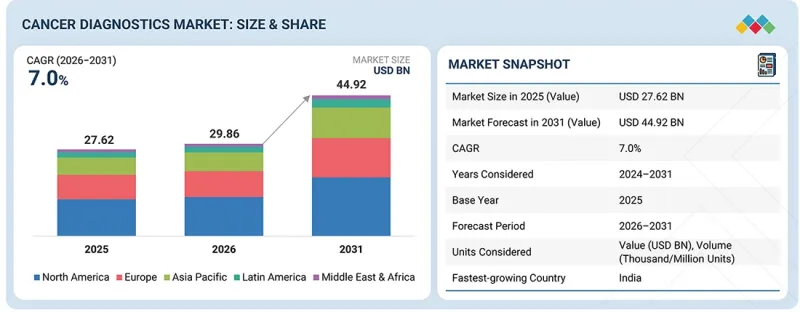
The cancer diagnostics market is projected to reach USD 44.92 billion by 2031 from USD 29.86 billion in 2026, registering a CAGR of 7.0%.
| Scope of the Report | |
|---|---|
| Years Considered for the Study | 2026-2031 |
| Base Year | 2025 |
| Forecast Period | 2026-2031 |
| Units Considered | Value (USD billion) |
| Segments | Product, Method, Technology, Application, End User, and Region |
| Regions covered | North America, Europe, Asia Pacific, Latin America, and Middle East & Africa |
Cancer diagnostics play a critical role in oncology by enabling early detection, accurate diagnosis, disease characterization, treatment selection, and ongoing monitoring of cancer. The cancer diagnostics market, segmented by product, comprises a broad portfolio of instruments and consumables used across in vitro diagnostics (IVD), anatomic pathology, and imaging-based diagnostics. Market growth is driven by the increasing adoption of advanced diagnostic technologies, sustained demand for consumables, rising global cancer incidence, expanding screening initiatives, and growing diagnostic testing volumes.
The market encompasses a wide range of diagnostic technologies, including PCR, immunohistochemistry (IHC), in situ hybridization (ISH), next-generation sequencing (NGS), microarrays, flow cytometry, immunoassays, histopathology, biopsy, CT, MRI, PET, mammography, and ultrasound. These technologies are used to diagnose both solid tumors and hematological malignancies, supporting applications such as cancer screening, early detection, disease diagnosis and characterization, treatment decision-making, and disease monitoring, including recurrence detection.
Based on product, the cancer diagnostics market is segmented into IVD testing, anatomic pathology, and imaging-based diagnostics. Among these, IVD testing accounted for the largest market share and is projected to witness the fastest growth during the forecast period. The segment's dominance is driven by the increasing global burden of cancer, growing emphasis on early detection and precision oncology, rising adoption of liquid biopsy and molecular diagnostic technologies, and expanding use of biomarker-based testing for cancer screening, diagnosis, treatment selection, and disease monitoring. Continuous advancements in next-generation sequencing (NGS), polymerase chain reaction (PCR), immunoassays, companion diagnostics, and AI-enabled diagnostic platforms have significantly enhanced diagnostic accuracy, sensitivity, and turnaround time. Supported by increasing healthcare investments, favorable reimbursement for molecular testing, government-led cancer screening initiatives, and expanding access to personalized medicine, the IVD testing segment is expected to maintain its leading position in the global cancer diagnostics market throughout the forecast period.
Based on end user, the cancer diagnostics market is segmented into hospitals and clinical laboratories. Among these, hospitals account for the largest market share due to their high patient volumes, comprehensive diagnostic infrastructure, and ability to provide integrated cancer care encompassing screening, diagnosis, treatment planning, and disease monitoring under a single setting. Hospitals are the primary centers for advanced imaging, biopsy procedures, molecular testing, and multidisciplinary oncology care, driving significant demand for cancer diagnostic services. The increasing adoption of precision oncology, companion diagnostics, next-generation sequencing (NGS), and AI-enabled diagnostic workflows, coupled with rising investments in hospital-based cancer centers and expanding access to advanced diagnostic technologies, continues to strengthen the dominance of the hospital segment. Furthermore, growing government initiatives for cancer screening, increasing cancer admissions, and the integration of digital pathology and laboratory information systems are reinforcing the leading position of hospitals in the global cancer diagnostics market, while clinical laboratories continue to witness steady growth driven by increasing outsourcing of specialized molecular and genomic testing.
Based on region, the cancer diagnostics market is segmented into North America, Europe, Asia Pacific, Latin America, and the Middle East & Africa. North America accounted for the largest market share in 2025 and continues to serve as the primary market driver, supported by its advanced healthcare infrastructure, high healthcare expenditure, favorable reimbursement policies, and early adoption of innovative cancer diagnostic technologies. The region has a high prevalence of cancer, well-established screening programs, and increasing demand for early detection and precision oncology, resulting in the widespread adoption of molecular diagnostics, next-generation sequencing (NGS), liquid biopsy, companion diagnostics, digital pathology, and advanced imaging technologies across hospitals, cancer centers, and clinical laboratories. The strong presence of leading diagnostics companies, continuous technological advancements, substantial investments in oncology research, supportive regulatory frameworks, and expanding integration of artificial intelligence into cancer diagnostics further reinforce North America's market leadership.
A breakdown of the primary respondents (supply-side) for the cancer diagnostics market referred to in this report is provided below:
- By Company Type: Tier 1: 40%, Tier 2: 30%, and Tier 3: 30%
- By Designation: C-level: 55%, Director Level: 27%, and Others: 18%
- By Region: North America: 43%, Europe: 28%, Asia Pacific: 20%, Latin America: 6% and Middle East & Africa: 3%
Prominent players in the cancer diagnostics market include Roche Diagnostics (Switzerland), Danaher Corporation (US), Thermo Fisher Scientific Inc. (US), Abbott Laboratories (US), Siemens Healthineers AG (Germany), Agilent Technologies, Inc. (US), QIAGEN N.V. (Netherlands), Illumina, Inc. (US), Hologic, Inc. (US), Becton, Dickinson and Company (US), Exact Sciences Corporation (US), Guardant Health, Inc. (US), Sysmex Corporation (Japan), Foundation Medicine, Inc. (US), Myriad Genetics, Inc. (US), NeoGenomics Laboratories, Inc. (US), bioMerieux SA (France), and Revvity, Inc. (US), among others.
Research Coverage
The report evaluates the cancer diagnostics market and estimates the market size and future growth potential of this market based on various segments, including product, end user, and region. The report also includes a competitive analysis of the major players in this market, along with company profiles, product offerings, recent developments, and key market strategies.
Reasons to Buy the Report
The report will assist market leaders and new entrants in the cancer diagnostics s market with data on the nearest approximations of revenue figures for the overall market and its subsegments. The report will help stakeholders understand the competitive landscape and gain insights into better positioning their businesses and developing effective go-to-market strategies. It also enables stakeholders to understand market dynamics and provides insights into key drivers, restraints, challenges, and growth opportunities influencing the cancer diagnostics market.
This report provides insights into the following points:
- Analysis of Key Drivers (Increasing global burden of cancer driven by aging populations, lifestyle changes, and environmental risk factors; Growing emphasis on early cancer detection and screening to improve patient outcomes and survival rates; Advancements in molecular diagnostics, next-generation sequencing (NGS), liquid biopsy, and companion diagnostics enabling precision oncology; Rising adoption of AI-powered imaging and digital pathology solutions to enhance diagnostic accuracy and workflow efficiency; Increasing investments in cancer research, biomarker discovery, and personalized medicine), restraints (High cost of advanced diagnostic technologies and genomic testing; Limited accessibility to sophisticated diagnostic infrastructure in low- and middle-income countries; Stringent regulatory approval and reimbursement challenges; Complexity in interpreting genomic and molecular data requiring specialized expertise), opportunities (Growing demand for non-invasive diagnostic techniques such as liquid biopsy; Expansion of national cancer screening programs and awareness initiatives; Increasing adoption of precision medicine and companion diagnostics; Rising investments in AI-enabled diagnostics, digital pathology, and multi-cancer early detection (MCED) tests; Growing healthcare infrastructure and diagnostic capabilities in emerging markets), and challenges (Shortage of skilled oncology and pathology professionals; Data privacy, interoperability, and integration issues with digital diagnostic platforms; High validation requirements for novel biomarkers and diagnostic assays; Reimbursement variability across different healthcare systems; Ensuring equitable access to advanced cancer diagnostics while maintaining affordability and diagnostic accuracy).
- Product Enhancement/Innovation: Comprehensive details about product launches and anticipated trends in the cancer diagnostics market.
- Market Development: Thorough knowledge and analysis of the profitable rising markets by product, type, application, technology, end user, and region.
- Market Diversification: Comprehensive information about newly launched products, expanding markets, current advancements, and investments in the cancer diagnostics market.
- Competitive Assessment: Thorough evaluation of the market shares, growth plans, offerings, and capacities of the major competitors in the cancer diagnostics market.
TABLE OF CONTENTS
1 INTRODUCTION
- 1.1 STUDY OBJECTIVES
- 1.2 MARKET DEFINITION
- 1.3 STUDY SCOPE
- 1.3.1 MARKETS COVERED AND REGIONAL SCOPE
- 1.3.2 INCLUSIONS AND EXCLUSIONS
- 1.3.3 YEARS CONSIDERED
- 1.4 CURRENCY CONSIDERED
- 1.5 STAKEHOLDERS
- 1.6 SUMMARY OF CHANGES
2 EXECUTIVE SUMMARY
- 2.1 KEY INSIGHTS AND MARKET HIGHLIGHTS
- 2.2 KEY MARKET PARTICIPANTS: SHARE INSIGHTS AND STRATEGIC DEVELOPMENTS
- 2.3 DISRUPTIVE TRENDS SHAPING MARKET
- 2.4 HIGH-GROWTH SEGMENTS AND EMERGING FRONTIERS
- 2.5 SNAPSHOT: GLOBAL MARKET SIZE, GROWTH RATE, AND FORECAST
3 PREMIUM INSIGHTS
- 3.1 CANCER DIAGNOSTICS MARKET OVERVIEW
- 3.2 ASIA PACIFIC CANCER DIAGNOSTICS MARKET, BY COUNTRY AND TECHNOLOGY
- 3.3 CANCER DIAGNOSTICS MARKET: GEOGRAPHIC GROWTH (2026-2031)
4 MARKET OVERVIEW
- 4.1 INTRODUCTION
- 4.2 MARKET DYNAMICS
- 4.2.1 DRIVERS
- 4.2.1.1 Growing incidence of cancer
- 4.2.1.2 Growth in number of private diagnostics centers
- 4.2.1.3 Availability of favorable reimbursement policies
- 4.2.2 RESTRAINTS
- 4.2.2.1 High capital investment requirements
- 4.2.2.2 High cost of advanced diagnostic imaging systems
- 4.2.3 OPPORTUNITIES
- 4.2.3.1 Increasing adoption of companion diagnostics
- 4.2.3.2 Expansion of organized cancer screening programs
- 4.2.3.3 Growing demand for cancer diagnostics in emerging markets
- 4.2.4 CHALLENGES
- 4.2.4.1 Increasing adoption of refurbished diagnostic imaging systems
- 4.2.4.2 Shortage of skilled professionals
- 4.2.4.3 Limited healthcare infrastructure and low awareness in developing countries
- 4.2.4.4 Product recalls and diagnostic test failures
- 4.2.1 DRIVERS
- 4.3 UNMET NEEDS AND WHITE SPACES
- 4.3.1 UNMET NEEDS IN CANCER DIAGNOSTICS MARKET
- 4.3.2 WHITE SPACE OPPORTUNITIES
- 4.4 INTERCONNECTED MARKETS AND CROSS-SECTOR OPPORTUNITIES
- 4.4.1 INTERCONNECTED MARKETS
- 4.5 STRATEGIC MOVES BY TIER 1/2/3 PLAYERS
- 4.5.1 KEY MOVES AND STRATEGIC FOCUS
5 INDUSTRY TRENDS
- 5.1 PORTER'S FIVE FORCES ANALYSIS
- 5.1.1 BARGAINING POWER OF SUPPLIERS
- 5.1.2 BARGAINING POWER OF BUYERS
- 5.1.3 THREAT OF NEW ENTRANTS
- 5.1.4 THREAT OF SUBSTITUTES
- 5.1.5 INTENSITY OF COMPETITIVE RIVALRY
- 5.2 MACROECONOMIC INDICATORS
- 5.2.1 INTRODUCTION
- 5.2.2 GDP TRENDS AND FORECAST
- 5.3 SUPPLY CHAIN ANALYSIS
- 5.4 ECOSYSTEM ANALYSIS
- 5.5 INVESTMENT AND FUNDING SCENARIO
- 5.6 PRICING ANALYSIS
- 5.6.1 AVERAGE SELLING PRICE BY PRODUCT
- 5.6.2 AVERAGE SELLING PRICE OF GLUCOSE MONITORING TEST STRIPS, BY KEY PLAYER
- 5.6.3 AVERAGE SELLING PRICE, BY REGION
- 5.6.3.1 Average selling price of glucose monitoring test strips, by region
- 5.6.3.2 Average selling price of infectious disease testing products, by region
- 5.6.3.3 Average selling price of cardiometabolic monitoring products, by region
- 5.7 VALUE CHAIN ANALYSIS
- 5.8 TRENDS/DISRUPTIONS IMPACTING CUSTOMER BUSINESS
- 5.9 CASE STUDY ANALYSIS
- 5.9.1 PRICE IMPACT ANALYSIS
- 5.9.2 IMPACT ON REGION
- 5.9.2.1 North America
- 5.9.2.2 Europe
- 5.9.2.3 Asia Pacific
6 TECHNOLOGICAL ADVANCEMENTS, AI-DRIVEN IMPACT, PATENTS, INNOVATIONS, AND FUTURE APPLICATIONS
- 6.1 KEY EMERGING TECHNOLOGIES
- 6.1.1 IVD TESTING
- 6.1.2 COMPLEMENTARY TECHNOLOGIES
- 6.1.2.1 Molecular diagnostics
- 6.1.3 ADJACENT TECHNOLOGIES
- 6.1.3.1 Biochemical technologies
- 6.2 TECHNOLOGY/PRODUCT ROADMAP
- 6.3 PATENT ANALYSIS
- 6.3.1 LIST OF MAJOR PATENTS
- 6.4 FUTURE APPLICATIONS
- 6.5 IMPACT OF AI/GENERATIVE AI ON CANCER DIAGNOSTICS MARKET
- 6.5.1 INTRODUCTION
- 6.5.2 TOP USE CASES AND MARKET POTENTIAL
- 6.5.3 KEY COMPANIES IMPLEMENTING AI
- 6.5.4 FUTURE OF AI
7 REGULATORY LANDSCAPE AND SUSTAINABILITY
- 7.1 REGIONAL REGULATIONS AND COMPLIANCE
- 7.1.1 REGULATORY BODIES, GOVERNMENT AGENCIES, AND OTHER ORGANIZATIONS
- 7.1.2 INDUSTRY STANDARDS
- 7.2 SUSTAINABILITY INITIATIVES
- 7.2.1 ENVIRONMENTAL IMPACT AND ECO-FRIENDLY INITIATIVES IN CANCER DIAGNOSTICS
- 7.2.1.1 Eco-friendly Initiatives
- 7.2.1 ENVIRONMENTAL IMPACT AND ECO-FRIENDLY INITIATIVES IN CANCER DIAGNOSTICS
- 7.3 SUSTAINABILITY IMPACT AND REGULATORY POLICY INITIATIVES
8 CUSTOMER LANDSCAPE & BUYER BEHAVIOR
- 8.1 DECISION-MAKING PROCESS
- 8.2 BUYER STAKEHOLDERS AND BUYING EVALUATION CRITERIA
- 8.2.1 KEY STAKEHOLDERS IN BUYING PROCESS
- 8.2.2 BUYING CRITERIA
- 8.3 ADOPTION BARRIERS & INTERNAL CHALLENGES
- 8.4 UNMET NEEDS OF VARIOUS END USERS
- 8.5 MARKET PROFITABILITY
- 8.5.1 REVENUE POTENTIAL
- 8.5.2 COST DYNAMICS
- 8.5.3 MARGIN OPPORTUNITIES IN KEY APPLICATIONS
9 CANCER DIAGNOSTICS MARKET, BY APPLICATION
- 9.1 INTRODUCTION
- 9.2 SCREENING & EARLY DETECTION
- 9.2.1 INCREASING EMPHASIS ON EARLY CANCER DETECTION TO DRIVE SEGMENT
- 9.3 DIAGNOSIS & DISEASE CHARACTERIZATION
- 9.3.1 GOVERNMENT INITIATIVES TO EXPAND HEALTHCARE ACCESS TO DRIVE SEGMENT
- 9.4 TREATMENT DECISION SUPPORT
- 9.4.1 RISING DEMAND FOR PRECISION ONCOLOGY TO PROPEL SEGMENT
- 9.5 TREATMENT MONITORING & DISEASE PROGRESSION ASSESSMENT
- 9.5.1 INCREASING DEMAND FOR DETECTION OF DISEASE PROGRESSION SUPPORT SEGMENT GROWTH
- 9.6 POST-TREATMENT SURVEILLANCE & RECURRENCE DETECTION
- 9.6.1 GROWING EMPHASIS ON POST-TREATMENT MONITORING TO DRIVE SEGMENT
10 CANCER DIAGNOSTICS MARKET, BY TECHNOLOGY
- 10.1 INTRODUCTION
- 10.2 IVD TESTING
- 10.2.1 POLYMERASE CHAIN REACTION
- 10.2.1.1 PCR-based diagnostic tests preferred as they provide simple representations of genomic data
- 10.2.2 IN SITU HYBRIDIZATION
- 10.2.2.1 ISH used for identification of specific mRNA species within sample cells
- 10.2.3 IMMUNOHISTOCHEMISTRY
- 10.2.3.1 Increasing use of IHC tests for cancer diagnostics to boost market growth
- 10.2.4 NEXT-GENERATION SEQUENCING
- 10.2.4.1 NGS dominates IVD testing market
- 10.2.5 IMMUNOASSAY
- 10.2.5.1 Immunoassay segment accounted for second-largest share of cancer diagnostics market for IVD testing
- 10.2.6 MICROARRAY
- 10.2.6.1 Cost-effectiveness of microarray technology to support market growth
- 10.2.7 FLOW CYTOMETRY
- 10.2.7.1 Limited budgets restrain segment growth
- 10.2.8 OTHER IVD TECHNOLOGIES
- 10.2.1 POLYMERASE CHAIN REACTION
- 10.3 IMAGING TECHNOLOGIES
- 10.3.1 MAGNETIC RESONANCE IMAGING
- 10.3.1.1 Technological advancements to boost segment growth
- 10.3.2 COMPUTED TOMOGRAPHY
- 10.3.2.1 CT is widely used technique in cancer diagnostics
- 10.3.3 POSITRON EMISSION TOMOGRAPHY (PET)
- 10.3.3.1 Widely used nuclear imaging technique in cancer diagnostics
- 10.3.4 MAMMOGRAPHY
- 10.3.4.1 Increasing government initiatives for breast cancer screening to drive segment growth
- 10.3.5 ULTRASOUND
- 10.3.5.1 Substantial clinical advancements and technical innovations to support market growth
- 10.3.1 MAGNETIC RESONANCE IMAGING
- 10.4 ANATOMIC PATHOLOGY
- 10.4.1 INTRODUCTION
- 10.4.1.1 Histopathology
- 10.4.1.1.1 Growing demand for high-throughput, error-free staining to drive market
- 10.4.1.2 Cytopathology
- 10.4.1.2.1 Rising cervical cancer screening volumes to boost demand for automated cytology systems
- 10.4.1.1 Histopathology
- 10.4.1 INTRODUCTION
- 10.5 BIOPSIES
11 CANCER DIAGNOSTICS MARKET, BY TYPE
- 11.1 INTRODUCTION
- 11.2 SOLID TUMORS
- 11.3 BREAST CANCER
- 11.3.1 SEGMENT TO ACCOUNT FOR LARGEST SHARE DURING FORECAST PERIOD
- 11.4 LUNG CANCER
- 11.4.1 LUNG CANCER SEGMENT ACCOUNTED FOR THE SECOND-LARGEST SHARE
- 11.5 COLORECTAL CANCER
- 11.5.1 INCREASING INCIDENCE OF COLORECTAL CANCER TO DRIVE MARKET GROWTH
- 11.6 GASTRIC CANCER
- 11.6.1 SEGMENT GROWTH SUPPORTED BY INCREASING ADOPTION OF BIOMARKER-BASED TESTING FOR TREATMENT SELECTION
- 11.7 HEAD & NECK CANCER
- 11.7.1 SEGMENT TO BE DRIVEN BY INCREASING AGING POPULATION
- 11.8 PROSTATE CANCER
- 11.8.1 RISING GLOBAL DISEASE BURDEN AND EVOLVING DIAGNOSTIC LANDSCAPE TO BOOST SEGMENT
- 11.9 CERVICAL CANCER
- 11.9.1 INCREASE IN SCREENING, HPV TESTING, AND BIOMARKER ADOPTION TO DRIVE MARKET GROWTH
- 11.10 MELANOMA
- 11.10.1 INCREASING INCIDENCE OF MELANOMA TO DRIVE MARKET GROWTH
- 11.10.2 OTHER SOLID TUMORS
- 11.11 LIQUID TUMORS
- 11.12 LEUKEMIA
- 11.12.1 SEGMENT CONTINUES TO REPRESENT SIGNIFICANT SHARE OF GLOBAL HEMATOLOGIC (LIQUID) CANCER BURDEN
- 11.13 MYELOMA
- 11.13.1 RISING CASES, PARTICULARLY ACROSS ASIA AND AFRICA, TO DRIVE MARKET
- 11.14 LYMPHOMA
- 11.14.1 INCREASING DISEASE BURDEN TO DRIVE SEGMENT
12 CANCER DIAGNOSTICS MARKET, BY PRODUCT
- 12.1 INTRODUCTION
- 12.2 IVD TESTING
- 12.2.1 KITS & REAGENTS
- 12.2.1.1 Increasing adoption due to ease of use to boost segment
- 12.2.2 INSTRUMENTS
- 12.2.2.1 PCR instruments
- 12.2.2.1.1 Cost-effectiveness drives growth of segment
- 12.2.2.2 NGS instruments
- 12.2.2.2.1 NGS is an emerging technology for cancer diagnostics
- 12.2.2.3 Microarrays
- 12.2.2.3.1 Use in determination of primary sites in metastatic carcinomas to boost market
- 12.2.2.1 PCR instruments
- 12.2.3 IN SITU HYBRIDIZATION
- 12.2.3.1 Use for identification of specific mRNA species within sample cells - key driver
- 12.2.4 IMMUNOHISTOCHEMISTRY
- 12.2.4.1 Increasing use of IHC tests for cancer diagnostics to boost market growth
- 12.2.5 IMMUNOASSAY
- 12.2.5.1 Segment holds second-largest share of cancer diagnostics market for IVD testing
- 12.2.6 FLOW CYTOMETRY
- 12.2.6.1 Use across diagnosis, monitoring, and treatment to propel market
- 12.2.7 OTHER IVD TESTING INSTRUMENTS
- 12.2.1 KITS & REAGENTS
- 12.3 ANATOMIC PATHOLOGY
- 12.3.1 INTRODUCTION
- 12.3.2 INSTRUMENTS
- 12.3.2.1 Slide staining systems
- 12.3.2.1.1 Increasing focus on automation to drive market
- 12.3.2.2 Tissue processing systems
- 12.3.2.2.1 Use in automatic processing of tissue samples to boost market
- 12.3.2.3 Cell processors
- 12.3.2.3.1 Used to remove unwanted matter from cytology samples
- 12.3.2.4 Microtomes
- 12.3.2.4.1 Segment gaining traction as rising biopsy volumes and automation drive demand
- 12.3.2.5 Embedding systems
- 12.3.2.5.1 Automated tissue embedding gains momentum in cancer diagnostics
- 12.3.2.6 Cover slippers
- 12.3.2.6.1 Automated cover slippers strengthen workflow efficiency in cancer diagnostics
- 12.3.2.7 Digital pathology scanners
- 12.3.2.7.1 Shift toward automated cancer diagnostics to accelerate segment growth
- 12.3.2.8 Other anatomic pathology instruments
- 12.3.2.1 Slide staining systems
- 12.3.3 CONSUMABLES
- 12.3.3.1 Antibodies
- 12.3.3.1.1 Cancer diagnostic consumables market
- 12.3.3.2 Kits & Reagents
- 12.3.3.2.1 Use of kits is increasing among end users owing to their ease of use
- 12.3.3.3 Probes
- 12.3.3.3.1 Probes Enable Precise Molecular Detection in Cancer Diagnostics
- 12.3.3.4 Other consumables
- 12.3.3.1 Antibodies
- 12.4 IMAGING-BASED
- 12.4.1 INSTRUMENTS
- 12.4.1.1 CT systems
- 12.4.1.1.1 Technological advancements to drive growth of segment
- 12.4.1.2 Ultrasound systems
- 12.4.1.2.1 Increasing incidence of cancer to drive segment growth
- 12.4.1.1 CT systems
- 12.4.2 MRI SYSTEMS
- 12.4.2.1 Rising cancer incidence and growing adoption of MRI drive market growth
- 12.4.2.2 Mammography systems
- 12.4.2.2.1 Increasing incidence of breast cancer to drive growth of segment
- 12.4.2.3 PET-CT
- 12.4.2.3.1 Technological advancements in nuclear imaging systems to drive segment
- 12.4.3 CONSUMABLES
- 12.4.3.1 Contrast agents
- 12.4.3.1.1 Increasing incidence of cancer to drive segment
- 12.4.3.2 Radiopharmaceuticals
- 12.4.3.2.1 Increasing availability of radioisotopes to drive segment
- 12.4.3.1 Contrast agents
- 12.4.1 INSTRUMENTS
13 CANCER DIAGNOSTICS MARKET, BY END USER
- 13.1 INTRODUCTION
- 13.2 HOSPITALS & CLINICS
- 13.2.1 SEGMENT IS LARGEST END USER OF CANCER DIAGNOSTIC PRODUCTS
- 13.3 DIAGNOSTIC LABORATORIES
- 13.3.1 INCREASING INCIDENCE OF CANCER TO DRIVE GROWTH
14 CANCER DIAGNOSTICS MARKET, BY REGION
- 14.1 INTRODUCTION
- 14.2 NORTH AMERICA
- 14.2.1 US
- 14.2.1.1 Expected to be dominant in North American market
- 14.2.2 CANADA
- 14.2.2.1 High cancer burden, aging population, and expanding screening programs to support market growth
- 14.2.1 US
- 14.3 EUROPE
- 14.3.1 GERMANY
- 14.3.1.1 Availability of reimbursements for colorectal cancer screening to drive market growth
- 14.3.2 UK
- 14.3.2.1 Favorable government initiatives to drive market growth
- 14.3.3 FRANCE
- 14.3.3.1 Increasing government funding for cancer diagnosis and prevention to support market growth
- 14.3.4 ITALY
- 14.3.4.1 High incidence of cancer to support market growth
- 14.3.5 SPAIN
- 14.3.5.1 High incidence of chronic diseases to drive market growth
- 14.3.6 REST OF EUROPE
- 14.3.1 GERMANY
- 14.4 ASIA PACIFIC
- 14.4.1 CHINA
- 14.4.1.1 Increasing healthcare expenditure to drive market growth
- 14.4.2 JAPAN
- 14.4.2.1 Advanced healthcare infrastructure to support market growth
- 14.4.3 INDIA
- 14.4.3.1 Expanding healthcare sector in country to drive market growth
- 14.4.4 SOUTH KOREA
- 14.4.4.1 Focus on genomic research and precision medicine to boost market growth
- 14.4.5 AUSTRALIA
- 14.4.6 REST OF ASIA PACIFIC
- 14.4.7 LATIN AMERICA
- 14.4.7.1 Increasing number of cancer screening programs to support market growth
- 14.4.8 BRAZIL
- 14.4.8.1 Expansion of cancer screening programs to support market growth
- 14.4.9 MEXICO
- 14.4.9.1 Increasing cancer screening initiatives and diagnostic infrastructure to drive market growth
- 14.4.10 REST OF LATIN AMERICA
- 14.4.11 MIDDLE EAST & AFRICA
- 14.4.11.1 Increasing incidence of cancer to drive market growth
- 14.4.1 CHINA
15 COMPETITIVE LANDSCAPE
- 15.1 INTRODUCTION
- 15.2 KEY PLAYER STRATEGIES/RIGHT TO WIN
- 15.2.1 OVERVIEW OF STRATEGIES ADOPTED BY PLAYERS IN CANCER DIAGNOSTICS MARKET
- 15.3 REVENUE ANALYSIS, 2023-2025
- 15.4 MARKET SHARE ANALYSIS, 2025
- 15.5 COMPANY VALUATION AND FINANCIAL METRICS
- 15.6 BRAND/PRODUCT COMPARISON
- 15.6.1 ABBOTT
- 15.6.2 F. HOFFMANN-LA ROCHE LTD.
- 15.6.3 DANAHER
- 15.7 COMPANY EVALUATION MATRIX: KEY PLAYERS, 2025
- 15.7.1 STARS
- 15.7.2 EMERGING LEADERS
- 15.7.3 PERVASIVE PLAYERS
- 15.7.4 PARTICIPANTS
- 15.7.5 COMPANY FOOTPRINT, KEY PLAYERS, 2025
- 15.7.5.1 Company footprint
- 15.7.5.2 Region footprint
- 15.7.5.3 End user footprint
- 15.7.5.4 Product footprint
- 15.7.5.5 Technology footprint
- 15.8 COMPANY EVALUATION MATRIX: STARTUPS/SMES, 2023
- 15.8.1 PROGRESSIVE COMPANIES
- 15.8.2 RESPONSIVE COMPANIES
- 15.8.3 DYNAMIC COMPANIES
- 15.8.4 STARTING BLOCKS
- 15.9 COMPANY EVALUATION MATRIX: STARTUPS/SMES, 2025
- 15.9.1 DETAILED LIST OF KEY STARTUPS/SMES
- 15.9.2 COMPETITIVE BENCHMARKING OF STARTUPS/SMES
- 15.10 COMPETITIVE SCENARIO
- 15.10.1 PRODUCT LAUNCHES AND APPROVALS
16 COMPANY PROFILE
- 16.1 KEY PLAYERS
- 16.1.1 F. HOFFMANN-LA ROCHE
- 16.1.1.1 Business overview
- 16.1.1.2 Products offered
- 16.1.1.3 Recent developments
- 16.1.1.3.1 Product launches and approvals
- 16.1.1.3.2 Deals
- 16.1.1.3.3 Expansions
- 16.1.1.4 MnM view
- 16.1.1.4.1 Right to win
- 16.1.1.4.2 Strategic choices
- 16.1.1.4.3 Weaknesses and competitive threats
- 16.1.2 DANAHER CORPORATION
- 16.1.2.1 Business overview
- 16.1.2.2 Products offered
- 16.1.2.3 Recent developments
- 16.1.2.3.1 Product launches and approvals
- 16.1.2.3.2 Deals
- 16.1.2.4 MnM view
- 16.1.2.4.1 Right to win
- 16.1.2.4.2 Strategic choices
- 16.1.2.4.3 Weaknesses and competitive threats
- 16.1.3 THERMO FISHER SCIENTIFIC INC
- 16.1.3.1 Business overview
- 16.1.3.2 Products offered
- 16.1.3.3 Recent developments
- 16.1.3.3.1 Product launches and approvals
- 16.1.3.3.2 Deals
- 16.1.3.4 MnM view
- 16.1.3.4.1 Right to win
- 16.1.3.4.2 Strategic choices
- 16.1.3.4.3 Weaknesses and competitive threats
- 16.1.4 ABBOTT LABORATORIES
- 16.1.4.1 Business overview
- 16.1.4.2 Products offered
- 16.1.4.3 Recent developments
- 16.1.4.3.1 Deals
- 16.1.4.3.2 Expansions
- 16.1.4.4 MnM view
- 16.1.4.4.1 Right to win
- 16.1.4.4.2 Strategic choices
- 16.1.4.4.3 Weaknesses and competitive threats
- 16.1.5 AGILENT TECHNOLOGIES INC.
- 16.1.5.1 Business overview
- 16.1.5.2 Products offered
- 16.1.5.3 Recent developments
- 16.1.5.3.1 Product launches and approvals
- 16.1.5.3.2 Deals
- 16.1.5.3.3 Expansions
- 16.1.5.4 MnM view
- 16.1.5.4.1 Right to win
- 16.1.5.4.2 Strategic choices
- 16.1.5.4.3 Weaknesses and competitive threats
- 16.1.6 QIAGEN N.V.
- 16.1.6.1 Business overview
- 16.1.6.2 Products offered
- 16.1.6.3 Recent developments
- 16.1.6.3.1 Product launches and approvals
- 16.1.6.3.2 Deals
- 16.1.6.3.3 Expansions
- 16.1.6.4 MnM view
- 16.1.6.4.1 Right to win
- 16.1.6.4.2 Strategic choices
- 16.1.6.4.3 Weaknesses and competitive threats
- 16.1.7 ILLUMINA, INC
- 16.1.7.1 Business overview
- 16.1.7.2 Products offered
- 16.1.7.3 Recent developments
- 16.1.7.3.1 Product launches and approvals
- 16.1.7.3.2 Deals
- 16.1.7.3.3 Expansions
- 16.1.7.4 MnM view
- 16.1.7.4.1 Right to win
- 16.1.7.4.2 Strategic choices
- 16.1.7.4.3 Weaknesses and competitive threats
- 16.1.8 HOLOGIC, INC
- 16.1.8.1 Business overview
- 16.1.8.2 Products offered
- 16.1.8.3 Recent developments
- 16.1.8.3.1 Product launches and approvals
- 16.1.8.3.2 Deals
- 16.1.8.3.3 Expansions
- 16.1.8.4 MnM view
- 16.1.8.4.1 Right to win
- 16.1.8.4.2 Strategic choices
- 16.1.8.4.3 Weaknesses and competitive threats
- 16.1.9 BECTON, DICKINSON AND COMPANY
- 16.1.9.1 Business overview
- 16.1.9.2 Products offered
- 16.1.9.3 Recent developments
- 16.1.9.3.1 Product launches and approvals
- 16.1.9.3.2 Deals
- 16.1.9.4 MnM view
- 16.1.9.4.1 Right to win
- 16.1.9.4.2 Strategic choices
- 16.1.9.4.3 Weaknesses and competitive threats
- 16.1.10 SIEMENS HEALTHINEERS AG
- 16.1.10.1 Business overview
- 16.1.10.2 Products offered
- 16.1.10.3 Recent developments
- 16.1.10.3.1 Product launches and approvals
- 16.1.10.3.2 Expansions
- 16.1.10.4 MnM view
- 16.1.10.4.1 Right to win
- 16.1.10.4.2 Strategic choices
- 16.1.10.4.3 Weaknesses and competitive threats
- 16.1.11 EXACT SCIENCES CORPORATION
- 16.1.11.1 Business overview
- 16.1.11.2 Products offered
- 16.1.11.3 Recent developments
- 16.1.11.3.1 Product launches and approvals
- 16.1.11.3.2 Deals
- 16.1.11.3.3 Expansions
- 16.1.12 GUARDANT HEALTH, INC
- 16.1.12.1 Business overview
- 16.1.12.2 Products offered
- 16.1.12.3 Recent developments
- 16.1.12.3.1 Product launches and approvals
- 16.1.12.3.2 Deals
- 16.1.13 SYSMEX CORPORATION
- 16.1.13.1 Business overview
- 16.1.13.2 Products offered
- 16.1.13.3 Recent developments
- 16.1.13.3.1 Expansions
- 16.1.14 BIOMERIEUX SA.
- 16.1.14.1 Business overview
- 16.1.14.2 Products offered
- 16.1.14.3 Recent developments
- 16.1.14.3.1 Product launches and approvals
- 16.1.15 MYRIAD GENETICS, INC
- 16.1.15.1 Business overview
- 16.1.15.2 Products offered
- 16.1.15.3 Recent developments
- 16.1.15.3.1 Product launches and approvals
- 16.1.15.3.2 Deals
- 16.1.1 F. HOFFMANN-LA ROCHE
- 16.2 OTHER PLAYERS
- 16.2.1 NEOGENOMICS, INC
- 16.2.2 NATERA, INC
- 16.2.3 TEMPUS AI, INC
- 16.2.4 GRAIL, INC
- 16.2.5 CARIS LIFE SCIENCES, INC, INC.
- 16.2.6 PERSONALIS, INC
- 16.2.7 DELFI DIAGNOSTICS, INC
- 16.2.8 FULGENT GENETICS, INC
- 16.2.9 BURNING ROCK BIOTECH LIMITED
- 16.2.10 GENETRON HOLDINGS LIMITED
17 RESEARCH METHODOLOGY
- 17.1 RESEARCH DATA
- 17.2 RESEARCH APPROACH
- 17.2.1 SECONDARY RESEARCH
- 17.2.1.1 Key data from secondary sources
- 17.2.2 PRIMARY DATA
- 17.2.2.1 Primary sources
- 17.2.2.2 Key data from primary sources
- 17.2.2.3 Key industry insights
- 17.2.1 SECONDARY RESEARCH
- 17.3 MARKET SIZE ESTIMATION
- 17.3.1 BOTTOM-UP APPROACH
- 17.3.1.1 Approach 1: Company revenue estimation approach
- 17.3.1.2 Approach 2: Presentations of companies and primary interviews
- 17.3.1.3 Growth forecast
- 17.3.2 TOP-DOWN APPROACH
- 17.3.1 BOTTOM-UP APPROACH
- 17.4 MARKET BREAKDOWN AND DATA TRIANGULATION
- 17.5 MARKET SHARE ANALYSIS
- 17.6 RESEARCH ASSUMPTIONS
- 17.6.1 PARAMETRIC ASSUMPTIONS
- 17.6.2 GROWTH RATE ASSUMPTIONS
- 17.7 RESEARCH LIMITATIONS
- 17.8 RISK ASSESSMENT
18 APPENDIX
- 18.1 DISCUSSION GUIDE
- 18.2 KNOWLEDGESTORE: MARKETSANDMARKETS' SUBSCRIPTION PORTAL
- 18.3 CUSTOMIZATION OPTIONS
- 18.4 RELATED REPORTS
- 18.5 AUTHOR DETAILS
List of Tables
- TABLE 1 PROJECTED INCREASE IN CANCER PATIENTS, BY REGION, 2025 VS. 2035 VS. 2045
- TABLE 2 CANCER DIAGNOSTICS MARKET: PORTER'S FIVE FORCES ANALYSIS
- TABLE 3 GDP PERCENTAGE CHANGE (%), BY KEY COUNTRY, 2024-2031
- TABLE 4 NORTH AMERICA: MACROECONOMIC INDICATORS
- TABLE 5 EUROPE: MACROECONOMIC INDICATORS
- TABLE 6 ASIA PACIFIC: MACROECONOMIC INDICATORS
- TABLE 7 LATIN AMERICA: MACROECONOMIC INDICATORS
- TABLE 8 MIDDLE EAST & AFRICA: MACROECONOMIC INDICATORS
- TABLE 9 CANCER DIAGNOSTICS MARKET: ROLE OF COMPANIES IN ECOSYSTEM
- TABLE 10 AVERAGE SELLING PRICE OF CANCER TESTS, BY PRODUCT, 2023-2025
- TABLE 11 AVERAGE SELLING PRICE OF GLUCOSE MONITORING TEST STRIPS, BY KEY PLAYER, 2023-2025
- TABLE 12 AVERAGE SELLING PRICE OF GLUCOSE MONITORING TEST STRIPS, BY REGION, 2023-2025
- TABLE 13 AVERAGE SELLING PRICE OF INFECTIOUS DISEASE TESTING PRODUCTS, BY REGION, 2023-2025
- TABLE 14 AVERAGE SELLING PRICE OF CARDIOMETABOLIC MONITORING PRODUCTS, BY REGION, 2023-2025
- TABLE 15 CANCER DIAGNOSTICS MARKET: KEY PATENTS, 2023-2025
- TABLE 16 KEY COMPANIES IMPLEMENTING AI IN CANCER DIAGNOSTICS MARKET
- TABLE 17 NORTH AMERICA: REGULATORY BODIES, GOVERNMENT AGENCIES, AND OTHER ORGANIZATIONS
- TABLE 18 EUROPE: REGULATORY BODIES, GOVERNMENT AGENCIES, AND OTHER ORGANIZATIONS
- TABLE 19 ASIA PACIFIC: REGULATORY BODIES, GOVERNMENT AGENCIES, AND OTHER ORGANIZATIONS
- TABLE 20 LATIN AMERICA: REGULATORY BODIES, GOVERNMENT AGENCIES, AND OTHER ORGANIZATIONS
- TABLE 21 REST OF THE WORLD: REGULATORY BODIES, GOVERNMENT AGENCIES, AND OTHER ORGANIZATIONS
- TABLE 22 GLOBAL STANDARDS IN CANCER DIAGNOSTICS MARKET
- TABLE 23 INFLUENCE OF STAKEHOLDERS ON BUYING PROCESS, BY TECHNOLOGY (%)
- TABLE 24 KEY BUYING CRITERIA, BY TECHNOLOGY
- TABLE 25 ADOPTION BARRIERS & INTERNAL CHALLENGES
- TABLE 26 CANCER DIAGNOSTICS MARKET: UNMET NEEDS OF VARIOUS END USERS
- TABLE 27 CANCER DIAGNOSTICS MARKET, BY APPLICATION, 2024-2031 (USD MILLION)
- TABLE 28 SCREENING & EARLY DETECTION: CANCER DIAGNOSTICS MARKET, BY REGION, 2024-2031 (USD MILLION)
- TABLE 29 NORTH AMERICA: SCREENING & EARLY DETECTION: CANCER DIAGNOSTICS MARKET, BY COUNTRY, 2024-2031 (USD MILLION)
- TABLE 30 EUROPE: SCREENING & EARLY DETECTION: CANCER DIAGNOSTICS MARKET, BY COUNTRY, 2024-2031 (USD MILLION)
- TABLE 31 ASIA PACIFIC: SCREENING & EARLY DETECTION: CANCER DIAGNOSTICS MARKET, BY COUNTRY, 2024-2031 (USD MILLION)
- TABLE 32 LATIN AMERICA: SCREENING & EARLY DETECTION: CANCER DIAGNOSTICS MARKET, BY COUNTRY, 2024-2031 (USD MILLION)
- TABLE 33 DIAGNOSIS & DISEASE CHARACTERIZATION: CANCER DIAGNOSTICS MARKET, BY APPLICATION, BY REGION, 2024-2031 (USD MILLION)
- TABLE 34 NORTH AMERICA :DIAGNOSIS & DISEASE CHARACTERIZATION: CANCER DIAGNOSTICS MARKET, BY COUNTRY, 2024-2031 (USD MILLION)
- TABLE 35 EUROPE: DIAGNOSIS & DISEASE CHARACTERIZATION: CANCER DIAGNOSTICS MARKET, BY COUNTRY, 2024-2031 (USD MILLION)
- TABLE 36 ASIA PACIFIC: DIAGNOSIS & DISEASE CHARACTERIZATION: CANCER DIAGNOSTICS MARKET, BY COUNTRY, 2024-2031 (USD MILLION)
- TABLE 37 LATIN AMERICA: DIAGNOSIS & DISEASE CHARACTERIZATION: CANCER DIAGNOSTICS MARKET, BY COUNTRY, 2024-2031 (USD MILLION)
- TABLE 38 TREATMENT DECISION SUPPORT: CANCER DIAGNOSTICS MARKET, BY REGION, 2024-2031 (USD MILLION)
- TABLE 39 NORTH AMERICA :TREATMENT DECISION SUPPORT: CANCER DIAGNOSTICS MARKET, BY COUNTRY, 2024-2031 (USD MILLION)
- TABLE 40 EUROPE: TREATMENT DECISION SUPPORT: CANCER DIAGNOSTICS MARKET, BY COUNTRY, 2024-2031 (USD MILLION)
- TABLE 41 ASIA PACIFIC :TREATMENT DECISION SUPPORT: CANCER DIAGNOSTICS MARKET, BY COUNTRY, 2024-2031 (USD MILLION)
- TABLE 42 LATIN AMERICA :TREATMENT DECISION SUPPORT: CANCER DIAGNOSTICS MARKET, BY COUNTRY, 2024-2031 (USD MILLION)
- TABLE 43 TREATMENT MONITORING & DISEASE PROGRESSION ASSESSMENT: CANCER DIAGNOSTICS MARKET, BY REGION, 2024-2031 (USD MILLION)
- TABLE 44 NORTH AMERICA :TREATMENT MONITORING & DISEASE PROGRESSION ASSESSMENT: CANCER DIAGNOSTICS MARKET, BY COUNTRY, 2024-2031 (USD MILLION)
- TABLE 45 EUROPE: TREATMENT MONITORING & DISEASE PROGRESSION ASSESSMENT: CANCER DIAGNOSTICS MARKET, BY COUNTRY, 2024-2031 (USD MILLION)
- TABLE 46 ASIA PACIFIC :TREATMENT MONITORING & DISEASE PROGRESSION ASSESSMENT: CANCER DIAGNOSTICS MARKET, BY COUNTRY, 2024-2031 (USD MILLION)
- TABLE 47 LATIN AMERICA :TREATMENT MONITORING & DISEASE PROGRESSION ASSESSMENT: CANCER DIAGNOSTICS MARKET, BY COUNTRY, 2024-2031 (USD MILLION)
- TABLE 48 POST-TREATMENT SURVEILLANCE & RECURRENCE DETECTION: CANCER DIAGNOSTICS MARKET, BY REGION, 2024-2031 (USD MILLION)
- TABLE 49 NORTH AMERICA :POST-TREATMENT SURVEILLANCE & RECURRENCE DETECTION: CANCER DIAGNOSTICS MARKET, BY COUNTRY, 2024-2031 (USD MILLION)
- TABLE 50 EUROPE: POST-TREATMENT SURVEILLANCE & RECURRENCE DETECTION: CANCER DIAGNOSTICS MARKET, BY COUNTRY, 2024-2031 (USD MILLION)
- TABLE 51 ASIA PACIFIC :POST-TREATMENT SURVEILLANCE & RECURRENCE DETECTION: CANCER DIAGNOSTICS MARKET, BY COUNTRY, 2024-2031 (USD MILLION)
- TABLE 52 LATIN AMERICA :POST-TREATMENT SURVEILLANCE & RECURRENCE DETECTION: CANCER DIAGNOSTICS MARKET, BY COUNTRY, 2024-2031 (USD MILLION)
- TABLE 53 CANCER DIAGNOSTICS MARKET, BY TECHNOLOGY, 2024-2031(USD MILLION)
- TABLE 54 CANCER DIAGNOSTICS MARKET FOR IVD TESTING, BY TECHNOLOGY, BY TYPE, 2024-2031 (USD MILLION)
- TABLE 55 CANCER DIAGNOSTICS MARKET FOR IVD TESTING, BY TECHNOLOGY, BY REGION, 2024-2031 (USD MILLION)
- TABLE 56 NORTH AMERICA :IVD TESTING: CANCER DIAGNOSTICS MARKET, BY TECHNOLOGY BY COUNTRY, 2024-2031 (USD MILLION)
- TABLE 57 EUROPE: IVD TESTING: CANCER DIAGNOSTICS MARKET, BY TECHNOLOGY, BY COUNTRY, 2024-2031 (USD MILLION)
- TABLE 58 ASIA PACIFIC :IVD TESTING: CANCER DIAGNOSTICS MARKET, BY TECHNOLOGY, BY COUNTRY, 2024-2031 (USD MILLION)
- TABLE 59 LATIN AMERICA :IVD TESTING: CANCER DIAGNOSTICS MARKET, BY TECHNOLOGY, BY COUNTRY, 2024-2031 (USD MILLION)
- TABLE 60 CANCER DIAGNOSTICS MARKET FOR POLYMERASE CHAIN REACTION, BY TECHNOLOGY, BY REGION, 2024-2031 (USD MILLION)
- TABLE 61 NORTH AMERICA :PCR: CANCER DIAGNOSTICS MARKET, BY TECHNOLOGY, BY COUNTRY, 2024-2031 (USD MILLION)
- TABLE 62 EUROPE: PCR: CANCER DIAGNOSTICS MARKET, BY TECHNOLOGY, BY COUNTRY, 2024-2031 (USD MILLION)
- TABLE 63 ASIA PACIFIC :PCR: CANCER DIAGNOSTICS MARKET, BY TECHNOLOGY, BY COUNTRY, 2024-2031 (USD MILLION)
- TABLE 64 LATIN AMERICA :PCR: CANCER DIAGNOSTICS MARKET, BY TECHNOLOGY, BY COUNTRY, 2024-2031 (USD MILLION)
- TABLE 65 CANCER DIAGNOSTICS MARKET FOR IN SITU HYBRIDIZATION, BY TECHNOLOGY, BY REGION, 2024-2031 (USD MILLION)
- TABLE 66 NORTH AMERICA: ISH: CANCER DIAGNOSTICS MARKET, BY COUNTRY, BY TECHNOLOGY, 2024-2031 (USD MILLION)
- TABLE 67 EUROPE: ISH: CANCER DIAGNOSTICS MARKET, BY TECHNOLOGY, BY COUNTRY, 2024-2031 (USD MILLION)
- TABLE 68 ASIA PACIFIC :ISH: CANCER DIAGNOSTICS MARKET, BY COUNTRY, BY TECHNOLOGY, 2024-2031 (USD MILLION)
- TABLE 69 LATIN AMERICA :ISH: CANCER DIAGNOSTICS MARKET, BY COUNTRY, BY TECHNOLOGY, 2024-2031 (USD MILLION)
- TABLE 70 CANCER DIAGNOSTICS MARKET FOR IMMUNOHISTOCHEMISTRY, BY TECHNOLOGY, BY REGION, 2024-2031 (USD MILLION)
- TABLE 71 NORTH AMERICA: IMMUNOHISTOCHEMISTRY: CANCER DIAGNOSTICS MARKET, BY TECHNOLOGY, BY COUNTRY, 2024-2031 (USD MILLION)
- TABLE 72 EUROPE: IMMUNOHISTOCHEMISTRY: CANCER DIAGNOSTICS MARKET, BY TECHNOLOGY, BY COUNTRY, 2024-2031 (USD MILLION)
- TABLE 73 ASIA PACIFIC: IMMUNOHISTOCHEMISTRY: CANCER DIAGNOSTICS MARKET, BY TECHNOLOGY, BY COUNTRY, 2024-2031 (USD MILLION)
- TABLE 74 LATIN AMERICA: IMMUNOHISTOCHEMISTRY: CANCER DIAGNOSTICS MARKET, BY TECHNOLOGY, BY COUNTRY, 2024-2031 (USD MILLION)
- TABLE 75 CANCER DIAGNOSTICS MARKET FOR NEXT-GENERATION SEQUENCING, BY TECHNOLOGY, BY REGION, 2024-2031 (USD MILLION)
- TABLE 76 NORTH AMERICA :NGS: CANCER DIAGNOSTICS MARKET, BY TECHNOLOGY, BY COUNTRY, 2024-2031 (USD MILLION)
- TABLE 77 EUROPE: NGS: CANCER DIAGNOSTICS MARKET, BY TECHNOLOGY, BY COUNTRY, 2024-2031 (USD MILLION)
- TABLE 78 ASIA PACIFIC: NGS: CANCER DIAGNOSTICS MARKET, BY TECHNOLOGY, BY COUNTRY, 2024-2031 (USD MILLION)
- TABLE 79 LATIN AMERICA :NGS: CANCER DIAGNOSTICS MARKET, BY TECHNOLOGY, BY COUNTRY, 2024-2031 (USD MILLION)
- TABLE 80 CANCER DIAGNOSTICS MARKET FOR IMMUNOASSAY, BY TECHNOLOGY, BY REGION, 2024-2031 (USD MILLION)
- TABLE 81 NORTH AMERICA: IMMUNOASSAY: CANCER DIAGNOSTICS MARKET, BY TECHNOLOGY, BY COUNTRY, 2024-2031 (USD MILLION)
- TABLE 82 EUROPE: IMMUNOASSAY: CANCER DIAGNOSTICS MARKET, BY TECHNOLOGY, BY COUNTRY, 2024-2031 (USD MILLION)
- TABLE 83 ASIA PACIFIC: IMMUNOASSAY: CANCER DIAGNOSTICS MARKET, BY TECHNOLOGY, BY COUNTRY, 2024-2031 (USD MILLION)
- TABLE 84 LATIN AMERICA: IMMUNOASSAY: CANCER DIAGNOSTICS MARKET, BY TECHNOLOGY, BY COUNTRY, 2024-2031 (USD MILLION)
- TABLE 85 CANCER DIAGNOSTICS MARKET FOR MICROARRAY, BY REGION, BY TECHNOLOGY, 2024-2031 (USD MILLION)
- TABLE 86 NORTH AMERICA: MICROARRAY: CANCER DIAGNOSTICS MARKET, BY TECHNOLOGY, BY COUNTRY, 2024-2031 (USD MILLION)
- TABLE 87 EUROPE: MICROARRAY: CANCER DIAGNOSTICS MARKET, BY TECHNOLOGY, BY COUNTRY, 2024-2031 (USD MILLION)
- TABLE 88 ASIA PACIFIC: MICROARRAY: CANCER DIAGNOSTICS MARKET, BY TECHNOLOGY, BY COUNTRY, 2024-2031 (USD MILLION)
- TABLE 89 LATIN AMERICA : MICROARRAY: CANCER DIAGNOSTICS MARKET, BY TECHNOLOGY, BY COUNTRY, 2024-2031 (USD MILLION)
- TABLE 90 CANCER DIAGNOSTICS MARKET FOR FLOW CYTOMETRY, BY TECHNOLOGY, BY REGION, 2024-2031 (USD MILLION)
- TABLE 91 NORTH AMERICA: FLOW CYTOMETRY: CANCER DIAGNOSTICS MARKET, BY TECHNOLOGY, BY COUNTRY, 2024-2031 (USD MILLION)
- TABLE 92 EUROPE: FLOW CYTOMETRY: CANCER DIAGNOSTICS MARKET, BY TECHNOLOGY, BY COUNTRY, 2024-2031 (USD MILLION)
- TABLE 93 ASIA PACIFIC :FLOW CYTOMETRY: CANCER DIAGNOSTICS MARKET, BY TECHNOLOGY, BY COUNTRY, 2024-2031 (USD MILLION)
- TABLE 94 LATIN AMERICA :FLOW CYTOMETRY: CANCER DIAGNOSTICS MARKET, BY TECHNOLOGY, BY COUNTRY, 2024-2031 (USD MILLION)
- TABLE 95 CANCER DIAGNOSTICS MARKET FOR OTHER IVD TECHNOLOGIES, BY TECHNOLOGY, BY REGION, 2024-2031 (USD MILLION)
- TABLE 96 NORTH AMERICA :OTHER IVD TECHNOLOGIES: CANCER DIAGNOSTICS MARKET, BY TECHNOLOGY,BY COUNTRY, 2024-2031 (USD MILLION)
- TABLE 97 EUROPE: OTHER IVD TECHNOLOGIES: CANCER DIAGNOSTICS MARKET, BY TECHNOLOGY, BY COUNTRY, 2024-2031 (USD MILLION)
- TABLE 98 ASIA PACIFIC: OTHER IVD TECHNOLOGIES: CANCER DIAGNOSTICS MARKET, BY TECHNOLOGY, BY COUNTRY, 2024-2031 (USD MILLION)
- TABLE 99 LATIN AMERICA: OTHER IVD TECHNOLOGIES: CANCER DIAGNOSTICS MARKET, BY TECHNOLOGY,BY COUNTRY, 2024-2031 (USD MILLION)
- TABLE 100 CANCER DIAGNOSTICS MARKET FOR IMAGING TECHNOLOGIES, BY TECHNOLOGY, BY TYPE, 2024-2031 (USD MILLION)
- TABLE 101 CANCER DIAGNOSTICS MARKET FOR IMAGING TECHNOLOGIES, BY TECHNOLOGY, BY REGION, 2024-2031 (USD MILLION)
- TABLE 102 NORTH AMERICA: IMAGING TECHNOLOGIES : CANCER DIAGNOSTICS MARKET, BY TECHNOLOGY,BY COUNTRY, 2024-2031 (USD MILLION)
- TABLE 103 EUROPE: IMAGING TECHNOLOGIES: CANCER DIAGNOSTICS MARKET, BY COUNTRY, BY TECHNOLOGY, 2024-2031 (USD MILLION)
- TABLE 104 ASIA PACIFIC : IMAGING TECHNOLOGIES: CANCER DIAGNOSTICS MARKET, BY COUNTRY, BY TECHNOLOGY, 2024-2031 (USD MILLION)
- TABLE 105 LATIN AMERICA :IMAGING TECHNOLOGIES :CANCER DIAGNOSTICS MARKET, BY TECHNOLOGY, BY COUNTRY, 2024-2031 (USD MILLION)
- TABLE 106 CANCER DIAGNOSTICS MARKET FOR MAGNETIC RESONANCE IMAGING, BY REGION, BY TECHNOLOGY, 2024-2031 (USD MILLION)
- TABLE 107 NORTH AMERICA :MRI : CANCER DIAGNOSTICS MARKET, BY COUNTRY, BY TECHNOLOGY, 2024-2031 (USD MILLION)
- TABLE 108 EUROPE: MRI: CANCER DIAGNOSTICS MARKET, BY COUNTRY, BY TECHNOLOGY, 2024-2031 (USD MILLION)
- TABLE 109 ASIA PACIFIC :MRI: CANCER DIAGNOSTICS MARKET, BY COUNTRY, BY TECHNOLOGY, 2024-2031 (USD MILLION)
- TABLE 110 LATIN AMERICA :MRI: CANCER DIAGNOSTICS MARKET, BY COUNTRY, BY TECHNOLOGY, 2024-2031 (USD MILLION)
- TABLE 111 CANCER DIAGNOSTICS MARKET FOR COMPUTED TOMOGRAPHY, BY REGION, BY TECHNOLOGY,2024-2031 (USD MILLION)
- TABLE 112 NORTH AMERICA :CT: CANCER DIAGNOSTICS MARKET, BY COUNTRY, BY TECHNOLOGY, 2024-2031 (USD MILLION)
- TABLE 113 EUROPE: CT: CANCER DIAGNOSTICS MARKET, BY TECHNOLOGY, BY COUNTRY, 2024-2031 (USD MILLION)
- TABLE 114 ASIA PACIFIC :CT: CANCER DIAGNOSTICS MARKET, BY COUNTRY, BY TECHNOLOGY, 2024-2031 (USD MILLION)
- TABLE 115 LATIN AMERICA :CT: CANCER DIAGNOSTICS MARKET, BY COUNTRY, BY TECHNOLOGY, 2024-2031 (USD MILLION)
- TABLE 116 CANCER DIAGNOSTICS MARKET FOR NUCLEAR IMAGING, BY REGION, BY TECHNOLOGY, 2024-2031 (USD MILLION)
- TABLE 117 NORTH AMERICA : PET: CANCER DIAGNOSTICS MARKET, BY COUNTRY, BY TECHNOLOGY, 2024-2031 (USD MILLION)
- TABLE 118 EUROPE: PET: CANCER DIAGNOSTICS MARKET, BY TECHNOLOGY, BY COUNTRY, 2024-2031 (USD MILLION)
- TABLE 119 ASIA PACIFIC :PET: CANCER DIAGNOSTICS MARKET, BY TECHNOLOGY, BY COUNTRY, 2024-2031 (USD MILLION)
- TABLE 120 LATIN AMERICA :PET: CANCER DIAGNOSTICS MARKET, BY TECHNOLOGY, BY COUNTRY, 2024-2031 (USD MILLION)
- TABLE 121 CANCER DIAGNOSTICS MARKET FOR MAMMOGRAPHY, BY TECHNOLOGY, BY REGION, 2024-2031 (USD MILLION)
- TABLE 122 NORTH AMERICA :MAMMOGRAPHY: CANCER DIAGNOSTICS MARKET, BY TECHNOLOGY, BY COUNTRY, 2024-2031 (USD MILLION)
- TABLE 123 EUROPE: MAMMOGRAPHY: CANCER DIAGNOSTICS MARKET, BY TECHNOLOGY, BY COUNTRY, 2024-2031 (USD MILLION)
- TABLE 124 ASIA PACIFIC :MAMMOGRAPHY: CANCER DIAGNOSTICS MARKET, BY TECHNOLOGY, BY COUNTRY, 2024-2031 (USD MILLION)
- TABLE 125 LATIN AMERICA :MAMMOGRAPHY: CANCER DIAGNOSTICS MARKET, BY TECHNOLOGY, BY COUNTRY, 2024-2031 (USD MILLION)
- TABLE 126 CANCER DIAGNOSTICS MARKET FOR ULTRASOUND, BY REGION, 2024-2031 (USD MILLION)
- TABLE 127 NORTH AMERICA :ULTRASOUND: CANCER DIAGNOSTICS MARKET, BY TECHNOLOGY, BY COUNTRY, 2024-2031 (USD MILLION)
- TABLE 128 EUROPE: ULTRASOUND: CANCER DIAGNOSTICS MARKET, BY COUNTRY, 2024-2031 (USD MILLION)
- TABLE 129 ASIA PACIFIC :ULTRASOUND: CANCER DIAGNOSTICS MARKET, BY TECHNOLOGY, BY COUNTRY, 2024-2031 (USD MILLION)
- TABLE 130 LATIN AMERICA :ULTRASOUND: CANCER DIAGNOSTICS MARKET, BY TECHNOLOGY, BY COUNTRY, 2024-2031 (USD MILLION)
- TABLE 131 ANATOMIC PATHOLOGY: CANCER DIAGNOSTICS MARKET, BY TECHNOLOGY, BY PRODUCT, 2024-2031 (USD MILLION)
- TABLE 132 INSTRUMENTS: ANATOMIC PATHOLOGY IN CANCER DIAGNOSTICS MARKET, BY TECHNOLOGY, BY TYPE, 2024-2031 (USD MILLION)
- TABLE 133 CANCER DIAGNOSTICS MARKET FOR ANATOMIC PATHOLOGY, BY TECHNOLOGY, BY REGION, 2024-2031 (USD MILLION)
- TABLE 134 NORTH AMERICA : ANATOMIC PATHOLOGY: CANCER DIAGNOSTICS MARKET, BY TECHNOLOGY, BY COUNTRY, 2024-2031 (USD MILLION)
- TABLE 135 EUROPE: ANATOMIC PATHOLOGY: CANCER DIAGNOSTICS MARKET, BY TECHNOLOGY, BY COUNTRY, 2024-2031 (USD MILLION)
- TABLE 136 ASIA PACIFIC :ANATOMIC PATHOLOGY: CANCER DIAGNOSTICS MARKET, BY TECHNOLOGY, BY COUNTRY, 2024-2031 (USD MILLION)
- TABLE 137 LATIN AMERICA :ANATOMIC PATHOLOGY: CANCER DIAGNOSTICS MARKET, BY TECHNOLOGY, BY COUNTRY, 2024-2031 (USD MILLION)
- TABLE 138 HISTOPATHOLOGY: ANATOMIC PATHOLOGY IN CANCER DIAGNOSTICS MARKET, BY TECHNOLOGY,BY REGION, 2024-2031(USD MILLION)
- TABLE 139 NORTH AMERICA :HISTOPATHOLOGY: CANCER DIAGNOSTICS MARKET, BY TECHNOLOGY, BY COUNTRY, 2024-2031 (USD MILLION)
- TABLE 140 EUROPE: HISTOPATHOLOGY: CANCER DIAGNOSTICS MARKET, BY COUNTRY, BY TECHNOLOGY,2024-2031 (USD MILLION)
- TABLE 141 ASIA PACIFIC :HISTOPATHOLOGY: CANCER DIAGNOSTICS MARKET, BY COUNTRY, BY TECHNOLOGY, 2024-2031 (USD MILLION)
- TABLE 142 LATIN AMERICA :HISTOPATHOLOGY: CANCER DIAGNOSTICS MARKET, BY COUNTRY, BY TECHNOLOGY,2024-2031 (USD MILLION)
- TABLE 143 CYTOPATHOLOGY: ANATOMIC PATHOLOGY IN CANCER DIAGNOSTICS MARKET, BY TECHNOLOGY,BY REGION, 2024-2031(USD MILLION)
- TABLE 144 NORTH AMERICA :CYTOPATHOLOGY: CANCER DIAGNOSTICS MARKET, BY COUNTRY, BY TECHNOLOGY,2024-2031 (USD MILLION)
- TABLE 145 EUROPE: CYTOPATHOLOGY: CANCER DIAGNOSTICS MARKET, BY COUNTRY, BY TECHNOLOGY, 2024-2031 (USD MILLION)
- TABLE 146 ASIA PACIFIC :CYTOPATHOLOGY: CANCER DIAGNOSTICS MARKET, BY TECHNOLOGY, BY COUNTRY, 2024-2031 (USD MILLION)
- TABLE 147 LATIN AMERICA :CYTOPATHOLOGY: CANCER DIAGNOSTICS MARKET, BY TECHNOLOGY, BY COUNTRY, 2024-2031 (USD MILLION)
- TABLE 148 CANCER DIAGNOSTICS MARKET FOR BIOPSIES, BY TECHNOLOGY, BY REGION, 2024-2031 (USD MILLION)
- TABLE 149 NORTH AMERICA :BIOPSIES: CANCER DIAGNOSTICS MARKET, BY TECHNOLOGY, BY COUNTRY, 2024-2031 (USD MILLION)
- TABLE 150 EUROPE: BIOPSIES: CANCER DIAGNOSTICS MARKET, BY TECHNOLOGY, BY COUNTRY, 2024-2031 (USD MILLION)
- TABLE 151 ASIA PACIFIC :BIOPSIES: CANCER DIAGNOSTICS MARKET, BY TECHNOLOGY, BY COUNTRY, 2024-2031 (USD MILLION)
- TABLE 152 LATIN AMERICA :BIOPSIES: CANCER DIAGNOSTICS MARKET, BY TECHNOLOGY, BY COUNTRY, 2024-2031 (USD MILLION)
- TABLE 153 CANCER DIAGNOSTICS MARKET, BY TYPE, 2024-2031 (USD MILLION)
- TABLE 154 CANCER DIAGNOSTICS MARKET FOR SOLID TUMORS, BY REGION, 2024-2031 (USD MILLION)
- TABLE 155 NORTH AMERICA :SOLID TUMORS: CANCER DIAGNOSTICS MARKET, BY COUNTRY, 2024-2031 (USD MILLION)
- TABLE 156 EUROPE: SOLID TUMORS: CANCER DIAGNOSTICS MARKET, BY COUNTRY, 2024-2031 (USD MILLION)
- TABLE 157 ASIA PACIFIC :SOLID TUMORS: CANCER DIAGNOSTICS MARKET, BY COUNTRY, 2024-2031 (USD MILLION)
- TABLE 158 LATIN AMERICA :SOLID TUMORS: CANCER DIAGNOSTICS MARKET, BY COUNTRY, 2024-2031 (USD MILLION)
- TABLE 159 SOLID TUMORS: CANCER DIAGNOSTICS MARKET, BY TYPE, 2024-2031 (USD MILLION)
- TABLE 160 BREAST CANCER INCIDENCE, BY REGION, 2020 VS. 2040
- TABLE 161 BREAST CANCER DIAGNOSTICS MARKET, BY REGION, 2024-2031 (USD MILLION)
- TABLE 162 NORTH AMERICA :BREAST CANCER: CANCER DIAGNOSTICS MARKET, BY COUNTRY, 2024-2031 (USD MILLION)
- TABLE 163 EUROPE: BREAST CANCER: CANCER DIAGNOSTICS MARKET, BY COUNTRY, 2024-2031 (USD MILLION)
- TABLE 164 ASIA PACIFIC :BREAST CANCER: CANCER DIAGNOSTICS MARKET, BY COUNTRY, 2024-2031 (USD MILLION)
- TABLE 165 LATIN AMERICA :BREAST CANCER: CANCER DIAGNOSTICS MARKET, BY COUNTRY, 2024-2031 (USD MILLION)
- TABLE 166 LUNG CANCER INCIDENCE, BY REGION, 2020 VS. 2040
- TABLE 167 LUNG CANCER DIAGNOSTICS MARKET, BY REGION, 2024-2031 (USD MILLION)
- TABLE 168 NORTH AMERICA :LUNG CANCER: CANCER DIAGNOSTICS MARKET, BY COUNTRY, 2024-2031 (USD MILLION)
- TABLE 169 EUROPE: LUNG CANCER: CANCER DIAGNOSTICS MARKET, BY COUNTRY, 2024-2031 (USD MILLION)
- TABLE 170 ASIA PACIFIC :LUNG CANCER: CANCER DIAGNOSTICS MARKET, BY COUNTRY, 2024-2031 (USD MILLION)
- TABLE 171 LATIN AMERICA :LUNG CANCER: CANCER DIAGNOSTICS MARKET, BY COUNTRY, 2024-2031 (USD MILLION)
- TABLE 172 COLORECTAL CANCER INCIDENCE, BY REGION, 2020 VS. 2040
- TABLE 173 COLORECTAL CANCER DIAGNOSTICS MARKET, BY REGION, 2024-2031 (USD MILLION)
- TABLE 174 NORTH AMERICA :COLORECTAL CANCER: CANCER DIAGNOSTICS MARKET, BY COUNTRY, 2024-2031 (USD MILLION)
- TABLE 175 EUROPE: COLORECTAL CANCER: CANCER DIAGNOSTICS MARKET, BY COUNTRY, 2024-2031 (USD MILLION)
- TABLE 176 ASIA PACIFIC :COLORECTAL CANCER: CANCER DIAGNOSTICS MARKET, BY COUNTRY, 2024-2031 (USD MILLION)
- TABLE 177 LATIN AMERICA :COLORECTAL CANCER: CANCER DIAGNOSTICS MARKET, BY COUNTRY, 2024-2031 (USD MILLION)
- TABLE 178 GASTRIC CANCER INCIDENCE, BY REGION, 2020 VS. 2040
- TABLE 179 GASTRIC CANCER DIAGNOSTICS MARKET, BY REGION, 2024-2031 (USD MILLION)
- TABLE 180 NORTH AMERICA :GASTRIC CANCER: CANCER DIAGNOSTICS MARKET, BY COUNTRY, 2024-2031 (USD MILLION)
- TABLE 181 EUROPE: GASTRIC CANCER: CANCER DIAGNOSTICS MARKET, BY COUNTRY, 2024-2031 (USD MILLION)
- TABLE 182 ASIA PACIFIC :GASTRIC CANCER: CANCER DIAGNOSTICS MARKET, BY COUNTRY, 2024-2031 (USD MILLION)
- TABLE 183 LATIN AMERICA :GASTRIC CANCER: CANCER DIAGNOSTICS MARKET, BY COUNTRY, 2024-2031 (USD MILLION)
- TABLE 184 HEAD & NECK CANCER INCIDENCE, BY REGION, 2020 VS. 2040
- TABLE 185 HEAD& NECK CANCER DIAGNOSTICS MARKET, BY REGION, 2024-2031 (USD MILLION)
- TABLE 186 NORTH AMERICA :HEAD& NECK CANCER: CANCER DIAGNOSTICS MARKET, BY COUNTRY, 2024-2031 (USD MILLION)
- TABLE 187 EUROPE: HEAD& NECK CANCER: CANCER DIAGNOSTICS MARKET, BY COUNTRY, 2024-2031 (USD MILLION)
- TABLE 188 ASIA PACIFIC :HEAD& NECK CANCER: CANCER DIAGNOSTICS MARKET, BY COUNTRY, 2024-2031 (USD MILLION)
- TABLE 189 LATIN AMERICA :HEAD& NECK CANCER: CANCER DIAGNOSTICS MARKET, BY COUNTRY, 2024-2031 (USD MILLION)
- TABLE 190 PROSTATE CANCER INCIDENCE, BY REGION, 2020 VS. 2040
- TABLE 191 PROSTATE CANCER DIAGNOSTICS MARKET, BY REGION, 2024-2031 (USD MILLION)
- TABLE 192 NORTH AMERICA :PROSTATE CANCER: CANCER DIAGNOSTICS MARKET, BY COUNTRY, 2024-2031 (USD MILLION)
- TABLE 193 EUROPE: PROSTATE CANCER: CANCER DIAGNOSTICS MARKET, BY COUNTRY, 2024-2031 (USD MILLION)
- TABLE 194 ASIA PACIFIC :PROSTATE CANCER: CANCER DIAGNOSTICS MARKET, BY COUNTRY, 2024-2031 (USD MILLION)
- TABLE 195 LATIN AMERICA :PROSTATE CANCER: CANCER DIAGNOSTICS MARKET, BY COUNTRY, 2024-2031 (USD MILLION)
- TABLE 196 CERVICAL CANCER INCIDENCE, BY REGION, 2020 VS. 2040
- TABLE 197 CERVICAL CANCER DIAGNOSTICS MARKET, BY REGION, 2024-2031 (USD MILLION)
- TABLE 198 NORTH AMERICA :CERVICAL CANCER: CANCER DIAGNOSTICS MARKET, BY COUNTRY, 2024-2031 (USD MILLION)
- TABLE 199 EUROPE: CERVICAL CANCER: CANCER DIAGNOSTICS MARKET, BY COUNTRY, 2024-2031 (USD MILLION)
- TABLE 200 ASIA PACIFIC :CERVICAL CANCER: CANCER DIAGNOSTICS MARKET, BY COUNTRY, 2024-2031 (USD MILLION)
- TABLE 201 LATIN AMERICA :CERVICAL CANCER: CANCER DIAGNOSTICS MARKET, BY COUNTRY, 2024-2031 (USD MILLION)
- TABLE 202 MELANOMA INCIDENCE, BY REGION, 2020 VS. 2040
- TABLE 203 MELANOMA DIAGNOSTICS MARKET, BY REGION, 2024-2031 (USD MILLION)
- TABLE 204 NORTH AMERICA :MELANOMA: CANCER DIAGNOSTICS MARKET, BY COUNTRY, 2024-2031 (USD MILLION)
- TABLE 205 EUROPE: MELANOMA: CANCER DIAGNOSTICS MARKET, BY COUNTRY, 2024-2031 (USD MILLION)
- TABLE 206 ASIA PACIFIC :MELANOMA: CANCER DIAGNOSTICS MARKET, BY COUNTRY, 2024-2031 (USD MILLION)
- TABLE 207 LATIN AMERICA :MELANOMA: CANCER DIAGNOSTICS MARKET, BY COUNTRY, 2024-2031 (USD MILLION)
- TABLE 208 OTHER SOLID TUMORS DIAGNOSTICS MARKET, BY REGION, 2024-2031 (USD MILLION)
- TABLE 209 NORTH AMERICA :OTHER SOLID TUMORS: CANCER DIAGNOSTICS MARKET, BY COUNTRY, 2024-2031 (USD MILLION)
- TABLE 210 EUROPE: OTHER SOLID TUMORS: CANCER DIAGNOSTICS MARKET, BY COUNTRY, 2024-2031 (USD MILLION)
- TABLE 211 ASIA PACIFIC :OTHER SOLID TUMORS: CANCER DIAGNOSTICS MARKET, BY COUNTRY, 2024-2031 (USD MILLION)
- TABLE 212 LATIN AMERICA :OTHER SOLID TUMORS: CANCER DIAGNOSTICS MARKET, BY COUNTRY, 2024-2031 (USD MILLION)
- TABLE 213 LIQUID TUMORS: CANCER DIAGNOSTICS MARKET, BY TYPE, 2024-2031 (USD MILLION)
- TABLE 214 LIQUID TUMORS CANCER DIAGNOSTICS MARKET, BY REGION, 2024-2031 (USD MILLION)
- TABLE 215 NORTH AMERICA :LIQUID TUMORS: CANCER DIAGNOSTICS MARKET, BY COUNTRY, 2024-2031 (USD MILLION)
- TABLE 216 EUROPE: LIQUID TUMORS: CANCER DIAGNOSTICS MARKET, BY COUNTRY, 2024-2031 (USD MILLION)
- TABLE 217 ASIA PACIFIC :LIQUID TUMORS: CANCER DIAGNOSTICS MARKET, BY COUNTRY, 2024-2031 (USD MILLION)
- TABLE 218 LATIN AMERICA :LIQUID TUMORS: CANCER DIAGNOSTICS MARKET, BY COUNTRY, 2024-2031 (USD MILLION)
- TABLE 219 LEUKEMIA INCIDENCE, BY REGION, 2020 VS. 2040
- TABLE 220 LEUKEMIA CANCER DIAGNOSTICS MARKET, BY REGION, 2024-2031 (USD MILLION)
- TABLE 221 NORTH AMERICA :LEUKEMIA: CANCER DIAGNOSTICS MARKET, BY COUNTRY, 2024-2031 (USD MILLION)
- TABLE 222 EUROPE: LEUKEMIA: CANCER DIAGNOSTICS MARKET, BY COUNTRY, 2024-2031 (USD MILLION)
- TABLE 223 ASIA PACIFIC :LEUKEMIA: CANCER DIAGNOSTICS MARKET, BY COUNTRY, 2024-2031 (USD MILLION)
- TABLE 224 LATIN AMERICA :LEUKEMIA: CANCER DIAGNOSTICS MARKET, BY COUNTRY, 2024-2031 (USD MILLION)
- TABLE 225 MYELOMA INCIDENCE, BY REGION, 2020 VS. 2040
- TABLE 226 MYELOMA CANCER DIAGNOSTICS MARKET, BY REGION, 2024-2031 (USD MILLION)
- TABLE 227 NORTH AMERICA :MYELOMA: CANCER DIAGNOSTICS MARKET, BY COUNTRY, 2024-2031 (USD MILLION)
- TABLE 228 EUROPE: MYELOMA: CANCER DIAGNOSTICS MARKET, BY COUNTRY, 2024-2031 (USD MILLION)
- TABLE 229 ASIA PACIFIC :MYELOMA: CANCER DIAGNOSTICS MARKET, BY COUNTRY, 2024-2031 (USD MILLION)
- TABLE 230 LATIN AMERICA :MYELOMA: CANCER DIAGNOSTICS MARKET, BY COUNTRY, 2024-2031 (USD MILLION)
- TABLE 231 HODGKINS LYMPHOMA INCIDENCE, BY REGION, 2020 VS. 2040
- TABLE 232 LYMPHOMA: CANCER DIAGNOSTICS MARKET, BY REGION, 2024-2031 (USD MILLION)
- TABLE 233 NORTH AMERICA :LYMPHOMA: CANCER DIAGNOSTICS MARKET, BY COUNTRY, 2024-2031 (USD MILLION)
- TABLE 234 EUROPE: LYMPHOMA: CANCER DIAGNOSTICS MARKET, BY COUNTRY, 2024-2031 (USD MILLION)
- TABLE 235 ASIA PACIFIC :LYMPHOMA: CANCER DIAGNOSTICS MARKET, BY COUNTRY, 2024-2031 (USD MILLION)
- TABLE 236 LATIN AMERICA :LYMPHOMA: CANCER DIAGNOSTICS MARKET, BY COUNTRY, 2024-2031 (USD MILLION)
- TABLE 237 CANCER DIAGNOSTICS MARKET, BY PRODUCT, 2024-2031 (USD MILLION)
- TABLE 238 IVD TESTING: CANCER DIAGNOSTICS MARKET, BY REGION, 2024-2031 (USD MILLION)
- TABLE 239 NORTH AMERICA :IVD TESTING: CANCER DIAGNOSTICS MARKET, BY COUNTRY, 2024-2031 (USD MILLION)
- TABLE 240 EUROPE: IVD TESTING: CANCER DIAGNOSTICS MARKET, BY COUNTRY, 2024-2031 (USD MILLION)
- TABLE 241 ASIA PACIFIC :IVD TESTING : CANCER DIAGNOSTICS MARKET, BY COUNTRY, 2024-2031 (USD MILLION)
- TABLE 242 LATIN AMERICA :IVD TESTING: CANCER DIAGNOSTICS MARKET, BY COUNTRY, 2024-2031 (USD MILLION)
- TABLE 243 IVD TESTING: CANCER DIAGNOSTICS MARKET, BY PRODUCT, 2024-2031(USD MILLION)
- TABLE 244 KITS & REAGENTS: IVD TESTING CONSUMABLES IN CANCER DIAGNOSTICS MARKET, BY REGION, 2024-2031(USD MILLION)
- TABLE 245 NORTH AMERICA: KITS & REAGENTS IVD TESTING: CANCER DIAGNOSTICS MARKET, BY COUNTRY, 2024-2031 (USD MILLION)
- TABLE 246 EUROPE: KITS & REAGENTS IVD TESTING: CANCER DIAGNOSTICS MARKET, BY COUNTRY, 2024-2031 (USD MILLION)
- TABLE 247 ASIA PACIFIC : KITS & REAGENTS IVD TESTING: CANCER DIAGNOSTICS MARKET, BY COUNTRY, 2024-2031 (USD MILLION)
- TABLE 248 LATIN AMERICA: KITS & REAGENTS IVD TESTING: CANCER DIAGNOSTICS MARKET, BY COUNTRY, 2024-2031 (USD MILLION)
- TABLE 249 INSTRUMENTS: IVD TESTING IN CANCER DIAGNOSTICS MARKET, BY TYPE, 2024-2031 (USD MILLION)
- TABLE 250 INSTRUMENTS: IVD TESTING IN CANCER DIAGNOSTICS MARKET, BY REGION, 2024-2031 (USD MILLION)
- TABLE 251 NORTH AMERICA :IVD TESTING INSTRUMENTS: CANCER DIAGNOSTICS MARKET, BY COUNTRY, 2024-2031 (USD MILLION)
- TABLE 252 EUROPE: IVD TESTING INSTRUMENTS: CANCER DIAGNOSTICS MARKET, BY COUNTRY, 2024-2031 (USD MILLION)
- TABLE 253 ASIA PACIFIC :IVD TESTING INSTRUMENTS: CANCER DIAGNOSTICS MARKET, BY COUNTRY, 2024-2031 (USD MILLION)
- TABLE 254 LATIN AMERICA :IVD TESTING INSTRUMENTS: CANCER DIAGNOSTICS MARKET, BY COUNTRY, 2024-2031 (USD MILLION)
- TABLE 255 PCR INSTRUMENTS: IVD TESTING IN CANCER DIAGNOSTICS MARKET, BY REGION, 2024-2031 (USD MILLION)
- TABLE 256 NORTH AMERICA :PCR INSTRUMENTS: CANCER DIAGNOSTICS MARKET, BY COUNTRY, 2024-2031 (USD MILLION)
- TABLE 257 EUROPE: PCR INSTRUMENTS: CANCER DIAGNOSTICS MARKET, BY COUNTRY, 2024-2031 (USD MILLION)
- TABLE 258 ASIA PACIFIC :PCR INSTRUMENTS: CANCER DIAGNOSTICS MARKET, BY COUNTRY, 2024-2031 (USD MILLION)
- TABLE 259 LATIN AMERICA :PCR INSTRUMENTS: CANCER DIAGNOSTICS MARKET, BY COUNTRY, 2024-2031 (USD MILLION)
- TABLE 260 NGS INSTRUMENTS: IVD TESTING IN CANCER DIAGNOSTICS MARKET, BY REGION, 2024-2031 (USD MILLION)
- TABLE 261 NORTH AMERICA :NGS IVD TESTING INSTRUMENTS: CANCER DIAGNOSTICS MARKET, BY COUNTRY, 2024-2031 (USD MILLION)
- TABLE 262 EUROPE: NGS IVD TESTING INSTRUMENTS: CANCER DIAGNOSTICS MARKET, BY COUNTRY, 2024-2031 (USD MILLION)
- TABLE 263 ASIA PACIFIC : NGS IVD TESTING INSTRUMENTS: CANCER DIAGNOSTICS MARKET, BY COUNTRY, 2024-2031 (USD MILLION)
- TABLE 264 LATIN AMERICA: NGS IVD TESTING INSTRUMENTS: CANCER DIAGNOSTICS MARKET, BY COUNTRY, 2024-2031 (USD MILLION)
- TABLE 265 MICROARRAYS: IVD TESTING IN CANCER DIAGNOSTICS MARKET, BY REGION, 2024-2031 (USD MILLION)
- TABLE 266 NORTH AMERICA :MICROARRAYS: CANCER DIAGNOSTICS MARKET, BY COUNTRY, 2024-2031 (USD MILLION)
- TABLE 267 EUROPE: MICROARRAYS: CANCER DIAGNOSTICS MARKET, BY COUNTRY, 2024-2031 (USD MILLION)
- TABLE 268 ASIA PACIFIC :MICROARRAYS: CANCER DIAGNOSTICS MARKET, BY COUNTRY, 2024-2031 (USD MILLION)
- TABLE 269 LATIN AMERICA : MICROARRAYS: CANCER DIAGNOSTICS MARKET, BY COUNTRY, 2024-2031 (USD MILLION)
- TABLE 270 IN SITU HYBRIDIZATION: IVD TESTING IN CANCER DIAGNOSTICS MARKET, BY REGION, 2024-2031 (USD MILLION)
- TABLE 271 NORTH AMERICA :ISH: CANCER DIAGNOSTICS MARKET, BY COUNTRY, 2024-2031 (USD MILLION)
- TABLE 272 EUROPE:ISH: CANCER DIAGNOSTICS MARKET, BY COUNTRY, 2024-2031 (USD MILLION)
- TABLE 273 ASIA PACIFIC :ISH: CANCER DIAGNOSTICS MARKET, BY COUNTRY, 2024-2031 (USD MILLION)
- TABLE 274 LATIN AMERICA :ISH: CANCER DIAGNOSTICS MARKET, BY COUNTRY, 2024-2031 (USD MILLION)
- TABLE 275 IMMUNOHISTOCHEMISTRY: IVD TESTING IN CANCER DIAGNOSTICS MARKET, BY REGION, 2024-2031 (USD MILLION)
- TABLE 276 NORTH AMERICA :IMMUNOHISTOCHEMISTRY: CANCER DIAGNOSTICS MARKET, BY COUNTRY, 2024-2031 (USD MILLION)
- TABLE 277 EUROPE: IMMUNOHISTOCHEMISTRY: CANCER DIAGNOSTICS MARKET, BY COUNTRY, 2024-2031 (USD MILLION)
- TABLE 278 ASIA PACIFIC :IMMUNOHISTOCHEMISTRY: CANCER DIAGNOSTICS MARKET, BY COUNTRY, 2024-2031 (USD MILLION)
- TABLE 279 LATIN AMERICA :IMMUNOHISTOCHEMISTRY: CANCER DIAGNOSTICS MARKET, BY COUNTRY, 2024-2031 (USD MILLION)
- TABLE 280 IMMUNOASSAY: IVD TESTING IN CANCER DIAGNOSTICS MARKET, BY REGION, 2024-2031 (USD MILLION)
- TABLE 281 NORTH AMERICA :IMMUNOASSAY: CANCER DIAGNOSTICS MARKET, BY COUNTRY, 2024-2031 (USD MILLION)
- TABLE 282 EUROPE: IMMUNOASSAY: CANCER DIAGNOSTICS MARKET, BY COUNTRY, 2024-2031 (USD MILLION)
- TABLE 283 ASIA PACIFIC :IMMUNOASSAY: CANCER DIAGNOSTICS MARKET, BY COUNTRY, 2024-2031 (USD MILLION)
- TABLE 284 LATIN AMERICA :IMMUNOASSAY: CANCER DIAGNOSTICS MARKET, BY COUNTRY, 2024-2031 (USD MILLION)
- TABLE 285 FLOW CYTOMETRY: IVD TESTING IN CANCER DIAGNOSTICS MARKET, BY REGION, 2024-2031 (USD MILLION)
- TABLE 286 NORTH AMERICA :FLOW CYTOMETRY: CANCER DIAGNOSTICS MARKET, BY COUNTRY, 2024-2031 (USD MILLION)
- TABLE 287 EUROPE: FLOW CYTOMETRY: CANCER DIAGNOSTICS MARKET, BY COUNTRY, 2024-2031 (USD MILLION)
- TABLE 288 ASIA PACIFIC :FLOW CYTOMETRY: CANCER DIAGNOSTICS MARKET, BY COUNTRY, 2024-2031 (USD MILLION)
- TABLE 289 LATIN AMERICA :FLOW CYTOMETRY: CANCER DIAGNOSTICS MARKET, BY COUNTRY, 2024-2031 (USD MILLION)
- TABLE 290 OTHER IVD TESTING INSTRUMENTS: CANCER DIAGNOSTICS MARKET, BY REGION, 2024-2031 (USD MILLION)
- TABLE 291 NORTH AMERICA :OTHER IVD TESTING INSTRUMENTS: CANCER DIAGNOSTICS MARKET, BY COUNTRY, 2024-2031 (USD MILLION)
- TABLE 292 EUROPE: OTHER IVD TESTING INSTRUMENTS: CANCER DIAGNOSTICS MARKET, BY COUNTRY, 2024-2031 (USD MILLION)
- TABLE 293 ASIA PACIFIC :OTHER IVD TESTING INSTRUMENTS: CANCER DIAGNOSTICS MARKET, BY COUNTRY, 2024-2031 (USD MILLION)
- TABLE 294 LATIN AMERICA :OTHER IVD TESTING INSTRUMENTS: CANCER DIAGNOSTICS MARKET, BY COUNTRY, 2024-2031 (USD MILLION)
- TABLE 295 ANATOMIC PATHOLOGY: CANCER DIAGNOSTICS MARKET, BY PRODUCT, 2024-2031 (USD MILLION)
- TABLE 296 AP: CANCER DIAGNOSTICS MARKET, BY REGION, 2024-2031 (USD MILLION)
- TABLE 297 NORTH AMERICA: INSTRUMENTS: CANCER DIAGNOSTICS MARKET, BY COUNTRY, 2024-2031 (USD MILLION)
- TABLE 298 EUROPE: INSTRUMENTS: CANCER DIAGNOSTICS MARKET, BY COUNTRY, 2024-2031 (USD MILLION)
- TABLE 299 ASIA PACIFIC :INSTRUMENTS: CANCER DIAGNOSTICS MARKET, BY COUNTRY, 2024-2031 (USD MILLION)
- TABLE 300 LATIN AMERICA :INSTRUMENTS: CANCER DIAGNOSTICS MARKET, BY COUNTRY, 2024-2031 (USD MILLION)
- TABLE 301 INSTRUMENTS: ANATOMIC PATHOLOGY IN CANCER DIAGNOSTICS MARKET, BY TYPE, 2024-2031 (USD MILLION)
- TABLE 302 SLIDE STAINING SYSTEMS: ANATOMIC PATHOLOGY IN CANCER DIAGNOSTICS MARKET, BY REGION, 2024-2031(USD MILLION)
- TABLE 303 NORTH AMERICA :SLIDE STAINING SYSTEMS: CANCER DIAGNOSTICS MARKET, BY COUNTRY, 2024-2031 (USD MILLION)
- TABLE 304 EUROPE: SLIDE STAINING SYSTEMS: CANCER DIAGNOSTICS MARKET, BY COUNTRY, 2024-2031 (USD MILLION)
- TABLE 305 ASIA PACIFIC :SLIDE STAINING SYSTEMS: CANCER DIAGNOSTICS MARKET, BY COUNTRY, 2024-2031 (USD MILLION)
- TABLE 306 LATIN AMERICA :SLIDE STAINING SYSTEMS: CANCER DIAGNOSTICS MARKET, BY COUNTRY, 2024-2031 (USD MILLION)
- TABLE 307 TISSUE PROCESSING SYSTEMS: ANATOMIC PATHOLOGY IN CANCER DIAGNOSTICS MARKET, BY REGION, 2024-2031(USD MILLION)
- TABLE 308 NORTH AMERICA :TISSUE PROCESSING SYSTEMS: CANCER DIAGNOSTICS MARKET, BY COUNTRY, 2024-2031 (USD MILLION)
- TABLE 309 EUROPE: TISSUE PROCESSING SYSTEMS: CANCER DIAGNOSTICS MARKET, BY COUNTRY, 2024-2031 (USD MILLION)
- TABLE 310 ASIA PACIFIC: TISSUE PROCESSING SYSTEMS: CANCER DIAGNOSTICS MARKET, BY COUNTRY, 2024-2031 (USD MILLION)
- TABLE 311 LATIN AMERICA :TISSUE PROCESSING SYSTEMS: CANCER DIAGNOSTICS MARKET, BY COUNTRY, 2024-2031 (USD MILLION)
- TABLE 312 CELL PROCESSORS: ANATOMIC PATHOLOGY IN CANCER DIAGNOSTICS MARKET, BY REGION, 2024-2031 (USD MILLION)
- TABLE 313 NORTH AMERICA :CELL PROCESSORS: CANCER DIAGNOSTICS MARKET, BY COUNTRY, 2024-2031 (USD MILLION)
- TABLE 314 EUROPE: CELL PROCESSORS: CANCER DIAGNOSTICS MARKET, BY COUNTRY, 2024-2031 (USD MILLION)
- TABLE 315 ASIA PACIFIC :CELL PROCESSORS: CANCER DIAGNOSTICS MARKET, BY COUNTRY, 2024-2031 (USD MILLION)
- TABLE 316 LATIN AMERICA :CELL PROCESSORS: CANCER DIAGNOSTICS MARKET, BY COUNTRY, 2024-2031 (USD MILLION)
- TABLE 317 MICROTOMES: ANATOMIC PATHOLOGY IN CANCER DIAGNOSTICS MARKET, BY REGION, 2024-2031 (USD MILLION)
- TABLE 318 NORTH AMERICA :MICROTOMES: CANCER DIAGNOSTICS MARKET, BY COUNTRY, 2024-2031 (USD MILLION)
- TABLE 319 EUROPE: MICROTOMES: CANCER DIAGNOSTICS MARKET, BY COUNTRY, 2024-2031 (USD MILLION)
- TABLE 320 ASIA PACIFIC :MICROTOMES: CANCER DIAGNOSTICS MARKET, BY COUNTRY, 2024-2031 (USD MILLION)
- TABLE 321 LATIN AMERICA :MICROTOMES: CANCER DIAGNOSTICS MARKET, BY COUNTRY, 2024-2031 (USD MILLION)
- TABLE 322 EMBEDDING SYSTEMS: ANATOMIC PATHOLOGY IN CANCER DIAGNOSTICS MARKET, BY REGION, 2024-2031 (USD MILLION)
- TABLE 323 NORTH AMERICA :EMBEDDING SYSTEMS: CANCER DIAGNOSTICS MARKET, BY COUNTRY, 2024-2031 (USD MILLION)
- TABLE 324 EUROPE: EMBEDDING SYSTEMS: CANCER DIAGNOSTICS MARKET, BY COUNTRY, 2024-2031 (USD MILLION)
- TABLE 325 ASIA PACIFIC :EMBEDDING SYSTEMS: CANCER DIAGNOSTICS MARKET, BY COUNTRY, 2024-2031 (USD MILLION)
- TABLE 326 LATIN AMERICA :EMBEDDING SYSTEMS: CANCER DIAGNOSTICS MARKET, BY COUNTRY, 2024-2031 (USD MILLION)
- TABLE 327 COVERSLIPPERS: ANATOMIC PATHOLOGY IN CANCER DIAGNOSTICS MARKET, BY REGION, 2024-2031 (USD MILLION)
- TABLE 328 NORTH AMERICA :COVERSLIPPERS: CANCER DIAGNOSTICS MARKET, BY COUNTRY, 2024-2031 (USD MILLION)
- TABLE 329 EUROPE: COVERSLIPPERS: CANCER DIAGNOSTICS MARKET, BY COUNTRY, 2024-2031 (USD MILLION)
- TABLE 330 ASIA PACIFIC :COVERSLIPPERS: CANCER DIAGNOSTICS MARKET, BY COUNTRY, 2024-2031 (USD MILLION)
- TABLE 331 LATIN AMERICA :COVERSLIPPERS: CANCER DIAGNOSTICS MARKET, BY COUNTRY, 2024-2031 (USD MILLION)
- TABLE 332 DIGITAL PATHOLOGY SCANNERS: ANATOMIC PATHOLOGY IN CANCER DIAGNOSTICS MARKET, BY REGION, 2024-2031 (USD MILLION)
- TABLE 333 NORTH AMERICA :DIGITAL PATHOLOGY SCANNERS: CANCER DIAGNOSTICS MARKET, BY COUNTRY, 2024-2031 (USD MILLION)
- TABLE 334 EUROPE: DIGITAL PATHOLOGY SCANNERS: CANCER DIAGNOSTICS MARKET, BY COUNTRY, 2024-2031 (USD MILLION)
- TABLE 335 ASIA PACIFIC :DIGITAL PATHOLOGY SCANNERS: CANCER DIAGNOSTICS MARKET, BY COUNTRY, 2024-2031 (USD MILLION)
- TABLE 336 LATIN AMERICA :DIGITAL PATHOLOGY SCANNERS: CANCER DIAGNOSTICS MARKET, BY COUNTRY, 2024-2031 (USD MILLION)
- TABLE 337 LATIN AMERICA :OTHER PATHOLOGY-BASED INSTRUMENTS: ANATOMIC PATHOLOGY IN CANCER DIAGNOSTICS MARKET, BY REGION, 2024-2031(USD MILLION)
- TABLE 338 NORTH AMERICA :OTHER PATHOLOGY-BASED INSTRUMENTS: CANCER DIAGNOSTICS MARKET, BY COUNTRY, 2024-2031 (USD MILLION)
- TABLE 339 EUROPE: OTHER PATHOLOGY-BASED INSTRUMENTS: CANCER DIAGNOSTICS MARKET, BY COUNTRY, 2024-2031 (USD MILLION)
- TABLE 340 ASIA PACIFIC :OTHER PATHOLOGY-BASED INSTRUMENTS: CANCER DIAGNOSTICS MARKET, BY COUNTRY, 2024-2031 (USD MILLION)
- TABLE 341 LATIN AMERICA :OTHER PATHOLOGY-BASED INSTRUMENTS: CANCER DIAGNOSTICS MARKET, BY COUNTRY, 2024-2031 (USD MILLION)
- TABLE 342 CONSUMABLES: ANATOMIC PATHOLOGY IN CANCER DIAGNOSTICS MARKET, BY TYPE, 2024-2031 (USD MILLION)
- TABLE 343 CONSUMABLES: ANATOMIC PATHOLOGY IN CANCER DIAGNOSTICS MARKET, BY REGION, 2024-2031 (USD MILLION)
- TABLE 344 NORTH AMERICA :CONSUMABLES: CANCER DIAGNOSTICS MARKET, BY COUNTRY, 2024-2031 (USD MILLION)
- TABLE 345 EUROPE: CONSUMABLES: CANCER DIAGNOSTICS MARKET, BY COUNTRY, 2024-2031 (USD MILLION)
- TABLE 346 ASIA PACIFIC :CONSUMABLES: CANCER DIAGNOSTICS MARKET, BY COUNTRY, 2024-2031 (USD MILLION)
- TABLE 347 LATIN AMERICA :CONSUMABLES: CANCER DIAGNOSTICS MARKET, BY COUNTRY, 2024-2031 (USD MILLION)
- TABLE 348 ANTIBODIES: ANATOMIC PATHOLOGY IN CANCER DIAGNOSTICS MARKET, BY REGION, 2024-2031 (USD MILLION)
- TABLE 349 NORTH AMERICA :ANTIBODIES: CANCER DIAGNOSTICS MARKET, BY COUNTRY, 2024-2031 (USD MILLION)
- TABLE 350 EUROPE: ANTIBODIES: CANCER DIAGNOSTICS MARKET, BY COUNTRY, 2024-2031 (USD MILLION)
- TABLE 351 ASIA PACIFIC :ANTIBODIES: CANCER DIAGNOSTICS MARKET, BY COUNTRY, 2024-2031 (USD MILLION)
- TABLE 352 LATIN AMERICA :ANTIBODIES: CANCER DIAGNOSTICS MARKET, BY COUNTRY, 2024-2031 (USD MILLION)
- TABLE 353 KITS & REAGENTS: ANATOMIC PATHOLOGY IN CANCER DIAGNOSTICS MARKET, BY REGION, 2024-2031 (USD MILLION)
- TABLE 354 NORTH AMERICA :KITS & REAGENTS: CANCER DIAGNOSTICS MARKET, BY COUNTRY, 2024-2031 (USD MILLION)
- TABLE 355 EUROPE: KITS & REAGENTS: CANCER DIAGNOSTICS MARKET, BY COUNTRY, 2024-2031 (USD MILLION)
- TABLE 356 ASIA PACIFIC :KITS & REAGENTS: CANCER DIAGNOSTICS MARKET, BY COUNTRY, 2024-2031 (USD MILLION)
- TABLE 357 LATIN AMERICA :KITS & REAGENTS: CANCER DIAGNOSTICS MARKET, BY COUNTRY, 2024-2031 (USD MILLION)
- TABLE 358 PROBES: ANATOMIC PATHOLOGY IN CANCER DIAGNOSTICS MARKET, BY REGION, 2024-2031 (USD MILLION)
- TABLE 359 NORTH AMERICA :PROBES: CANCER DIAGNOSTICS MARKET, BY COUNTRY, 2024-2031 (USD MILLION)
- TABLE 360 EUROPE: PROBES: CANCER DIAGNOSTICS MARKET, BY COUNTRY, 2024-2031 (USD MILLION)
- TABLE 361 ASIA PACIFIC :PROBES: CANCER DIAGNOSTICS MARKET, BY COUNTRY, 2024-2031 (USD MILLION)
- TABLE 362 LATIN AMERICA :PROBES: CANCER DIAGNOSTICS MARKET, BY COUNTRY, 2024-2031 (USD MILLION)
- TABLE 363 OTHER CONSUMABLES: ANATOMIC PATHOLOGY IN CANCER DIAGNOSTICS MARKET, BY REGION, 2024-2031 (USD MILLION)
- TABLE 364 NORTH AMERICA :OTHER CONSUMABLES: CANCER DIAGNOSTICS MARKET, BY COUNTRY, 2024-2031 (USD MILLION)
- TABLE 365 EUROPE: OTHER CONSUMABLES: CANCER DIAGNOSTICS MARKET, BY COUNTRY, 2024-2031 (USD MILLION)
- TABLE 366 ASIA PACIFIC :OTHER CONSUMABLES: CANCER DIAGNOSTICS MARKET, BY COUNTRY, 2024-2031 (USD MILLION)
- TABLE 367 LATIN AMERICA :OTHER CONSUMABLES: CANCER DIAGNOSTICS MARKET, BY COUNTRY, 2024-2031 (USD MILLION)
- TABLE 368 IMAGING INSTRUMENTS IN CANCER DIAGNOSTICS MARKET, BY TYPE, 2024-2031 (USD MILLION)
- TABLE 369 IMAGING INSTRUMENTS IN CANCER DIAGNOSTICS MARKET, BY REGION, 2024-2031(USD MILLION)
- TABLE 370 NORTH AMERICA: IMAGING INSTRUMENTS: CANCER DIAGNOSTICS MARKET, BY COUNTRY, 2024-2031 (USD MILLION)
- TABLE 371 EUROPE: IMAGING INSTRUMENTS: CANCER DIAGNOSTICS MARKET, BY COUNTRY, 2024-2031 (USD MILLION)
- TABLE 372 ASIA PACIFIC: IMAGING INSTRUMENTS: CANCER DIAGNOSTICS MARKET, BY COUNTRY, 2024-2031 (USD MILLION)
- TABLE 373 LATIN AMERICA: IMAGING INSTRUMENTS: CANCER DIAGNOSTICS MARKET, BY COUNTRY, 2024-2031 (USD MILLION)
- TABLE 374 CT SYSTEMS: IMAGING INSTRUMENTS IN CANCER DIAGNOSTICS MARKET, BY REGION, 2024-2031(USD MILLION)
- TABLE 375 NORTH AMERICA :CT SYSTEMS: CANCER DIAGNOSTICS MARKET, BY COUNTRY, 2024-2031 (USD MILLION)
- TABLE 376 EUROPE: CT SYSTEMS: CANCER DIAGNOSTICS MARKET, BY COUNTRY, 2024-2031 (USD MILLION)
- TABLE 377 ASIA PACIFIC :CT SYSTEMS: CANCER DIAGNOSTICS MARKET, BY COUNTRY, 2024-2031 (USD MILLION)
- TABLE 378 LATIN AMERICA :CT SYSTEMS: CANCER DIAGNOSTICS MARKET, BY COUNTRY, 2024-2031 (USD MILLION)
- TABLE 379 ULTRASOUND SYSTEMS: IMAGING INSTRUMENTS IN CANCER DIAGNOSTICS MARKET, BY REGION, 2024-2031 (USD MILLION)
- TABLE 380 NORTH AMERICA: ULTRASOUND IMAGING INSTRUMENTS: CANCER DIAGNOSTICS MARKET, BY COUNTRY, 2024-2031 (USD MILLION)
- TABLE 381 EUROPE: ULTRASOUND: IMAGING INSTRUMENTS CANCER DIAGNOSTICS MARKET, BY COUNTRY, 2024-2031 (USD MILLION)
- TABLE 382 ASIA PACIFIC: ULTRASOUND: IMAGING INSTRUMENTS CANCER DIAGNOSTICS MARKET, BY COUNTRY, 2024-2031 (USD MILLION)
- TABLE 383 LATIN AMERICA: ULTRASOUND: IMAGING INSTRUMENTS CANCER DIAGNOSTICS MARKET, BY COUNTRY, 2024-2031 (USD MILLION)
- TABLE 384 MRI SYSTEMS: IMAGING INSTRUMENTS IN CANCER DIAGNOSTICS MARKET, BY REGION, 2024-2031(USD MILLION)
- TABLE 385 NORTH AMERICA :MRI SYSTEMS: CANCER DIAGNOSTICS MARKET, BY COUNTRY, 2024-2031 (USD MILLION)
- TABLE 386 EUROPE: MRI SYSTEMS: CANCER DIAGNOSTICS MARKET, BY COUNTRY, 2024-2031 (USD MILLION)
- TABLE 387 ASIA PACIFIC :MRI SYSTEMS: CANCER DIAGNOSTICS MARKET, BY COUNTRY, 2024-2031 (USD MILLION)
- TABLE 388 LATIN AMERICA :MRI SYSTEMS: CANCER DIAGNOSTICS MARKET, BY COUNTRY, 2024-2031 (USD MILLION)
- TABLE 389 MAMMOGRAPHY SYSTEMS: IMAGING INSTRUMENTS IN CANCER DIAGNOSTICS MARKET, BY REGION, 2024-2031(USD MILLION)
- TABLE 390 NORTH AMERICA :MAMMOGRAPHY: CANCER DIAGNOSTICS MARKET, BY COUNTRY, 2024-2031 (USD MILLION)
- TABLE 391 EUROPE: MAMMOGRAPHY: CANCER DIAGNOSTICS MARKET, BY COUNTRY, 2024-2031 (USD MILLION)
- TABLE 392 ASIA PACIFIC :MAMMOGRAPHY: CANCER DIAGNOSTICS MARKET, BY COUNTRY, 2024-2031 (USD MILLION)
- TABLE 393 LATIN AMERICA :MAMMOGRAPHY: CANCER DIAGNOSTICS MARKET, BY COUNTRY, 2024-2031 (USD MILLION)
- TABLE 394 PET-CT: IMAGING INSTRUMENTS IN CANCER DIAGNOSTICS MARKET, BY REGION, 2024-2031(USD MILLION)
- TABLE 395 NORTH AMERICA :PET-CT: CANCER DIAGNOSTICS MARKET, BY COUNTRY, 2024-2031 (USD MILLION)
- TABLE 396 EUROPE: PET-CT: CANCER DIAGNOSTICS MARKET, BY COUNTRY, 2024-2031 (USD MILLION)
- TABLE 397 ASIA PACIFIC :PET-CT: CANCER DIAGNOSTICS MARKET, BY COUNTRY, 2024-2031 (USD MILLION)
- TABLE 398 LATIN AMERICA :PET-CT: CANCER DIAGNOSTICS MARKET, BY COUNTRY, 2024-2031 (USD MILLION)
- TABLE 399 CONSUMABLES: IMAGING INSTRUMENTS IN CANCER DIAGNOSTICS MARKET, BY REGION, 2024-2031(USD MILLION)
- TABLE 400 NORTH AMERICA :CONSUMABLES: CANCER DIAGNOSTICS MARKET, BY COUNTRY, 2024-2031 (USD MILLION)
- TABLE 401 EUROPE: CONSUMABLES: CANCER DIAGNOSTICS MARKET, BY COUNTRY, 2024-2031 (USD MILLION)
- TABLE 402 ASIA PACIFIC :CONSUMABLES: CANCER DIAGNOSTICS MARKET, BY COUNTRY, 2024-2031 (USD MILLION)
- TABLE 403 LATIN AMERICA :CONSUMABLES: CANCER DIAGNOSTICS MARKET, BY COUNTRY, 2024-2031 (USD MILLION)
- TABLE 404 CONSUMABLES: CANCER DIAGNOSTICS MARKET, BY COUNTRY, 2024-2031 (USD MILLION)
- TABLE 405 CONTRAST AGENTS: IMAGING CONSUMABLES IN CANCER DIAGNOSTICS MARKET, BY REGION, 2024-2031 (USD MILLION)
- TABLE 406 NORTH AMERICA :CONTRAST AGENTS MARKET, BY COUNTRY, 2024-2031 (USD MILLION)
- TABLE 407 EUROPE: CONTRAST AGENTS: CANCER DIAGNOSTICS MARKET, BY COUNTRY, 2024-2031 (USD MILLION)
- TABLE 408 ASIA PACIFIC :CONTRAST AGENTS: CANCER DIAGNOSTICS MARKET, BY COUNTRY, 2024-2031 (USD MILLION)
- TABLE 409 LATIN AMERICA :CONTRAST AGENTS: CANCER DIAGNOSTICS MARKET, BY COUNTRY, 2024-2031 (USD MILLION)
- TABLE 410 RADIOPHARMACEUTICALS: IMAGING CONSUMABLES IN CANCER DIAGNOSTICS MARKET, BY REGION, 2024-2031 (USD MILLION)
- TABLE 411 NORTH AMERICA: RADIOPHARMACEUTICALS INSTRUMENTS: CANCER DIAGNOSTICS MARKET, BY COUNTRY, 2024-2031 (USD MILLION)
- TABLE 412 EUROPE: RADIOPHARMACEUTICALS INSTRUMENTS: CANCER DIAGNOSTICS MARKET, BY COUNTRY, 2024-2031 (USD MILLION)
- TABLE 413 ASIA PACIFIC :RADIOPHARMACEUTICALS INSTRUMENTS: CANCER DIAGNOSTICS MARKET, BY COUNTRY, 2024-2031 (USD MILLION)
- TABLE 414 LATIN AMERICA : RADIOPHARMACEUTICALS INSTRUMENTS: CANCER DIAGNOSTICS MARKET, BY COUNTRY, 2024-2031 (USD MILLION)
- TABLE 415 CANCER DIAGNOSTICS MARKET, BY END USER, 2024-2031 (USD MILLION)
- TABLE 416 CANCER DIAGNOSTICS MARKET FOR HOSPITALS & CLINICS, BY REGION, 2024-2031 (USD MILLION)
- TABLE 417 NORTH AMERICA :HOSPITALS & CLINICS: CANCER DIAGNOSTICS MARKET, BY COUNTRY, 2024-2031 (USD MILLION)
- TABLE 418 EUROPE: HOSPITALS & CLINICS: CANCER DIAGNOSTICS MARKET, BY COUNTRY, 2024-2031 (USD MILLION)
- TABLE 419 ASIA PACIFIC :HOSPITALS & CLINICS: CANCER DIAGNOSTICS MARKET, BY COUNTRY, 2024-2031 (USD MILLION)
- TABLE 420 LATIN AMERICA :HOSPITALS & CLINICS: CANCER DIAGNOSTICS MARKET, BY COUNTRY, 2024-2031 (USD MILLION)
- TABLE 421 CANCER DIAGNOSTICS MARKET FOR DIAGNOSTIC LABORATORIES, BY REGION, 2024-2031 (USD MILLION)
- TABLE 422 NORTH AMERICA :DIAGNOSTIC LABORATORIES: CANCER DIAGNOSTICS MARKET, BY COUNTRY, 2024-2031 (USD MILLION)
- TABLE 423 EUROPE: DIAGNOSTIC LABORATORIES: CANCER DIAGNOSTICS MARKET, BY COUNTRY, 2024-2031 (USD MILLION)
- TABLE 424 ASIA PACIFIC :DIAGNOSTIC LABORATORIES: CANCER DIAGNOSTICS MARKET, BY COUNTRY, 2024-2031 (USD MILLION)
- TABLE 425 LATIN AMERICA :DIAGNOSTIC LABORATORIES: CANCER DIAGNOSTICS MARKET, BY COUNTRY, 2024-2031 (USD MILLION)
- TABLE 426 CANCER DIAGNOSTICS MARKET, BY REGION, 2024-2031 (USD MILLION)
- TABLE 427 NORTH AMERICA: CANCER DIAGNOSTICS MARKET, BY COUNTRY, 2024-2031 (USD MILLION)
- TABLE 428 NORTH AMERICA: CANCER DIAGNOSTICS MARKET, BY PRODUCT, 2024-2031 (USD MILLION)
- TABLE 429 NORTH AMERICA: CANCER DIAGNOSTICS MARKET FOR IVD TESTING PRODUCTS, BY TYPE, 2024-2031 (USD MILLION)
- TABLE 430 NORTH AMERICA: CANCER DIAGNOSTICS MARKET FOR IVD TESTING INSTRUMENTS, BY TYPE, 2024-2031 (USD MILLION)
- TABLE 431 NORTH AMERICA: CANCER DIAGNOSTICS MARKET FOR ANATOMIC PATHOLOGY PRODUCTS, BY TYPE 2024-2031 (USD MILLION)
- TABLE 432 NORTH AMERICA: CANCER DIAGNOSTICS MARKET FOR ANATOMIC PATHOLOGY INSTRUMENTS, BY TYPE, 2024-2031 (USD MILLION)
- TABLE 433 NORTH AMERICA: CANCER DIAGNOSTICS MARKET FOR ANATOMIC PATHOLOGY CONSUMABLES, BY TYPE, 2024-2031 (USD MILLION)
- TABLE 434 NORTH AMERICA: CANCER DIAGNOSTICS MARKET FOR IMAGING-BASED PRODUCTS, BY TYPE, 2024-2031 (USD MILLION)
- TABLE 435 NORTH AMERICA: CANCER DIAGNOSTICS MARKET FOR IMAGING-BASED CONSUMABLES, BY TYPE, 2024-2031 (USD MILLION)
- TABLE 436 NORTH AMERICA: CANCER DIAGNOSTICS MARKET FOR IMAGING-BASED INSTRUMENTS, BY TYPE, 2024-2031 (USD MILLION)
- TABLE 437 NORTH AMERICA: CANCER DIAGNOSTICS MARKET, BY TECHNOLOGY, 2024-2031 (USD MILLION)
- TABLE 438 NORTH AMERICA: CANCER DIAGNOSTICS MARKET FOR IVD TESTING, BY TECHNOLOGY, 2024-2031 (USD MILLION)
- TABLE 439 NORTH AMERICA: CANCER DIAGNOSTICS MARKET FOR ANATOMIC PATHOLOGY TECHNOLOGIES, BY TYPE, 2024-2031 (USD MILLION)
- TABLE 440 NORTH AMERICA: CANCER DIAGNOSTICS MARKET FOR IMAGING TECHNOLOGIES, BY TYPE, 2024-2031 (USD MILLION)
- TABLE 441 NORTH AMERICA: CANCER DIAGNOSTICS MARKET, BY TYPE, 2024-2031 (USD MILLION)
- TABLE 442 NORTH AMERICA: CANCER DIAGNOSTICS MARKET, BY SOLID TUMOR TYPE, 2024-2031 (USD MILLION)
- TABLE 443 NORTH AMERICA: CANCER DIAGNOSTICS MARKET, BY LIQUID TUMOR TYPE, 2024-2031 (USD MILLION)
- TABLE 444 NORTH AMERICA: CANCER DIAGNOSTICS MARKET, BY APPLICATION, 2024-2031 (USD MILLION)
- TABLE 445 NORTH AMERICA: CANCER DIAGNOSTICS MARKET, BY END USER, 2024-2031 (USD MILLION)
- TABLE 446 US: CANCER DIAGNOSTICS MARKET, BY PRODUCT, 2024-2031 (USD MILLION)
- TABLE 447 US: CANCER DIAGNOSTICS MARKET, BY PRODUCT, BY TYPE, 2024-2031 (USD MILLION)
- TABLE 448 US: CANCER DIAGNOSTICS MARKET FOR IVD-BASED INSTRUMENTS, BY TYPE, 2024-2031 (USD MILLION)
- TABLE 449 US: CANCER DIAGNOSTICS MARKET FOR ANATOMIC PATHOLOGY, BY TYPE, 2024-2031 (USD MILLION)
- TABLE 450 US: CANCER DIAGNOSTICS MARKET FOR ANATOMIC PATHOLOGY INSTRUMENTS, BY TYPE, 2024-2031 (USD MILLION)
- TABLE 451 US: CANCER DIAGNOSTICS MARKET FOR ANATOMIC PATHOLOGY CONSUMABLES, BY TYPE, 2024-2031 (USD MILLION)
- TABLE 452 US: CANCER DIAGNOSTICS MARKET FOR ANATOMIC PATHOLOGY, BY PRODUCT BY TYPE, 2024-2031 (USD MILLION)
- TABLE 453 US: CANCER DIAGNOSTICS MARKET FOR IMAGING INSTRUMENTS, BY TYPE, 2024-2031 (USD MILLION)
- TABLE 454 US: CANCER DIAGNOSTICS MARKET FOR ANATOMIC PATHOLOGY, BY CONSUMABLES BY TYPE, 2024-2031 (USD MILLION)
- TABLE 455 US: CANCER DIAGNOSTICS MARKET, BY TECHNOLOGY, 2024-2031 (USD MILLION)
- TABLE 456 US: CANCER DIAGNOSTICS MARKET FOR IVD TESTING, BY TECHNOLOGY, 2024-2031 (USD MILLION)
- TABLE 457 US: CANCER DIAGNOSTICS MARKET FOR ANATOMIC PATHOLOGY TECHNOLOGIES, BY TYPE, 2024-2031 (USD MILLION)
- TABLE 458 US: CANCER DIAGNOSTICS MARKET FOR IMAGING TECHNOLOGIES, BY TYPE, 2024-2031 (USD MILLION)
- TABLE 459 US: CANCER DIAGNOSTICS MARKET, BY TYPE, 2024-2031 (USD MILLION)
- TABLE 460 US: CANCER DIAGNOSTICS MARKET, BY SOLID TUMOR, 2024-2031 (USD MILLION)
- TABLE 461 US: CANCER DIAGNOSTICS MARKET, BY LIQUID TUMORS, 2024-2031 (USD MILLION)
- TABLE 462 US: CANCER DIAGNOSTICS MARKET, BY APPLICATION, 2024-2031 (USD MILLION)
- TABLE 463 US: CANCER DIAGNOSTICS MARKET, BY END USER, 2024-2031 (USD MILLION)
- TABLE 464 CANADA: CANCER DIAGNOSTICS MARKET, BY PRODUCT, 2024-2031 (USD MILLION)
- TABLE 465 CANADA: CANCER DIAGNOSTICS MARKET FOR IVD TESTING PRODUCTS, BY TYPE, 2024-2031 (USD MILLION)
- TABLE 466 CANADA: CANCER DIAGNOSTICS MARKET FOR IVD TESTING INSTRUMENTS, BY TYPE, 2024-2031 (USD MILLION)
- TABLE 467 CANADA: CANCER DIAGNOSTICS MARKET FOR ANATOMIC PATHOLOGY PRODUCTS, BY TYPE, 2024-2031 (USD MILLION)
- TABLE 468 CANADA: CANCER DIAGNOSTICS MARKET FOR ANATOMIC PATHOLOGY INSTRUMENTS, BY TYPE, 2024-2031 (USD MILLION)
- TABLE 469 CANADA: CANCER DIAGNOSTICS MARKET FOR ANATOMIC PATHOLOGY CONSUMABLES, BY TYPE, 2024-2031 (USD MILLION)
- TABLE 470 CANADA: CANCER DIAGNOSTICS MARKET FOR IMAGING-BASED PRODUCTS, BY TYPE, 2024-2031 (USD MILLION)
- TABLE 471 CANADA: CANCER DIAGNOSTICS MARKET FOR IMAGING-BASED CONSUMABLES, BY TYPE, 2024-2031 (USD MILLION)
- TABLE 472 CANADA: CANCER DIAGNOSTICS MARKET FOR IMAGING-BASED INSTRUMENTS, BY TYPE, 2024-2031 (USD MILLION)
- TABLE 473 CANADA: CANCER DIAGNOSTICS MARKET, BY TECHNOLOGY, 2024-2031 (USD MILLION)
- TABLE 474 CANADA: CANCER DIAGNOSTICS MARKET FOR IVD TESTING, BY TECHNOLOGY, 2024-2031 (USD MILLION)
- TABLE 475 CANADA: CANCER DIAGNOSTICS MARKET FOR ANATOMIC PATHOLOGY TECHNOLOGIES, BY TYPE, 2024-2031 (USD MILLION)
- TABLE 476 CANADA: CANCER DIAGNOSTICS MARKET FOR IMAGING TECHNOLOGIES, BY TYPE, 2024-2031 (USD MILLION)
- TABLE 477 CANADA: CANCER DIAGNOSTICS MARKET, BY TYPE, 2024-2031 (USD MILLION)
- TABLE 478 CANADA: CANCER DIAGNOSTICS MARKET, BY SOLID TUMOR TYPE, 2024-2031 (USD MILLION)
- TABLE 479 CANADA: CANCER DIAGNOSTICS MARKET, BY LIQUID TUMOR TYPE, 2024-2031 (USD MILLION)
- TABLE 480 CANADA: CANCER DIAGNOSTICS MARKET, BY APPLICATION, 2024-2031 (USD MILLION)
- TABLE 481 CANADA: CANCER DIAGNOSTICS MARKET, BY END USER, 2024-2031 (USD MILLION)
- TABLE 482 EUROPE: ESTIMATED NUMBER OF CASES, AGE [0-85+], BY CANCER TYPE (2018 AND 2025)
- TABLE 483 EUROPE: CANCER DIAGNOSTICS MARKET, BY COUNTRY, 2024-2031 (USD MILLION)
- TABLE 484 EUROPE: CANCER DIAGNOSTICS MARKET, BY PRODUCT, 2024-2031 (USD MILLION)
- TABLE 485 EUROPE: CANCER DIAGNOSTICS MARKET FOR IVD TESTING PRODUCTS, BY TYPE, 2024-2031 (USD MILLION)
- TABLE 486 EUROPE: CANCER DIAGNOSTICS MARKET FOR IVD TESTING INSTRUMENTS, BY TYPE, 2024-2031 (USD MILLION)
- TABLE 487 EUROPE: CANCER DIAGNOSTICS MARKET FOR ANATOMIC PATHOLOGY PRODUCTS, BY TYPE 2024-2031 (USD MILLION)
- TABLE 488 EUROPE: CANCER DIAGNOSTICS MARKET FOR ANATOMIC PATHOLOGY INSTRUMENTS, BY TYPE, 2024-2031 (USD MILLION)
- TABLE 489 EUROPE: CANCER DIAGNOSTICS MARKET FOR ANATOMIC PATHOLOGY CONSUMABLES, BY TYPE, 2024-2031 (USD MILLION)
- TABLE 490 EUROPE: CANCER DIAGNOSTICS MARKET FOR IMAGING-BASED PRODUCTS, BY TYPE, 2024-2031 (USD MILLION)
- TABLE 491 EUROPE: CANCER DIAGNOSTICS MARKET FOR IMAGING-BASED CONSUMABLES, BY TYPE, 2024-2031 (USD MILLION)
- TABLE 492 EUROPE: CANCER DIAGNOSTICS MARKET FOR IMAGING-BASED INSTRUMENTS, BY TYPE, 2024-2031 (USD MILLION)
- TABLE 493 EUROPE: CANCER DIAGNOSTICS MARKET, BY TECHNOLOGY, 2024-2031 (USD MILLION)
- TABLE 494 EUROPE: CANCER DIAGNOSTICS MARKET FOR IVD TESTING, BY TECHNOLOGY, 2024-2031 (USD MILLION)
- TABLE 495 EUROPE: CANCER DIAGNOSTICS MARKET FOR ANATOMIC PATHOLOGY TECHNOLOGIES, BY TYPE, 2024-2031 (USD MILLION)
- TABLE 496 EUROPE: CANCER DIAGNOSTICS MARKET FOR IMAGING TECHNOLOGIES, BY TYPE, 2024-2031 (USD MILLION)
- TABLE 497 EUROPE: CANCER DIAGNOSTICS MARKET, BY TYPE, 2024-2031 (USD MILLION)
- TABLE 498 EUROPE: CANCER DIAGNOSTICS MARKET, BY SOLID TUMOR TYPE, 2024-2031 (USD MILLION)
- TABLE 499 EUROPE: CANCER DIAGNOSTICS MARKET, BY LIQUID TUMOR TYPE, 2024-2031 (USD MILLION)
- TABLE 500 EUROPE: CANCER DIAGNOSTICS MARKET, BY APPLICATION, 2024-2031 (USD MILLION)
- TABLE 501 EUROPE: CANCER DIAGNOSTICS MARKET, BY END USER, 2024-2031 (USD MILLION)
- TABLE 502 GERMANY: CANCER INCIDENCE, BY TYPE OF CANCER, 2018 VS. 2025
- TABLE 503 GERMANY: CANCER DIAGNOSTICS MARKET, BY PRODUCT, 2024-2031 (USD MILLION)
- TABLE 504 GERMANY: CANCER DIAGNOSTICS MARKET FOR IVD TESTING PRODUCTS, BY TYPE, 2024-2031 (USD MILLION)
- TABLE 505 GERMANY: CANCER DIAGNOSTICS MARKET FOR IVD TESTING INSTRUMENTS, BY TYPE, 2024-2031 (USD MILLION)
- TABLE 506 GERMANY: CANCER DIAGNOSTICS MARKET FOR ANATOMIC PATHOLOGY PRODUCTS, BY TYPE, 2024-2031 (USD MILLION)
- TABLE 507 GERMANY: CANCER DIAGNOSTICS MARKET FOR ANATOMIC PATHOLOGY INSTRUMENTS, BY TYPE, 2024-2031 (USD MILLION)
- TABLE 508 GERMANY: CANCER DIAGNOSTICS MARKET FOR ANATOMIC PATHOLOGY CONSUMABLES, BY TYPE, 2024-2031 (USD MILLION)
- TABLE 509 GERMANY: CANCER DIAGNOSTICS MARKET FOR IMAGING-BASED PRODUCTS, BY TYPE, 2024-2031 (USD MILLION)
- TABLE 510 GERMANY: CANCER DIAGNOSTICS MARKET FOR IMAGING-BASED CONSUMABLES, BY TYPE, 2024-2031 (USD MILLION)
- TABLE 511 GERMANY: CANCER DIAGNOSTICS MARKET FOR IMAGING-BASED INSTRUMENTS, BY TYPE, 2024-2031 (USD MILLION)
- TABLE 512 GERMANY: CANCER DIAGNOSTICS MARKET, BY TECHNOLOGY, 2024-2031 (USD MILLION)
- TABLE 513 GERMANY: CANCER DIAGNOSTICS MARKET FOR IVD TESTING, BY TECHNOLOGY, 2024-2031 (USD MILLION)
- TABLE 514 GERMANY: CANCER DIAGNOSTICS MARKET FOR ANATOMIC PATHOLOGY TECHNOLOGIES, BY TYPE, 2024-2031 (USD MILLION)
- TABLE 515 GERMANY: CANCER DIAGNOSTICS MARKET FOR IMAGING TECHNOLOGIES, BY TYPE, 2024-2031 (USD MILLION)
- TABLE 516 GERMANY: CANCER DIAGNOSTICS MARKET, BY TYPE, 2024-2031 (USD MILLION)
- TABLE 517 GERMANY: CANCER DIAGNOSTICS MARKET, BY SOLID TUMOR TYPE, 2024-2031 (USD MILLION)
- TABLE 518 GERMANY: CANCER DIAGNOSTICS MARKET, BY LIQUID TUMOR TYPE, 2024-2031 (USD MILLION)
- TABLE 519 GERMANY: CANCER DIAGNOSTICS MARKET, BY APPLICATION, 2024-2031 (USD MILLION)
- TABLE 520 GERMANY: CANCER DIAGNOSTICS MARKET, BY END USER, 2024-2031 (USD MILLION)
- TABLE 521 UK: CANCER DIAGNOSTICS MARKET, BY PRODUCT, 2024-2031 (USD MILLION)
- TABLE 522 UK: CANCER DIAGNOSTICS MARKET FOR IVD TESTING PRODUCTS, BY TYPE, 2024-2031 (USD MILLION)
- TABLE 523 UK: CANCER DIAGNOSTICS MARKET FOR IVD TESTING INSTRUMENTS, BY TYPE, 2024-2031 (USD MILLION)
- TABLE 524 UK: CANCER DIAGNOSTICS MARKET FOR ANATOMIC PATHOLOGY PRODUCTS, BY TYPE, 2024-2031 (USD MILLION)
- TABLE 525 UK: CANCER DIAGNOSTICS MARKET FOR ANATOMIC PATHOLOGY INSTRUMENTS, BY TYPE, 2024-2031 (USD MILLION)
- TABLE 526 UK: CANCER DIAGNOSTICS MARKET FOR ANATOMIC PATHOLOGY CONSUMABLES, BY TYPE, 2024-2031 (USD MILLION)
- TABLE 527 UK: CANCER DIAGNOSTICS MARKET FOR IMAGING-BASED PRODUCTS, BY TYPE, 2024-2031 (USD MILLION)
- TABLE 528 UK: CANCER DIAGNOSTICS MARKET FOR IMAGING-BASED CONSUMABLES, BY TYPE, 2024-2031 (USD MILLION)
- TABLE 529 UK: CANCER DIAGNOSTICS MARKET FOR IMAGING-BASED INSTRUMENTS, BY TYPE, 2024-2031 (USD MILLION)
- TABLE 530 UK: CANCER DIAGNOSTICS MARKET, BY TECHNOLOGY, 2024-2031 (USD MILLION)
- TABLE 531 UK: CANCER DIAGNOSTICS MARKET FOR IVD TESTING, BY TECHNOLOGY, 2024-2031 (USD MILLION)
- TABLE 532 UK: CANCER DIAGNOSTICS MARKET FOR ANATOMIC PATHOLOGY TECHNOLOGIES, BY TYPE, 2024-2031 (USD MILLION)
- TABLE 533 UK: CANCER DIAGNOSTICS MARKET FOR IMAGING TECHNOLOGIES, BY TYPE, 2024-2031 (USD MILLION)
- TABLE 534 UK: CANCER DIAGNOSTICS MARKET, BY TYPE, 2024-2031 (USD MILLION)
- TABLE 535 UK: CANCER DIAGNOSTICS MARKET, BY SOLID TUMOR TYPE, 2024-2031 (USD MILLION)
- TABLE 536 UK: CANCER DIAGNOSTICS MARKET, BY LIQUID TUMOR TYPE, 2024-2031 (USD MILLION)
- TABLE 537 UK: CANCER DIAGNOSTICS MARKET, BY APPLICATION, 2024-2031 (USD MILLION)
- TABLE 538 UK: CANCER DIAGNOSTICS MARKET, BY END USER, 2024-2031 (USD MILLION)
- TABLE 539 FRANCE: CANCER INCIDENCE, BY TYPE OF CANCER, 2018 VS. 2025
- TABLE 540 FRANCE: CANCER DIAGNOSTICS MARKET, BY PRODUCT, 2024-2031 (USD MILLION)
- TABLE 541 FRANCE: CANCER DIAGNOSTICS MARKET FOR IVD TESTING PRODUCTS, BY TYPE, 2024-2031 (USD MILLION)
- TABLE 542 FRANCE: CANCER DIAGNOSTICS MARKET FOR IVD TESTING INSTRUMENTS, BY TYPE, 2024-2031 (USD MILLION)
- TABLE 543 FRANCE: CANCER DIAGNOSTICS MARKET FOR ANATOMIC PATHOLOGY PRODUCTS, BY TYPE, 2024-2031 (USD MILLION)
- TABLE 544 FRANCE: CANCER DIAGNOSTICS MARKET FOR ANATOMIC PATHOLOGY INSTRUMENTS, BY TYPE, 2024-2031 (USD MILLION)
- TABLE 545 FRANCE: CANCER DIAGNOSTICS MARKET FOR ANATOMIC PATHOLOGY CONSUMABLES, BY TYPE, 2024-2031 (USD MILLION)
- TABLE 546 FRANCE: CANCER DIAGNOSTICS MARKET FOR IMAGING-BASED PRODUCTS, BY TYPE, 2024-2031 (USD MILLION)
- TABLE 547 FRANCE: CANCER DIAGNOSTICS MARKET FOR IMAGING-BASED CONSUMABLES, BY TYPE, 2024-2031 (USD MILLION)
- TABLE 548 FRANCE: CANCER DIAGNOSTICS MARKET FOR IMAGING-BASED INSTRUMENTS, BY TYPE, 2024-2031 (USD MILLION)
- TABLE 549 FRANCE: CANCER DIAGNOSTICS MARKET, BY TECHNOLOGY, 2024-2031 (USD MILLION)
- TABLE 550 FRANCE: CANCER DIAGNOSTICS MARKET FOR IVD TESTING, BY TECHNOLOGY, 2024-2031 (USD MILLION)
- TABLE 551 FRANCE: CANCER DIAGNOSTICS MARKET FOR ANATOMIC PATHOLOGY TECHNOLOGIES, BY TYPE, 2024-2031 (USD MILLION)
- TABLE 552 FRANCE: CANCER DIAGNOSTICS MARKET FOR IMAGING TECHNOLOGIES, BY TYPE, 2024-2031 (USD MILLION)
- TABLE 553 FRANCE: CANCER DIAGNOSTICS MARKET, BY TYPE, 2024-2031 (USD MILLION)
- TABLE 554 FRANCE: CANCER DIAGNOSTICS MARKET, BY SOLID TUMOR TYPE, 2024-2031 (USD MILLION)
- TABLE 555 FRANCE: CANCER DIAGNOSTICS MARKET, BY LIQUID TUMOR TYPE, 2024-2031 (USD MILLION)
- TABLE 556 FRANCE: CANCER DIAGNOSTICS MARKET, BY APPLICATION, 2024-2031 (USD MILLION)
- TABLE 557 FRANCE: CANCER DIAGNOSTICS MARKET, BY END USER, 2024-2031 (USD MILLION)
- TABLE 558 ITALY: CANCER INCIDENCE, BY TYPE OF CANCER, 2018 VS. 2025
- TABLE 559 ITALY: CANCER DIAGNOSTICS MARKET, BY PRODUCT, 2024-2031 (USD MILLION)
- TABLE 560 ITALY: CANCER DIAGNOSTICS MARKET FOR IVD TESTING PRODUCTS, BY TYPE, 2024-2031 (USD MILLION)
- TABLE 561 ITALY: CANCER DIAGNOSTICS MARKET FOR IVD TESTING INSTRUMENTS, BY TYPE, 2024-2031 (USD MILLION)
- TABLE 562 ITALY: CANCER DIAGNOSTICS MARKET FOR ANATOMIC PATHOLOGY PRODUCTS, BY TYPE, 2024-2031 (USD MILLION)
- TABLE 563 ITALY: CANCER DIAGNOSTICS MARKET FOR ANATOMIC PATHOLOGY INSTRUMENTS, BY TYPE, 2024-2031 (USD MILLION)
- TABLE 564 ITALY: CANCER DIAGNOSTICS MARKET FOR ANATOMIC PATHOLOGY CONSUMABLES, BY TYPE, 2024-2031 (USD MILLION)
- TABLE 565 ITALY: CANCER DIAGNOSTICS MARKET FOR IMAGING-BASED PRODUCTS, BY TYPE, 2024-2031 (USD MILLION)
- TABLE 566 ITALY: CANCER DIAGNOSTICS MARKET FOR IMAGING-BASED CONSUMABLES, BY TYPE, 2024-2031 (USD MILLION)
- TABLE 567 ITALY: CANCER DIAGNOSTICS MARKET FOR IMAGING-BASED INSTRUMENTS, BY TYPE, 2024-2031 (USD MILLION)
- TABLE 568 ITALY: CANCER DIAGNOSTICS MARKET, BY TECHNOLOGY, 2024-2031 (USD MILLION)
- TABLE 569 ITALY: CANCER DIAGNOSTICS MARKET FOR IVD TESTING, BY TECHNOLOGY, 2024-2031 (USD MILLION)
- TABLE 570 ITALY: CANCER DIAGNOSTICS MARKET FOR ANATOMIC PATHOLOGY TECHNOLOGIES, BY TYPE, 2024-2031 (USD MILLION)
- TABLE 571 ITALY: CANCER DIAGNOSTICS MARKET FOR IMAGING TECHNOLOGIES, BY TYPE, 2024-2031 (USD MILLION)
- TABLE 572 ITALY: CANCER DIAGNOSTICS MARKET, BY TYPE, 2024-2031 (USD MILLION)
- TABLE 573 ITALY: CANCER DIAGNOSTICS MARKET, BY SOLID TUMOR TYPE, 2024-2031 (USD MILLION)
- TABLE 574 ITALY: CANCER DIAGNOSTICS MARKET, BY LIQUID TUMOR TYPE, 2024-2031 (USD MILLION)
- TABLE 575 ITALY: CANCER DIAGNOSTICS MARKET, BY APPLICATION, 2024-2031 (USD MILLION)
- TABLE 576 ITALY: CANCER DIAGNOSTICS MARKET, BY END USER, 2024-2031 (USD MILLION)
- TABLE 577 SPAIN: CANCER INCIDENCE, BY TYPE OF CANCER, 2018 VS. 2025
- TABLE 578 SPAIN: CANCER DIAGNOSTICS MARKET, BY PRODUCT, 2024-2031 (USD MILLION)
- TABLE 579 SPAIN: CANCER DIAGNOSTICS MARKET FOR IVD TESTING PRODUCTS, BY TYPE, 2024-2031 (USD MILLION)
- TABLE 580 SPAIN: CANCER DIAGNOSTICS MARKET FOR IVD TESTING INSTRUMENTS, BY TYPE, 2024-2031 (USD MILLION)
- TABLE 581 SPAIN: CANCER DIAGNOSTICS MARKET FOR ANATOMIC PATHOLOGY PRODUCTS, BY TYPE, 2024-2031 (USD MILLION)
- TABLE 582 SPAIN: CANCER DIAGNOSTICS MARKET FOR ANATOMIC PATHOLOGY INSTRUMENTS, BY TYPE, 2024-2031 (USD MILLION)
- TABLE 583 SPAIN: CANCER DIAGNOSTICS MARKET FOR ANATOMIC PATHOLOGY CONSUMABLES, BY TYPE, 2024-2031 (USD MILLION)
- TABLE 584 SPAIN: CANCER DIAGNOSTICS MARKET FOR IMAGING-BASED PRODUCTS, BY TYPE, 2024-2031 (USD MILLION)
- TABLE 585 SPAIN: CANCER DIAGNOSTICS MARKET FOR IMAGING-BASED CONSUMABLES, BY TYPE, 2024-2031 (USD MILLION)
- TABLE 586 SPAIN: CANCER DIAGNOSTICS MARKET FOR IMAGING-BASED INSTRUMENTS, BY TYPE, 2024-2031 (USD MILLION)
- TABLE 587 SPAIN: CANCER DIAGNOSTICS MARKET, BY TECHNOLOGY, 2024-2031 (USD MILLION)
- TABLE 588 SPAIN: CANCER DIAGNOSTICS MARKET FOR IVD TESTING, BY TECHNOLOGY, 2024-2031 (USD MILLION)
- TABLE 589 SPAIN: CANCER DIAGNOSTICS MARKET FOR ANATOMIC PATHOLOGY TECHNOLOGIES, BY TYPE, 2024-2031 (USD MILLION)
- TABLE 590 SPAIN: CANCER DIAGNOSTICS MARKET FOR IMAGING TECHNOLOGIES, BY TYPE, 2024-2031 (USD MILLION)
- TABLE 591 SPAIN: CANCER DIAGNOSTICS MARKET, BY TYPE, 2024-2031 (USD MILLION)
- TABLE 592 SPAIN: CANCER DIAGNOSTICS MARKET, BY SOLID TUMOR TYPE, 2024-2031 (USD MILLION)
- TABLE 593 SPAIN: CANCER DIAGNOSTICS MARKET, BY LIQUID TUMOR TYPE, 2024-2031 (USD MILLION)
- TABLE 594 SPAIN: CANCER DIAGNOSTICS MARKET, BY APPLICATION, 2024-2031 (USD MILLION)
- TABLE 595 SPAIN: CANCER DIAGNOSTICS MARKET, BY END USER, 2024-2031 (USD MILLION)
- TABLE 596 LUNG CANCER INCIDENCE IN KEY REST OF EUROPE COUNTRIES, 2018 VS. 2025
- TABLE 597 LIVER CANCER INCIDENCE IN KEY REST OF EUROPE COUNTRIES, 2018 VS. 2025
- TABLE 598 BREAST CANCER INCIDENCE IN KEY REST OF EUROPE COUNTRIES, 2018 VS. 2025
- TABLE 599 REST OF EUROPE: CANCER DIAGNOSTICS MARKET, BY PRODUCT, 2024-2031 (USD MILLION)
- TABLE 600 REST OF EUROPE: CANCER DIAGNOSTICS MARKET FOR IVD TESTING PRODUCTS, BY TYPE, 2024-2031 (USD MILLION)
- TABLE 601 REST OF EUROPE: CANCER DIAGNOSTICS MARKET FOR IVD TESTING INSTRUMENTS, BY TYPE, 2024-2031 (USD MILLION)
- TABLE 602 REST OF EUROPE: CANCER DIAGNOSTICS MARKET FOR ANATOMIC PATHOLOGY PRODUCTS, BY TYPE, 2024-2031 (USD MILLION)
- TABLE 603 REST OF EUROPE: CANCER DIAGNOSTICS MARKET FOR ANATOMIC PATHOLOGY INSTRUMENTS, BY TYPE, 2024-2031 (USD MILLION)
- TABLE 604 REST OF EUROPE: CANCER DIAGNOSTICS MARKET FOR ANATOMIC PATHOLOGY CONSUMABLES, BY TYPE, 2024-2031 (USD MILLION)
- TABLE 605 REST OF EUROPE: CANCER DIAGNOSTICS MARKET FOR IMAGING-BASED PRODUCTS, BY TYPE, 2024-2031 (USD MILLION)
- TABLE 606 REST OF EUROPE: CANCER DIAGNOSTICS MARKET FOR IMAGING-BASED CONSUMABLES, BY TYPE, 2024-2031 (USD MILLION)
- TABLE 607 REST OF EUROPE: CANCER DIAGNOSTICS MARKET FOR IMAGING-BASED INSTRUMENTS, BY TYPE, 2024-2031 (USD MILLION)
- TABLE 608 REST OF EUROPE: CANCER DIAGNOSTICS MARKET, BY TECHNOLOGY, 2024-2031 (USD MILLION)
- TABLE 609 REST OF EUROPE: CANCER DIAGNOSTICS MARKET FOR IVD TESTING, BY TECHNOLOGY, 2024-2031 (USD MILLION)
- TABLE 610 REST OF EUROPE: CANCER DIAGNOSTICS MARKET FOR ANATOMIC PATHOLOGY TECHNOLOGIES, BY TYPE, 2024-2031 (USD MILLION)
- TABLE 611 REST OF EUROPE: CANCER DIAGNOSTICS MARKET FOR IMAGING TECHNOLOGIES, BY TYPE, 2024-2031 (USD MILLION)
- TABLE 612 REST OF EUROPE: CANCER DIAGNOSTICS MARKET, BY TYPE, 2024-2031 (USD MILLION)
- TABLE 613 REST OF EUROPE: CANCER DIAGNOSTICS MARKET, BY SOLID TUMOR TYPE, 2024-2031 (USD MILLION)
- TABLE 614 REST OF EUROPE: CANCER DIAGNOSTICS MARKET, BY LIQUID TUMOR TYPE, 2024-2031 (USD MILLION)
- TABLE 615 REST OF EUROPE: CANCER DIAGNOSTICS MARKET, BY APPLICATION, 2024-2031 (USD MILLION)
- TABLE 616 REST OF EUROPE: CANCER DIAGNOSTICS MARKET, BY END USER, 2024-2031 (USD MILLION)
- TABLE 617 ASIA PACIFIC: CANCER DIAGNOSTICS MARKET, BY COUNTRY, 2024-2031 (USD MILLION)
- TABLE 618 ASIA PACIFIC: CANCER DIAGNOSTICS MARKET, BY PRODUCT, 2024-2031 (USD MILLION)
- TABLE 619 ASIA PACIFIC: CANCER DIAGNOSTICS MARKET FOR IVD TESTING PRODUCTS, BY TYPE, 2024-2031 (USD MILLION)
- TABLE 620 ASIA PACIFIC: CANCER DIAGNOSTICS MARKET FOR IVD TESTING INSTRUMENTS, BY TYPE, 2024-2031 (USD MILLION)
- TABLE 621 ASIA PACIFIC: CANCER DIAGNOSTICS MARKET FOR ANATOMIC PATHOLOGY PRODUCTS, BY TYPE,2024-2031 (USD MILLION)
- TABLE 622 ASIA PACIFIC: CANCER DIAGNOSTICS MARKET FOR ANATOMIC PATHOLOGY INSTRUMENTS, BY TYPE, 2024-2031 (USD MILLION)
- TABLE 623 ASIA PACIFIC: CANCER DIAGNOSTICS MARKET FOR ANATOMIC PATHOLOGY CONSUMABLES, BY TYPE, 2024-2031 (USD MILLION)
- TABLE 624 ASIA PACIFIC: CANCER DIAGNOSTICS MARKET FOR IMAGING-BASED PRODUCTS, BY TYPE, 2024-2031 (USD MILLION)
- TABLE 625 ASIA PACIFIC: CANCER DIAGNOSTICS MARKET FOR IMAGING-BASED CONSUMABLES, BY TYPE, 2024-2031 (USD MILLION)
- TABLE 626 ASIA PACIFIC: CANCER DIAGNOSTICS MARKET FOR IMAGING-BASED INSTRUMENTS, BY TYPE, 2024-2031 (USD MILLION)
- TABLE 627 ASIA PACIFIC: CANCER DIAGNOSTICS MARKET, BY TECHNOLOGY, 2024-2031 (USD MILLION)
- TABLE 628 ASIA PACIFIC: CANCER DIAGNOSTICS MARKET FOR IVD TESTING, BY TECHNOLOGY, 2024-2031 (USD MILLION)
- TABLE 629 ASIA PACIFIC: CANCER DIAGNOSTICS MARKET FOR ANATOMIC PATHOLOGY TECHNOLOGIES, BY TYPE, 2024-2031 (USD MILLION)
- TABLE 630 ASIA PACIFIC: CANCER DIAGNOSTICS MARKET FOR IMAGING TECHNOLOGIES, BY TYPE, 2024-2031 (USD MILLION)
- TABLE 631 ASIA PACIFIC: CANCER DIAGNOSTICS MARKET, BY TYPE, 2024-2031 (USD MILLION)
- TABLE 632 ASIA PACIFIC: CANCER DIAGNOSTICS MARKET, BY SOLID TUMOR TYPE, 2024-2031 (USD MILLION)
- TABLE 633 ASIA PACIFIC: CANCER DIAGNOSTICS MARKET, BY LIQUID TUMOR TYPE, 2024-2031 (USD MILLION)
- TABLE 634 ASIA PACIFIC: CANCER DIAGNOSTICS MARKET, BY APPLICATION, 2024-2031 (USD MILLION)
- TABLE 635 ASIA PACIFIC: CANCER DIAGNOSTICS MARKET, BY END USER, 2024-2031 (USD MILLION)
- TABLE 636 CHINA: CANCER INCIDENCE, BY TYPE OF CANCER, 2018 VS. 2025
- TABLE 637 CHINA: CANCER DIAGNOSTICS MARKET, BY PRODUCT, 2024-2031 (USD MILLION)
- TABLE 638 CHINA: CANCER DIAGNOSTICS MARKET FOR IVD TESTING PRODUCTS, BY TYPE, 2024-2031 (USD MILLION)
- TABLE 639 CHINA: CANCER DIAGNOSTICS MARKET FOR IVD TESTING INSTRUMENTS, BY TYPE, 2024-2031 (USD MILLION)
- TABLE 640 CHINA: CANCER DIAGNOSTICS MARKET FOR ANATOMIC PATHOLOGY PRODUCTS, BY TYPE, 2024-2031 (USD MILLION)
- TABLE 641 CHINA: CANCER DIAGNOSTICS MARKET FOR ANATOMIC PATHOLOGY INSTRUMENTS, BY TYPE, 2024-2031 (USD MILLION)
- TABLE 642 CHINA: CANCER DIAGNOSTICS MARKET FOR ANATOMIC PATHOLOGY CONSUMABLES, BY TYPE, 2024-2031 (USD MILLION)
- TABLE 643 CHINA: CANCER DIAGNOSTICS MARKET FOR IMAGING-BASED PRODUCTS, BY TYPE, 2024-2031 (USD MILLION)
- TABLE 644 CHINA: CANCER DIAGNOSTICS MARKET FOR IMAGING-BASED CONSUMABLES, BY TYPE, 2024-2031 (USD MILLION)
- TABLE 645 CHINA: CANCER DIAGNOSTICS MARKET FOR IMAGING-BASED INSTRUMENTS, BY TYPE, 2024-2031 (USD MILLION)
- TABLE 646 CHINA: CANCER DIAGNOSTICS MARKET, BY TECHNOLOGY, 2024-2031 (USD MILLION)
- TABLE 647 CHINA: CANCER DIAGNOSTICS MARKET FOR IVD TESTING, BY TECHNOLOGY, 2024-2031 (USD MILLION)
- TABLE 648 CHINA: CANCER DIAGNOSTICS MARKET FOR ANATOMIC PATHOLOGY TECHNOLOGIES, BY TYPE, 2024-2031 (USD MILLION)
- TABLE 649 CHINA: CANCER DIAGNOSTICS MARKET FOR IMAGING TECHNOLOGIES, BY TYPE, 2024-2031 (USD MILLION)
- TABLE 650 CHINA: CANCER DIAGNOSTICS MARKET, BY TYPE, 2024-2031 (USD MILLION)
- TABLE 651 CHINA: CANCER DIAGNOSTICS MARKET, BY SOLID TUMOR TYPE, 2024-2031 (USD MILLION)
- TABLE 652 CHINA: CANCER DIAGNOSTICS MARKET, BY LIQUID TUMOR TYPE, 2024-2031 (USD MILLION)
- TABLE 653 CHINA: CANCER DIAGNOSTICS MARKET, BY APPLICATION, 2024-2031 (USD MILLION)
- TABLE 654 CHINA: CANCER DIAGNOSTICS MARKET, BY END USER, 2024-2031 (USD MILLION)
- TABLE 655 JAPAN: CANCER INCIDENCE, BY TYPE OF CANCER, 2018 VS. 2025
- TABLE 656 JAPAN: CANCER DIAGNOSTICS MARKET, BY PRODUCT, 2024-2031 (USD MILLION)
- TABLE 657 JAPAN: CANCER DIAGNOSTICS MARKET FOR IVD TESTING PRODUCTS, BY TYPE, 2024-2031 (USD MILLION)
- TABLE 658 JAPAN: CANCER DIAGNOSTICS MARKET FOR IVD TESTING INSTRUMENTS, BY TYPE, 2024-2031 (USD MILLION)
- TABLE 659 JAPAN: CANCER DIAGNOSTICS MARKET FOR ANATOMIC PATHOLOGY PRODUCTS, BY TYPE, 2024-2031 (USD MILLION)
- TABLE 660 JAPAN: CANCER DIAGNOSTICS MARKET FOR ANATOMIC PATHOLOGY INSTRUMENTS, BY TYPE, 2024-2031 (USD MILLION)
- TABLE 661 JAPAN: CANCER DIAGNOSTICS MARKET FOR ANATOMIC PATHOLOGY CONSUMABLES, BY TYPE, 2024-2031 (USD MILLION)
- TABLE 662 JAPAN: CANCER DIAGNOSTICS MARKET FOR IMAGING-BASED PRODUCTS, BY TYPE, 2024-2031 (USD MILLION)
- TABLE 663 JAPAN: CANCER DIAGNOSTICS MARKET FOR IMAGING-BASED CONSUMABLES, BY TYPE, 2024-2031 (USD MILLION)
- TABLE 664 JAPAN: CANCER DIAGNOSTICS MARKET FOR IMAGING-BASED INSTRUMENTS, BY TYPE, 2024-2031 (USD MILLION)
- TABLE 665 JAPAN: CANCER DIAGNOSTICS MARKET, BY TECHNOLOGY, 2024-2031 (USD MILLION)
- TABLE 666 JAPAN: CANCER DIAGNOSTICS MARKET FOR IVD TESTING, BY TECHNOLOGY, 2024-2031 (USD MILLION)
- TABLE 667 JAPAN: CANCER DIAGNOSTICS MARKET FOR ANATOMIC PATHOLOGY TECHNOLOGIES, BY TYPE, 2024-2031 (USD MILLION)
- TABLE 668 JAPAN: CANCER DIAGNOSTICS MARKET FOR IMAGING TECHNOLOGIES, BY TYPE, 2024-2031 (USD MILLION)
- TABLE 669 JAPAN: CANCER DIAGNOSTICS MARKET, BY TYPE, 2024-2031 (USD MILLION)
- TABLE 670 JAPAN: CANCER DIAGNOSTICS MARKET, BY SOLID TUMOR TYPE, 2024-2031 (USD MILLION)
- TABLE 671 JAPAN: CANCER DIAGNOSTICS MARKET, BY LIQUID TUMOR TYPE, 2024-2031 (USD MILLION)
- TABLE 672 JAPAN: CANCER DIAGNOSTICS MARKET, BY APPLICATION, 2024-2031 (USD MILLION)
- TABLE 673 JAPAN: CANCER DIAGNOSTICS MARKET, BY END USER, 2024-2031 (USD MILLION)
- TABLE 674 INDIA: CANCER INCIDENCE, BY TYPE OF CANCER, 2018 VS. 2025
- TABLE 675 INDIA: CANCER DIAGNOSTICS MARKET, BY PRODUCT, 2024-2031 (USD MILLION)
- TABLE 676 INDIA: CANCER DIAGNOSTICS MARKET FOR IVD TESTING PRODUCTS, BY TYPE, 2024-2031 (USD MILLION)
- TABLE 677 INDIA: CANCER DIAGNOSTICS MARKET FOR IVD TESTING INSTRUMENTS, BY TYPE, 2024-2031 (USD MILLION)
- TABLE 678 INDIA: CANCER DIAGNOSTICS MARKET FOR ANATOMIC PATHOLOGY PRODUCTS, BY TYPE, 2024-2031 (USD MILLION)
- TABLE 679 INDIA: CANCER DIAGNOSTICS MARKET FOR ANATOMIC PATHOLOGY INSTRUMENTS, BY TYPE, 2024-2031 (USD MILLION)
- TABLE 680 INDIA: CANCER DIAGNOSTICS MARKET FOR ANATOMIC PATHOLOGY CONSUMABLES, BY TYPE, 2024-2031 (USD MILLION)
- TABLE 681 INDIA: CANCER DIAGNOSTICS MARKET FOR IMAGING-BASED PRODUCTS, BY TYPE, 2024-2031 (USD MILLION)
- TABLE 682 INDIA: CANCER DIAGNOSTICS MARKET FOR IMAGING-BASED CONSUMABLES, BY TYPE, 2024-2031 (USD MILLION)
- TABLE 683 INDIA: CANCER DIAGNOSTICS MARKET FOR IMAGING-BASED INSTRUMENTS, BY TYPE, 2024-2031 (USD MILLION)
- TABLE 684 INDIA: CANCER DIAGNOSTICS MARKET, BY TECHNOLOGY, 2024-2031 (USD MILLION)
- TABLE 685 INDIA: CANCER DIAGNOSTICS MARKET FOR IVD TESTING, BY TECHNOLOGY, 2024-2031 (USD MILLION)
- TABLE 686 INDIA: CANCER DIAGNOSTICS MARKET FOR ANATOMIC PATHOLOGY TECHNOLOGIES, BY TYPE, 2024-2031 (USD MILLION)
- TABLE 687 INDIA: CANCER DIAGNOSTICS MARKET FOR IMAGING TECHNOLOGIES, BY TYPE, 2024-2031 (USD MILLION)
- TABLE 688 INDIA: CANCER DIAGNOSTICS MARKET, BY TYPE, 2024-2031 (USD MILLION)
- TABLE 689 INDIA: CANCER DIAGNOSTICS MARKET, BY SOLID TUMOR TYPE, 2024-2031 (USD MILLION)
- TABLE 690 INDIA: CANCER DIAGNOSTICS MARKET, BY LIQUID TUMOR TYPE, 2024-2031 (USD MILLION)
- TABLE 691 INDIA: CANCER DIAGNOSTICS MARKET, BY APPLICATION, 2024-2031 (USD MILLION)
- TABLE 692 INDIA: CANCER DIAGNOSTICS MARKET, BY END USER, 2024-2031 (USD MILLION)
- TABLE 693 SOUTH KOREA: CANCER DIAGNOSTICS MARKET, BY PRODUCT, 2024-2031 (USD MILLION)
- TABLE 694 SOUTH KOREA: CANCER DIAGNOSTICS MARKET FOR IVD TESTING PRODUCTS, BY TYPE, 2024-2031 (USD MILLION)
- TABLE 695 SOUTH KOREA: CANCER DIAGNOSTICS MARKET FOR IVD TESTING INSTRUMENTS, BY TYPE, 2024-2031 (USD MILLION)
- TABLE 696 SOUTH KOREA: CANCER DIAGNOSTICS MARKET FOR ANATOMIC PATHOLOGY PRODUCTS, BY TYPE, 2024-2031 (USD MILLION)
- TABLE 697 SOUTH KOREA: CANCER DIAGNOSTICS MARKET FOR ANATOMIC PATHOLOGY INSTRUMENTS, BY TYPE, 2024-2031 (USD MILLION)
- TABLE 698 SOUTH KOREA: CANCER DIAGNOSTICS MARKET FOR ANATOMIC PATHOLOGY CONSUMABLES, BY TYPE, 2024-2031 (USD MILLION)
- TABLE 699 SOUTH KOREA: CANCER DIAGNOSTICS MARKET FOR IMAGING-BASED PRODUCTS, BY TYPE, 2024-2031 (USD MILLION)
- TABLE 700 SOUTH KOREA: CANCER DIAGNOSTICS MARKET FOR IMAGING-BASED CONSUMABLES, BY TYPE, 2024-2031 (USD MILLION)
- TABLE 701 SOUTH KOREA: CANCER DIAGNOSTICS MARKET FOR IMAGING-BASED INSTRUMENTS, BY TYPE, 2024-2031 (USD MILLION)
- TABLE 702 SOUTH KOREA: CANCER DIAGNOSTICS MARKET, BY TECHNOLOGY, 2024-2031 (USD MILLION)
- TABLE 703 SOUTH KOREA: CANCER DIAGNOSTICS MARKET FOR IVD TESTING, BY TECHNOLOGY, 2024-2031 (USD MILLION)
- TABLE 704 SOUTH KOREA: CANCER DIAGNOSTICS MARKET FOR ANATOMIC PATHOLOGY TECHNOLOGIES, BY TYPE, 2024-2031 (USD MILLION)
- TABLE 705 SOUTH KOREA: CANCER DIAGNOSTICS MARKET FOR IMAGING TECHNOLOGIES, BY TYPE, 2024-2031 (USD MILLION)
- TABLE 706 SOUTH KOREA: CANCER DIAGNOSTICS MARKET, BY TYPE, 2024-2031 (USD MILLION)
- TABLE 707 SOUTH KOREA: CANCER DIAGNOSTICS MARKET, BY SOLID TUMOR TYPE, 2024-2031 (USD MILLION)
- TABLE 708 SOUTH KOREA: CANCER DIAGNOSTICS MARKET, BY LIQUID TUMOR TYPE, 2024-2031 (USD MILLION)
- TABLE 709 SOUTH KOREA: CANCER DIAGNOSTICS MARKET, BY APPLICATION, 2024-2031 (USD MILLION)
- TABLE 710 SOUTH KOREA: CANCER DIAGNOSTICS MARKET, BY END USER, 2024-2031 (USD MILLION)
- TABLE 711 AUSTRALIA: CANCER DIAGNOSTICS MARKET, BY PRODUCT, 2024-2031 (USD MILLION)
- TABLE 712 AUSTRALIA: CANCER DIAGNOSTICS MARKET FOR IVD TESTING PRODUCTS, BY TYPE, 2024-2031 (USD MILLION)
- TABLE 713 AUSTRALIA: CANCER DIAGNOSTICS MARKET FOR IVD TESTING INSTRUMENTS, BY TYPE, 2024-2031 (USD MILLION)
- TABLE 714 AUSTRALIA: CANCER DIAGNOSTICS MARKET FOR ANATOMIC PATHOLOGY PRODUCTS, BY TYPE, 2024-2031 (USD MILLION)
- TABLE 715 AUSTRALIA: CANCER DIAGNOSTICS MARKET FOR ANATOMIC PATHOLOGY INSTRUMENTS, BY TYPE, 2024-2031 (USD MILLION)
- TABLE 716 AUSTRALIA: CANCER DIAGNOSTICS MARKET FOR ANATOMIC PATHOLOGY CONSUMABLES, BY TYPE, 2024-2031 (USD MILLION)
- TABLE 717 AUSTRALIA: CANCER DIAGNOSTICS MARKET FOR IMAGING-BASED PRODUCTS, BY TYPE, 2024-2031 (USD MILLION)
- TABLE 718 AUSTRALIA: CANCER DIAGNOSTICS MARKET FOR IMAGING-BASED CONSUMABLES, BY TYPE, 2024-2031 (USD MILLION)
- TABLE 719 AUSTRALIA: CANCER DIAGNOSTICS MARKET FOR IMAGING-BASED INSTRUMENTS, BY TYPE, 2024-2031 (USD MILLION)
- TABLE 720 AUSTRALIA: CANCER DIAGNOSTICS MARKET, BY TECHNOLOGY, 2024-2031 (USD MILLION)
- TABLE 721 AUSTRALIA: CANCER DIAGNOSTICS MARKET FOR IVD TESTING, BY TECHNOLOGY, 2024-2031 (USD MILLION)
- TABLE 722 AUSTRALIA: CANCER DIAGNOSTICS MARKET FOR ANATOMIC PATHOLOGY TECHNOLOGIES, BY TYPE, 2024-2031 (USD MILLION)
- TABLE 723 AUSTRALIA: CANCER DIAGNOSTICS MARKET FOR IMAGING TECHNOLOGIES, BY TYPE, 2024-2031 (USD MILLION)
- TABLE 724 AUSTRALIA: CANCER DIAGNOSTICS MARKET, BY TYPE, 2024-2031 (USD MILLION)
- TABLE 725 AUSTRALIA: CANCER DIAGNOSTICS MARKET, BY SOLID TUMOR TYPE, 2024-2031 (USD MILLION)
- TABLE 726 AUSTRALIA: CANCER DIAGNOSTICS MARKET, BY LIQUID TUMOR TYPE, 2024-2031 (USD MILLION)
- TABLE 727 AUSTRALIA: CANCER DIAGNOSTICS MARKET, BY APPLICATION, 2024-2031 (USD MILLION)
- TABLE 728 AUSTRALIA: CANCER DIAGNOSTICS MARKET, BY END USER, 2024-2031 (USD MILLION)
- TABLE 729 INCIDENCE OF CANCER IN REST OF ASIA PACIFIC COUNTRIES
- TABLE 730 REST OF ASIA PACIFIC: CANCER DIAGNOSTICS MARKET, BY PRODUCT, 2024-2031 (USD MILLION)
- TABLE 731 REST OF ASIA PACIFIC: CANCER DIAGNOSTICS MARKET FOR IVD TESTING PRODUCTS, BY TYPE, 2024-2031 (USD MILLION)
- TABLE 732 REST OF ASIA PACIFIC: CANCER DIAGNOSTICS MARKET FOR IVD TESTING INSTRUMENTS, BY TYPE, 2024-2031 (USD MILLION)
- TABLE 733 REST OF ASIA PACIFIC: CANCER DIAGNOSTICS MARKET FOR ANATOMIC PATHOLOGY PRODUCTS, BY TYPE, 2024-2031 (USD MILLION)
- TABLE 734 REST OF ASIA PACIFIC: CANCER DIAGNOSTICS MARKET FOR ANATOMIC PATHOLOGY INSTRUMENTS, BY TYPE, 2024-2031 (USD MILLION)
- TABLE 735 REST OF ASIA PACIFIC: CANCER DIAGNOSTICS MARKET FOR ANATOMIC PATHOLOGY CONSUMABLES, BY TYPE, 2024-2031 (USD MILLION)
- TABLE 736 REST OF ASIA PACIFIC: CANCER DIAGNOSTICS MARKET FOR IMAGING-BASED PRODUCTS, BY TYPE, 2024-2031 (USD MILLION)
- TABLE 737 REST OF ASIA PACIFIC: CANCER DIAGNOSTICS MARKET FOR IMAGING-BASED CONSUMABLES, BY TYPE, 2024-2031 (USD MILLION)
- TABLE 738 REST OF ASIA PACIFIC: CANCER DIAGNOSTICS MARKET FOR IMAGING-BASED INSTRUMENTS, BY TYPE, 2024-2031 (USD MILLION)
- TABLE 739 REST OF ASIA PACIFIC: CANCER DIAGNOSTICS MARKET, BY TECHNOLOGY, 2024-2031 (USD MILLION)
- TABLE 740 REST OF ASIA PACIFIC: CANCER DIAGNOSTICS MARKET FOR IVD TESTING, BY TECHNOLOGY, 2024-2031 (USD MILLION)
- TABLE 741 REST OF ASIA PACIFIC: CANCER DIAGNOSTICS MARKET FOR ANATOMIC PATHOLOGY TECHNOLOGIES, BY TYPE, 2024-2031 (USD MILLION)
- TABLE 742 REST OF ASIA PACIFIC: CANCER DIAGNOSTICS MARKET FOR IMAGING TECHNOLOGIES, BY TYPE, 2024-2031 (USD MILLION)
- TABLE 743 REST OF ASIA PACIFIC: CANCER DIAGNOSTICS MARKET, BY TYPE, 2024-2031 (USD MILLION)
- TABLE 744 REST OF ASIA PACIFIC: CANCER DIAGNOSTICS MARKET, BY SOLID TUMOR TYPE, 2024-2031 (USD MILLION)
- TABLE 745 REST OF ASIA PACIFIC: CANCER DIAGNOSTICS MARKET, BY LIQUID TUMOR TYPE, 2024-2031 (USD MILLION)
- TABLE 746 REST OF ASIA PACIFIC: CANCER DIAGNOSTICS MARKET, BY APPLICATION, 2024-2031 (USD MILLION)
- TABLE 747 REST OF ASIA PACIFIC: CANCER DIAGNOSTICS MARKET, BY END USER, 2024-2031 (USD MILLION)
- TABLE 748 LATIN AMERICA: CANCER DIAGNOSTICS MARKET, BY COUNTRY, 2024-2031 (USD MILLION)
- TABLE 749 LUNG CANCER INCIDENCE IN KEY LATIN AMERICAN COUNTRIES, 2018 VS. 2025
- TABLE 750 LIVER CANCER INCIDENCE IN KEY LATIN AMERICAN COUNTRIES, 2018 VS. 2025
- TABLE 751 BREAST CANCER INCIDENCE IN KEY LATIN AMERICAN COUNTRIES, 2018 VS. 2025
- TABLE 752 LATIN AMERICA: CANCER DIAGNOSTICS MARKET, BY PRODUCT, 2024-2031 (USD MILLION)
- TABLE 753 LATIN AMERICA: CANCER DIAGNOSTICS MARKET FOR IVD TESTING PRODUCTS, BY TYPE, 2024-2031 (USD MILLION)
- TABLE 754 LATIN AMERICA: CANCER DIAGNOSTICS MARKET FOR IVD TESTING INSTRUMENTS, BY TYPE, 2024-2031 (USD MILLION)
- TABLE 755 LATIN AMERICA: CANCER DIAGNOSTICS MARKET FOR ANATOMIC PATHOLOGY PRODUCTS, BY TYPE, 2024-2031 (USD MILLION)
- TABLE 756 LATIN AMERICA: CANCER DIAGNOSTICS MARKET FOR ANATOMIC PATHOLOGY INSTRUMENTS, BY TYPE, 2024-2031 (USD MILLION)
- TABLE 757 LATIN AMERICA: CANCER DIAGNOSTICS MARKET FOR ANATOMIC PATHOLOGY CONSUMABLES, BY TYPE, 2024-2031 (USD MILLION)
- TABLE 758 LATIN AMERICA: CANCER DIAGNOSTICS MARKET FOR IMAGING-BASED PRODUCTS, BY TYPE, 2024-2031 (USD MILLION)
- TABLE 759 LATIN AMERICA: CANCER DIAGNOSTICS MARKET FOR IMAGING-BASED CONSUMABLES, BY TYPE, 2024-2031 (USD MILLION)
- TABLE 760 LATIN AMERICA: CANCER DIAGNOSTICS MARKET FOR IMAGING-BASED INSTRUMENTS, BY TYPE, 2024-2031 (USD MILLION)
- TABLE 761 LATIN AMERICA: CANCER DIAGNOSTICS MARKET, BY TECHNOLOGY, 2024-2031 (USD MILLION)
- TABLE 762 LATIN AMERICA: CANCER DIAGNOSTICS MARKET FOR IVD TESTING, BY TECHNOLOGY, 2024-2031 (USD MILLION)
- TABLE 763 LATIN AMERICA: CANCER DIAGNOSTICS MARKET FOR ANATOMIC PATHOLOGY TECHNOLOGIES, BY TYPE, 2024-2031 (USD MILLION)
- TABLE 764 LATIN AMERICA: CANCER DIAGNOSTICS MARKET FOR IMAGING TECHNOLOGIES, BY TYPE, 2024-2031 (USD MILLION)
- TABLE 765 LATIN AMERICA: CANCER DIAGNOSTICS MARKET, BY TYPE, 2024-2031 (USD MILLION)
- TABLE 766 LATIN AMERICA: CANCER DIAGNOSTICS MARKET, BY SOLID TUMOR TYPE, 2024-2031 (USD MILLION)
- TABLE 767 LATIN AMERICA: CANCER DIAGNOSTICS MARKET, BY LIQUID TUMOR TYPE, 2024-2031 (USD MILLION)
- TABLE 768 LATIN AMERICA: CANCER DIAGNOSTICS MARKET, BY APPLICATION, 2024-2031 (USD MILLION)
- TABLE 769 LATIN AMERICA: CANCER DIAGNOSTICS MARKET, BY END USER, 2024-2031 (USD MILLION)
- TABLE 770 BRAZIL: CANCER DIAGNOSTICS MARKET, BY PRODUCT, 2024-2031 (USD MILLION)
- TABLE 771 BRAZIL: CANCER DIAGNOSTICS MARKET FOR IVD TESTING PRODUCTS, BY TYPE, 2024-2031 (USD MILLION)
- TABLE 772 BRAZIL: CANCER DIAGNOSTICS MARKET FOR IVD TESTING INSTRUMENTS, BY TYPE, 2024-2031 (USD MILLION)
- TABLE 773 BRAZIL: CANCER DIAGNOSTICS MARKET FOR ANATOMIC PATHOLOGY PRODUCTS, BY TYPE, 2024-2031 (USD MILLION)
- TABLE 774 BRAZIL: CANCER DIAGNOSTICS MARKET FOR ANATOMIC PATHOLOGY INSTRUMENTS, BY TYPE, 2024-2031 (USD MILLION)
- TABLE 775 BRAZIL: CANCER DIAGNOSTICS MARKET FOR ANATOMIC PATHOLOGY CONSUMABLES, BY TYPE, 2024-2031 (USD MILLION)
- TABLE 776 BRAZIL: CANCER DIAGNOSTICS MARKET FOR IMAGING-BASED PRODUCTS, BY TYPE, 2024-2031 (USD MILLION)
- TABLE 777 BRAZIL: CANCER DIAGNOSTICS MARKET FOR IMAGING-BASED CONSUMABLES, BY TYPE, 2024-2031 (USD MILLION)
- TABLE 778 BRAZIL: CANCER DIAGNOSTICS MARKET FOR IMAGING-BASED INSTRUMENTS, BY TYPE, 2024-2031 (USD MILLION)
- TABLE 779 BRAZIL: CANCER DIAGNOSTICS MARKET, BY TECHNOLOGY, 2024-2031 (USD MILLION)
- TABLE 780 BRAZIL: CANCER DIAGNOSTICS MARKET FOR IVD TESTING, BY TECHNOLOGY, 2024-2031 (USD MILLION)
- TABLE 781 BRAZIL: CANCER DIAGNOSTICS MARKET FOR ANATOMIC PATHOLOGY TECHNOLOGIES, BY TYPE, 2024-2031 (USD MILLION)
- TABLE 782 BRAZIL: CANCER DIAGNOSTICS MARKET FOR IMAGING TECHNOLOGIES, BY TYPE, 2024-2031 (USD MILLION)
- TABLE 783 BRAZIL: CANCER DIAGNOSTICS MARKET, BY TYPE, 2024-2031 (USD MILLION)
- TABLE 784 BRAZIL: CANCER DIAGNOSTICS MARKET, BY SOLID TUMOR TYPE, 2024-2031 (USD MILLION)
- TABLE 785 BRAZIL: CANCER DIAGNOSTICS MARKET, BY LIQUID TUMOR TYPE, 2024-2031 (USD MILLION)
- TABLE 786 BRAZIL: CANCER DIAGNOSTICS MARKET, BY APPLICATION, 2024-2031 (USD MILLION)
- TABLE 787 BRAZIL: CANCER DIAGNOSTICS MARKET, BY END USER, 2024-2031 (USD MILLION)
- TABLE 788 MEXICO: CANCER DIAGNOSTICS MARKET, BY PRODUCT, 2024-2031 (USD MILLION)
- TABLE 789 MEXICO: CANCER DIAGNOSTICS MARKET FOR IVD TESTING PRODUCTS, BY TYPE, 2024-2031 (USD MILLION)
- TABLE 790 MEXICO: CANCER DIAGNOSTICS MARKET FOR IVD TESTING INSTRUMENTS, BY TYPE, 2024-2031 (USD MILLION)
- TABLE 791 MEXICO: CANCER DIAGNOSTICS MARKET FOR ANATOMIC PATHOLOGY PRODUCTS, BY TYPE, 2024-2031 (USD MILLION)
- TABLE 792 MEXICO: CANCER DIAGNOSTICS MARKET FOR ANATOMIC PATHOLOGY INSTRUMENTS, BY TYPE, 2024-2031 (USD MILLION)
- TABLE 793 MEXICO: CANCER DIAGNOSTICS MARKET FOR ANATOMIC PATHOLOGY CONSUMABLES, BY TYPE, 2024-2031 (USD MILLION)
- TABLE 794 MEXICO: CANCER DIAGNOSTICS MARKET FOR IMAGING-BASED PRODUCTS, BY TYPE, 2024-2031 (USD MILLION)
- TABLE 795 MEXICO: CANCER DIAGNOSTICS MARKET FOR IMAGING-BASED CONSUMABLES, BY TYPE, 2024-2031 (USD MILLION)
- TABLE 796 MEXICO: CANCER DIAGNOSTICS MARKET FOR IMAGING-BASED INSTRUMENTS, BY TYPE, 2024-2031 (USD MILLION)
- TABLE 797 MEXICO: CANCER DIAGNOSTICS MARKET, BY TECHNOLOGY, 2024-2031 (USD MILLION)
- TABLE 798 MEXICO: CANCER DIAGNOSTICS MARKET FOR IVD TESTING, BY TECHNOLOGY, 2024-2031 (USD MILLION)
- TABLE 799 MEXICO: CANCER DIAGNOSTICS MARKET FOR ANATOMIC PATHOLOGY TECHNOLOGIES, BY TYPE, 2024-2031 (USD MILLION)
- TABLE 800 MEXICO: CANCER DIAGNOSTICS MARKET FOR IMAGING TECHNOLOGIES, BY TYPE, 2024-2031 (USD MILLION)
- TABLE 801 MEXICO: CANCER DIAGNOSTICS MARKET, BY TYPE, 2024-2031 (USD MILLION)
- TABLE 802 MEXICO: CANCER DIAGNOSTICS MARKET, BY SOLID TUMOR TYPE, 2024-2031 (USD MILLION)
- TABLE 803 MEXICO: CANCER DIAGNOSTICS MARKET, BY LIQUID TUMOR TYPE, 2024-2031 (USD MILLION)
- TABLE 804 MEXICO: CANCER DIAGNOSTICS MARKET, BY APPLICATION, 2024-2031 (USD MILLION)
- TABLE 805 MEXICO: CANCER DIAGNOSTICS MARKET, BY END USER, 2024-2031 (USD MILLION)
- TABLE 806 REST OF LATIN AMERICA: CANCER DIAGNOSTICS MARKET, BY PRODUCT, 2024-2031 (USD MILLION)
- TABLE 807 REST OF LATIN AMERICA: CANCER DIAGNOSTICS MARKET FOR IVD TESTING PRODUCTS, BY TYPE, 2024-2031 (USD MILLION)
- TABLE 808 REST OF LATIN AMERICA: CANCER DIAGNOSTICS MARKET FOR IVD TESTING INSTRUMENTS, BY TYPE, 2024-2031 (USD MILLION)
- TABLE 809 REST OF LATIN AMERICA: CANCER DIAGNOSTICS MARKET FOR ANATOMIC PATHOLOGY PRODUCTS, BY TYPE, 2024-2031 (USD MILLION)
- TABLE 810 REST OF LATIN AMERICA: CANCER DIAGNOSTICS MARKET FOR ANATOMIC PATHOLOGY INSTRUMENTS, BY TYPE, 2024-2031 (USD MILLION)
- TABLE 811 REST OF LATIN AMERICA: CANCER DIAGNOSTICS MARKET FOR ANATOMIC PATHOLOGY CONSUMABLES, BY TYPE, 2024-2031 (USD MILLION)
- TABLE 812 REST OF LATIN AMERICA: CANCER DIAGNOSTICS MARKET FOR IMAGING-BASED PRODUCTS, BY TYPE, 2024-2031 (USD MILLION)
- TABLE 813 REST OF LATIN AMERICA: CANCER DIAGNOSTICS MARKET FOR IMAGING-BASED CONSUMABLES, BY TYPE, 2024-2031 (USD MILLION)
- TABLE 814 REST OF LATIN AMERICA: CANCER DIAGNOSTICS MARKET FOR IMAGING-BASED INSTRUMENTS, BY TYPE, 2024-2031 (USD MILLION)
- TABLE 815 REST OF LATIN AMERICA: CANCER DIAGNOSTICS MARKET, BY TECHNOLOGY, 2024-2031 (USD MILLION)
- TABLE 816 REST OF LATIN AMERICA: CANCER DIAGNOSTICS MARKET FOR IVD TESTING, BY TECHNOLOGY, 2024-2031 (USD MILLION)
- TABLE 817 REST OF LATIN AMERICA: CANCER DIAGNOSTICS MARKET FOR ANATOMIC PATHOLOGY TECHNOLOGIES, BY TYPE, 2024-2031 (USD MILLION)
- TABLE 818 REST OF LATIN AMERICA: CANCER DIAGNOSTICS MARKET FOR IMAGING TECHNOLOGIES, BY TYPE, 2024-2031 (USD MILLION)
- TABLE 819 REST OF LATIN AMERICA: CANCER DIAGNOSTICS MARKET, BY TYPE, 2024-2031 (USD MILLION)
- TABLE 820 REST OF LATIN AMERICA: CANCER DIAGNOSTICS MARKET, BY SOLID TUMOR TYPE, 2024-2031 (USD MILLION)
- TABLE 821 REST OF LATIN AMERICA: CANCER DIAGNOSTICS MARKET, BY LIQUID TUMOR TYPE, 2024-2031 (USD MILLION)
- TABLE 822 REST OF LATIN AMERICA: CANCER DIAGNOSTICS MARKET, BY APPLICATION, 2024-2031 (USD MILLION)
- TABLE 823 REST OF LATIN AMERICA: CANCER DIAGNOSTICS MARKET, BY END USER, 2024-2031 (USD MILLION)
- TABLE 824 AFRICA: CANCER INCIDENCE, BY TYPE OF CANCER, 2018 VS. 2025
- TABLE 825 MIDDLE EAST & AFRICA: CANCER DIAGNOSTICS MARKET, BY PRODUCT, 2024-2031 (USD MILLION)
- TABLE 826 MIDDLE EAST & AFRICA: CANCER DIAGNOSTICS MARKET FOR IVD TESTING PRODUCTS, BY TYPE, 2024-2031 (USD MILLION)
- TABLE 827 MIDDLE EAST & AFRICA: CANCER DIAGNOSTICS MARKET FOR IVD TESTING INSTRUMENTS, BY TYPE, 2024-2031 (USD MILLION)
- TABLE 828 MIDDLE EAST & AFRICA: CANCER DIAGNOSTICS MARKET FOR ANATOMIC PATHOLOGY PRODUCTS, BY TYPE, 2024-2031 (USD MILLION)
- TABLE 829 MIDDLE EAST & AFRICA: CANCER DIAGNOSTICS MARKET FOR ANATOMIC PATHOLOGY INSTRUMENTS, BY TYPE, 2024-2031 (USD MILLION)
- TABLE 830 MIDDLE EAST & AFRICA: CANCER DIAGNOSTICS MARKET FOR ANATOMIC PATHOLOGY CONSUMABLES, BY TYPE, 2024-2031 (USD MILLION)
- TABLE 831 MIDDLE EAST & AFRICA: CANCER DIAGNOSTICS MARKET FOR IMAGING-BASED PRODUCTS, BY TYPE, 2024-2031 (USD MILLION)
- TABLE 832 MIDDLE EAST & AFRICA: CANCER DIAGNOSTICS MARKET FOR IMAGING-BASED CONSUMABLES, BY TYPE, 2024-2031 (USD MILLION)
- TABLE 833 MIDDLE EAST & AFRICA: CANCER DIAGNOSTICS MARKET FOR IMAGING-BASED INSTRUMENTS, BY TYPE, 2024-2031 (USD MILLION)
- TABLE 834 MIDDLE EAST & AFRICA: CANCER DIAGNOSTICS MARKET, BY TECHNOLOGY, 2024-2031 (USD MILLION)
- TABLE 835 MIDDLE EAST & AFRICA: CANCER DIAGNOSTICS MARKET FOR IVD TESTING, BY TECHNOLOGY, 2024-2031 (USD MILLION)
- TABLE 836 MIDDLE EAST & AFRICA: CANCER DIAGNOSTICS MARKET FOR ANATOMIC PATHOLOGY TECHNOLOGIES, BY TYPE, 2024-2031 (USD MILLION)
- TABLE 837 MIDDLE EAST & AFRICA: CANCER DIAGNOSTICS MARKET FOR IMAGING TECHNOLOGIES, BY TYPE, 2024-2031 (USD MILLION)
- TABLE 838 MIDDLE EAST & AFRICA: CANCER DIAGNOSTICS MARKET, BY TYPE, 2024-2031 (USD MILLION)
- TABLE 839 MIDDLE EAST & AFRICA: CANCER DIAGNOSTICS MARKET, BY SOLID TUMOR TYPE, 2024-2031 (USD MILLION)
- TABLE 840 MIDDLE EAST & AFRICA: CANCER DIAGNOSTICS MARKET, BY LIQUID TUMOR TYPE, 2024-2031 (USD MILLION)
- TABLE 841 MIDDLE EAST & AFRICA: CANCER DIAGNOSTICS MARKET, BY APPLICATION, 2024-2031 (USD MILLION)
- TABLE 842 MIDDLE EAST & AFRICA: CANCER DIAGNOSTICS MARKET, BY END USER, 2024-2031 (USD MILLION)
- TABLE 843 CANCER DIAGNOSTICS MARKET: DEGREE OF COMPETITION
- TABLE 844 CANCER DIAGNOSTICS MARKET: REGION FOOTPRINT
- TABLE 845 CANCER DIAGNOSTICS MARKET: BY END USER FOOTPRINT
- TABLE 846 CANCER DIAGNOSTICS MARKET: PRODUCT FOOTPRINT
- TABLE 847 CANCER DIAGNOSTICS MARKET: TECHNOLOGY FOOTPRINT
- TABLE 848 CANCER DIAGNOSTICS MARKET: DETAILED LIST OF KEY STARTUPS/SMES
- TABLE 849 CANCER DIAGNOSTICS MARKET: COMPETITIVE BENCHMARKING OF STARTUPS/SMES (1/2)
- TABLE 850 CANCER DIAGNOSTICS MARKET: COMPETITIVE BENCHMARKING OF STARTUPS/SMES (2/2)
- TABLE 851 CANCER DIAGNOSTICS MARKET: PRODUCT LAUNCHES AND APPROVALS, JANUARY 2023-DECEMBER 2025
- TABLE 852 F. HOFFMANN-LA ROCHE: COMPANY OVERVIEW
- TABLE 853 F. HOFFMANN-LA ROCHE: PRODUCTS OFFERED
- TABLE 854 F. HOFFMANN-LA ROCHE: PRODUCT LAUNCHES AND APPROVALS, JANUARY 2023-JUNE 2026
- TABLE 855 F. HOFFMANN-LA ROCHE: DEALS, JANUARY 2023-JUNE 2026
- TABLE 856 F. HOFFMANN-LA ROCHE: EXPANSIONS, JANUARY 2023-JUNE 2026
- TABLE 857 DANAHER CORPORATION: COMPANY OVERVIEW
- TABLE 858 DANAHER CORPORATION: PRODUCTS OFFERED
- TABLE 859 DANAHER CORPORATION: PRODUCT LAUNCHES AND APPROVALS, JANUARY 2023-JUNE 2026
- TABLE 860 DANAHER CORPORATION: DEALS, JANUARY 2023-JUNE 2026
- TABLE 861 THERMO FISHER SCIENTIFIC INC: COMPANY OVERVIEW
- TABLE 862 THERMO FISHER SCIENTIFIC INC: PRODUCTS OFFERED
- TABLE 863 THERMO FISHER SCIENTIFIC INC: PRODUCT LAUNCHES AND APPROVALS, JANUARY 2023-JUNE 2026
- TABLE 864 THERMO FISHER SCIENTIFIC INC: DEALS, JANUARY 2023-JUNE 2026
- TABLE 865 ABBOTT LABORATORIES: COMPANY OVERVIEW
- TABLE 866 ABBOTT LABORATORIES: PRODUCTS OFFERED
- TABLE 867 ABBOTT LABORATORIES: DEALS, JANUARY 2023-JUNE 2026
- TABLE 868 ABBOTT LABORATORIES: EXPANSIONS, JANUARY 2023-JUNE 2026
- TABLE 869 AGILENT TECHNOLOGIES INC: COMPANY OVERVIEW
- TABLE 870 AGILENT TECHNOLOGIES INC: PRODUCTS OFFERED
- TABLE 871 AGILENT TECHNOLOGIES INC: PRODUCT LAUNCHES AND APPROVALS, JANUARY 2023-JUNE 2026
- TABLE 872 AGILENT TECHNOLOGIES INC: DEALS, JANUARY 2023-JUNE 2026
- TABLE 873 AGILENT TECHNOLOGIES INC: EXPANSIONS, JANUARY 2023-JUNE 2026
- TABLE 874 QIAGEN N.V.: COMPANY OVERVIEW
- TABLE 875 QIAGEN N.V: PRODUCTS OFFERED
- TABLE 876 QIAGEN N.V: PRODUCT LAUNCHES AND APPROVALS, JANUARY 2023-JUNE 2026
- TABLE 877 QIAGEN N.V: DEALS, JANUARY 2023-JUNE 2026
- TABLE 878 QIAGEN N.V: EXPANSIONS, JANUARY 2023-JUNE 2026
- TABLE 879 ILLUMINA, INC: COMPANY OVERVIEW
- TABLE 880 ILLUMINA, INC: PRODUCTS OFFERED
- TABLE 881 ILLUMINA, INC: PRODUCT LAUNCHES AND APPROVALS, JANUARY 2023-JUNE 2026
- TABLE 882 ILLUMINA, INC: DEALS, JANUARY 2023-JUNE 2026
- TABLE 883 ILLUMINA, INC: EXPANSIONS, JANUARY 2023-JUNE 2026
- TABLE 884 HOLOGIC, INC.: COMPANY OVERVIEW
- TABLE 885 HOLOGIC, INC: PRODUCTS OFFERED
- TABLE 886 HOLOGIC, INC: PRODUCT LAUNCHES AND APPROVALS, JANUARY 2023-JUNE 2026
- TABLE 887 HOLOGIC, INC: DEALS, JANUARY 2023-JUNE 2026
- TABLE 888 HOLOGIC, INC: EXPANSIONS, JANUARY 2023-JUNE 2026
- TABLE 889 BECTON, DICKINSON AND COMPANY (BD): COMPANY OVERVIEW
- TABLE 890 BECTON, DICKINSON AND COMPANY (BD): PRODUCTS OFFERED
- TABLE 891 BECTON, DICKINSON AND COMPANY (BD): PRODUCT LAUNCHES AND APPROVALS, JANUARY 2023-JUNE 2026
- TABLE 892 BECTON, DICKINSON AND COMPANY (BD): DEALS, JANUARY 2023-JUNE 2026
- TABLE 893 SIEMENS HEALTHINEERS AG: COMPANY OVERVIEW
- TABLE 894 SIEMENS HEALTHINEERS AG: PRODUCTS OFFERED
- TABLE 895 SIEMENS HEALTHINEERS AG: PRODUCT LAUNCHES AND APPROVALS, JANUARY 2023-JUNE 2026
- TABLE 896 SIEMENS HEALTHINEERS AG: EXPANSIONS, JANUARY 2023-JUNE 2026
- TABLE 897 EXACT SCIENCES CORPORATION: COMPANY OVERVIEW
- TABLE 898 EXACT SCIENCES CORPORATION: PRODUCTS OFFERED
- TABLE 899 EXACT SCIENCES CORPORATION: PRODUCT APPROVALS, JANUARY 2023-JUNE 2026
- TABLE 900 EXACT SCIENCES CORPORATION: DEALS, JANUARY 2023-JUNE 2026
- TABLE 901 EXACT SCIENCES CORPORATION: EXPANSIONS, JANUARY 2023-JUNE 2026
- TABLE 902 GUARDANT HEALTH, INC: COMPANY OVERVIEW
- TABLE 903 GUARDANT HEALTH, INC: PRODUCTS OFFERED
- TABLE 904 GUARDANT HEALTH, INC: PRODUCT APPROVALS, JANUARY 2023-JUNE 2026
- TABLE 905 GUARDANT HEALTH, INC.: DEALS, JANUARY 2023 - JUNE 2026
- TABLE 906 SYSMEX CORPORATION: COMPANY OVERVIEW
- TABLE 907 SYSMEX CORPORATION: PRODUCTS OFFERED
- TABLE 908 SYSMEX CORPORATION: EXPANSIONS, JANUARY 2023-JUNE 2026
- TABLE 909 BIOMERIEUX SA: COMPANY OVERVIEW
- TABLE 910 BIOMERIEUX SA: PRODUCTS OFFERED
- TABLE 911 BIOMERIEUX SA: PRODUCT APPROVALS, JANUARY 2023-JUNE 2026
- TABLE 912 MYRIAD GENETICS, INC: COMPANY OVERVIEW
- TABLE 913 MYRIAD GENETICS, INC: PRODUCTS OFFERED
- TABLE 914 MYRIAD GENETICS, INC: PRODUCT APPROVALS, JANUARY 2023-JUNE 2026
- TABLE 915 MYRIAD GENETICS, INC: DEALS, JANUARY 2023-JUNE 2026
- TABLE 916 NEOGENOMICS INC: COMPANY OVERVIEW
- TABLE 917 NATERA, INC: COMPANY OVERVIEW
- TABLE 918 TEMPUS AI, INC: COMPANY OVERVIEW
- TABLE 919 GRAIL, INC: COMPANY OVERVIEW
- TABLE 920 CARIS LIFE SCIENCES, INC.: COMPANY OVERVIEW
- TABLE 921 PERSONALIS INC: COMPANY OVERVIEW
- TABLE 922 DELFI DIAGNOSTICS, INC: COMPANY OVERVIEW
- TABLE 923 FULGENT GENETICS, INC: COMPANY OVERVIEW
- TABLE 924 BURNING ROCK BIOTECH LIMITED: COMPANY OVERVIEW
- TABLE 925 GENETRON HOLDINGS LIMITED: COMPANY OVERVIEW
- TABLE 926 CANCER DIAGNOSTICS MARKET: RISK ASSESSMENT
List of Figures
- FIGURE 1 CANCER DIAGNOSTICS MARKET SEGMENTATION
- FIGURE 2 KEY INSIGHTS AND MARKET HIGHLIGHTS
- FIGURE 3 GLOBAL CANCER DIAGNOSTICS MARKET, 2024-2031
- FIGURE 4 MAJOR STRATEGIES ADOPTED BY KEY PLAYERS IN CANCER DIAGNOSTICS MARKET, 2023-2025
- FIGURE 5 DISRUPTIVE TRENDS IMPACTING GROWTH OF CANCER DIAGNOSTICS MARKET
- FIGURE 6 HIGH-GROWTH SEGMENTS AND EMERGING FRONTIERS IN CANCER DIAGNOSTICS MARKET, 2026-2031
- FIGURE 7 ASIA PACIFIC TO REGISTER FASTEST GROWTH DURING FORECAST PERIOD
- FIGURE 8 CANCER DIAGNOSTICS MARKET: RISING CANCER BURDEN AND ADVANCEMENTS IN EARLY DETECTION DRIVE GROWTH
- FIGURE 9 IVD TESTING AND CHINA DOMINATED ASIA PACIFIC MARKET IN 2025
- FIGURE 10 INDIA TO REGISTER HIGHEST GROWTH RATE BY 2031
- FIGURE 11 CANCER DIAGNOSTICS MARKET: DRIVERS, RESTRAINTS, OPPORTUNITIES, AND CHALLENGES
- FIGURE 12 REGIONAL INCIDENCE OF CANCER, 2022
- FIGURE 13 CANCER DIAGNOSTICS MARKET: PORTER'S FIVE FORCES ANALYSIS
- FIGURE 14 CANCER DIAGNOSTICS MARKET: SUPPLY CHAIN ANALYSIS
- FIGURE 15 CANCER DIAGNOSTICS MARKET: ECOSYSTEM ANALYSIS
- FIGURE 16 INVESTMENT AND FUNDING SCENARIO, 2023-2026
- FIGURE 17 CANCER DIAGNOSTICS MARKET: VALUE CHAIN ANALYSIS
- FIGURE 18 CANCER DIAGNOSTICS MARKET : TRENDS/DISRUPTIONS IMPACTING CUSTOMER BUSINESS
- FIGURE 19 PATENT ANALYSIS FOR CANCER DIAGNOSTICS
- FIGURE 20 POTENTIAL OF AI IN CANCER DIAGNOSTICS MARKET
- FIGURE 21 INFLUENCE OF STAKEHOLDERS ON BUYING PROCESS, BY TECHNOLOGY
- FIGURE 22 KEY BUYING CRITERIA, BY TECHNOLOGY
- FIGURE 23 NORTH AMERICA: CANCER DIAGNOSTICS MARKET SNAPSHOT
- FIGURE 24 ASIA PACIFIC: CANCER DIAGNOSTICS MARKET SNAPSHOT
- FIGURE 25 REVENUE ANALYSIS OF KEY PLAYERS IN CANCER DIAGNOSTICS MARKET 2023-2025
- FIGURE 26 CANCER DIAGNOSTICS MARKET SHARE ANALYSIS OF KEY PLAYERS, 2025
- FIGURE 27 EV/EBITDA OF KEY VENDORS, 2025
- FIGURE 28 YEAR-TO-DATE (YTD) PRICE TOTAL RETURN AND 5-YEAR STOCK BETA OF KEY VENDORS, 2025
- FIGURE 29 CANCER DIAGNOSTICS MARKET: BRAND/PRODUCT COMPARISON
- FIGURE 30 CANCER DIAGNOSTICS MARKET: COMPANY EVALUATION MATRIX (KEY PLAYERS), 2025
- FIGURE 31 CANCER DIAGNOSTICS MARKET: COMPANY FOOTPRINT
- FIGURE 32 CANCER DIAGNOSTICS MARKET: COMPANY EVALUATION MATRIX (STARTUPS/SMES), 2025
- FIGURE 33 F. HOFFMANN-LA ROCHE: COMPANY SNAPSHOT (2025)
- FIGURE 34 DANAHER CORPORATION: COMPANY SNAPSHOT (2025)
- FIGURE 35 THERMO FISHER SCIENTIFIC INC: COMPANY SNAPSHOT (2025)
- FIGURE 36 ABBOTT LABORATORIES: COMPANY SNAPSHOT (2025)
- FIGURE 37 AGILENT TECHNOLOGIES INC: COMPANY SNAPSHOT (2025)
- FIGURE 38 QIAGEN N.V.: COMPANY SNAPSHOT (2025)
- FIGURE 39 ILLUMINA, INC: COMPANY SNAPSHOT (2025)
- FIGURE 40 HOLOGIC, INC.: COMPANY SNAPSHOT (2025)
- FIGURE 41 BECTON, DICKINSON AND COMPANY (BD): COMPANY SNAPSHOT (2025)
- FIGURE 42 SIEMENS HEALTHINEERS AG: COMPANY SNAPSHOT (2025)
- FIGURE 43 EXACT SCIENCES CORPORATION: COMPANY SNAPSHOT (2025)
- FIGURE 44 GUARDANT HEALTH, INC: COMPANY SNAPSHOT (2025)
- FIGURE 45 SYSMEX CORPORATION: COMPANY SNAPSHOT (2025)
- FIGURE 46 BIOMERIEUX SA: COMPANY SNAPSHOT (2025)
- FIGURE 47 MYRIAD GENETICS, INC: COMPANY SNAPSHOT (2025)
- FIGURE 48 CANCER DIAGNOSTICS MARKET: RESEARCH DESIGN
- FIGURE 49 BREAKDOWN OF PRIMARY INTERVIEWS: SUPPLY-SIDE AND DEMAND-SIDE PARTICIPANTS
- FIGURE 50 BREAKDOWN OF PRIMARY INTERVIEWS: BY COMPANY TYPE, DESIGNATION, AND REGION
- FIGURE 51 GLOBAL CANCER DIAGNOSTICS MARKET: REVENUE SHARE ANALYSIS
- FIGURE 52 CAGR PROJECTIONS: SUPPLY-SIDE ANALYSIS
- FIGURE 53 TOP-DOWN APPROACH
- FIGURE 54 DATA TRIANGULATION METHODOLOGY

