PUBLISHER: Mordor Intelligence | PRODUCT CODE: 2121981

PUBLISHER: Mordor Intelligence | PRODUCT CODE: 2121981
Cancer Diagnostics - Market Share Analysis, Industry Trends & Statistics, Growth Forecasts (2026 - 2031)
According to Mordor Intelligence, the cancer diagnostics market size is projected to expand from USD 114.80 billion in 2025 and USD 124.10 billion in 2026 to USD 183.53 billion by 2031, registering a CAGR of 8.20% between 2026 to 2031.
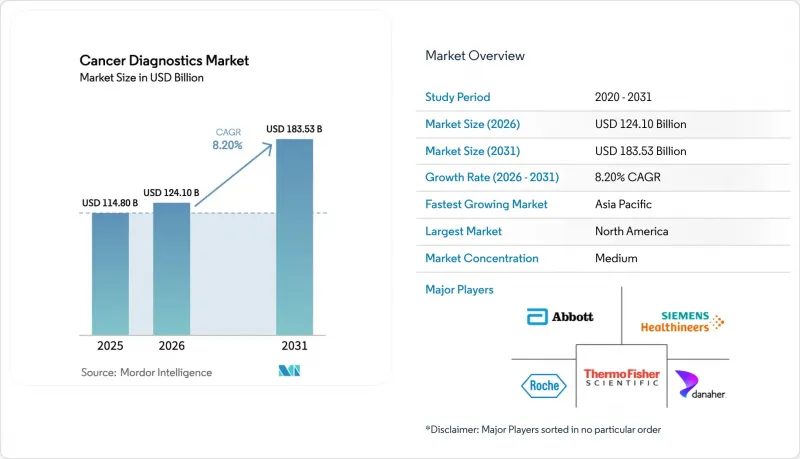
This report is Segmented by Diagnostic Type (Diagnostic Imaging Tests, Biopsy & Cytology Tests, and More), Cancer Type (Breast Cancer, Lung Cancer, Colorectal Cancer, Cervical Cancer, and More), End User (Hospitals, Diagnostic Laboratories, and More), and Geography (North America, Europe, Asia-Pacific, Middle East & Africa, and South America). The Market Forecasts are Provided in Terms of Value (USD).
Global Cancer Diagnostics Market Trends and Insights
Increasing Government-Funded Screening Programs
Governments now treat cancer screening as essential infrastructure because early detection reduces treatment spending by as much as 60-80% compared with late-stage therapy. China's Healthy China 2030 plan also seeks to alleviate the financial burden on citizens by recommending reducing individual out-of-pocket health costs to 25% by 2030. To support these goals, China is heavily investing in biotech innovation and digital health, specifically targeting 3 registered doctors and 4.7 registered nurses per 1,000 residents by 2030. In 2024, the Health Resources and Services Administration (HRSA) awarded nearly USD 9 million to 18 health centers through the Accelerating Cancer Screening (AxCS) program to improve access to screening services, such as colorectal cancer screening. In India, a nationwide screening campaign for non-communicable diseases (NCDs), including oral, breast, and cervical cancers, was launched from February 20, 2025, to March 31, 2025, targeting individuals aged 30 and above across the country. Furthermore, the Union Budget 2025-26 announced plans to establish 200 Day Care Cancer Centres in district hospitals across India to decentralize cancer care and improve accessibility. Collectively, these programs elevate baseline testing volumes, enhance vendor visibility, and make long-term contracts contingent on interoperability with national health information. exchanges.
Rising Global Cancer Incidence & Aging Population
In 2025, around 2 million new cancer cases and 0.6 million cancer deaths were projected to occur in the United States. The share of the global population aged 65 and older will move from 10% in 2025 to 16% by 2050, pushing demand in regions where oncologist density remains below OECD norms. Japan and South Korea, with median ages above 48, now reimburse liquid-biopsy panels alongside biennial imaging for citizens over 40, aiming to offset specialist shortages through automation. China's oncologist-to-population ratio is half the OECD average, prompting rapid adoption of AI-assisted pathology platforms that maintain throughput despite workforce gaps. The demographic trajectory ensures sustained test volume growth, but it also underscores the urgency of decision-support software to prevent bottlenecks.
High Cost of Advanced Molecular Diagnostics
Next-generation sequencing and liquid-biopsy assays list between USD 2,800 and USD 5,000, a level unaffordable in regions where annual health spending per capita is below USD 500. In India, a USD 3,500 genomic panel equals 1.4 times the median monthly household income, restricting uptake to metropolitan centers. Kenya's public insurance pays only USD 12 for a complete blood count and offers no coverage for genomic tests, leaving private patients to spend three months' wages on a single BRCA assay. Even in the United States, high-deductible plans shift USD 1,000 or more to patients, leading 23% of eligible individuals to forego testing in 2025. Manufacturers are rolling out slimmed-down 50-gene panels priced near USD 1,000, but these miss actionable mutations in almost one in five cases.
Other drivers and restraints analyzed in the detailed report include:
- Rapid Adoption of Liquid-Biopsy & ctDNA Tests
- Expansion of Point-of-Care Imaging & Diagnostics
- Limited Reimbursement in Low-Income Nations
For complete list of drivers and restraints, kindly check the Table Of Contents.
Segment Analysis
IVD immunoassays contributed 53.22% to 2025 revenue, supported by high-throughput analyzers that process up to 400 samples an hour at unit costs below USD 5. Genomic and liquid-biopsy platforms are projected to expand at 9.29% yearly through 2031 as coverage decisions proliferate and standard turnaround time drops to under 48 hours. Diagnostic imaging retains a mid-teens share and benefits from AI algorithms that reduce false positives by 22%, encouraging radiologist adoption. Biopsy and cytology test volumes are plateauing because oncologists now use blood-based assays for therapy selection, eliminating repeat tissue procedures. Tumor biomarker tests remain indispensable for ongoing monitoring, but grow more slowly than the overall cancer diagnostics market.
Margin profiles vary widely. Immunoassay vendors earn stable reagent revenue from broad installed bases, while genomic firms rely on intellectual-property-protected data analytics. Illumina's NovaSeq X lowered sequencing cost per genome to USD 200, enabling laboratories to price comprehensive panels at USD 1,500 with 40% gross margins. Thermo Fisher Scientific's sample-to-answer PCR unit delivers 28-gene detection in four hours without manual extraction, opening molecular testing to community hospitals lacking specialist staff. Regulators reinforce momentum; the FDA cleared 17 breakthrough oncology platforms in 2025, and the European Medicines Agency cut nine months off average review timelines for assays with strong clinical evidence. Consequently, immunoassays will continue to anchor revenue, but liquid biopsies will capture most incremental growth, reshaping the cancer diagnostics market by 2031.
Complete Report Scope:
- By Diagnostic Type
- Diagnostic Imaging Tests
- Biopsy & Cytology Tests
- Tumor Biomarkers
- Genomic / Liquid-Biopsy Tests
- IVD Immunoassays
- Other Diagnostic Types
- By Cancer Type
- Breast Cancer
- Lung Cancer
- Colorectal Cancer
- Cervical Cancer
- Prostate Cancer
- Kidney Cancer
- Liver Cancer
- Pancreatic Cancer
- Ovarian Cancer
- Other Cancer Types
- By End User
- Hospitals
- Diagnostic Laboratories
- Academic & Research Institutes
- POC / Ambulatory Centres
- By Geography
- North America
- United States
- Canada
- Mexico
- Europe
- Germany
- United Kingdom
- France
- Italy
- Spain
- Rest of Europe
- Asia-Pacific
- China
- Japan
- India
- South Korea
- Australia
- Rest of Asia-Pacific
- Middle East & Africa
- GCC
- South Africa
- Rest of Middle East & Africa
- South America
- Brazil
- Argentina
- Rest of South America
- North America
Geography Analysis
North America accounted for 39.26% of sales in 2025, underpinned by USD 12,500 per capita health spending and broad coverage for advanced diagnostics, whereas Asia-Pacific is set to rise at an 8.92% CAGR, the fastest regional pace. The regional cancer diagnostics market will sustain mid-single-digit growth as Medicare coverage for multi-cancer early detection took effect in 2026, adding 41 million reimbursed lives. The United Kingdom delayed the national liquid biopsy rollout due to a GBP 2.1 billion funding gap, signaling divergent adoption rates across Europe.
India's Ayushman Bharat scheme covers 550 million citizens aged 50 and older. China's domestic diagnostic chains now run 1,800 labs, driving local procurement and shortening installation cycles from 16 to six weeks. Japan's shrinking population masks rising per-capita spending, which climbed 6.2% in 2025 after the government prioritized early detection to control late-stage therapy costs. South Korea's screening program reached 76% participation in 2025, the highest globally, and newly reimbursed liquid-biopsy monitoring for colorectal survivors will support future test volumes. Australia expanded companion-diagnostic coverage in 2025, reinforcing a regional trend toward precision oncology reimbursement.
The Middle East and Africa remain a low-single-digit share but show targeted investment. Saudi Arabia allocated USD 1.2 billion under Vision 2030 to install 45 PET-CT scanners and set up genomic labs in three major cities. The United Arab Emirates is establishing oncology centers that integrate AI pathology, aiming to serve medical tourists. South America presents mixed signals; Brazil's national system added mammography and colonoscopy to coverage in 2024, yet equipment shortages persist in northern states. Overall, while North America and Europe still drive absolute revenue, Asia-Pacific will contribute most net new spending, reshaping competitive focus within the cancer diagnostics market.
- Abbott Laboratories
- Agilent Technologies
- Beckton Dickinson
- bioMerieux
- Bio-Rad Laboratories
- Danaher
- Exact Sciences
- Roche
- Foundation Medicine
- GE Healthcare
- Guardant Health
- Hologic
- Illumina
- Myriad Genetics
- NanoString Technologies
- Natera
- NeoGenomics Inc.
- PerkinElmer
- QIAGEN
- Siemens Healthineers
- Sysmex
- Thermo Fisher Scientific
Additional Benefits:
- The market estimate (ME) sheet in Excel format
- 3 months of analyst support
TABLE OF CONTENTS
1 Introduction
- 1.1 Study Assumptions & Market Definition
- 1.2 Scope of the Study
2 Research Methodology
3 Executive Summary
4 Market Landscape
- 4.1 Market Overview
- 4.2 Market Drivers
- 4.2.1 Increasing Government-Funded Screening Programs
- 4.2.2 Rising Global Cancer Incidence & Aging Population
- 4.2.3 Rapid Adoption of Liquid-Biopsy & ctDNA Tests
- 4.2.4 Expansion of Point-Of-Care Imaging & Diagnostics
- 4.2.5 Ai-Driven Multi-Omics Early Detection Platforms
- 4.2.6 Decentralized Microfluidic Sample-To-Answer Systems
- 4.3 Market Restraints
- 4.3.1 High Cost of Advanced Molecular Diagnostics
- 4.3.2 Limited Reimbursement in Low-Income Nations
- 4.3.3 Shortage Of Trained Molecular Pathologists
- 4.3.4 Data-Privacy Concerns in AI Cloud Workflows
- 4.4 Supply-Chain Analysis
- 4.5 Regulatory Landscape
- 4.6 Technological Outlook
- 4.7 Porter's Five Forces
- 4.7.1 Threat of New Entrants
- 4.7.2 Bargaining Power of Buyers
- 4.7.3 Bargaining Power of Suppliers
- 4.7.4 Threat of Substitute Products
- 4.7.5 Intensity of Competitive Rivalry
5 Market Size & Growth Forecasts (Value, USD)
- 5.1 By Diagnostic Type
- 5.1.1 Diagnostic Imaging Tests
- 5.1.2 Biopsy & Cytology Tests
- 5.1.3 Tumor Biomarkers
- 5.1.4 Genomic / Liquid-Biopsy Tests
- 5.1.5 IVD Immunoassays
- 5.1.6 Other Diagnostic Types
- 5.2 By Cancer Type
- 5.2.1 Breast Cancer
- 5.2.2 Lung Cancer
- 5.2.3 Colorectal Cancer
- 5.2.4 Cervical Cancer
- 5.2.5 Prostate Cancer
- 5.2.6 Kidney Cancer
- 5.2.7 Liver Cancer
- 5.2.8 Pancreatic Cancer
- 5.2.9 Ovarian Cancer
- 5.2.10 Other Cancer Types
- 5.3 By End User
- 5.3.1 Hospitals
- 5.3.2 Diagnostic Laboratories
- 5.3.3 Academic & Research Institutes
- 5.3.4 POC / Ambulatory Centres
- 5.4 By Geography
- 5.4.1 North America
- 5.4.1.1 United States
- 5.4.1.2 Canada
- 5.4.1.3 Mexico
- 5.4.2 Europe
- 5.4.2.1 Germany
- 5.4.2.2 United Kingdom
- 5.4.2.3 France
- 5.4.2.4 Italy
- 5.4.2.5 Spain
- 5.4.2.6 Rest of Europe
- 5.4.3 Asia-Pacific
- 5.4.3.1 China
- 5.4.3.2 Japan
- 5.4.3.3 India
- 5.4.3.4 South Korea
- 5.4.3.5 Australia
- 5.4.3.6 Rest of Asia-Pacific
- 5.4.4 Middle East & Africa
- 5.4.4.1 GCC
- 5.4.4.2 South Africa
- 5.4.4.3 Rest of Middle East & Africa
- 5.4.5 South America
- 5.4.5.1 Brazil
- 5.4.5.2 Argentina
- 5.4.5.3 Rest of South America
- 5.4.1 North America
6 Competitive Landscape
- 6.1 Market Concentration
- 6.2 Market Share Analysis
- 6.3 Company Profiles (includes Global level Overview, Market level overview, Core Segments, Financials as available, Strategic Information, Market Rank/Share for key companies, Products & Services, and Recent Developments)
- 6.3.1 Abbott Laboratories
- 6.3.2 Agilent Technologies
- 6.3.3 Becton, Dickinson and Company
- 6.3.4 bioMerieux SA
- 6.3.5 Bio-Rad Laboratories
- 6.3.6 Danaher Corporation (Cepheid)
- 6.3.7 Exact Sciences Corporation
- 6.3.8 F. Hoffmann-La Roche Ltd
- 6.3.9 Foundation Medicine
- 6.3.10 GE HealthCare
- 6.3.11 Guardant Health
- 6.3.12 Hologic Inc.
- 6.3.13 Illumina Inc.
- 6.3.14 Myriad Genetics
- 6.3.15 NanoString Technologies
- 6.3.16 Natera Inc.
- 6.3.17 NeoGenomics Inc.
- 6.3.18 PerkinElmer
- 6.3.19 Qiagen
- 6.3.20 Siemens Healthineers
- 6.3.21 Sysmex Corporation
- 6.3.22 Thermo Fisher Scientific
7 Market Opportunities & Future Outlook
- 7.1 White-Space & Unmet-Need Assessment

