PUBLISHER: Mordor Intelligence | PRODUCT CODE: 2066373

PUBLISHER: Mordor Intelligence | PRODUCT CODE: 2066373
Coffee - Market Share Analysis, Industry Trends & Statistics, Growth Forecasts (2026 - 2031)
According to Mordor Intelligence, the global coffee market size was valued at USD 176.55 billion in 2025 and estimated to grow from USD 185.69 billion in 2026 to reach USD 238.99 billion by 2031, at a CAGR of 5.18% during the forecast period (2026-2031).
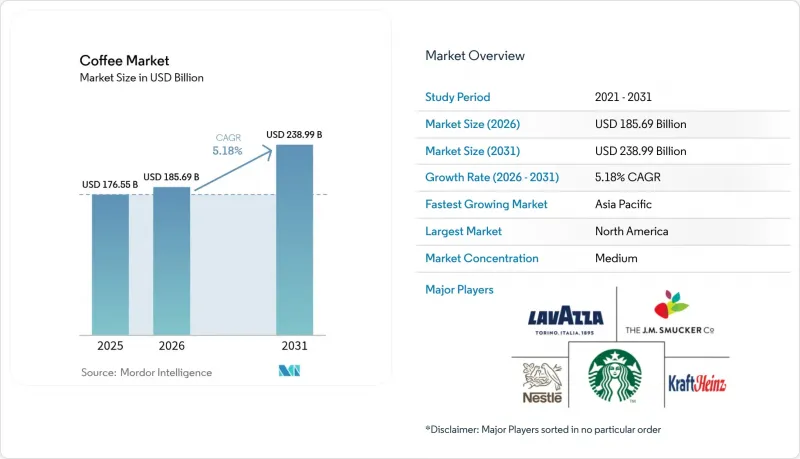
This report is Segmented by Product Type (Whole-Bean, Ground Coffee, and More), Distribution Channel (On-Trade and Off-Trade), Coffee Species (Arabica, Robusta and More), Origin (Single Origin/Specialty and Mixed), and Geography (North America, Europe, Asia-Pacific, South America, and Middle East and Africa). The Market Forecasts are Provided in Terms of Value (USD) and Volume (Tons).
Global Coffee Market Trends and Insights
Rising demand for specialty and premium coffee
Growing demand for specialty and premium coffee is driving the global coffee market, as consumer preferences continue to evolve, particularly among younger generations. In the United States, specialty coffee has become a significant part of retail consumption. According to the National Coffee Association of the USA, 46% of American adults consumed specialty coffee in 2024.This trend is also evident in the U.S. coffee market, reflecting rising interest in single-origin beans, ethically sourced products, and cafe-style experiences. Globally, specialty coffee consumption is increasing at a faster pace compared to traditional coffee, supported by strong demand for out-of-home consumption and its ability to withstand economic challenges. In India, domestic coffee consumption has been steadily rising, while the country's coffee exports have doubled over the past decade, reaching USD 1.8 billion in FY24, according to the Ministry of External Affairs as of June 2025. As consumers place greater importance on quality, unique flavors, and ethical sourcing rather than focusing solely on price, specialty coffee continues to expand its market share.
Growing coffee culture among millennials and gen Z
Millennials and Gen Z are playing a major role in the growth of the global coffee market. These younger consumers are looking for high-quality, ethically sourced coffee and prefer unique flavors and premium experiences. Many of them enjoy specialty cafes and artisanal coffee over regular options. According to Convenience Org, Gen Z coffee drinkers are just as likely to start with iced coffee as hot coffee, and about 85% of them add creamer, compared to 70% of coffee drinkers overall. This shows their preference for personalized and flavorful coffee. They also tend to drink more coffee outside the home, boosting the popularity of cafe culture. In India, urbanization, higher incomes, and the rise of cafe chains have made coffee more popular among young adults, as reported by the Coffee Board of India. These changing preferences are reshaping the coffee market worldwide, driving innovation and steady growth.
Regulatory pressure and import/export restrictions
Regulatory pressure and changing trade restrictions are creating significant challenges for the global coffee market. For instance, in August 2025, the U.S. introduced a 50% tariff on Brazilian coffee, disrupting established supply chains. This forced exporters to redirect shipments to alternative markets like China and the European Union, creating uncertainty for Brazil, one of the largest coffee suppliers globally. Similarly, India has implemented new import rules requiring fumigation certificates for coffee beans to prevent pest infestations. These regulations have added extra compliance burdens for exporters. As a result, operational costs are rising, shipments are facing delays, and smaller producers are struggling to adapt to the new standards and documentation requirements. These challenges are reshaping the market dynamics, particularly for producers and exporters who lack the resources to navigate these regulatory changes effectively.
Other drivers and restraints analyzed in the detailed report include:
- Sustainability and ethical sourcing awareness
- Corporate and workplace coffee solutions
- Consumer concerns over caffeine and health risks
For complete list of drivers and restraints, kindly check the Table Of Contents.
Segment Analysis
Ground coffee made up 33.02% of the global coffee market share in 2025, maintaining its position as the top revenue generator among coffee products. Its popularity is driven by consumers valuing the rich aroma, flavor, and brewing experience it offers. With more people buying home brewing equipment like French presses, moka pots, and espresso machines, there is a growing demand for cafe-style coffee at home. This trend highlights the focus on premium quality, especially in established markets like Europe and North America.
On the other hand, ready-to-drink(RTD) is expected to grow at a CAGR of 7.52% from 2026 to 2031, making it the fastest-growing segment in the coffee market. Ready-to-drink coffee, once seen merely as a quick caffeine fix, is now undergoing a premium transformation. With the introduction of sophisticated flavor profiles, cold brews, specialty-style recipes, and advanced brewing technologies, the taste and texture of RTD coffee have been significantly elevated. Urban youth, always on the move, are increasingly drawn to single-serve cans and bottles, especially those that are functional and health-oriented. They also favor offerings from convenience stores, underscoring a demand for portable coffee that seamlessly fits into their fast-paced lives. This shift underscores a growing appetite for barista-quality coffee in convenient formats, solidifying RTD coffee's position as a key growth driver in both emerging and established beverage markets.
Arabica remained the top choice in the global coffee market in 2025, holding 56.74% of the total share. Its smooth flavor and lower caffeine content make it popular among consumers who value quality. Grown in cooler, high-altitude regions, Arabica is widely used in specialty coffee and premium blends, especially in developed markets like North America, Europe, and Japan. Its popularity is further boosted by the rise in at-home brewing and the demand for single-origin and traceable coffee products, where flavor and quality are key.
While Arabica leads in value, Robusta is expected to grow the fastest among coffee types, with a CAGR of 5.98% through 2031. Known for its stronger, more bitter taste and higher caffeine content, Robusta is increasingly used in espresso blends, ready-to-drink coffee, and instant coffee due to its affordability and bold flavor. It is also more resistant to climate change and diseases, making it a preferred choice for producers in countries like Vietnam, Brazil, and parts of Africa. With improvements in processing and flavor, Robusta is gaining acceptance and expanding in both budget-friendly and innovative market segments.
Geography Analysis
North America accounted for 23.64% of the global coffee market revenue in 2025, driven by a strong cafe culture, the popularity of cold-brew coffee, and the widespread adoption of specialty coffee. The region has one of the highest per-capita coffee consumption rates globally, which supports higher pricing for premium products. Roasters in North America are also leading sustainability initiatives, such as partnering with farmers in Mexico for regenerative agriculture and providing adaptation loans to Colombian growers. These efforts are setting global standards for sustainable coffee production and supply chain practices. The region's focus on innovation and sustainability continues to shape the global coffee market landscape.
The Middle East and Africa are the fastest-growing regions in the coffee market, with a projected CAGR of 8.16% through 2031. Rising middle-class incomes and a young, urban population are accelerating coffee demand across the Middle East and Africa, where consumers are increasingly trading up from traditional formats to more premium cafe and at-home experiences. In the Gulf, cities such as Dubai, Riyadh, and Doha are seeing a proliferation of specialty cafes and international chains, blending long-standing coffee traditions with third-wave concepts and positioning the region as a showcase for experiential, design-led coffee spaces. African markets like Ethiopia, Nigeria, and South Africa are witnessing stronger domestic consumption, with a growing focus on locally sourced arabica, specialty roasteries, and capsule or pod systems that target affluent and aspirational drinkers. From limited-edition drinks in high-traffic malls to premium capsules in hospitality and office channels, the region's increasingly sophisticated coffee culture and evolving taste preferences are underpinning robust growth in both out-of-home and retail coffee segments.
Europe is playing a significant role in reshaping the global coffee market, particularly through its strict sustainability regulations. These regulations are pushing for greater traceability in coffee sourcing, which is becoming a standard expectation worldwide. Scandinavian countries are leading the way in adopting fair-trade coffee, while traditional markets like Italy and France are balancing their love for classic coffee with a growing interest in single-origin espressos. Latin America, as both a major producer and an emerging consumer market, is experiencing growth in domestic coffee consumption.
- Nestle SA
- UCC Ueshima Coffee Co.
- Starbucks Corporation
- The Kraft Heinz Company
- Luigi Lavazza S.p.A.
- Massimo Zanetti Beverage Group SpA
- The J. M. Smucker Company
- Tata Consumer Products
- Coava Coffee Roasters
- Tchibo GmbH
- Louis Dreyfus Company Coffee
- TGL Company
- Trung Nguyen Legend Group
- Mayora Group (Kopiko)
- The Coca-Cola Company
- Unilever PLC
- Zino Davidoff Group
- Sleepy Owl Coffee
- Bewley's Limited
- Strauss Group
Additional Benefits:
- The market estimate (ME) sheet in Excel format
- 3 months of analyst support
TABLE OF CONTENTS
1 INTRODUCTION
- 1.1 Study Assumptions and Market Definition
- 1.2 Scope of the Study
2 RESEARCH METHODOLOGY
3 EXECUTIVE SUMMARY
4 MARKET LANDSCAPE
- 4.1 Market Overview
- 4.2 Market Drivers
- 4.2.1 Rising demand for specialty and premium coffee
- 4.2.2 Growing coffee culture among millennials and Gen Z
- 4.2.3 Booming RTD/cold-brew consumption
- 4.2.4 Sustainability and ethical sourcing awareness
- 4.2.5 Corporate and workplace coffee solutions
- 4.2.6 Influence of social media and influencer marketing
- 4.3 Market Restraints
- 4.3.1 Volatility in coffee bean prices
- 4.3.2 Tariffs and European union deforestation regulation barriers
- 4.3.3 Regulatory pressure and import/export restrictions
- 4.3.4 Consumer concerns over caffeine and health risks
- 4.4 Value Chain Analysis
- 4.5 Regulatory Landscape
- 4.6 Technological Outlook
- 4.7 Porter's Five Forces
- 4.7.1 Bargaining Power of Suppliers
- 4.7.2 Bargaining Power of Buyers/Consumers
- 4.7.3 Threat of New Entrants
- 4.7.4 Threat of Substitute Products
- 4.7.5 Intensity of Competitive Rivalry
5 MARKET SIZE AND GROWTH FORECASTS (VALUE AND VOLUME)
- 5.1 By Product Type
- 5.1.1 Whole-bean
- 5.1.2 Ground Coffee
- 5.1.3 Instant Coffee
- 5.1.4 Ready-to-Drink (RTD)
- 5.1.5 Coffee Pod and Capsules
- 5.2 By Distribution Channel
- 5.2.1 On-trade
- 5.2.2 Off-trade
- 5.2.2.1 Supermarkets/Hypermarkets
- 5.2.2.2 Convenience Stores
- 5.2.2.3 Specialist Retailers
- 5.2.2.4 Online Retail
- 5.2.2.5 Other Off-trade Channels
- 5.3 By Coffee Species
- 5.3.1 Arabica
- 5.3.2 Robusta
- 5.3.3 Liberica
- 5.3.4 Others
- 5.4 By Origin
- 5.4.1 Single Origin/Specialty
- 5.4.2 Mixed
- 5.5 By Geography
- 5.5.1 North America
- 5.5.1.1 United States
- 5.5.1.2 Canada
- 5.5.1.3 Mexico
- 5.5.1.4 Rest of North America
- 5.5.2 South America
- 5.5.2.1 Brazil
- 5.5.2.2 Colombia
- 5.5.2.3 Argentina
- 5.5.2.4 Rest of South America
- 5.5.3 Europe
- 5.5.3.1 Germany
- 5.5.3.2 United Kingdom
- 5.5.3.3 France
- 5.5.3.4 Italy
- 5.5.3.5 Spain
- 5.5.3.6 Russia
- 5.5.3.7 Netherlands
- 5.5.3.8 Rest of Europe
- 5.5.4 Asia-Pacific
- 5.5.4.1 China
- 5.5.4.2 Japan
- 5.5.4.3 India
- 5.5.4.4 South Korea
- 5.5.4.5 Australia
- 5.5.4.6 Indonesia
- 5.5.4.7 Vietnam
- 5.5.4.8 Malaysia
- 5.5.4.9 Singapore
- 5.5.4.10 Rest of Asia-Pacific
- 5.5.5 Middle East and Africa
- 5.5.5.1 United Arab Emirates
- 5.5.5.2 Saudi Arabia
- 5.5.5.3 Turkey
- 5.5.5.4 South Africa
- 5.5.5.5 Egypt
- 5.5.5.6 Kuwait
- 5.5.5.7 Ethiopia
- 5.5.5.8 Rest of Middle East and Africa
- 5.5.1 North America
6 COMPETITIVE LANDSCAPE
- 6.1 Market Concentration
- 6.2 Strategic Moves
- 6.3 Market Share Analysis
- 6.4 Company Profiles (includes Global level Overview, Market level overview, Core Segments, Financials as available, Strategic Information, Market Rank/Share for key companies, Products and Services, and Recent Developments)
- 6.4.1 Nestle SA
- 6.4.2 UCC Ueshima Coffee Co.
- 6.4.3 Starbucks Corporation
- 6.4.4 The Kraft Heinz Company
- 6.4.5 Luigi Lavazza S.p.A.
- 6.4.6 Massimo Zanetti Beverage Group SpA
- 6.4.7 The J. M. Smucker Company
- 6.4.8 Tata Consumer Products
- 6.4.9 Coava Coffee Roasters
- 6.4.10 Tchibo GmbH
- 6.4.11 Louis Dreyfus Company Coffee
- 6.4.12 TGL Company
- 6.4.13 Trung Nguyen Legend Group
- 6.4.14 Mayora Group (Kopiko)
- 6.4.15 The Coca-Cola Company
- 6.4.16 Unilever PLC
- 6.4.17 Zino Davidoff Group
- 6.4.18 Sleepy Owl Coffee
- 6.4.19 Bewley's Limited
- 6.4.20 Strauss Group
7 MARKET OPPORTUNITIES AND FUTURE OUTLOOK

