PUBLISHER: Mordor Intelligence | PRODUCT CODE: 2120563

PUBLISHER: Mordor Intelligence | PRODUCT CODE: 2120563
Germany In-Vitro Diagnostics - Market Share Analysis, Industry Trends & Statistics, Growth Forecasts (2026 - 2031)
According to Mordor Intelligence, the Germany in-Vitro diagnostics market size is expected to grow from USD 5.82 billion in 2025 to USD 6.14 billion in 2026 and is forecast to reach USD 8.06 billion by 2031 at 5.58% CAGR over 2026-2031.
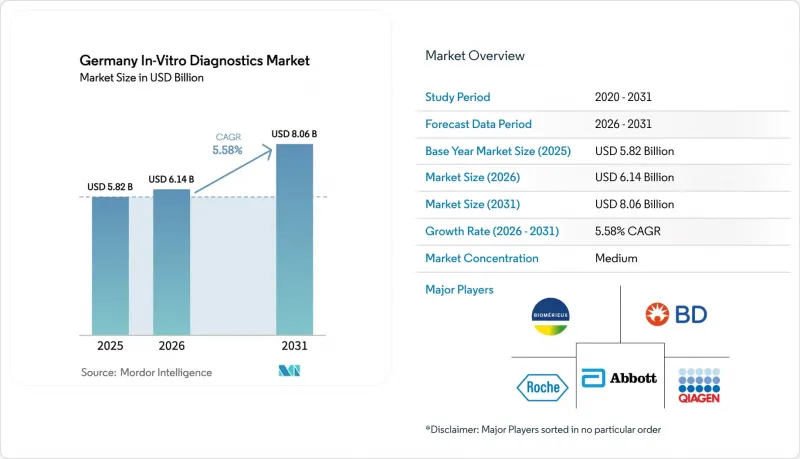
This report is Segmented by Test Type (Clinical Chemistry, and More), Product & Service (Reagents & Consumables, and More), Usability (Disposable IVD Devices and Reusable IVD Devices), Specimen Type (Blood/Serum, Urine, and More), Application (Infectious Diseases, and More), and End User (Academic & Research Institutes, and More). The Market Forecasts are Provided in Terms of Value (USD).
Germany In-Vitro Diagnostics Market Trends and Insights
Rising Chronic Disease Burden
Chronic pathology anchors baseline test volumes in the Germany in-vitro diagnostics market. More than 53.7% of adults live with at least one long-term condition, including 8.4% with diabetes and 6.8% with cardiovascular disease, driving continuous demand for chemistry panels, immunoassays and glucose monitoring. Statutory insurers have widened HbA1c screening intervals under the Disease Management Program to intercept pre-diabetes early, and oncology testing is buoyed by 510,000 new cancer diagnoses recorded in 2024. Cardiovascular biomarker panels are migrating into outpatient cardiology because 2025 guidelines recommend annual troponin, BNP and D-dimer checks for citizens >=50 years, opening a recurring preventive market.
Expansion of Precision Medicine Initiatives
The EUR 700 million genomDE pilot seeks to sequence 100,000 genomes by 2027, embedding next-generation sequencing into daily practice at 33 comprehensive cancer centers. Companion diagnostics now sit under IVDR Rule 3d, meaning clinical utility must be proven prospectively, but once certified they enjoy reimbursement certainty. Illumina's NovaSeq X Plus has pushed whole-genome sequencing costs down to USD 200 per run, making population scale feasible. Prenatal NIPT penetration jumped to 18% of births in 2024 after blanket GKV coverage, underscoring how policy unlocks latent precision-testing demand.
Stringent Regulatory Compliance Requirements
The IVDR transition forces around 25,000 legacy assays through only 35 notified bodies able to review ~8,000 files a year, leaving a backlog that drives some mid-tier suppliers from the Germany in-vitro diagnostics market. Average recertification cost per product line ranges EUR 200,000-500,000, and companion diagnostics must fund 200-patient prospective trials, extending launch timelines by up to two years. BfArM tracking shows 18% of manufacturers have already dropped at least one low-margin test, thinning choice in niche pathogen panels.
Other drivers and restraints analyzed in the detailed report include:
- Government Funding for Digital Health Infrastructure
- Shift Toward Decentralized Testing Models
- Pricing and Reimbursement Pressures
For complete list of drivers and restraints, kindly check the Table Of Contents.
Segment Analysis
Clinical chemistry underpinned 33.54% of Germany in-vitro diagnostics market share in 2025 on the back of millions of metabolic and lipid panels processed each day. Still, molecular diagnostics is clocking a brisk 7.87% CAGR from 2026-2031 as oncologists, geneticists and infectious-disease teams pivot to NGS and rapid PCR. The Germany in-vitro diagnostics market size tied to molecular assays benefits directly from the EUR 700 million genomDE pipeline and IVDR companion-diagnostic mandates that guarantee reimbursement once clinical utility is proven. Laboratories continue to run chemistry platforms for population-wide screening, but capital budgets increasingly favor sequencers and syndromic PCR stations that condense multi-day culture workflows into one-hour runs. Microbiology culture's share erodes as 450 German hospitals rely on Cepheid GeneXpert for 90-minute sepsis panels, while immunodiagnostics hold steady with hormone, tumor-marker and autoimmune workloads.
Automated hematology analyzers such as Sysmex XN-Series embed AI morphology modules, reducing manual slide reviews and elevating hematology to a higher-margin, insight-driven service line. Point-of-care rapid tests that flourished during the pandemic are now repurposed for flu and streptococcus screening in community pharmacies. Over the next five years, genomDE feeder projects at 38 university hospitals will lift germline and somatic variant testing penetration, locking molecular diagnostics into double-digit revenue share by the end of the forecast horizon.
Reagents and consumables generated 55.65% of Germany in-vitro diagnostics market size in 2025 because every assay cycle demands single-use chemicals and cartridges. Yet software and services revenue rides an 8.65% CAGR through 2031 as laboratories rush to install middleware that converts legacy LIS outputs into IVDR-mandated FHIR messages. Germany's Health Data Usage Act, European Health Data Space linkage and real-time upload to EUDAMED all hinge on this digital layer. The Germany in-vitro diagnostics market share for instruments is under cyclical lift as labs replace aging analyzers with IVDR-validated platforms like Roche cobas 8000 or Siemens Atellica, which integrate QC automation to satisfy stricter post-market surveillance.
Service lines diversify beyond maintenance into regulatory consulting, with midsize manufacturers outsourcing technical documentation writing for EUR 80,000-150,000 per SKU. Near-shoring of reagent production strengthens continuity; Thermo Fisher's Freiburg expansion will reduce Asian dependency, and Siemens' AI process manager cuts waste 15%. Together, these investments ensure reagent dominance persists, even as digital revenues compound from a smaller base.
Complete Report Scope:
- By Test Type
- Clinical Chemistry
- Immunodiagnostics
- Molecular Diagnostics
- Hematology
- Microbiology & Lateral Flow
- Coagulation
- Point-Of-Care (Rapid) Tests
- Other Tests
- By Product & Service
- Reagents & Consumables
- Instruments / Analyzers
- Software & Services
- By Usability
- Disposable IVD Devices
- Reusable IVD Devices
- By Specimen Type
- Blood / Serum
- Urine
- Saliva
- Tissue / Biopsy
- Other Specimen Types
- By Application
- Infectious Diseases
- Diabetes
- Cancer / Oncology
- Cardiology
- Autoimmune Disorders
- Nephrology & Renal Panels
- Prenatal / Genetic Screening
- Blood Screening
- Other Applications
- By End User
- Academic & Research Institutes
- Diagnostic Laboratories
- Home-Care / POC Centers
- Hospitals & Clinics
- Other End Users
- By Country
- Germany
- United Kingdom
- France
- Italy
- Spain
- Rest of Europe
List of Companies Covered in this Report:
- Abbott Laboratories
- Beckton Dickinson
- bioMerieux
- Bruker Daltonics
- Danaher (Beckman Coulter & Cepheid)
- DiaSorin
- Illumina
- Limbach Group SE
- Nova Biomedical
- Ortho Clinical Diagnostics
- QIAGEN
- Randox Laboratories
- Roche
- Seegene Germany GmbH
- Siemens Healthineers
- Synlab AG
- Sysmex Corp.
- Thermo Fisher Scientific
- Werfen GmbH
Additional Benefits:
- The market estimate (ME) sheet in Excel format
- 3 months of analyst support
TABLE OF CONTENTS
1 Introduction
- 1.1 Study Assumptions & Market Definition
- 1.2 Scope of the Study
2 Research Methodology
3 Executive Summary
4 Market Landscape
- 4.1 Market Overview
- 4.2 Market Drivers
- 4.2.1 Rising Chronic Disease Burden
- 4.2.2 Expansion of Precision Medicine Initiatives
- 4.2.3 Government Funding for Digital Health Infrastructure
- 4.2.4 Shift Toward Decentralized Testing Models
- 4.2.5 Continuous Technological Advancements in IVD
- 4.2.6 Aging Population and Preventive Health Focus
- 4.3 Market Restraints
- 4.3.1 Stringent Regulatory Compliance Requirements
- 4.3.2 Pricing and Reimbursement Pressures
- 4.3.3 Supply Chain Vulnerabilities for Critical Components
- 4.3.4 Data Privacy and Security Concerns
- 4.4 Value / Supply-Chain Analysis
- 4.5 Regulatory Landscape
- 4.6 Technological Outlook
- 4.7 Porter's Five Forces Analysis
- 4.7.1 Threat Of New Entrants
- 4.7.2 Bargaining Power Of Buyers
- 4.7.3 Bargaining Power Of Suppliers
- 4.7.4 Threat Of Substitutes
- 4.7.5 Competitive Rivalry
5 Market Size & Growth Forecasts (Value, USD)
- 5.1 By Test Type
- 5.1.1 Clinical Chemistry
- 5.1.2 Immunodiagnostics
- 5.1.3 Molecular Diagnostics
- 5.1.4 Hematology
- 5.1.5 Microbiology & Lateral Flow
- 5.1.6 Coagulation
- 5.1.7 Point-Of-Care (Rapid) Tests
- 5.1.8 Other Tests
- 5.2 By Product & Service
- 5.2.1 Reagents & Consumables
- 5.2.2 Instruments / Analyzers
- 5.2.3 Software & Services
- 5.3 By Usability
- 5.3.1 Disposable IVD Devices
- 5.3.2 Reusable IVD Devices
- 5.4 By Specimen Type
- 5.4.1 Blood / Serum
- 5.4.2 Urine
- 5.4.3 Saliva
- 5.4.4 Tissue / Biopsy
- 5.4.5 Other Specimen Types
- 5.5 By Application
- 5.5.1 Infectious Diseases
- 5.5.2 Diabetes
- 5.5.3 Cancer / Oncology
- 5.5.4 Cardiology
- 5.5.5 Autoimmune Disorders
- 5.5.6 Nephrology & Renal Panels
- 5.5.7 Prenatal / Genetic Screening
- 5.5.8 Blood Screening
- 5.5.9 Other Applications
- 5.6 By End User
- 5.6.1 Academic & Research Institutes
- 5.6.2 Diagnostic Laboratories
- 5.6.3 Home-Care / POC Centers
- 5.6.4 Hospitals & Clinics
- 5.6.5 Other End Users
- 5.7 By Country
- 5.7.1 Germany
- 5.7.2 United Kingdom
- 5.7.3 France
- 5.7.4 Italy
- 5.7.5 Spain
- 5.7.6 Rest of Europe
6 Competitive Landscape
- 6.1 Market Concentration
- 6.2 Market Share Analysis
- 6.3 Company Profiles {(Includes Global Level Overview, Market Level Overview, Core Segments, Financials as Available, Strategic Information, Market Rank/Share for Key Companies, Products & Services, and Recent Developments)}
- 6.3.1 Abbott Laboratories
- 6.3.2 Becton Dickinson
- 6.3.3 bioMerieux SA
- 6.3.4 Bruker Daltonics
- 6.3.5 Danaher (Beckman Coulter & Cepheid)
- 6.3.6 DiaSorin S.p.A.
- 6.3.7 Illumina Inc.
- 6.3.8 Limbach Group SE
- 6.3.9 Nova Biomedical
- 6.3.10 Ortho Clinical Diagnostics
- 6.3.11 Qiagen N.V.
- 6.3.12 Randox Laboratories
- 6.3.13 Roche Diagnostics
- 6.3.14 Seegene Germany GmbH
- 6.3.15 Siemens Healthineers
- 6.3.16 Synlab AG
- 6.3.17 Sysmex Corp.
- 6.3.18 Thermo Fisher Scientific
- 6.3.19 Werfen GmbH
7 Market Opportunities & Future Outlook
- 7.1 White-Space & Unmet-Need Assessment

