PUBLISHER: Mordor Intelligence | PRODUCT CODE: 2124139

PUBLISHER: Mordor Intelligence | PRODUCT CODE: 2124139
Medical Protective Equipment - Market Share Analysis, Industry Trends & Statistics, Growth Forecasts (2026 - 2031)
According to Mordor Intelligence, the medical personal protective equipment market size is expected to grow from USD 43.53 billion in 2025 to USD 46.29 billion in 2026 and is forecast to reach USD 62.94 billion by 2031 at 6.34% CAGR over 2026-2031.
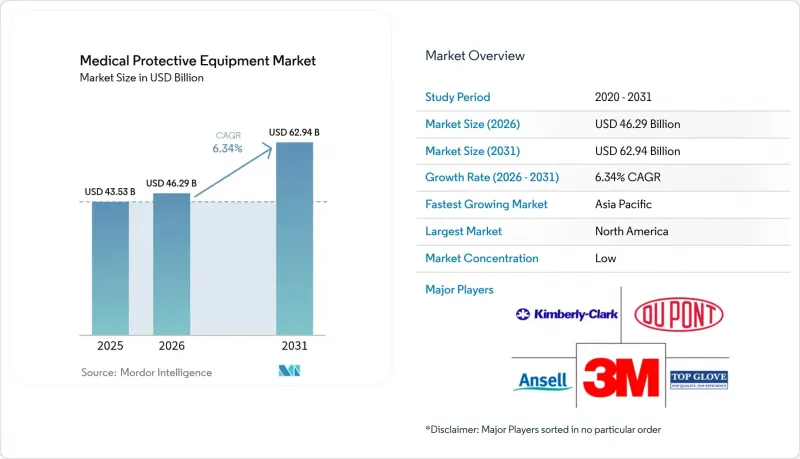
This report Segments the Industry Into by Product (Surgical Masks, N95 Respirators, Gloves, Gowns, Face Shields, Other Products), by Usability (Disposable, Reusable), by End User (Hospitals and Clinics, Ambulatory Surgical Centers, Diagnostic Laboratories, Other End Users), and Geography (North America, Europe, Asia-Pacific, Middle East and Africa, South America).
Global Medical Protective Equipment Market Trends and Insights
Rising Surgical Procedure Volumes
Growing backlogs of deferred electives and aging populations are pushing annual global surgical counts upward, especially in ambulatory surgery centers where volumes are forecast to rise 12% within five years. Each intervention demands multiple glove changes, fluid-resistant gowns, and splash shields, all of which directly enlarge the medical personal protective equipment market. Ambulatory centers operate on lean inventories, so suppliers able to guarantee frequent, small-lot deliveries are favored. Complex minimally invasive procedures now require specialty respirators and precision barrier drapes, further widening product breadth. As outpatient volumes climb, procurement models are integrating automated reorder points tied to procedure schedules, tightening distributor-provider collaboration.
Heightened Infection-Prevention Mandates Post-COVID-19
Updated CDC targets now compel even low-acuity settings-such as primary care clinics and home-health visits-to maintain baseline PPE stocks, embedding durable demand into the medical personal protective equipment market. Clinical laboratories must document biosafety risk assessments for every instrument, triggering higher-grade glove and goggle requirements. Fit-testing audits reveal that one in five staff cannot achieve a safe seal with legacy respirators, prompting demand for inclusive sizing and custom-fit solutions. Hospital accreditation bodies link reimbursement to adherence with these standards, incentivizing continuous inventory replenishment. Regulators are also tightening shelf-life monitoring, pushing facilities toward demand-sensing software that minimizes expiries without risking stockouts.
Raw-Material Price Volatility (Nitrile & Polypropylene)
Nitrile butadiene rubber costs can swing double digits within a quarter, with 2025 tariff chatter adding fresh uncertainty. Only 15% of TSA's glove requirements are sourced domestically, underscoring exposure to geopolitical shocks. Glove makers are hedging via dual sourcing and derivative contracts, yet hospitals still confront quarterly catalog repricing. Polypropylene follows similar volatility, as refinery outages ripple into melt-blown fabric availability. These swings compress margins for fixed-price contracts and can delay capital upgrades when working capital is diverted to inventory buffers.
Other drivers and restraints analyzed in the detailed report include:
- Shift Toward Reusable PPE to Curb Waste & Cost
- Advanced Material Science Enabling Lighter Barrier Fabrics
- Environmental Pushback on Single-Use Plastics
For complete list of drivers and restraints, kindly check the Table Of Contents.
Segment Analysis
Gloves generated USD 13.24 billion, equivalent to 30.42% of the medical personal protective equipment market in 2025, underpinned by universal procedure use and rapid turnover. Nitrile substitutes for latex allergies lock in glove indispensability across emergent and elective care. Innovation centers on tactile-sensing coatings that allow clinicians to maintain instrument feel while adding puncture alerts. Protective clothing, buoyed by 6.75% CAGR, benefits from expanded isolation protocols and new material blends incorporating recycled polypropylene fibers. RadiciGroup's Respunsible(R) fabric exemplifies momentum toward closed-loop supply. Integrated sensor threads that log donning duration signal when gowns should be replaced, adding aftermarket software revenue.
Second-tier categories such as masks and respirators stabilize after pandemic peaks but remain critical where fit-test compliance dictates higher-spec SKUs. Face-and-eye protectors see incremental growth tied to splash guidelines, while foot covers preserve relevance in clean rooms. Collectively, these niches ensure product diversification for vendors seeking to hedge against glove price cycles, reinforcing competitive intensity within the medical personal protective equipment market.
Nitrile rubber retained 37.63% revenue share in 2025 thanks to strong chemical resistance and latex-free acceptance, supporting the medical personal protective equipment market size expansions. Yet supply shocks during COVID-19 triggered strategic sourcing pivots toward natural rubber, driving latex gloves to a 6.98% CAGR. Thailand forecasts a steady climb in latex exports as healthcare throughput rises with aging populations. Hybrid composites that blend nitrile on the patient side with biodegradable layers on the exterior seek to balance cost, comfort, and sustainability. Polypropylene remains fundamental in melt-blown masks and SMS gowns, although recyclate percentages inch higher each year. Silver-nanoparticle woven cotton enters pilot runs for reusable gowns, carving a growing slice of specialty demand.
Complete Report Scope:
- By Product Type
- Protective Clothing
- Masks & Respirators
- Gloves
- Face, Eye & Head Protection
- Foot & Shoe Covers
- Others
- By Material
- Non-woven Polypropylene
- Nitrile Rubber
- Natural Rubber/Latex
- Polyethylene & Other Plastics
- By Usability
- Disposable
- Reusable
- By End User
- Hospitals & Clinics
- Ambulatory Surgical Centers
- Diagnostic Laboratories
- Home Healthcare
- Research & Academic Institutes
- Others
- By Distribution Channel
- Hospital Pharmacies
- Retail Pharmacies & Drug Stores
- Direct Tenders & Group Purchasing
- Online Platforms
- By Geography
- North America
- U.S.
- Canada
- Mexico
- Europe
- Germany
- United Kingdom
- France
- Italy
- Spain
- Rest of Europe
- Asia-Pacific
- China
- India
- Japan
- South Korea
- Australia
- Rest of Asia-Pacific
- South America
- Brazil
- Argentina
- Rest of South America
- Middle East and Africa
- GCC
- South Africa
- Rest of Middle East and Africa
- North America
Geography Analysis
North America generated 41.65% of 2025 sales as FDA alignment with ISO 13485 demands elevated quality and spurred domestic re-shoring initiatives like the USD 510 million allocation to bolster regional production. The medical personal protective equipment market benefits from integrated health systems capable of multi-year offtake commitments that de-risk capital expenditure on advanced melt-blown lines. Education campaigns around reusable gowns tap into the U.S. climate agenda, nudging hospital purchasing committees toward sustainable SKUs.
Asia-Pacific is set for 7.85% CAGR to 2031 as governments boost healthcare capacity and OEMs expand nitrile glove factories. Malaysia's tariff incentives and India's PPE technical-textile parks anchor regional supply, while regulatory harmonization via ASEAN Medical Device Directive accelerates foreign entrant registration. Rising middle-class healthcare spend fuels surgical volumes, enlarging addressable demand and enticing multinational brands to establish joint ventures for localized fit testing.
Europe progresses steadily under the Medical Device Regulation, which now covers PPE. The CE-marking extension in the U.K. eases post-Brexit uncertainty and preserves intra-European trade flows. Sustainability imperatives, embodied in the Green Deal, prioritize reusables, pushing hospitals to trial sterilizable respirators. South America and Middle East & Africa trail in absolute value but register pockets of growth where private hospitals scale up infection-control standards, signaling future expansion corridors for the medical personal protective equipment market.
- 3M
- DuPont
- Ansell
- Cardinal Health
- Medline Industries
- Lakeland Industries, Inc.
- MSA Safety Incorporated
- Molnlycke Health Care
- Top Glove
- Supermax
- Hartalega Holdings
- Alpha Pro Tech, Ltd.
- Medtecs International Corp.
- Owens & Minor, Inc.
- Steris plc
- Dynarex
Additional Benefits:
- The market estimate (ME) sheet in Excel format
- 3 months of analyst support
TABLE OF CONTENTS
1 Introduction
- 1.1 Study Assumptions & Market Definition
- 1.2 Scope of the Study
2 Research Methodology
3 Executive Summary
4 Market Landscape
- 4.1 Market Overview
- 4.2 Market Drivers
- 4.2.1 Rising surgical procedure volumes
- 4.2.2 Heightened infection-prevention mandates post-COVID-19
- 4.2.3 Shift toward reusable PPE to curb waste & cost
- 4.2.4 Advanced material science enabling lighter barrier fabrics
- 4.2.5 On-site 3-D printing of customized respirators (under-radar)
- 4.2.6 AI-driven demand-sensing boosting distributor inventory turns (under-radar)
- 4.3 Market Restraints
- 4.3.1 Raw-material price volatility (nitrile & non-woven polypropylene)
- 4.3.2 Environmental pushback on single-use plastics
- 4.3.3 Counterfeit certification schemes eroding buyer trust (under-radar)
- 4.3.4 Robotics-enabled "no-touch" surgery lowering PPE intensity (under-radar)
- 4.4 Value / Supply-Chain Analysis
- 4.5 Regulatory Landscape
- 4.6 Technological Outlook
- 4.7 Porter's Five Forces
- 4.7.1 Threat of New Entrants
- 4.7.2 Bargaining Power of Suppliers
- 4.7.3 Bargaining Power of Buyers
- 4.7.4 Threat of Substitutes
- 4.7.5 Competitive Rivalry
5 Market Size & Growth Forecasts (Value, USD)
- 5.1 By Product Type
- 5.1.1 Protective Clothing
- 5.1.2 Masks & Respirators
- 5.1.3 Gloves
- 5.1.4 Face, Eye & Head Protection
- 5.1.5 Foot & Shoe Covers
- 5.1.6 Others
- 5.2 By Material
- 5.2.1 Non-woven Polypropylene
- 5.2.2 Nitrile Rubber
- 5.2.3 Natural Rubber/Latex
- 5.2.4 Polyethylene & Other Plastics
- 5.3 By Usability
- 5.3.1 Disposable
- 5.3.2 Reusable
- 5.4 By End User
- 5.4.1 Hospitals & Clinics
- 5.4.2 Ambulatory Surgical Centers
- 5.4.3 Diagnostic Laboratories
- 5.4.4 Home Healthcare
- 5.4.5 Research & Academic Institutes
- 5.4.6 Others
- 5.5 By Distribution Channel
- 5.5.1 Hospital Pharmacies
- 5.5.2 Retail Pharmacies & Drug Stores
- 5.5.3 Direct Tenders & Group Purchasing
- 5.5.4 Online Platforms
- 5.6 By Geography
- 5.6.1 North America
- 5.6.1.1 U.S.
- 5.6.1.2 Canada
- 5.6.1.3 Mexico
- 5.6.2 Europe
- 5.6.2.1 Germany
- 5.6.2.2 United Kingdom
- 5.6.2.3 France
- 5.6.2.4 Italy
- 5.6.2.5 Spain
- 5.6.2.6 Rest of Europe
- 5.6.3 Asia-Pacific
- 5.6.3.1 China
- 5.6.3.2 India
- 5.6.3.3 Japan
- 5.6.3.4 South Korea
- 5.6.3.5 Australia
- 5.6.3.6 Rest of Asia-Pacific
- 5.6.4 South America
- 5.6.4.1 Brazil
- 5.6.4.2 Argentina
- 5.6.4.3 Rest of South America
- 5.6.5 Middle East and Africa
- 5.6.5.1 GCC
- 5.6.5.2 South Africa
- 5.6.5.3 Rest of Middle East and Africa
- 5.6.1 North America
6 Competitive Landscape
- 6.1 Market Concentration
- 6.2 Market Share Analysis
- 6.3 Company Profiles (includes Global level Overview, Market level overview, Core Segments, Financials as available, Strategic Information, Market Rank/Share for key companies, Products & Services, and Recent Developments)
- 6.3.1 3M Company
- 6.3.2 DuPont de Nemours, Inc.
- 6.3.3 Ansell Limited
- 6.3.4 Cardinal Health, Inc.
- 6.3.5 Medline Industries, LP
- 6.3.6 Lakeland Industries, Inc.
- 6.3.7 MSA Safety Incorporated
- 6.3.8 Molnlycke Health Care AB
- 6.3.9 Top Glove Corporation Bhd
- 6.3.10 Supermax Corporation Berhad
- 6.3.11 Hartalega Holdings Berhad
- 6.3.12 Alpha Pro Tech, Ltd.
- 6.3.13 Medtecs International Corp.
- 6.3.14 Owens & Minor, Inc.
- 6.3.15 Steris plc
- 6.3.16 Dynarex Corporation
7 Market Opportunities & Future Outlook
- 7.1 White-space & Unmet-Need Assessment

