PUBLISHER: Mordor Intelligence | PRODUCT CODE: 1906165

PUBLISHER: Mordor Intelligence | PRODUCT CODE: 1906165
Cosmetic Products - Market Share Analysis, Industry Trends & Statistics, Growth Forecasts (2026 - 2031)
The cosmetics market is expected to grow from USD 80.54 billion in 2025 to USD 83.65 billion in 2026 and is forecast to reach USD 101.13 billion by 2031 at 3.86% CAGR over 2026-2031.
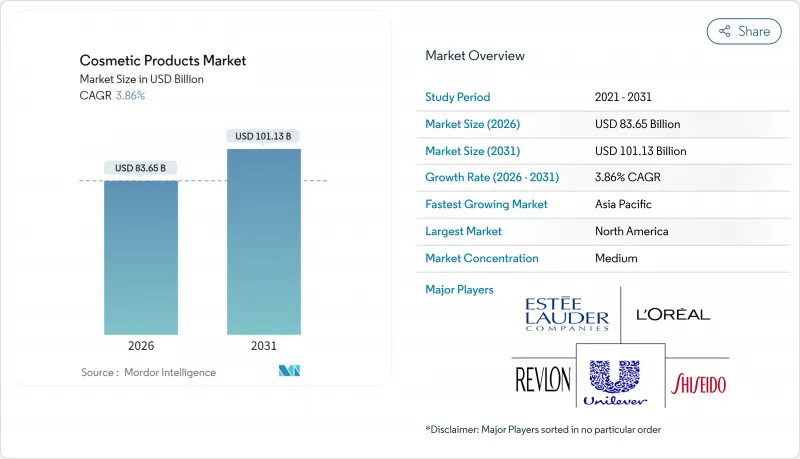
This growth trajectory is primarily attributed to advancements in regulatory frameworks, the increasing adoption of sustainable and eco-friendly formulations, and the accelerated integration of digital technologies across various stages of the value chain, including research, production, and retail. In the United States, the Modernization of Cosmetics Regulation Act (MoCRA) has introduced mandatory facility registration, ensuring stricter compliance standards. Similarly, the European Union has implemented substance prohibitions to enhance product safety, while China has streamlined its ingredient approval processes to facilitate market entry. These regulatory developments are significantly influencing compliance costs, providing a competitive edge to companies with well-established regulatory infrastructures. Additionally, social media platforms are playing a pivotal role in driving brand engagement, enabling companies to connect with consumers more effectively. These trends are creating substantial revenue opportunities for businesses capable of integrating advanced technologies with transparent and ethical sourcing practices. From a regional perspective, the Asia-Pacific region is emerging as a dominant player, outpacing mature Western economies. This growth is fueled by the expansion of middle-class incomes and the widespread penetration of mobile commerce, which is transforming consumer purchasing behaviors and driving market expansion in the region.
Global Cosmetic Products Market Trends and Insights
Consumer preference for natural and organic products
The ongoing transition towards natural and organic cosmetics is significantly transforming product development cycles and regulatory compliance strategies within the industry. According to the USDA's National Organic Program regulations (7 CFR 205), products labeled as "organic" are required to contain a minimum of 95% organically produced ingredients. In contrast, products claiming to be "made with organic ingredients" must include at least 70% organic content. Similarly, the NSF/ANSI 305 standard enforces a 70% organic content threshold for personal care products. Furthermore, the Strengthening Organic Enforcement rules, which came into effect in March 2024, introduce the requirement for electronic NOP import certificates. This measure enhances traceability across the supply chain and provides a competitive edge to suppliers equipped with advanced digital compliance systems. Established manufacturers with extensive global supply chains are better positioned to address these regulatory demands efficiently compared to smaller market entrants. This capability enables them to leverage premium pricing strategies and achieve faster product placement on retail shelves.
Rising demand for sustainable cosmetic products
Manufacturing processes and supply chains are being redefined by sustainability mandates, with regulatory enforcement providing a competitive advantage to early adopters. Effective March 2024, the EU's Directive 2024/825 will prohibit vague environmental claims such as "eco-friendly" or "biodegradable" unless they are supported by specific substantiation criteria. Companies will be required to present verifiable evidence for all green marketing claims. Demonstrating the integration of technology and sustainability, L'Oreal, in partnership with IBM, plans to deploy customized AI models by January 2025. These models aim to transition product formulas to circular and bio-based alternatives within five years, accelerating compliance with sustainability standards while reducing reformulation costs. Additionally, France's upcoming ban on PFAS in cosmetics, effective January 2026, will create opportunities for companies capable of reformulating products without compromising performance. The combination of regulatory pressures and increased consumer awareness is compelling businesses to internalize environmental costs that were previously externalized, fundamentally transforming competitive dynamics and profit margins across the value chain.
Consumer concerns about chemical ingredients
Smaller players in the chemical industry are facing challenges as increased regulatory scrutiny drives up reformulation costs and creates barriers to market access. This regulatory environment is also accelerating the trend toward premiumization. The FDA's implementation of MoCRA requires companies to retain adverse event records for six years and report serious incidents within 15 days, creating a liability framework that favors organizations with robust pharmacovigilance systems. In the United States, five states, California, Colorado, Maryland, Minnesota, and Washington, have introduced regulations targeting heavy metals, particularly lead. California's PFAS-Free Beauty Act is notable as the first state law to ban PFAS in cosmetics. Additionally, New York's proposed Beauty Justice Act seeks to ban products containing certain restricted substances while mandating the identification of safer alternatives, reflecting the growing regulatory focus on chemical restrictions. These developments are compelling companies to invest significantly in ingredient safety validation and alternative formulations. Established players with extensive toxicology databases and regulatory expertise are gaining a competitive edge, although this environment may hinder innovation in the development of groundbreaking ingredients.
Other drivers and restraints analyzed in the detailed report include:
- Technological advancements in product formulations
- Social media influence to boost the market
- Rising concerns over counterfeit products in the market
For complete list of drivers and restraints, kindly check the Table Of Contents.
Segment Analysis
Eye Cosmetics is anticipated to exhibit the highest growth within the cosmetics market, with a projected compound annual growth rate (CAGR) of 4.39% during the forecast period of 2026 to 2031. This growth rate positions the segment as a standout performer compared to the overall cosmetics market. In 2025, facial cosmetics emerged as the dominant segment, capturing a substantial 38.12% share of the cosmetics market. The segment's prominence is driven by the increasing reliance on video conferencing and the pervasive influence of social media, both of which emphasize eye expressions and encourage frequent product innovations. Consumers are increasingly seeking products that offer precision application and long-lasting performance, enabling them to achieve professional-quality results at home.
The high frequency of product repurchases ensures a stable revenue stream and supports the adoption of premium pricing strategies. Celebrity-endorsed product launches and the introduction of seasonal palettes play a pivotal role in maintaining consumer engagement. Additionally, the integration of augmented reality (AR)-enabled virtual try-on tools is significantly enhancing conversion rates within digital storefronts. As eye makeup trends rapidly transcend geographical boundaries, leading global corporations are implementing well-coordinated marketing campaigns. These campaigns are tailored to localize color palettes while maintaining the integrity and consistency of their brand identity.
By 2031, premium offerings are set to grow at a robust CAGR of 5.12%, outpacing the mass trade segment's growth. In 2025, the mass trade segment held a significant 57.68% share of the cosmetics market. In the Asia-Pacific and Middle East regions, an expanding base of aspirational consumers is gravitating towards prestige formulations. These formulations not only offer sensory appeal but also prioritize clean and sustainable ingredients, aligning with the increasing demand for environmentally conscious and health-focused products. This trend highlights a shift in consumer preferences towards high-quality, innovative products that cater to both aesthetic and ethical considerations. In a testament to the sector's emphasis on technology-driven differentiation, Estee Lauder has forged a strategic partnership with Exuud. Their goal is to commercialize the Soliqaire TM fragrance delivery system, which enhances fragrance longevity and sensory experience, marking a significant leap in product innovation within the premium cosmetics arena.
Premium brands are harnessing loyalty programs, crafting personalized omnichannel experiences, and unveiling exclusive limited-edition product launches. These strategies not only bolster their pricing power but also deepen customer engagement by creating a sense of exclusivity and fostering brand loyalty. Meanwhile, mass-market players are rolling out sub-premium product extensions, aiming to capture consumers who are moving towards higher-value offerings. In 2024, the Organisation for Economic Co-operation and Development spotlighted Luxembourg, noting its household net adjusted annual disposable income in Europe stood at USD 44.77 thousand. This uptick in disposable income has emboldened consumers, especially young professionals and urbanites, to gravitate towards premium cosmetics. They're now opting for luxury items, like high-end lipsticks and foundations, leaving mass-market choices behind. This shift reflects a growing inclination towards products that not only deliver superior performance but also align with the aspirational lifestyles of these consumer groups.
The Cosmetics Market Report is Segmented by Product Type (Facial Cosmetics, Eye Cosmetics, and Lip and Nail Make-Up Products), Category (Premium Products, and Mass Products), Ingredient Type (Natural and Organic, and Conventional/Synthetic), Distribution Channel (Specialty Stores, Supermarkets/Hypermarkets, and More), and Geography. The Market Forecasts are Provided in Terms of Value (USD) and Volume (Units).
Geography Analysis
In 2025, North America captured 33.10% of the global revenue share, driven by well-established consumption patterns and a strong presence in the premium segment. The implementation of the Modernization of Cosmetics Regulation Act (MoCRA) in January 2025 will introduce mandatory facility registration and product listing requirements, leading to increased compliance costs. This regulatory shift is expected to consolidate market positions among larger manufacturers with the resources to adapt. Future growth in the region is anticipated to be propelled by advancements in AI-driven personalization, which will enable tailored consumer experiences, and the adoption of sustainable packaging solutions to address environmental concerns and counteract market saturation.
Directive 2024/825, set to take effect in September 2025, aims to tighten regulations across Europe by banning ambiguous eco-claims and certain substances. This directive is expected to create a more stringent regulatory framework, compelling companies to enhance their compliance strategies. Established players with strong regulatory expertise and compliance capabilities are likely to gain a competitive edge in navigating these changes. Furthermore, with rising disposable incomes, markets in Central and Eastern Europe, such as Lithuania, Hungary, and Bulgaria, are witnessing rapid growth. This growth underscores lucrative expansion opportunities, as increased consumer spending on cosmetics drives demand in these regions.
The Asia-Pacific region is projected to achieve the highest regional compound annual growth rate (CAGR) of 7.18% during the forecast period of 2026 to 2031. In China, the 2025 National Medical Products Administration (NMPA) provisions aim to simplify ingredient approval processes, thereby reducing the time to market for innovative active ingredients. Local brands, which are adept at aligning with cultural preferences, are scaling operations rapidly. However, multinational companies maintain a competitive edge due to their technological advancements and efficient multi-country logistics networks. Countries such as India, China, Indonesia, and Vietnam, characterized by large and youthful populations, present substantial growth potential. According to the World Bank, 68.02% of India's population fell within the 15-64 age group in 2024. This younger demographic is increasingly beauty-conscious, trend-aware, and open to experimentation, driving robust demand for skin care products, color cosmetics, and offerings inspired by K-beauty and J-beauty trends.
- L'Oreal S.A.
- The Estee Lauder Companies Inc.
- Unilever PLC
- Chanel Limited
- Coty Inc
- Shiseido Co. Ltd.
- LVMH Moet Hennessy Louis Vuitton SE
- TSG Consumer Partners(Huda Beauty)
- Sugar Cosmetics
- Coty Inc.
- Cosnova GmbH
- Groupe Clarins Sa
- Revlon, Inc.
- Mary Kay Inc.
- Natura and Co Holding SA
- Oriflame Holding AG
- Amorepacific Corp.
- Kylie Cosmetics LLC
- Charlotte Tilbury Beauty Ltd.
- Orveon Global US LLC
Additional Benefits:
- The market estimate (ME) sheet in Excel format
- 3 months of analyst support
TABLE OF CONTENTS
1 INTRODUCTION
- 1.1 Study Assumptions and Market Definition
- 1.2 Scope of the Study
2 RESEARCH METHODOLOGY
3 EXECUTIVE SUMMARY
4 MARKET LANDSCAPE
- 4.1 Market Overview
- 4.2 Market Drivers
- 4.2.1 Consumer preference for natural and organic products
- 4.2.2 Rising demand for sustainable cosmetic products
- 4.2.3 Technological advancements in product formulations
- 4.2.4 Social media influence to boost the market
- 4.2.5 Increasing disposable income drives market expansion
- 4.2.6 Growing e-commerce platforms enhance product accessibility
- 4.3 Market Restraints
- 4.3.1 Consumer concerns about chemical ingredients
- 4.3.2 Rising concerns over counterfeit products in the market
- 4.3.3 Stringent regulatory frameworks impacting product launches
- 4.3.4 High costs associated with premium and organic products
- 4.4 Consumer Behaviour Analysis
- 4.5 Regulatory Outlook
- 4.6 Porters Five Forces
- 4.6.1 Bargaining Power of Suppliers
- 4.6.2 Bargaining Power of Buyers
- 4.6.3 Threat of New Entrants
- 4.6.4 Threat of Substitutes
- 4.6.5 Degree of Competition
5 MARKET SIZE AND GROWTH FORECASTS (VALUE AND VOLUME)
- 5.1 By Product Type
- 5.1.1 Facial Cosmetics
- 5.1.2 Eye Cosmetics
- 5.1.3 Lip and Nail Make-up Products
- 5.2 By Category
- 5.2.1 Premium Products
- 5.2.2 Mass Products
- 5.3 By Ingredient Type
- 5.3.1 Natural and Organic
- 5.3.2 Conventional/Synthetic
- 5.4 By Distribution Channel
- 5.4.1 Specialty Stores
- 5.4.2 Supermarkets/Hypermarkets
- 5.4.3 Online Retail Stores
- 5.4.4 Other Channels
- 5.5 By Geography
- 5.5.1 North America
- 5.5.1.1 United States
- 5.5.1.2 Canada
- 5.5.1.3 Mexico
- 5.5.1.4 Rest of North America
- 5.5.2 Europe
- 5.5.2.1 United Kingdom
- 5.5.2.2 Germany
- 5.5.2.3 Spain
- 5.5.2.4 France
- 5.5.2.5 Italy
- 5.5.2.6 Russia
- 5.5.2.7 Rest of Europe
- 5.5.3 Asia-Pacific
- 5.5.3.1 China
- 5.5.3.2 Japan
- 5.5.3.3 India
- 5.5.3.4 Australia
- 5.5.3.5 Rest of Asia-Pacific
- 5.5.4 South America
- 5.5.4.1 Brazil
- 5.5.4.2 Argentina
- 5.5.4.3 Rest of South America
- 5.5.5 Middle East and Africa
- 5.5.5.1 Saudi Arabia
- 5.5.5.2 South Africa
- 5.5.5.3 Rest of Middle East and Africa
- 5.5.1 North America
6 COMPETITIVE LANDSCAPE
- 6.1 Market Concentration
- 6.2 Strategic Moves
- 6.3 Market Share Analysis
- 6.4 Company Profiles (includes Global level Overview, Market level overview, Core Segments, Financials as available, Strategic Information, Market Rank/Share for key companies, Products and Services, and Recent Developments)
- 6.4.1 L'Oreal S.A.
- 6.4.2 The Estee Lauder Companies Inc.
- 6.4.3 Unilever PLC
- 6.4.4 Chanel Limited
- 6.4.5 Coty Inc
- 6.4.6 Shiseido Co. Ltd.
- 6.4.7 LVMH Moet Hennessy Louis Vuitton SE
- 6.4.8 TSG Consumer Partners(Huda Beauty)
- 6.4.9 Sugar Cosmetics
- 6.4.10 Coty Inc.
- 6.4.11 Cosnova GmbH
- 6.4.12 Groupe Clarins Sa
- 6.4.13 Revlon, Inc.
- 6.4.14 Mary Kay Inc.
- 6.4.15 Natura and Co Holding SA
- 6.4.16 Oriflame Holding AG
- 6.4.17 Amorepacific Corp.
- 6.4.18 Kylie Cosmetics LLC
- 6.4.19 Charlotte Tilbury Beauty Ltd.
- 6.4.20 Orveon Global US LLC
7 MARKET OPPORTUNITIES AND FUTURE OUTLOOK

