
PUBLISHER: Mordor Intelligence | PRODUCT CODE: 1911274

PUBLISHER: Mordor Intelligence | PRODUCT CODE: 1911274
India Travel Retail - Market Share Analysis, Industry Trends & Statistics, Growth Forecasts (2026 - 2031)
The India travel retail market was valued at USD 2.83 billion in 2025 and estimated to grow from USD 3.21 billion in 2026 to reach USD 5.98 billion by 2031, at a CAGR of 13.28% during the forecast period (2026-2031).
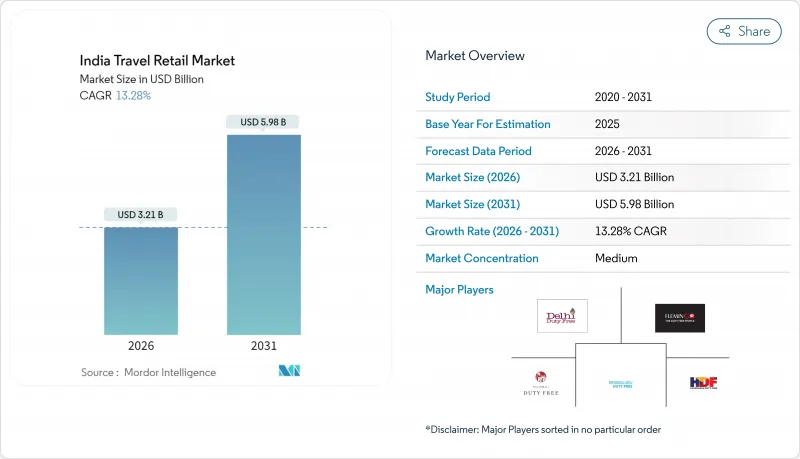
Sustained airport capacity upgrades, a swelling middle-income population, and liberalized foreign-investment rules are unlocking new duty-free footprints that convert larger traveler cohorts into high-margin retail spenders. Digital payment ubiquity and friction-less biometric processing are also raising dwell-time conversion rates, while premium liquor tariff cuts under recently concluded trade pacts are expanding average basket values. Operators are responding with omnichannel pre-order platforms, curated assortments, and loyalty-airline tie-ups that reinforce brand stickiness despite intensifying competitive pressure. Meanwhile, persistent customs-duty gaps between duty-free and domestic channels continue to shape shopper price perceptions, making regulatory certainty an essential variable for sustained growth.
India Travel Retail Market Trends and Insights
Rapid Airport Capacity Expansions Across Tier-2 Cities
Government outlays worth INR 980 billion (USD 11.8 billion) are upgrading 21 non-metro terminals, widening runways and adding retail-concession space that decentralizes the India travel retail market beyond the largest hubs. Coimbatore's runway extension now permits wide-body aircraft, Surat's new integrated terminal increases passenger handling by 350%, and Amritsar's apron expansion supports charter arrival growth. The UDAN scheme's 540 operational regional routes in 2024 create feeder traffic that bolsters commercial viability for emerging duty-free operators. Early tenant agreements indicate strong brand interest because rental yields remain lower than in saturated metros, strengthening profitability arcs. Yet route sustainability after subsidy expiry remains a watch-point, pressing operators to adopt flexible inventory rotation and data-driven assortment planning.
Surge in Outbound Indian Leisure Traffic Post-2025
Indian travelers spent USD 31.7 billion overseas in 2024 and are projected to shell out USD 76.8 billion by 2034 amid a middle-class cohort adding 120 million households earning above USD 40,000. Q1 2024 posted 97 million passenger movements, with international segments already 4% above 2019 levels; Europe, Japan, and Vietnam each logged double-digit Indian arrival growth. Leisure itineraries are lengthening, amplifying duty-free purchase windows and lifting per-trip spends to as high as USD 7,000. High-spending millennials value experiential merchandising, prompting operators to introduce sampling bars, digital kiosks, and limited-edition collectibles. Airlines are partnering with concessionaires on joint loyalty wallets that transfer miles into shopping credits, raising conversion rates among repeat flyers.
High Customs Duties on Non-Duty-Free Retail Dampening Price Gaps
Liquor outside duty-free zones attracts 150% customs duty, compressing perceived savings and curbing shopper conversion once inside arrival halls. Recent bourbon duty relief to 50% underscores policy unpredictability, forcing retailers to maintain dual price books that add logistical drag. Tight margins discourage aggressive domestic-channel promotions, steering premium-price-sensitive buyers toward gray-market alternatives. Industry associations lobby for gradual harmonization, but fiscal-revenue dependence limits legislative pace. Sustained disparity hinders omnichannel ambitions because price parity is essential for integrating online reservations with post-arrival pick-ups.
Other drivers and restraints analyzed in the detailed report include:
- FDI-Backed Upgrades of Duty-Free Retail Formats
- Rising Premiumisation of Indian Spirits and Craft Liquor
- Regulatory Uncertainty on Tobacco & Liquor Allowances
For complete list of drivers and restraints, kindly check the Table Of Contents.
Segment Analysis
Wine & Spirits held a commanding 75.68% share of the India travel retail market in 2025, mirroring the country's status as the top global whisky consumer. The dominance also manifests at the India travel retail market size level, where the segment generated more than USD 2 billion in sales last year. Demand is anchored in cultural preference and widening premium tiers; single-malt assortments alone expanded 40% year-on-year within duty-free outlets. Exclusivity and gift-pack innovation drive repeat visits, while tariff reductions promise further upside for imported labels from 2026 onward.
Fragrances & Cosmetics is projected to log the fastest 14.92% CAGR through 2031 as India's luxury beauty outlay doubles to USD 1.6 billion by 2028. Growing female traveler participation and social-media-led beauty consciousness propel penetration, and beauty-tech fixtures enable virtual try-ons that increase basket sizes. The India travel retail market continues to benefit from brand collaborations that debut global SKUs first at airports, transforming fragrance aisles into discovery zones.
The India Travel Retail Market Report is Segmented by Product Type (Fashion and Accessories, Wine and Spirits, and More), Distribution Channel (Airports, Cruise Liners, Railway Stations, Other Distribution Channels), Traveler Demographics (Business Travelers, Leisure Travelers, and More), and Geography (North India, South India, West India, East India, Central India). The Market Forecasts are Provided in Terms of Value (USD).
List of Companies Covered in this Report:
- Delhi Duty Free Services Pvt Ltd
- Flemingo International
- Mumbai Duty Free (DFS)
- Bangalore Duty Free (BIAL)
- Hyderabad Duty Free Retail Ltd
- GMR Aero Services
- Adani Airports Duty Free
- Pernod Ricard India
- ITC Limited
- Godfrey Phillips India
- Titan Company Limited
- Raymond Group
- Shoppers Stop Ltd
- Travel Food Services (TFS)
- Mondelez India
- L'Oreal India
- Luxottica India
- Reliance Brands
- Diageo India
- Hidesign
- Fabindia Overseas Pvt Ltd
- Sula Vineyards
- Amrut Distilleries
- Wow Momo Foods
- Hamleys India
Additional Benefits:
- The market estimate (ME) sheet in Excel format
- 3 months of analyst support
TABLE OF CONTENTS
1 Introduction
- 1.1 Study Assumptions & Market Definition
- 1.2 Scope of the Study
2 Research Methodology
3 Executive Summary
4 Market Landscape
- 4.1 Market Overview
- 4.2 Market Drivers
- 4.2.1 Rapid airport capacity expansions across Tier-2 cities
- 4.2.2 Surge in outbound Indian leisure traffic post-2025
- 4.2.3 FDI-backed upgrades of duty-free retail formats
- 4.2.4 Rising premiumisation of Indian spirits and craft liquor
- 4.2.5 Growing acceptance of digital payment wallets in duty-free
- 4.2.6 Expansion of loyalty coalitions between airlines & retailers
- 4.3 Market Restraints
- 4.3.1 High customs duties on non-duty-free retail dampening price gaps
- 4.3.2 Regulatory uncertainty on tobacco & liquor allowances
- 4.3.3 Limited dwell time at congested metro airports
- 4.3.4 Counterfeit risk deterring luxury brands store rollout
- 4.4 Value / Supply-Chain Analysis
- 4.5 Regulatory Landscape
- 4.6 Technological Outlook
- 4.7 Porter's Five Forces
- 4.7.1 Threat of New Entrants
- 4.7.2 Bargaining Power of Buyers
- 4.7.3 Bargaining Power of Suppliers
- 4.7.4 Threat of Substitutes
- 4.7.5 Competitive Rivalry
5 Market Size & Growth Forecasts
- 5.1 By Product Type
- 5.1.1 Fashion and Accessories
- 5.1.2 Wine and Spirits
- 5.1.3 Tobacco
- 5.1.4 Food and Confectionary
- 5.1.5 Fragrances and Cosmetics
- 5.1.6 Other Product Types (Stationery, Electronics, Watches, Jewelry, etc.)
- 5.2 By Distribution Channel
- 5.2.1 Airports
- 5.2.2 Cruise Liners
- 5.2.3 Railway Stations
- 5.2.4 Other Distribution Channels
- 5.3 By Traveler Demographics
- 5.3.1 Business Travelers
- 5.3.2 Leisure Travelers
- 5.3.3 Visiting Friends & Relatives (VFR)
- 5.3.4 Medical & Wellness Tourists
- 5.3.5 Student Travelers
- 5.4 By Geography
- 5.4.1 North India
- 5.4.2 South India
- 5.4.3 West India
- 5.4.4 East India
- 5.4.5 Central India
6 Competitive Landscape
- 6.1 Market Concentration
- 6.2 Strategic Moves
- 6.3 Market Share Analysis
- 6.4 Company Profiles {(includes Global level Overview, Market level overview, Core Segments, Financials as available, Strategic Information, Market Rank/Share for key companies, Products & Services, and Recent Developments)}
- 6.4.1 Delhi Duty Free Services Pvt Ltd
- 6.4.2 Flemingo International
- 6.4.3 Mumbai Duty Free (DFS)
- 6.4.4 Bangalore Duty Free (BIAL)
- 6.4.5 Hyderabad Duty Free Retail Ltd
- 6.4.6 GMR Aero Services
- 6.4.7 Adani Airports Duty Free
- 6.4.8 Pernod Ricard India
- 6.4.9 ITC Limited
- 6.4.10 Godfrey Phillips India
- 6.4.11 Titan Company Limited
- 6.4.12 Raymond Group
- 6.4.13 Shoppers Stop Ltd
- 6.4.14 Travel Food Services (TFS)
- 6.4.15 Mondelez India
- 6.4.16 L'Oreal India
- 6.4.17 Luxottica India
- 6.4.18 Reliance Brands
- 6.4.19 Diageo India
- 6.4.20 Hidesign
- 6.4.21 Fabindia Overseas Pvt Ltd
- 6.4.22 Sula Vineyards
- 6.4.23 Amrut Distilleries
- 6.4.24 Wow Momo Foods
- 6.4.25 Hamleys India
7 Market Opportunities & Future Outlook
- 7.1 Integration of e-commerce pre-order with duty-free pickup
- 7.2 Premiumisation of Indian artisanal products for outbound travelers

