PUBLISHER: Mordor Intelligence | PRODUCT CODE: 1911357

PUBLISHER: Mordor Intelligence | PRODUCT CODE: 1911357
Middle East Seafood - Market Share Analysis, Industry Trends & Statistics, Growth Forecasts (2026 - 2031)
The Middle East seafood market is expected to grow from USD 22.13 billion in 2025 to USD 22.54 billion in 2026 and is forecast to reach USD 24.72 billion by 2031 at 1.86% CAGR over 2026-2031.
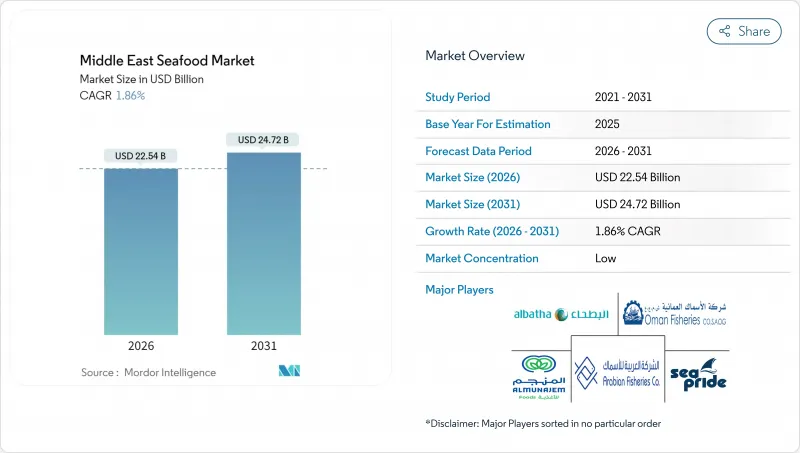
This growth is driven by increasing health awareness among consumers and the rising expatriate population in the region. Fish remains the most consumed seafood due to its deep-rooted presence in traditional cuisines. At the same time, premium shrimp is becoming more popular as consumers prefer seafood that is both nutritious and versatile in cooking. There is also a noticeable shift toward frozen and processed seafood products, influenced by the growing presence of modern retail stores and the challenges of preserving fresh seafood in the region's hot climate. Farmed seafood production is expanding rapidly, while wild-catch production has remained steady, reflecting a shift in sourcing trends. In terms of distribution, the foodservice sector continues to dominate, driven by the region's strong dining-out culture. However, retail channels are evolving, with modern supermarkets and hypermarkets reshaping how consumers purchase seafood. The market is highly competitive and fragmented, with regional seafood processors, independent fishing fleets, and global exporters competing for market share. These players are striving to secure shelf space in retail outlets and placements on foodservice menus, making the competition intense across the supply chain.
Middle East Seafood Market Trends and Insights
Health-driven shift toward lean protein and omega-3 diets
Increasingly, people are opting for seafood as a healthier and leaner source of protein and omega-3 fatty acids. Consumers are increasingly aware of how their diet affects their overall health, particularly in reducing the risk of lifestyle-related diseases and improving heart health. Seafood is now widely recognized as a better alternative to red and processed meats because of its nutritional value. According to research from PubMed Central, seafood contains about 20-30% of its total weight as protein, making it a high-quality and easily digestible source of essential amino acids. Fish such as salmon, mackerel, and shrimp are rich in omega-3 fatty acids, which are known to promote heart, brain, and joint health. This growing demand for seafood has encouraged retailers to expand their selection of fresh and chilled seafood products. Similarly, restaurants are increasingly featuring grilled, baked, or steamed seafood dishes on their menus, highlighting seafood as a nutritious and health-conscious meal choice.
Government aquaculture initiatives and food security policies
Middle Eastern governments are taking significant steps to expand aquaculture and develop the seafood industry as part of their efforts to improve food security and diversify their economies. In Saudi Arabia, the Ministry of Environment, Water, and Agriculture (MEWA) has set a goal to produce 600,000 tonnes of fish annually by 2030. This initiative also aims to increase the country's per-capita seafood consumption from 11.7 kg in 2024 to 20 kg, aligning with the Vision 2030 sustainability framework, according to the United States Department of Agriculture. These measures are designed to boost self-sufficiency and reduce reliance on imported meat and seafood. Similarly, the United Arab Emirates' National Food Security Strategy 2051 emphasizes the growth of aquaculture, supporting projects like the Aquatic Research Center in Umm Al Quwain and partnerships between public and private sectors to develop advanced fish farming technologies. Governments in the region are investing in hatchery programs, feed production facilities, and biosecurity systems.
Competition from alternative proteins
The demand for alternative proteins is growing rapidly, such as initiatives like the United Arab Emirates' Future Food Initiative are driving investments into startups that are developing innovative alternatives to traditional meat, poultry, and seafood. These alternatives, which include plant-based and lab-grown options, are providing consumers with more choices to meet their protein needs. For example, Eat Just is focusing on producing cultivated chicken, while Meatable is working on lab-grown beef tailored for the region. BlueNalu has partnered with NEOM to advance technology in cultivated seafood production. This trend reflects a shift in consumer preferences, as people are increasingly considering health benefits, ethical concerns, and environmental impacts when selecting their food. As a result, traditional seafood suppliers are facing growing competition. They are being pushed to adapt by adjusting their pricing strategies, improving product differentiation, and finding ways to maintain their market share in this evolving landscape.
Other drivers and restraints analyzed in the detailed report include:
- Sustainable and traceable sourcing trends
- Expanding expatriate and tourism base
- Climatic and environmental challenges
For complete list of drivers and restraints, kindly check the Table Of Contents.
Segment Analysis
In 2025, fish made up 64.02% of the Middle East seafood market share, largely due to the popularity of regional favorites like hamour and grouper. These fish are widely featured in restaurants and hotels, often served as grilled whole fish or in communal platters, which are staples in the region's cuisine. The strong demand for finfish is rooted in cultural traditions and a preference for fresh, high-quality protein. The consistent availability of these fish through retail stores and foodservice channels ensures their dominance in the market. This combination of cultural significance and reliable supply has made finfish the largest and most stable segment in the Middle East seafood market.
Shrimp is the fastest-growing segment in the region, with a projected CAGR of 2.48%, driven by changing consumer preferences and evolving food trends. Younger consumers are increasingly enjoying shrimp in various dishes like tacos, tempura, and spicy boils, which have gained popularity through social media and street food culture. Gulf producers are focusing on species like vannamei and black tiger shrimp because of their efficient growth rates and high feed-to-growth ratios. Investments in nurseries and hatcheries have also helped reduce production cycles, allowing shrimp to reach the market faster. These factors are fueling the growth of shrimp as a dynamic and expanding category in the Middle East seafood market.
Frozen seafood made up 52.10% of the Middle East seafood market in 2025, largely because consumers trust its longer shelf life, which is especially important in the region's hot climate. Retailers are encouraging sales by offering family-sized packs of fillets and breaded seafood, along with discounts and loyalty rewards. To support this demand, cold-storage facilities near key ports like Jebel Ali and Dammam are expanding, helping to reduce spoilage and improve supply efficiency. Online grocery platforms are also making frozen seafood more accessible by using insulated packaging and same-day delivery services. These efforts are making frozen seafood a convenient and reliable choice for consumers across the region.
Processed seafood is becoming a fast-growing segment, with a 2.36% CAGR, as urban lifestyles drive demand for ready-to-eat and easy-to-prepare meal options. Companies are introducing innovative products like canned tuna with bold flavors such as chili or lemon and pepper, as well as sushi kits that allow consumers to prepare meals at home. Strict adherence to halal and food safety standards, such as HACCP, is also helping manufacturers tap into export opportunities in Muslim-majority African countries. Additionally, premium packaging and targeted marketing in travel retail are boosting the appeal of processed seafood. This growth reflects a shift toward convenience and variety without compromising on quality or taste.
The Middle East Seafood Market Report is Segmented by Seafood Type (Fish, Shrimp, and More), Form (Canned, Frozen, and More), Source (Farmed and Wild-Caught), Distribution Channel (On-Trade and Off-Trade), and Country (Bahrain, Kuwait, Oman, Qatar, Saudi Arabia, United Arab Emirates, and Rest of Middle East). The Market Forecasts are Provided in Terms of Value (USD) and Volume (Tons).
List of Companies Covered in this Report:
- Albatha Group
- Al Munajem Foods
- National Fishing Company K.S.C.
- Oman Fisheries Co. SAOG
- Mowi ASA
- Sea Pride LLC
- Arabian Fisheries Co.
- National Aquaculture Group (NAQUA)
- Savola Foods Company (Al Kabeer Group)
- Saudi Fisheries Co.
- The Arabian Shrimp Company
- Tabuk Fisheries Co.
- Alkhazar Fisheries Factory
- Thai Union (Chicken of the Sea)
- Al Jaraf Fisheries
- Dulcich Inc.
- Sea World Fish Processing (LLC)
- Al Islami Foods
- Danah Fisheries Company
- Nueva Pescanova Group
Additional Benefits:
- The market estimate (ME) sheet in Excel format
- 3 months of analyst support
TABLE OF CONTENTS
1 INTRODUCTION
- 1.1 Study Assumptions and Market Definition
- 1.2 Scope of the Study
2 RESEARCH METHODOLOGY
3 EXECUTIVE SUMMARY
4 MARKET LANDSCAPE
- 4.1 Market Overview
- 4.2 Market Drivers
- 4.2.1 Health-driven shift toward lean protein and omega-3 diets
- 4.2.2 Expanding expatriate and tourism base
- 4.2.3 Increasing processed and value-added seafood demand
- 4.2.4 Sustainable and traceable sourcing trends
- 4.2.5 Culinary globalization and foodservice demand
- 4.2.6 Government aquaculture initiatives and food security policies
- 4.3 Market Restraints
- 4.3.1 Competition from alternative proteins
- 4.3.2 Limited export competitiveness
- 4.3.3 Stringent regulatory and quality standards
- 4.3.4 Climatic and environmental challenges
- 4.4 Regulatory Outlook
- 4.5 Consumer Behaviour Analysis
- 4.6 Porter's Five Forces
- 4.6.1 Threat of New Entrants
- 4.6.2 Bargaining Power of Buyers
- 4.6.3 Bargaining Power of Suppliers
- 4.6.4 Threat of Substitute Products
- 4.6.5 Intensity of Competitive Rivalry
5 MARKET SIZE AND GROWTH FORECASTS (VALUE AND VOLUME)
- 5.1 By Seafood Type
- 5.1.1 Fish
- 5.1.1.1 Salmon
- 5.1.1.2 Hamour
- 5.1.1.3 Other Fish Type
- 5.1.2 Shrimp
- 5.1.3 Other Seafood
- 5.1.1 Fish
- 5.2 By Form
- 5.2.1 Canned
- 5.2.2 Fresh/Chilled
- 5.2.3 Frozen
- 5.2.4 Processed
- 5.3 By Source
- 5.3.1 Farmed
- 5.3.2 Wild-Caught
- 5.4 By Distribution Channel
- 5.4.1 Off-Trade
- 5.4.1.1 Supermarkets/Hypermarkets
- 5.4.1.2 Online Retail Stores
- 5.4.1.3 Convenience Stores
- 5.4.1.4 Others
- 5.4.2 On-Trade
- 5.4.2.1 Hotels
- 5.4.2.2 Restaurants
- 5.4.2.3 Catering
- 5.4.1 Off-Trade
- 5.5 By Country
- 5.5.1 Bahrain
- 5.5.2 Kuwait
- 5.5.3 Oman
- 5.5.4 Qatar
- 5.5.5 Saudi Arabia
- 5.5.6 United Arab Emirates
- 5.5.7 Rest of Middle East
6 COMPETITIVE LANDSCAPE
- 6.1 Market Concentration
- 6.2 Strategic Moves
- 6.3 Market Share Analysis
- 6.4 Company Profiles (includes Global-level Overview, Market-level Overview, Core Segments, Financials (if available), Strategic Information, Market Rank/Share, Products and Services, Recent Developments)
- 6.4.1 Albatha Group
- 6.4.2 Al Munajem Foods
- 6.4.3 National Fishing Company K.S.C.
- 6.4.4 Oman Fisheries Co. SAOG
- 6.4.5 Mowi ASA
- 6.4.6 Sea Pride LLC
- 6.4.7 Arabian Fisheries Co.
- 6.4.8 National Aquaculture Group (NAQUA)
- 6.4.9 Savola Foods Company (Al Kabeer Group)
- 6.4.10 Saudi Fisheries Co.
- 6.4.11 The Arabian Shrimp Company
- 6.4.12 Tabuk Fisheries Co.
- 6.4.13 Alkhazar Fisheries Factory
- 6.4.14 Thai Union (Chicken of the Sea)
- 6.4.15 Al Jaraf Fisheries
- 6.4.16 Dulcich Inc.
- 6.4.17 Sea World Fish Processing (LLC)
- 6.4.18 Al Islami Foods
- 6.4.19 Danah Fisheries Company
- 6.4.20 Nueva Pescanova Group
7 MARKET OPPORTUNITIES AND FUTURE OUTLOOK

