
PUBLISHER: Mordor Intelligence | PRODUCT CODE: 1934752

PUBLISHER: Mordor Intelligence | PRODUCT CODE: 1934752
US Wine - Market Share Analysis, Industry Trends & Statistics, Growth Forecasts (2026 - 2031)
US wine market size in 2026 is estimated at USD 360.3 billion, growing from 2025 value of USD 352.34 billion with 2031 projections showing USD 402.93 billion, growing at 2.26% CAGR over 2026-2031.
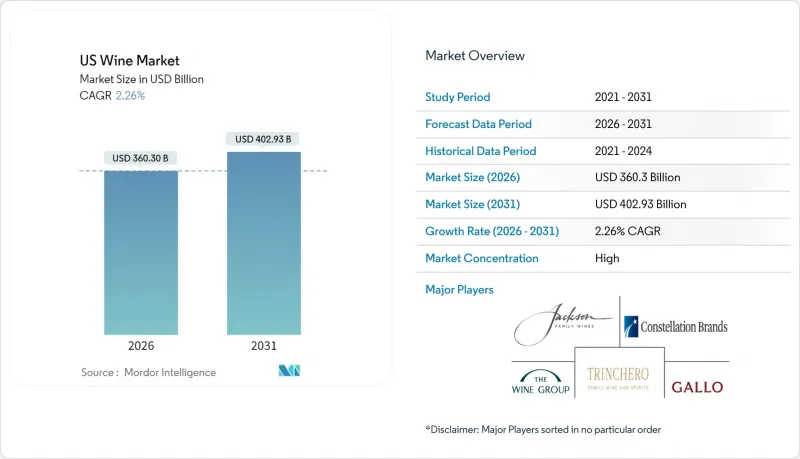
Driven by changing consumer preferences and a pronounced tilt towards premiumization, the U.S. wine market is on an upward trajectory. Younger consumers are increasingly favoring higher-quality wines, often opting for boutique or vineyard-specific labels that promise distinct character and authenticity. Innovations such as canned formats and resealable bottles are making sparkling and rose wines more accessible, elevating their appeal beyond just celebratory moments. In response to this burgeoning demand, leading producers like E. & J. Gallo and The Duckhorn Portfolio are broadening their premium offerings. While still wines continue to anchor the market, sparkling variants are swiftly gaining traction. Rose, celebrated for its versatile flavor, is becoming a top choice for trend-savvy drinkers. The market's momentum is further highlighted by gender and retail trends: female consumers currently dominate wine purchases, yet male consumption is on the rise. Distribution is largely led by off-trade channels, such as grocery and specialty stores, but there's a notable resurgence in on-trade venues like restaurants and wine bars, emphasizing the experiential nature of modern wine drinking.
US Wine Market Trends and Insights
Growing tourism and hospitality impact positive growth
As the hospitality sector rebounds, the U.S. wine market is witnessing a vigorous upswing, largely driven by the pivotal roles of restaurants and bars. Today's on-premise wine programs have undergone a significant transformation, now prioritizing curated selections that highlight distinctive varietals and boutique domestic producers. Notable mentions include Napa Valley's Silver Oak and vineyards from Oregon's Willamette Valley. This evolution presents premium wineries with a golden chance to engage a more discerning clientele that values quality over mere quantity. As consumers increasingly link wine consumption in upscale dining to notions of indulgence and cultural significance, premium wines are witnessing a surge in popularity, with patrons justifying their elevated price points. Concurrently, wine tourism in regions such as Sonoma, Paso Robles, and the Finger Lakes is experiencing a renaissance. Wineries are expanding their offerings beyond the conventional tastings, introducing immersive experiences. These range from chef-led food pairings and vineyard hikes to blending workshops and sustainability tours. Such enhancements resonate with the U.S. populace's rising appetite for authentic, experiential, and eco-conscious travel. By investing in these initiatives, wineries are not only drawing in affluent visitors but also bolstering brand loyalty and ensuring their foothold in an experience-centric market.
Rising consumer preference for low alcohol products
As health and wellness take center stage in consumer preferences, the U.S. wine market is witnessing a significant surge in demand for low- and no-alcohol wine options. This trend resonates strongly with younger demographics, especially Gen Z, who are pursuing moderation without sacrificing flavor or social experiences. In response, wineries are crafting a new wave of low-alcohol wines that rival the complexity and quality of their traditional counterparts. Notably, producers like Giesen and Fre Wines have rolled out alcohol-removed wines, maintaining varietal character to cater to health-conscious consumers. These innovations are making waves in both retail and on-premise channels, with sommeliers and beverage directors integrating low-alcohol options into their curated wine lists. Moreover, transparent labeling practices and wellness-centric branding bolster consumer trust and informed choices. The Alcohol and Tobacco Tax and Trade Bureau's (TTB) push for nutritional labeling is further propelling this shift, offering consumers clear insights into caloric and alcohol content for more informed purchases . Consequently, a premium segment of mindful wine options is emerging, aligning with modern lifestyles. Wineries that adeptly blend craftsmanship with health-forward innovations, such as organic, lower-calorie, or low-ABV selections, are poised to captivate today's discerning consumers, who seek both elevated and responsible drinking experiences.
Stringent government regulations
The U.S. wine industry operates within a complex regulatory framework that significantly influences market growth and innovation potential. The post-prohibition three-tier distribution system creates market access barriers, with smaller producers particularly struggling to establish distribution channels through major wholesalers. The regulatory landscape continues to expand with the TTB's introduction of mandatory allergen labeling requirements, which include a five-year implementation timeline. Further regulatory changes loom as the Consumer Federation of America advocates for comprehensive labeling requirements, encompassing nutritional information and enhanced health warnings, changes that would increase production costs and potentially reshape consumer perceptions. The regulatory complexity intensifies at the state level, where 18 states maintain direct control over alcohol sales, while other states implement varying licensing systems. This regulatory environment creates an uneven playing field, particularly impacting small and medium-sized wineries that constitute the majority of the industry. These smaller operations, unlike their larger counterparts with established compliance teams, often lack the necessary resources to efficiently navigate the extensive regulatory requirements.
Other drivers and restraints analyzed in the detailed report include:
- Surge in demand for premium and super premium wine
- Product diffrentiation in terms of raw material
- Rising consumer inclination towards other alcoholic beverages
For complete list of drivers and restraints, kindly check the Table Of Contents.
Segment Analysis
In 2025, still wine dominates the U.S. wine market, holding a commanding 69.42% share. Classic varietals like Cabernet Sauvignon, Pinot Noir, and Chardonnay bolster its leadership. The segment is witnessing a premiumization trend, as demand from consumers gravitates towards refined, terroir-driven expressions. Producers such as Duckhorn and Stag's Leap Wine Cellars are seizing this opportunity, offering high-quality selections that resonate with consumer desires for authenticity and craftsmanship. Furthermore, innovations in sustainable viticulture and the rise of direct-to-consumer models are fortifying the position of premium still wines, appealing to consumers who value quality, origin, and environmental responsibility.
Sparkling wine is emerging as the fastest-growing segment in the U.S. wine market, with projections indicating a 2.69% CAGR from 2026 to 2031. This surge is attributed to the category's evolving role in casual settings, transcending its traditional association with celebrations. Sparkling wines, especially Prosecco, Cava, and domestic sparkling rose, have gained traction among younger consumers due to their lighter profiles, lower alcohol content, and enhanced drinkability. Brands like La Marca and Chandon are spearheading this growth, leveraging innovative formats like mini bottles and cans, alongside lifestyle-centric marketing that strikes a chord on social media.
In 2025, red wine commands a significant 44.32% share of the U.S. wine market, solidifying its status as a core category. Its enduring appeal stems from its rich flavor profile, versatility in food pairings, and a loyal consumer base. Varietals like Cabernet Sauvignon, Pinot Noir, and Merlot bolster its prominence, remaining favorites in both retail and dining establishments. As consumer preferences shift, producers are innovating, introducing styles with softer tannins, reduced alcohol content, and vibrant fruit profiles. Wineries such as Meiomi and Josh Cellars are leading this charge, presenting approachable red blends that resonate with both novices and connoisseurs. Furthermore, red wine's association with health benefits, particularly its links to heart health when consumed in moderation, underscores its continued relevance among health-conscious consumers.
Rose wine emerges as the U.S. wine market's fastest-growing segment, eyeing a CAGR of 2.88% from 2026 to 2031. Its ascent is fueled by its all-year-round allure, eye-catching presentation, and versatility across diverse occasions. Once relegated to seasonal status, rose has cemented its place as a lifestyle choice, gracing everything from brunch tables to outdoor soirees. Its refreshing taste and moderate alcohol content appeal to younger, multicultural audiences who lean towards simpler, more sociable wine experiences. Brands like Whispering Angel and La Fete du Rose have harnessed this trend, leveraging inclusive branding and robust social media strategies. The rose category adeptly straddles the line between entry-level and premium markets, with top-tier producers from Provence and Napa broadening their rose offerings to cater to surging demand. This adaptability and cultural significance position rose as a pivotal growth driver in the dynamic U.S. wine scene.
The US Wine Market Report is Segmented by Product Type (Fortified Wine, Still Wine, Sparkling Wine, and Other Wine Types); by Color (Red Wine, White Wine, and Rose Wine); by End User (Men and Women); and by Distribution Channel (On-Trade and Off-Trade). The Market Forecasts are Provided in Terms of Value (USD).
List of Companies Covered in this Report:
- E. & J. Gallo Winery
- Constellation Brands, Inc.
- The Wine Group
- Trinchero Family Estates
- Treasury Wine Estates Limited
- Jackson Family Wines Inc.
- Delicato Family Wines
- Ste. Michelle Wine Estates Ltd.
- Bronco Wine Company
- Boisset Collection
- Pernod Ricard S.A
- LVMH Moet Hennessy Louis Vuitton SE
- Foley Family Wines, Inc.
- The Duckhorn Portfolio, Inc.
- J. Lohr Vineyards & Winery
- Precept Wine LLC
- Cooper's Hawk Intermediate Holding, LLC
- Wente Family Estates
- Silver Oak Cellars
- Ridge Vineyards, Inc.
Additional Benefits:
- The market estimate (ME) sheet in Excel format
- 3 months of analyst support
TABLE OF CONTENTS
1 INTRODUCTION
- 1.1 Study Assumptions & Market Definition
- 1.2 Scope of the Study
2 RESEARCH METHODOLOGY
3 EXECUTIVE SUMMARY
4 MARKET LANDSCAPE
- 4.1 Market Overview
- 4.2 Market Drivers
- 4.2.1 Growing tourism and hospitality impact positive growth
- 4.2.2 Rising consumer preference for low alcohol products
- 4.2.3 Surge in demand for premium and super premium wine
- 4.2.4 Product diffrentiation in terms of raw material
- 4.2.5 Innovative packaging formats attract new consumer segments.
- 4.2.6 Wine subscription services create steady demand.
- 4.3 Market Restraints
- 4.3.1 Stringent government regulations
- 4.3.2 Rising consumer inclination towards other alcoholic beverages
- 4.3.3 Supply chain disruptions and increased transportation costs
- 4.3.4 Labor shortages in vineyards and production
- 4.4 Consumer Behaviour Analysis
- 4.5 Regulatory Outlook
- 4.6 Porter's Five Forces
- 4.6.1 Bargaining Power of Suppliers
- 4.6.2 Bargaining Power of Buyers
- 4.6.3 Threat of New Entrants
- 4.6.4 Threat of Substitutes
- 4.6.5 Degree of Competition
5 MARKET SIZE AND GROWTH FORECASTS (VALUE)
- 5.1 By Product Type
- 5.1.1 Fortified Wine
- 5.1.2 Still Wine
- 5.1.3 Sparkling Wine
- 5.1.4 Others Wine Types
- 5.2 By Color
- 5.2.1 Red Wine
- 5.2.2 White Wine
- 5.2.3 Rose Wine
- 5.3 By End User
- 5.3.1 Men
- 5.3.2 Women
- 5.4 By Distribution Channel
- 5.4.1 On-Trade
- 5.4.2 Off-Trade
- 5.4.2.1 Specialty/Liquor Stores
- 5.4.2.2 Others Off Trade Channels
6 COMPETITIVE LANDSCAPE
- 6.1 Market Concentration
- 6.2 Strategic Moves
- 6.3 Market Share Analysis
- 6.4 Company Profiles (includes Global level Overview, Market level overview, Core Segments, Financials as available, Strategic Information, Market Rank/Share for key companies, Products & Services, and Recent Developments)
- 6.4.1 E. & J. Gallo Winery
- 6.4.2 Constellation Brands, Inc.
- 6.4.3 The Wine Group
- 6.4.4 Trinchero Family Estates
- 6.4.5 Treasury Wine Estates Limited
- 6.4.6 Jackson Family Wines Inc.
- 6.4.7 Delicato Family Wines
- 6.4.8 Ste. Michelle Wine Estates Ltd.
- 6.4.9 Bronco Wine Company
- 6.4.10 Boisset Collection
- 6.4.11 Pernod Ricard S.A
- 6.4.12 LVMH Moet Hennessy Louis Vuitton SE
- 6.4.13 Foley Family Wines, Inc.
- 6.4.14 The Duckhorn Portfolio, Inc.
- 6.4.15 J. Lohr Vineyards & Winery
- 6.4.16 Precept Wine LLC
- 6.4.17 Cooper's Hawk Intermediate Holding, LLC
- 6.4.18 Wente Family Estates
- 6.4.19 Silver Oak Cellars
- 6.4.20 Ridge Vineyards, Inc.
7 MARKET OPPORTUNITIES AND FUTURE OUTLOOK

