PUBLISHER: Mordor Intelligence | PRODUCT CODE: 1934819

PUBLISHER: Mordor Intelligence | PRODUCT CODE: 1934819
Germany Container Glass - Market Share Analysis, Industry Trends & Statistics, Growth Forecasts (2026 - 2031)
The Germany Container Glass Market is expected to grow from 4.73 million tonnes in 2025 to 4.91 million tonnes in 2026 and is forecast to reach 5.91 million tonnes by 2031 at 3.79% CAGR over 2026-2031.
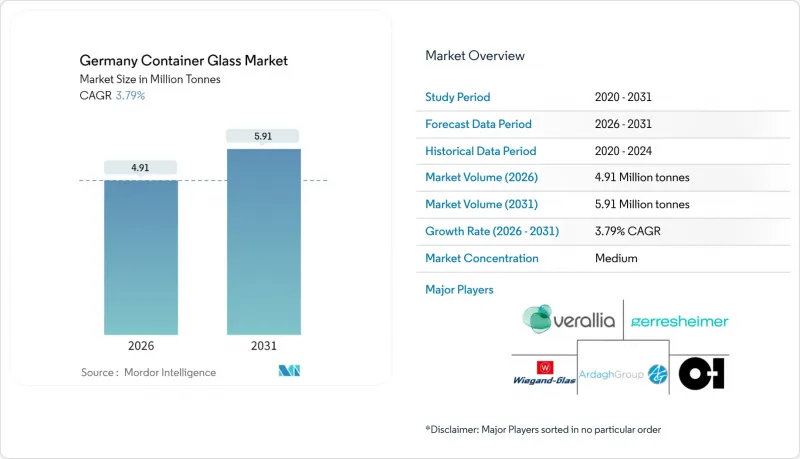
The market's medium-term momentum is underpinned by lightweight glass innovation, hybrid furnace deployment, and the government's circular economy strategy, despite the impact of energy prices and a multi-year decline in beer volumes on near-term growth. Premium beverage owners are specifying customized bottles that reinforce brand identity while reducing their carbon footprint, and pharmaceutical fillers are shifting toward sterile, ready-to-use containers that meet EU Good Manufacturing Practice Annex 1 guidelines. National targets for 25% recycled raw material use and 80% glass collection rates position container glass favorably against plastic, whose producers now face minimum recycled-content thresholds ihk.de. Scale manufacturers are responding with capacity rationalization and investments in low-carbon technology, a dual strategy that is expected to boost productivity and reduce per-ton emissions. Germany container glass market participants able to secure renewable power and deploy hybrid melting technology are forecast to capture the bulk of incremental demand from high-value pharmaceutical, cosmetics, and premium spirits applications.
Germany Container Glass Market Trends and Insights
Increasing Demand for Recyclable Packaging in Germany
The National Circular Economy Strategy, adopted in January 2025, mandates that 25% of strategic raw material demand be met through recycling and that per capita municipal waste decline by 10-20% by 2030-2040. This framework elevates container glass, whose infinite recyclability and stable quality outperform polymer substitutes. Roughly 300,000 public glass-collection points already deliver glass return rates above 80%, providing producers with a dependable cullet stream and reducing furnace energy demand by up to 30% per ton of glass melted. Digital product passports planned under the strategy will document the recycled content, creating competitive differentiation for bottles containing high levels of cullet. Brands seeking to comply with forthcoming single-use plastic recycled-content mandates find glass to be a straightforward path to achieving packaging sustainability targets, thereby bolstering demand for Germany's container glass market.
Growing Pharmaceutical Sector Accelerates High-Quality Glass Demand
SCHOTT Pharma recorded EUR 957 million (USD 1.08 billion) in revenue for 2024, representing a 12% constant-currency increase. High-value syringes and ready-to-use (RTU) containers now account for 55% of turnover. Germany's concentration of biologics production and the introduction of new GLP-1 therapies are driving demand for low-alkali, low-particle glass formats that can withstand lyophilization and maintain drug stability. The "Alliance for RTU" formed by SCHOTT Pharma, Gerresheimer, and Stevanato Group is standardizing RTU specifications to streamline pharma filling lines and reduce contamination risk, further expanding the addressable market for premium borosilicate and aluminosilicate glass. These trends channel incremental volume to producers that can certify USP (660) and EU Pharmacopoeia Type I compliance while offering rapid changeover and sterile supply capabilities.
Rising Energy Costs Elevate Glass Production Expenses
Industrial electricity hovered near EUR 40 (USD 43.2) per MWh in 2024-2025, roughly four times pre-crisis levels, while natural-gas price spikes raised total melt costs despite temporary government subsidies. Because melting at 1,600 °C accounts for 70-75% of furnace operating cost, elevated power prices erode profitability and compress investment budgets. Hybrid furnaces can reduce CO2 by up to 64%, as demonstrated by Ardagh's NextGen line, yet still rely on competitively priced renewable electricity. Until grid decarbonization and industrial power-price relief stabilize input costs, Germany's container glass market capacity growth will lag potential demand.
Other drivers and restraints analyzed in the detailed report include:
- Premium Beverages Drive Customized Bottle Requirements
- Circular Economy Policies Strengthen Glass Recycling Systems
- Competition from PET and Imported Glass Packaging
For complete list of drivers and restraints, kindly check the Table Of Contents.
Segment Analysis
Beverages retained 51.60% of the German container glass market share in 2025, equivalent to 2.44 thousand kilotons, reflecting the entrenched traditions of refillable beer and wine. However, from January to May 2025, beer shipments fell 6.8% to 34.1 million hectoliters, marking the lowest post-reunification level, which trimmed bottle demand and prompted brewery rationalization. Germany's container glass market size linked to standard beer bottles is projected to contract at a low single-digit CAGR through 2030. Spirits, craft, and alcohol-free malt drinks partly offset this decline by adopting bespoke lightweight glass that commands premium shelf prices. Producers serving these niches can defend margins by offering rapid mold turnaround and low-CO2 glass certificates.
Pharmaceutical applications accounted for an estimated 10.40% of Germany's container glass market size in 2025, yet are forecast to outpace beverages, expanding at a 5.05% or more CAGR, thanks to the growing demand for biologics, GLP-1 injectables, and mRNA vaccines. Stringent EU Annex 1 rules promote RTU vials and syringes that deliver sterility assurance and line efficiency, thereby lifting average selling prices and reducing the grades of cullet required. Cosmetics and personal care hold only 8.10% volume but post the fastest 5.12% CAGR as premium skin-care brands switch from plastic to glass for a luxury unboxing experience. Food jars maintain a resilient mid-single-digit share, benefiting from consumer perception of glass as inert and reusable, although growth mirrors that of the broader grocery market.
The Germany Container Glass Market Report is Segmented by End-User (Beverages [Alcoholic (Beer, Wine, Spirits, and Other Alcoholic Beverages), Non-Alcoholic (Juices, Carbonated Drinks, Dairy Product Based Drinks, and Other Non-Alcoholic Beverages]), Food, Cosmetics and Personal Care, Pharmaceuticals, and Perfumery), Color (Green, Amber, Flint, and More). The Market Forecasts are Provided in Terms of Volume (Tonnes).
List of Companies Covered in this Report:
- Ardagh Glass GmbH
- Systempack Manufaktur GmbH
- HEINZ-GLAS GmbH & Co. KGaA
- Schott AG
- Saint-Gobain Oberland AG (Verallia Deutschland AG)
- Rixius AG
- O-I Germany GmbH & Co KG
- Gerresheimer AG
- Wiegand-Glas GmbH
- Noelle + von Campe GmbH & Co. KG
- SGD Pharma Germany GmbH
- Glashutte Freital GmbH
- KP Glas GmbH & Co. KG
- Verallia Deutschland AG
- Glashutte Eisch GmbH
Additional Benefits:
- The market estimate (ME) sheet in Excel format
- 3 months of analyst support
TABLE OF CONTENTS
1 INTRODUCTION
- 1.1 Study Assumptions and Market Definition
- 1.2 Scope of the Study
2 RESEARCH METHODOLOGY
3 EXECUTIVE SUMMARY
4 MARKET LANDSCAPE
- 4.1 Market Overview
- 4.2 Market Drivers
- 4.2.1 Increasing Demand for Recyclable Packaging in Germany
- 4.2.2 Growing Pharma Sector Boosts High-Quality Glass Packaging
- 4.2.3 Premium Beverages Drive Customized Bottle Requirements
- 4.2.4 Circular Economy Policies Strengthen Glass Recycling Systems
- 4.2.5 Sustainability Targets Accelerate Lightweight Glass Innovation
- 4.2.6 Industry Consolidation Reshapes Container Glass Capacity
- 4.3 Market Restraints
- 4.3.1 Rising Energy Costs Elevate Glass Production Expenses
- 4.3.2 Competition from PET and Imported Glass Packaging
- 4.3.3 Regulatory Compliance Raises Barriers for Small Producers
- 4.3.4 Plant Closures Reduce Local Supply Availability
- 4.4 PESTEL Analysis
- 4.5 Industry Value Chain Analysis
- 4.6 Container Glass Furnace Capacity and Locations in Germany
- 4.6.1 Plant Locations and Year of Commencement
- 4.6.2 Production Capacities
- 4.6.3 Types of Furnaces
- 4.6.4 Color of Glass Produced
- 4.7 Export-Import Data of Container Glass - Covering Key Import and Export Destinations
- 4.7.1 Import Volume and Value, 2021-2024
- 4.7.2 Export Volume and Value, 2021-2024
- 4.8 Porter's Five Forces Analysis
- 4.8.1 Threat of New Entrants
- 4.8.2 Bargaining Power of Suppliers
- 4.8.3 Bargaining Power of Buyers
- 4.8.4 Threat of Substitutes
- 4.8.5 Competitive Rivalry
- 4.9 Raw Material Analysis
- 4.10 Recycling Trends for Glass Packaging
- 4.11 Demand vs Supply Analysis for Glass Packaging
5 MARKET SIZE AND GROWTH FORECASTS (VOLUME)
- 5.1 By End-user
- 5.1.1 Beverages
- 5.1.1.1 Alcoholic
- 5.1.1.1.1 Beer
- 5.1.1.1.2 Wine
- 5.1.1.1.3 Spirits
- 5.1.1.1.4 Other Alcoholic Beverages (Cider and Other Fermented Drinks)
- 5.1.1.2 Non-Alcoholic
- 5.1.1.2.1 Juices
- 5.1.1.2.2 Carbonated Drinks (CSDs)
- 5.1.1.2.3 Dairy Product Based Drinks
- 5.1.1.2.4 Other Non-Alcoholic Beverages
- 5.1.1.1 Alcoholic
- 5.1.2 Food (Jam, Jelly, Marmalades, Honey, Sausages and Condiments, Oil, Pickles)
- 5.1.3 Cosmetics and Personal Care
- 5.1.4 Pharmaceuticals (excluding Vials and Ampoules)
- 5.1.5 Perfumery
- 5.1.1 Beverages
- 5.2 By Color
- 5.2.1 Green
- 5.2.2 Amber
- 5.2.3 Flint
- 5.2.4 Other Colors
6 COMPETITIVE LANDSCAPE
- 6.1 Market Concentration
- 6.2 Strategic Moves and Developments
- 6.3 Company Market Share Analysis, (Based on Latest Production Capacity)
- 6.4 Company Profiles (includes Global level Overview, Market level overview, Core Segments, Financials as available, Strategic Information, Market Rank/Share for key companies, Products and Services, and Recent Developments)
- 6.4.1 Ardagh Glass GmbH
- 6.4.2 Systempack Manufaktur GmbH
- 6.4.3 HEINZ-GLAS GmbH & Co. KGaA
- 6.4.4 Schott AG
- 6.4.5 Saint-Gobain Oberland AG (Verallia Deutschland AG)
- 6.4.6 Rixius AG
- 6.4.7 O-I Germany GmbH & Co KG
- 6.4.8 Gerresheimer AG
- 6.4.9 Wiegand-Glas GmbH
- 6.4.10 Noelle + von Campe GmbH & Co. KG
- 6.4.11 SGD Pharma Germany GmbH
- 6.4.12 Glashutte Freital GmbH
- 6.4.13 KP Glas GmbH & Co. KG
- 6.4.14 Verallia Deutschland AG
- 6.4.15 Glashutte Eisch GmbH
7 MARKET OPPORTUNITIES AND FUTURE OUTLOOK
- 7.1 White-space and Unmet-Need Assessment

