PUBLISHER: Mordor Intelligence | PRODUCT CODE: 1940815

PUBLISHER: Mordor Intelligence | PRODUCT CODE: 1940815
Vietnam Container Glass - Market Share Analysis, Industry Trends & Statistics, Growth Forecasts (2026 - 2031)
The Vietnam container glass market was valued at 230.30 kilotons in 2025 and estimated to grow from 237.37 kilotons in 2026 to reach 276.15 kilotons by 2031, at a CAGR of 3.07% during the forecast period (2026-2031).
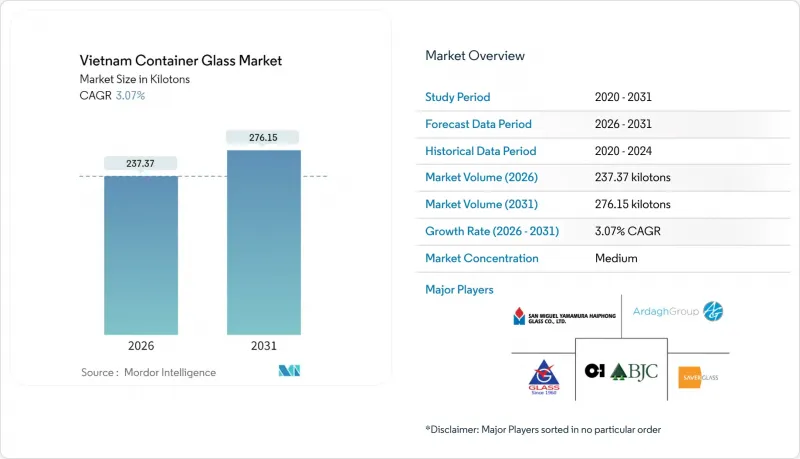
Steady population growth, rising disposable incomes, and Vietnam's position as a regional export base underpin demand, while regulatory support for sustainable packaging reinforces long-term prospects. Foreign direct investment (FDI) into manufacturing, worth USD 25.58 billion in 2024, is catalyzing furnace upgrades that improve efficiency and capacity. Premiumization trends in beverages, cosmetics, and pharmaceuticals favor glass over plastic as brand owners seek superior barrier properties and a premium shelf image. Electricity price escalation and rPET substitution temper momentum, yet incentives embedded in Vietnam's amended Law on Pharmacy, effective July 2025, expand specialized demand for amber and Type I pharmaceutical glass. Building a nationwide cullet collection network remains vital for decarbonization and cost control, positioning recycling infrastructure investment as a strategic priority.
Vietnam Container Glass Market Trends and Insights
ESG-Driven Export Packaging Shift
International buyers, especially in Europe and North America, increasingly require recyclable packaging for premium food and beverage imports, prompting Vietnam's exporters to switch from plastic to glass. Coffee, tea, and specialty food producers report 15-20% price premiums when adopting glass, bolstering the Vietnam container glass market. Glass also supports origin branding efforts and mitigates trade-policy risks related to environmental standards. Multinational corporations sourcing from Vietnam embed strict sustainability clauses in supplier contracts, ensuring a stable offtake for domestic glass producers. This shift intensifies near major ports where export consolidation occurs. Over the medium term, ESG compliance is expected to lift export-oriented demand by an incremental 0.8% of the forecast CAGR.
FDI-Driven Furnace Upgrades and Capacity Additions
USD 25.58 billion in manufacturing FDI in 2024 channels technology transfer into the Vietnam container glass market through joint ventures that deploy oxy-combustion furnaces able to trim CO2 emissions by about 18% versus legacy units. New lines in Binh Duong and Hai Phong cut fuel consumption and widen color flexibility, letting producers chase higher-margin amber batches without compromising line efficiency. Multi-year investment schedules align with Vietnam's industrial-park expansion, guaranteeing steady glass-grade soda ash imports and furnace-refractory demand. Over the long term, modern capacity raises domestic supply resilience and limits import reliance on bottles for pharmaceutical filling operations.
Electricity Cost Inflation and Grid Instability
Average retail electricity tariffs hit VND 2,103.11 per kWh in October 2024, with peak-hour rates soaring to VND 3,640 per kWh. Energy accounts for roughly 23% of glass production cost, so spikes compress margins and deter furnace rebuilds. Grid outages drive investment in diesel backup and elevate scrap rates when batch temperatures fall. The government plans to allocate over 80% of a USD 36 billion 2025 infrastructure budget to power generation and transmission, aiming to stabilize supply. Still, near-term volatility subtracts 0.6 percentage points from expected CAGR.
Other drivers and restraints analyzed in the detailed report include:
- Pharmaceutical Manufacturing Expansion
- Booming Cosmetics and Personal Care Sector
- rPET Bottle Substitution Pressure
For complete list of drivers and restraints, kindly check the Table Of Contents.
Segment Analysis
The beverages segment dominated the Vietnam container glass market with 60.74% market share in 2025 and is expected to maintain volume leadership through 2031 as domestic beer output scales and export-oriented spirits bottlers expand. Glass bottles remain preferred for premium lager and craft beer branding, supported by established returnable bottle systems that reduce per-fill cost. Cosmetics and personal care, though smaller in tonnage, are projected as the fastest-growing category at a 3.52% CAGR, reflecting rising disposable incomes and e-commerce penetration. High-spend consumers link glass with product purity, enabling mid-sized local brands to trade up packaging without sacrificing margin. Pharmaceutical glass demand benefits from new domestic fill-finish lines encouraged by the amended pharmacy law, ensuring consistent offtake for ISO-certified vials. Food applications such as condiments and honey experience stable growth, powered by export demand to Japan and South Korea, while perfumery, the most premium niche, commands the highest unit revenue despite modest volumes.
In absolute terms, beverages are forecast to add the largest incremental tonnage to the Vietnam container glass market size over 2026-2031. Cosmetics, however, deliver margin upside through value-added decoration, smaller batch runs, and thicker-wall specifications favored by luxury skincare. Pharmaceutical glass's stringent regulatory standards set a high barrier to entry, limiting competition and supporting specialized price premiums. A balanced end-user portfolio, therefore, enhances producer resilience, smoothing revenue against commodity price swings and seasonal beverage cycles.
The Vietnam Container Glass Market Report is Segmented by End-User (Beverages [Alcoholic {Beer, Wine, Spirits, Other Alcoholic Beverages}, and Non-Alcoholic {Carbonated Drinks (CSDs), Dairy Product Based Drinks, and More}], Food [Jam and Jelly, Condiments and Sauces, and More], Cosmetics and Personal Care, and More), Color (Flint, Amber, Green, and More). The Market Forecasts are Provided in Terms of Volume (Kilotons).
List of Companies Covered in this Report:
- O-I BJC Vietnam Glass Company Limited
- San Miguel Yamamura Hai Phong Glass Co., Ltd.
- Thuduc Glass Bottle Joint Stock Company
- Bao Minh Glass Joint Stock Company
- San Miguel Yamamura Phu Tho Packaging Co., Ltd.
- Saverglass SAS
- Verallia Packaging SAS
- Ardagh Group S.A.
- Go Vap Glass
- Bormioli Rocco
Additional Benefits:
- The market estimate (ME) sheet in Excel format
- 3 months of analyst support
TABLE OF CONTENTS
1 INTRODUCTION
- 1.1 Study Assumptions and Market Definition
- 1.2 Scope of the Study
2 RESEARCH METHODOLOGY
3 EXECUTIVE SUMMARY
4 MARKET LANDSCAPE
- 4.1 Market Overview
- 4.2 Market Drivers
- 4.2.1 ESG-Driven Export Packaging Shift
- 4.2.2 FDI-Driven Furnace Upgrades and Capacity Additions
- 4.2.3 Pharmaceutical Manufacturing Expansion
- 4.2.4 Booming Cosmetics and Personal Care Sector
- 4.2.5 Government Push Against Single-Use Plastics
- 4.2.6 Surging Alcoholic Beverage Output
- 4.3 Market Restraints
- 4.3.1 Electricity Cost Inflation and Grid Instability
- 4.3.2 rPET Bottle Substitution Pressure
- 4.3.3 Weak Cullet Collection Infrastructure
- 4.3.4 Logistics and Breakage Challenges
- 4.4 PESTEL Analysis
- 4.5 Industry Supply-Chain Analysis
- 4.6 Container Glass Furnace Capacity and Locations in Vietnam
- 4.6.1 Plant Locations and Year of Commencement
- 4.6.2 Production Capacities
- 4.6.3 Types of Furnaces
- 4.6.4 Color of Glass Produced
- 4.7 Export-Import Data of Container Glass - Covering Key Import and Export Destinations
- 4.7.1 Import Volume and Value, 2021-2024
- 4.7.2 Export Volume and Value, 2021-2024
- 4.8 Porter's Five Forces Analysis
- 4.8.1 Threat of New Entrants
- 4.8.2 Bargaining Power of Suppliers
- 4.8.3 Bargaining Power of Buyers
- 4.8.4 Threat of Substitutes
- 4.8.5 Competitive Rivalry
- 4.9 Raw Material Analysis
- 4.10 Recycling Trends for Glass Packaging
- 4.11 Demand vs Supply Analysis for Glass Packaging
5 MARKET SIZE AND GROWTH FORECASTS (VOLUME)
- 5.1 By End-user
- 5.1.1 Beverages
- 5.1.1.1 Alcoholic
- 5.1.1.1.1 Beer
- 5.1.1.1.2 Wine
- 5.1.1.1.3 Spirits
- 5.1.1.1.4 Other Alcoholic Beverages (Cider and Other Fermented Drinks)
- 5.1.1.2 Non-Alcoholic
- 5.1.1.2.1 Juices
- 5.1.1.2.2 Carbonated Drinks (CSDs)
- 5.1.1.2.3 Dairy Product Based Drinks
- 5.1.1.2.4 Other Non-Alcoholic Beverages
- 5.1.1.1 Alcoholic
- 5.1.2 Food (Jam, Jelly, Marmalades, Honey, Sausages and Condiments, Oil, Pickles)
- 5.1.3 Cosmetics and Personal Care
- 5.1.4 Pharmaceuticals (excluding Vials and Ampoules)
- 5.1.5 Perfumery
- 5.1.1 Beverages
- 5.2 By Color
- 5.2.1 Green
- 5.2.2 Amber
- 5.2.3 Flint
- 5.2.4 Other Colors
6 COMPETITIVE LANDSCAPE
- 6.1 Market Concentration
- 6.2 Strategic Moves and Developments
- 6.3 Company Market Share Analysis, (Based on Latest Production Capacity)
- 6.4 Company Profiles (includes Global level Overview, Market level overview, Core Segments, Financials as available, Strategic Information, Market Rank/Share for key companies, Products and Services, and Recent Developments)
- 6.4.1 O-I BJC Vietnam Glass Company Limited
- 6.4.2 San Miguel Yamamura Hai Phong Glass Co., Ltd.
- 6.4.3 Thuduc Glass Bottle Joint Stock Company
- 6.4.4 Bao Minh Glass Joint Stock Company
- 6.4.5 San Miguel Yamamura Phu Tho Packaging Co., Ltd.
- 6.4.6 Saverglass SAS
- 6.4.7 Verallia Packaging SAS
- 6.4.8 Ardagh Group S.A.
- 6.4.9 Go Vap Glass
- 6.4.10 Bormioli Rocco
7 MARKET OPPORTUNITIES AND FUTURE OUTLOOK
- 7.1 White-space and Unmet-Need Assessment

