PUBLISHER: Mordor Intelligence | PRODUCT CODE: 2116742

PUBLISHER: Mordor Intelligence | PRODUCT CODE: 2116742
Thailand Container Glass - Market Share Analysis, Industry Trends & Statistics, Growth Forecasts (2026 - 2031)
According to Mordor Intelligence, the Thailand container glass market size was valued at 3.95 million tonnes in 2025 and estimated to grow from 4.12 million tonnes in 2026 to reach 5.09 million tonnes by 2031, at a CAGR of 4.30% during the forecast period (2026-2031).
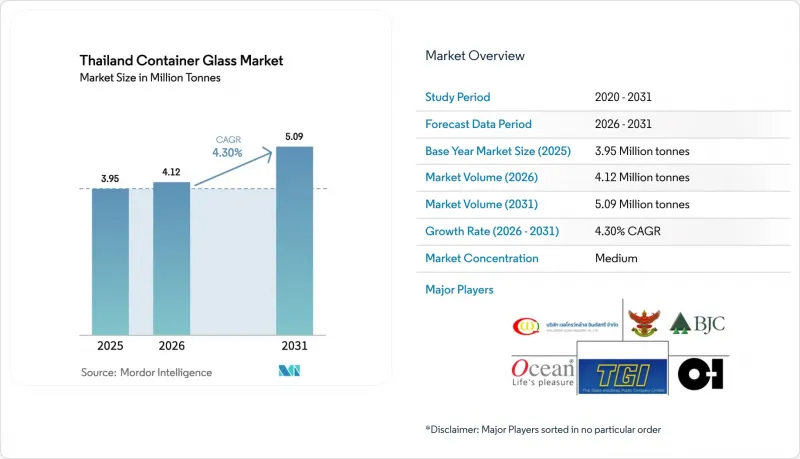
This report is Segmented by End-User(Beverages [Alcoholic {Beer, Wine, Spirits, and More}, and Non-Alcoholic {Juices, Csds, Dairy Product Based Drinks, and More}], Food [Jam, Jelly, Marmalades, Oil, Pickles, and More], Cosmetics and Personal Care, Pharmaceuticals, and Perfumery), Color (Green, Amber, Flint, and Other Colors). The Market Forecasts are Provided in Terms of Volume (Tonnes).
Thailand Container Glass Market Trends and Insights
Regulatory Push for Sustainable and Recyclable Packaging
Thailand's plastic-waste roadmap eliminates single-use foam food boxes and thin plastic cups by 2025, creating structural substitution toward glass containers. Enforcement extends to microbead bans in cosmetics since 2020 and retailer-led plastic-bag phase-downs, anchoring consumer perception of glass as the low-carbon default. The carbon tax amplifies cost differentials between plastics and glass when lifecycle footprints are considered, encouraging brand owners to specify recycled-content glass. Leading energy conglomerate PTT has already committed to circular waste management targets, reinforcing supply-chain alignment around recyclable packaging. As policy milestones approach, demand visibility rises for producers able to guarantee high-cullet, low-emission output. The combined regulatory environment therefore adds 1.2 percentage points to the forecast CAGR of the Thailand container glass market.
Premiumization in Beverage and Cosmetics Packaging
Brands leverage glass aesthetics to justify higher price points in craft beer, functional drinks, and prestige beauty lines, where packaging communicates authenticity and sustainability. Early success stories in ready-to-drink green tea, whose value expanded from USD 10 million in 2001 to USD 150 million by 2004, underscore consumers' willingness to trade up when packaging aligns with perceived quality. Social-media imagery further rewards clear, glossy glass surfaces, elevating shelf appeal and driving repeat purchases among eco-conscious millennials. Domestic cosmetic companies translate these cues into product launches that feature thick-wall flint jars and droppers, sustaining a premiumization flywheel that adds 0.8 percentage points to market growth.
Rapid Penetration of PET and Aluminum Cans
Lightweight PET and aluminum offer cost and logistics advantages in low-margin beverage segments, squeezing glass volumes in convenience channels. Indorama Ventures' downstream PET integration improves supply economics, enabling aggressive pricing into mass-market soft drinks. C-store operators favor lighter packs to optimize shelf replenishment, dulling glass demand in price-sensitive categories and shaving 1.1 percentage points off market CAGR.
Other drivers and restraints analyzed in the detailed report include:
- Domestic Craft-Beer and Alcoholic Consumption Uptrend
- Cannabis Beverages Driving Demand for UV-Protective Glass
- High Furnace Energy Costs and Fuel-Switching CAPEX
For complete list of drivers and restraints, kindly check the Table Of Contents.
Segment Analysis
Beverages accounted for 53.78% of Thailand container glass market share in 2025, outpacing all other uses by leveraging the tourism rebound and a shift toward premium craft formulations. Within this base, beer maintains volume leadership, but premium spirits and functional drinks now contribute the highest value growth, supported by differentiated bottle shapes, embossing, and tamper-evident closures. The Thailand container glass market size attached to beverages is projected to expand steadily as hospitality footfall returns to pre-pandemic norms.
Growing brand focus on sustainability integrates 30-65% recycled cullet into bottles, reinforcing circular economy positioning while reducing furnace energy intensity. In parallel, non-alcoholic segments such as kombucha and cold-brew coffee migrate to glass to emphasize authenticity and clean-label credentials. The cosmetics and personal care category though smaller today will post a 5.01% CAGR to 2031, reflecting consumer preference for premium glass jars, droppers, and rollers that convey efficacy and eco-consciousness. High-end skincare brands already advertise their bottles as 100% recyclable, reinforcing adoption momentum among domestic shoppers seeking responsible luxury.
Complete Report Scope:
- By End-user
- Beverages
- Alcoholic
- Beer
- Wine
- Spirits
- Other Alcoholic Beverages (Cider and Other Fermented Drinks)
- Non-Alcoholic
- Juices
- Carbonated Drinks (CSDs)
- Dairy Product Based Drinks
- Other Non-Alcoholic Beverages
- Alcoholic
- Food (Jam, Jelly, Marmalades, Honey, Sausages and Condiments, Oil, Pickles)
- Cosmetics and Personal Care
- Pharmaceuticals (excluding Vials and Ampoules)
- Perfumery
- Beverages
- By Color
- Green
- Amber
- Flint
- Other Colors
List of Companies Covered in this Report:
- Thai Glass Industries Public Company Limited
- Wellgrow Glass Industry Co., Ltd.
- Berli Jucker Public Company Limited (BJC Packaging)
- Ocean Glass Public Company Limited
- O-I Glass, Inc.
- Ardagh Group S.A.
- Verallia S.A.
- Nihon Yamamura Glass Co., Ltd.
- Saverglass SAS
- Heinz-Glas GmbH & Co. KGaA
- Gerresheimer AG
- Vetropack Holding AG
- Asahi Glass Public Company Limited (AGC)
- Sisecam Group
- AGI Glaspac (HSIL Ltd.)
- PT Culletprima Setia (Indonesia)
- Union Glass Public Company Limited
Additional Benefits:
- The market estimate (ME) sheet in Excel format
- 3 months of analyst support
TABLE OF CONTENTS
1 INTRODUCTION
- 1.1 Study Assumptions and Market Definition
- 1.2 Scope of the Study
2 RESEARCH METHODOLOGY
3 EXECUTIVE SUMMARY
4 MARKET LANDSCAPE
- 4.1 Market Overview
- 4.2 Market Drivers
- 4.2.1 Regulatory push for sustainable and recyclable packaging
- 4.2.2 Premiumization in beverage and cosmetics packaging
- 4.2.3 Domestic craft-beer and alcoholic consumption uptrend
- 4.2.4 Mandatory recycled-content targets in government procurement
- 4.2.5 Cannabis beverages driving demand for UV-protective glass
- 4.2.6 Scrap-surcharge rebates for 60 % cullet usage
- 4.3 Market Restraints
- 4.3.1 Rapid penetration of PET and aluminum cans
- 4.3.2 High furnace energy costs and fuel-switching CAPEX
- 4.3.3 Stricter 2023 NOx caps delaying furnace rebuilds
- 4.3.4 Fragmented rural cullet-collection logistics
- 4.4 PESTEL Analysis
- 4.5 Industry Value Chain Analysis
- 4.6 Container Glass Furnace Capacity and Locations in Thailand
- 4.6.1 Plant Locations and Year of Commencement
- 4.6.2 Production Capacities
- 4.6.3 Types of Furnaces
- 4.6.4 Color of Glass Produced
- 4.7 Export-Import Data of Container Glass - Covering Key Import and Export Destinations
- 4.7.1 Import Volume and Value, 2021-2024
- 4.7.2 Export Volume and Value, 2021-2024
- 4.8 Porter's Five Forces Analysis
- 4.8.1 Threat of New Entrants
- 4.8.2 Bargaining Power of Suppliers
- 4.8.3 Bargaining Power of Buyers
- 4.8.4 Threat of Substitutes
- 4.8.5 Competitive Rivalry
- 4.9 Raw Material Analysis
- 4.10 Recycling Trends for Glass Packaging
- 4.11 Demand vs Supply Analysis for Glass Packaging
5 MARKET SIZE AND GROWTH FORECASTS (VOLUME)
- 5.1 By End-user
- 5.1.1 Beverages
- 5.1.1.1 Alcoholic
- 5.1.1.1.1 Beer
- 5.1.1.1.2 Wine
- 5.1.1.1.3 Spirits
- 5.1.1.1.4 Other Alcoholic Beverages (Cider and Other Fermented Drinks)
- 5.1.1.2 Non-Alcoholic
- 5.1.1.2.1 Juices
- 5.1.1.2.2 Carbonated Drinks (CSDs)
- 5.1.1.2.3 Dairy Product Based Drinks
- 5.1.1.2.4 Other Non-Alcoholic Beverages
- 5.1.1.1 Alcoholic
- 5.1.2 Food (Jam, Jelly, Marmalades, Honey, Sausages and Condiments, Oil, Pickles)
- 5.1.3 Cosmetics and Personal Care
- 5.1.4 Pharmaceuticals (excluding Vials and Ampoules)
- 5.1.5 Perfumery
- 5.1.1 Beverages
- 5.2 By Color
- 5.2.1 Green
- 5.2.2 Amber
- 5.2.3 Flint
- 5.2.4 Other Colors
6 COMPETITIVE LANDSCAPE
- 6.1 Market Concentration
- 6.2 Strategic Moves and Developments
- 6.3 Company Market Share Analysis, (Based on Latest Production Capacity)
- 6.4 Company Profiles (includes Global level Overview, Market level overview, Core Segments, Financials as available, Strategic Information, Market Rank/Share for key companies, Products and Services, and Recent Developments)
- 6.4.1 Thai Glass Industries Public Company Limited
- 6.4.2 Wellgrow Glass Industry Co., Ltd.
- 6.4.3 Berli Jucker Public Company Limited (BJC Packaging)
- 6.4.4 Ocean Glass Public Company Limited
- 6.4.5 O-I Glass, Inc.
- 6.4.6 Ardagh Group S.A.
- 6.4.7 Verallia S.A.
- 6.4.8 Nihon Yamamura Glass Co., Ltd.
- 6.4.9 Saverglass SAS
- 6.4.10 Heinz-Glas GmbH & Co. KGaA
- 6.4.11 Gerresheimer AG
- 6.4.12 Vetropack Holding AG
- 6.4.13 Asahi Glass Public Company Limited (AGC)
- 6.4.14 Sisecam Group
- 6.4.15 AGI Glaspac (HSIL Ltd.)
- 6.4.16 PT Culletprima Setia (Indonesia)
- 6.4.17 Union Glass Public Company Limited
7 MARKET OPPORTUNITIES AND FUTURE OUTLOOK
- 7.1 White-space and Unmet-Need Assessment

