
PUBLISHER: Mordor Intelligence | PRODUCT CODE: 1937320

PUBLISHER: Mordor Intelligence | PRODUCT CODE: 1937320
Chickpea - Market Share Analysis, Industry Trends & Statistics, Growth Forecasts (2026 - 2031)
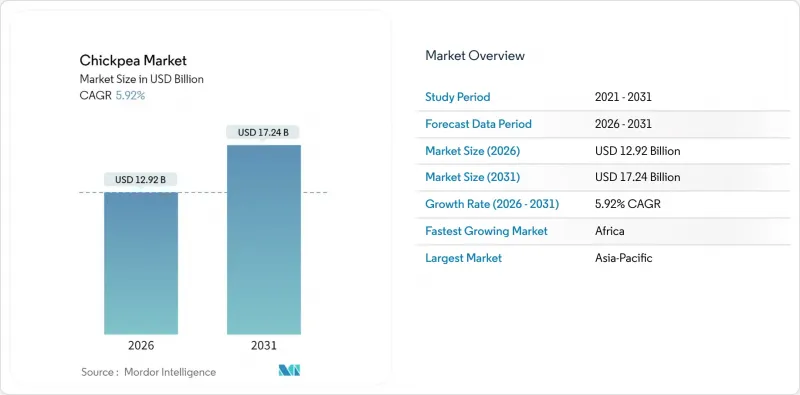
The chickpea market was valued at USD 12.2 billion in 2025 and estimated to grow from USD 12.92 billion in 2026 to reach USD 17.24 billion by 2031, at a CAGR of 5.92% during the forecast period (2026-2031).
Robust demand from plant-based eating trends, rapid uptake of pulse proteins in functional foods, and government-backed nutrition programs are the pivotal growth drivers. Companies are scaling processing capacity for high-purity isolates while simultaneously valorizing by-products such as aquafaba for clean-label emulsifiers. Digital agriculture tools are beginning to narrow historic yield gaps in smallholder systems, supporting a more reliable supply. On the demand side, gluten-free bakery innovation and mainstream adoption of meat alternatives are broadening chickpea applications, encouraging ingredient manufacturers to lock in longer contracts and invest in upstream traceability platforms. The market also reflects growing price premiums for high-protein and organic variants, signaling an enduring shift toward value-added positioning.
Global Chickpea Market Trends and Insights
Expanding Vegan and Flexitarian Populations
Plant-based dietary adoption is outpacing animal protein growth as consumers pursue ethical, health, and environmental goals. Similar shifts are observed in the United States, where omnivores account for over half of all plant-based product purchases, confirming that pulses have penetrated mainstream grocery baskets. Brands are leveraging the halo effect of "clean protein" to launch chickpea-based ready meals, nutrition bars, and milk alternatives that target flexitarian shoppers. The demographic sweet spot overlaps with younger, urban consumers whose purchasing power is set to expand through 2030. This shift fuels demand for reliable ingredient quality, prompting processors to formalize long-term contracts with growers.
Surge in Pulse-Based Protein Isolates for Functional Foods
Technological advances in membrane filtration and salt-based extraction have delivered chickpea protein isolates exceeding 90% purity while retaining solubility and gel strength vital for meat analogs. Strategic partnerships, such as Ingredion teaming with InnovoPro, accelerate commercialization by pairing global distribution with proprietary extraction know-how. The result is a virtuous cycle: reliable isolate quality encourages food formulators to trial chickpea proteins, which in turn secures off-take agreements that justify further capacity expansion. End uses now include sports-nutrition powders, spoonable yogurts, and frozen desserts, pushing demand beyond historical hummus and flour applications.
Yield Volatility from El Nino-Linked Drought Cycles
Historical El Nino events have slashed chickpea output by up to 65% in Ethiopia and 25-30% in India, triggering price spikes and import surges. Drought stress not only limits yield but also amplifies root pathogens, with dry root rot incidence expanding 14-fold under severe moisture deficits. Growers in semi-arid belts increasingly shift acreage to more drought-tolerant pulses or cereals during forecasted El Nino years, compounding supply tightness. Breeding programs are accelerating drought-escape varieties, but widespread adoption remains several seasons away. Adaptation strategies include developing drought-tolerant varieties and implementing supplemental irrigation systems, with research indicating that early sowing and short-duration cultivars can mitigate some yield losses.
Other drivers and restraints analyzed in the detailed report include:
- Growth of Gluten-Free Bakery and Snack Categories
- Government Biofortification Programs for Climate-Smart Legumes
- Post-Harvest Mycotoxin Contamination Risks
For complete list of drivers and restraints, kindly check the Table Of Contents.
Segment Analysis
The Chickpea Market Report is Segmented by Geography (North America, South America, Europe, Asia-Pacific, Middle East, and Africa). The Report Includes Production Analysis (Volume), Consumption Analysis (Value and Volume), Export Analysis (Value and Volume), Import Analysis (Value and Volume), and Price Trend Analysis. The Market Forecasts are Provided in Terms of Value (USD) and Volume (Metric Tons).
Geography Analysis
Asia-Pacific captured 35.58% of the chickpea market share in 2025, reflecting entrenched culinary traditions and expanding packaged food use. The chickpea market size attached to regional processing clusters is anticipated to widen as multinational snack brands procure from dedicated sourcing hubs. The regional dynamics reflect divergent consumption patterns and production capabilities that are reshaping global trade flows.
Africa's contribution remains smaller in absolute terms, yet the region posts the fastest CAGR at 6.91% through 2031. Ethiopia leveraged digital extension platforms to lift yields and unlock export quality standards, aligning with EU import protocols. Donor-funded biofortification projects introduce high-iron varieties, enhancing both domestic nutrition and premium export positioning. The chickpea market size for African origin shipments is projected to surpass USD 458 million by 2031, buoyed by trade diversification into Middle Eastern and Southeast Asian destinations.
North America and Europe command premium niches focused on high-protein flours and isolates destined for flexitarian product lines. Recent consolidation, exemplified by Above Food's takeover of The Redwood Group's specialty crop division, signals an emerging scale play to secure contiguous supply in these mature but innovation-oriented markets. Australia's record 2 million metric tons harvest showcases the potential for counter-seasonal supply to smooth global availability, though logistics constraints remain a limiting factor. South America contributes modestly through Argentine and Brazilian acreage expansions focused on counter-seasonal supply windows. Meanwhile, Turkey's target of USD 1 billion in food exports to China over five years underscores the Middle East's ambitions to leverage geographic proximity as a trading bridge.
- Market Overview
- Market Drivers
- Market Restraints
- Regulatory Landscape
- Technological Outlook
- Value/Supply-Chain Analysis
- PESTEL Analysis
- List of Stakeholders
Additional Benefits:
- The market estimate (ME) sheet in Excel format
- 3 months of analyst support
TABLE OF CONTENTS
1 Introduction
- 1.1 Study Assumptions and Market Definition
- 1.2 Scope of the Study
2 Research Methodology
3 Executive Summary
4 Market Landscape
- 4.1 Market Overview
- 4.2 Market Drivers
- 4.2.1 Expanding vegan and flexitarian populations
- 4.2.2 Surge in pulse-based protein isolates for functional foods
- 4.2.3 Growth of gluten-free bakery and snack categories
- 4.2.4 Government biofortification programs for climate-smart legumes
- 4.2.5 Circular-economy valorization of chickpea by-products
- 4.2.6 Digital agriculture boosting smallholder chickpea yields
- 4.3 Market Restraints
- 4.3.1 Yield volatility from El Nino linked drought cycles
- 4.3.2 Post-harvest mycotoxin contamination risks
- 4.3.3 Price under-cutting from synthetic pea-protein concentrates
- 4.3.4 Logistics bottlenecks at key export ports
- 4.4 Regulatory Landscape
- 4.5 Technological Outlook
- 4.6 Value/Supply-Chain Analysis
- 4.7 PESTEL Analysis
5 Market Size and Growth Forecasts (Value and Volume)
- 5.1 By Geography (Production Analysis (Volume), Consumption Analysis (Volume and Value), Import Analysis (Volume and Value), Export Analysis (Volume and Value), and Price Trend Analysis)
- 5.1.1 North America
- 5.1.1.1 United States
- 5.1.1.2 Canada
- 5.1.1.3 Mexico
- 5.1.2 South America
- 5.1.2.1 Brazil
- 5.1.2.2 Argentina
- 5.1.3 Europe
- 5.1.3.1 Germany
- 5.1.3.2 United Kingdom
- 5.1.3.3 France
- 5.1.3.4 Spain
- 5.1.4 Asia-Pacific
- 5.1.4.1 India
- 5.1.4.2 China
- 5.1.4.3 Australia
- 5.1.4.4 Japan
- 5.1.5 Middle East
- 5.1.5.1 Turkey
- 5.1.5.2 Saudi Arabia
- 5.1.5.3 United Arab Emirates
- 5.1.6 Africa
- 5.1.6.1 South Africa
- 5.1.6.2 Egypt
- 5.1.6.3 Ethiopia
- 5.1.1 North America
6 Competitive Landscape
- 6.1 List of Stakeholders
- 6.1.1 AGT Food and Ingredients Inc.
- 6.1.2 ADM
- 6.1.3 Olam Group
- 6.1.4 Louis Dreyfus Company
- 6.1.5 Cargill, Incorporated
- 6.1.6 Bunge
- 6.1.7 Batory Foods Inc.
- 6.1.8 The Scoular Company
- 6.1.9 Hakan Agro DMCC
- 6.1.10 Indigo Ag Inc.
- 6.1.11 Ingredion Inc.
7 Market Opportunities and Future Outlook

