
PUBLISHER: Mordor Intelligence | PRODUCT CODE: 1937400

PUBLISHER: Mordor Intelligence | PRODUCT CODE: 1937400
South-East Asia Consulting Services - Market Share Analysis, Industry Trends & Statistics, Growth Forecasts (2026 - 2031)
The South-East Asia consulting services market size in 2026 is estimated at USD 12.05 billion, growing from 2025 value of USD 11.26 billion with 2031 projections showing USD 16.92 billion, growing at 7.01% CAGR over 2026-2031.
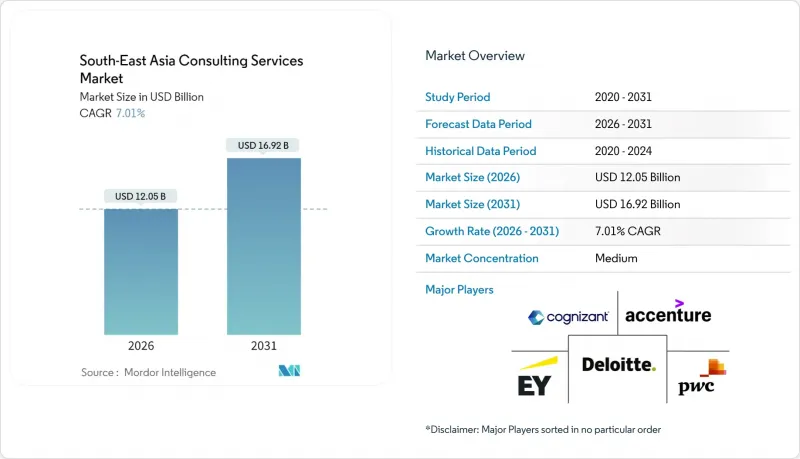
Robust government-led digitalization roadmaps, mandatory sustainability reporting, and rapid SME formation are the primary forces expanding advisory demand across the ten ASEAN member states. Enterprises racing to modernize legacy applications and integrate AI platforms are channeling the largest spending into IT and Digital Consulting, while the push for transparent environmental disclosures propels Sustainability and ESG advisory uptake. Concurrently, a pivot from episodic projects to subscription-based advisory models is reshaping revenue cycles as clients favor continuous support. Boutiques leveraging cloud-native delivery and independent talent platforms now challenge incumbents on price and agility, while China+1 supply-chain realignment sends manufacturers to Vietnam, Thailand, and Malaysia, unlocking cross-border regulatory workstreams.
South-East Asia Consulting Services Market Trends and Insights
Digital-first Transformation Programmes
Government programmes such as Singapore's Smart Nation initiative and Malaysia's Digital Investment Office are collectively injecting USD 48 billion into regional transformation projects . Indonesia's plan to merge 27,000 public-sector apps into nine super-apps exemplifies the complexity of change management, cybersecurity, and cloud migration tasks that demand specialized advice. Singapore's Analytics.gov platform, now supporting more than 1,600 public-sector users, highlights the consultative work required to govern data, build AI models, and align multi-agency processes. Thailand's electricity authority chose PLEXOS for grid optimization, signaling rising need for resource-planning advisory across energy utilities. Together these initiatives demonstrate why multi-year engagements around enterprise architecture, governance, and talent upskilling form a resilient revenue stream for the South-East Asia consulting services market.
SME and Start-up Boom Demanding Scalable Advice
Ninety-seven percent of ASEAN businesses are MSMEs, and they face a USD 300 billion funding deficit, prompting governments and donors to subsidize advisory access [HSBC.COM]. Subscription models priced well below the traditional USD 350-1,500 daily rate are gaining ground, enabling founders to secure on-call guidance using independent experts billing USD 250-1,600 per day. Vietnam's venture ecosystem, supported by InnoVen Capital's 190 loans, illustrates the appetite for fundraising, unit economics, and go-to-market consulting among high-growth startups. Institutional programs such as the ASEAN Social Enterprise Development Programme 4.0 supply training and seed grants up to USD 40,000, further widening the advisory client base. As founders prioritize sustainable profitability, demand rises for consultants versed in capital efficiency and ESG integration, reinforcing long-term momentum for the Southeast Asia consulting services market.
Corporate In-house Consulting Build-outs
Financial institutions such as DBS have cultivated internal digital-transformation squads, reducing dependence on third-party advisors for day-to-day analytics, cybersecurity, and DevOps mandates. These captive units accumulate institutional knowledge and align tightly with corporate culture, often matching or outpacing external consultants on speed of execution. As more enterprises replicate the model, a portion of routine advisory spend migrates in-house, trimming revenue growth for commoditized services. However, complex multi-market transformations, unfamiliar regulatory changes, and independent board-mandated reviews still require external objectivity, preserving scope for high-value engagements. Consulting firms are responding by deepening specialization and offering outcome-based contracts that internal teams struggle to replicate.
Other drivers and restraints analyzed in the detailed report include:
- Adoption of AI, Analytics and Cloud Platforms
- Government Digital-Economy Road-maps and FDI Inflows
- Price Erosion from Commoditized Offerings
For complete list of drivers and restraints, kindly check the Table Of Contents.
Segment Analysis
IT and Digital Consulting contributes 37.02% of 2025 revenue, underscoring enterprise urgency to decommission legacy stacks, adopt cloud-native architectures, and deploy AI workloads. The Southeast Asia consulting services market size for this segment is forecast to expand steadily alongside hyperscale cloud investments and public-sector digital mandates. Sustainability and ESG Consulting, growing at an 17.55% CAGR, gains momentum from Singapore's 2025 compulsory ESG reporting and Thailand's re-branded SET ESG Ratings that align with FTSE Russell standards . Clients increasingly demand integrated digital-plus-ESG roadmaps, prompting firms to cross-train technologists in carbon-accounting frameworks. Strategy and Operations Consulting benefits from manufacturers' China+1 shifts, while Risk and Compliance advisors capitalize on divergent data-localization laws that fragment deployment architectures. HR Consulting remains resilient as 30-70% of tech roles sit vacant, driving projects in talent analytics and workforce planning.
Consultancies now embed AI copilots into delivery, automating document review and scenario modeling, thus shortening sprint cycles and elevating advisory margins. Firms like Tact Social Consulting partner with hyperscalers to bundle cloud credits with ESG advisory, winning enterprise pilots across Thailand. As output-based fees displace billable-hour models, providers quantify value via cost savings, risk mitigation, or carbon-reduction metrics, an approach that resonates with CFOs seeking transparency. The South-East Asia consulting services market share of digital advisory revenue is projected to hold above 35% through 2031 despite the surge in sustainability work, indicating a durable dual-track growth pattern that fuses technology and ESG imperatives.
Financial Services represented 27.05% of 2025 spending, anchored by exhaustive digital banking roadmaps, open-API compliance, and stringent anti-money-laundering rules. KBank's KBTG unit and Vietnam's MSB-Backbase partnership are emblematic of institutions investing in omnichannel platforms and AI-enabled credit engines. Energy and Utilities produces the fastest expansion at 14.06% CAGR, fueled by grid modernization and renewable-integration projects such as Thailand's PLEXOS deployment and Indonesia's first digital substation in East Java. Manufacturing consulting demand swells as electronics and automotive firms replot supply chains, while telecom operators channel big-ticket capex into 5G and data-center buildouts, attracting infrastructure advisory.
Government and Public Sector engagements escalate with Indonesia's nine-super-app consolidation, pushing requirements for program management offices, cybersecurity, and service-design expertise. Retail and E-commerce assignments focus on customer-journey redesign and fraud analytics as mobile wallets multiply to an expected 440 million accounts by 2025. Healthcare providers pursue cloud migrations to compress claims-processing times and improve patient triage, opening avenues for HIPAA-analog compliance and legacy-system decommissioning consulting. Collectively, these verticals sustain a robust pipeline, reaffirming the South-East Asia consulting services market as the advisory hotspot within emerging Asian economies.
The Southeast Asia Consulting Services Market Report is Segmented by Service Type (HR Consulting, Financial Consulting, and More), End-User Industry (Financial Services, Life Sciences and Healthcare, IT and Telecommunications, and More), Consulting Model (Project-Based Advisory, Retainer-Based Advisory, and More), Firm Size (SMEs, and Large Enterprises), and Country. The Market Forecasts are Provided in Terms of Value (USD).
List of Companies Covered in this Report:
- Accenture plc
- Deloitte Touche Tohmatsu Limited
- PricewaterhouseCoopers International Limited (PwC)
- Ernst and Young Global Limited
- KPMG International Limited
- McKinsey & Company, Inc.
- Boston Consulting Group, Inc.
- Bain & Company, Inc.
- Cognizant Technology Solutions Corporation
- Tata Consultancy Services Limited
- Wipro Limited
- Mercer LLC
- Aon plc
- Protiviti Inc.
- A.T. Kearney, Inc.
- Roland Berger Holding GmbH
- L.E.K. Consulting LLC
- Frost & Sullivan, Inc.
- RSM International Limited
- YCP Holdings Limited
Additional Benefits:
- The market estimate (ME) sheet in Excel format
- 3 months of analyst support
TABLE OF CONTENTS
1 INTRODUCTION
- 1.1 Study Assumptions and Market Definition
- 1.2 Scope of the Study
2 RESEARCH METHODOLOGY
3 EXECUTIVE SUMMARY
4 MARKET INSIGHTS
- 4.1 Market Overview
- 4.2 Market Drivers
- 4.2.1 Digital-first transformation programmes
- 4.2.2 SME and start-up boom demanding scalable advice
- 4.2.3 Adoption of AI, analytics and cloud platforms
- 4.2.4 Government digital-economy road-maps and FDI inflows
- 4.2.5 Mandatory ESG-reporting fuelling sustainability advisory
- 4.2.6 China+1 supply-chain realignment into ASEAN
- 4.3 Market Restraints
- 4.3.1 Corporate in-house consulting build-outs
- 4.3.2 Price erosion from commoditised offerings
- 4.3.3 Shortage of bilingual domain experts
- 4.3.4 Data-sovereignty and residency barriers
- 4.4 Value Chain Analysis
- 4.5 Regulatory Landscape
- 4.6 Technological Outlook
- 4.7 Porter's Five Forces Analysis
- 4.7.1 Bargaining Power of Suppliers
- 4.7.2 Bargaining Power of Buyers
- 4.7.3 Threat of New Entrants
- 4.7.4 Threat of Substitutes
- 4.7.5 Competitive Rivalry
- 4.8 Industry Ecosystem Analysis
- 4.9 Key Use Cases and Case Studies
- 4.10 Assessment of Macroeconomic Trends
- 4.11 Investment Analysis
5 MARKET SIZE AND GROWTH FORECASTS (VALUE)
- 5.1 By Service Type
- 5.1.1 HR Consulting
- 5.1.2 Financial Consulting
- 5.1.3 IT and Digital Consulting
- 5.1.4 Strategy and Operations Consulting
- 5.1.5 Risk and Compliance Consulting
- 5.1.6 Sustainability and ESG Consulting
- 5.2 By End-user Industry
- 5.2.1 Financial Services
- 5.2.2 Life Sciences and Healthcare
- 5.2.3 IT and Telecommunications
- 5.2.4 Government and Public Sector
- 5.2.5 Energy and Utilities
- 5.2.6 Manufacturing
- 5.2.7 Retail and E-commerce
- 5.3 By Consulting Model
- 5.3.1 Project-based Advisory
- 5.3.2 Retainer-based Advisory
- 5.3.3 Managed Services / Outsourcing
- 5.3.4 Advisory-as-a-Service (Subscription)
- 5.4 By Firm Size
- 5.4.1 Small and Medium Enterprises (SMEs)
- 5.4.2 Large Enterprises
- 5.5 By Country
- 5.5.1 Singapore
- 5.5.2 Indonesia
- 5.5.3 Thailand
- 5.5.4 Vietnam
- 5.5.5 Philippines
- 5.5.6 Malaysia
- 5.5.7 Rest of Southeast Asia
6 COMPETITIVE LANDSCAPE
- 6.1 Market Concentration
- 6.2 Strategic Moves
- 6.3 Market Share Analysis
- 6.4 Company Profiles (includes Global level Overview, Market level overview, Core Segments, Financials as available, Strategic Information, Market Rank/Share for key companies, Products and Services, and Recent Developments)
- 6.4.1 Accenture plc
- 6.4.2 Deloitte Touche Tohmatsu Limited
- 6.4.3 PricewaterhouseCoopers International Limited (PwC)
- 6.4.4 Ernst and Young Global Limited
- 6.4.5 KPMG International Limited
- 6.4.6 McKinsey & Company, Inc.
- 6.4.7 Boston Consulting Group, Inc.
- 6.4.8 Bain & Company, Inc.
- 6.4.9 Cognizant Technology Solutions Corporation
- 6.4.10 Tata Consultancy Services Limited
- 6.4.11 Wipro Limited
- 6.4.12 Mercer LLC
- 6.4.13 Aon plc
- 6.4.14 Protiviti Inc.
- 6.4.15 A.T. Kearney, Inc.
- 6.4.16 Roland Berger Holding GmbH
- 6.4.17 L.E.K. Consulting LLC
- 6.4.18 Frost & Sullivan, Inc.
- 6.4.19 RSM International Limited
- 6.4.20 YCP Holdings Limited
7 MARKET OPPORTUNITIES AND FUTURE OUTLOOK
- 7.1 White-space and Unmet-Need Assessment

