PUBLISHER: Mordor Intelligence | PRODUCT CODE: 1939690

PUBLISHER: Mordor Intelligence | PRODUCT CODE: 1939690
AI In Oil And Gas - Market Share Analysis, Industry Trends & Statistics, Growth Forecasts (2026 - 2031)
The AI in the oil and gas market was valued at USD 3.79 billion in 2025 and estimated to grow from USD 4.28 billion in 2026 to reach USD 7.91 billion by 2031, at a CAGR of 13.03% during the forecast period (2026-2031).
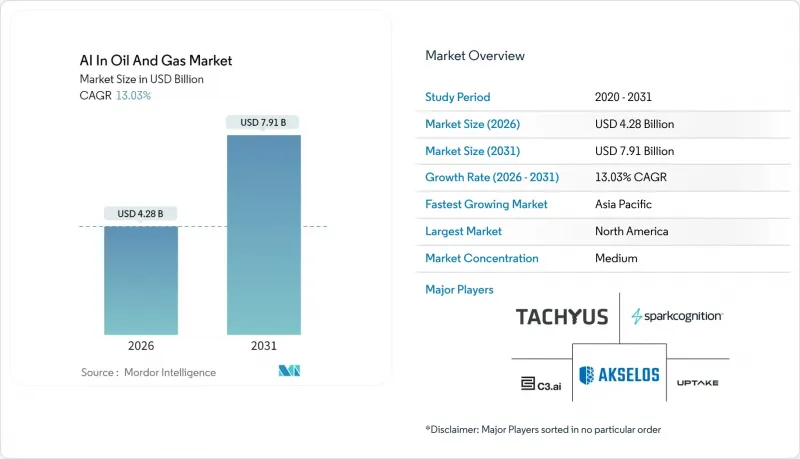
Market growth is being propelled by real-time hydraulic-fracturing control enabled through edge analytics, autonomous drilling systems that trim crew exposure in deepwater projects, and predictive-maintenance programs that curb unplanned downtime. Cloud-edge convergence is shortening model-deployment cycles, while physics-informed models are yielding faster subsurface insights that sharpen well-placement accuracy. Competitive activity is heating up as oilfield service majors embed AI into integrated platforms and cloud hyperscalers launch energy-specific tool sets. Capital-intensive platform rollouts and a thin pool of domain-aware data scientists temper near-term adoption, yet rising ESG requirements for methane-leak detection offer a widening demand runway.
Global AI In Oil And Gas Market Trends and Insights
Ability to Process Complex Subsurface Big Data
Seismic archives exceeding 1,500 petabytes at leading operators now require AI accelerators capable of parsing decades of drilling, petrophysical, and production data within hours, lifting drilling-location accuracy by 70% compared with manual methods. ADNOC's ENERGYai agents trimmed geological-model build times by 75% through autonomous seismic analysis, allowing reservoir engineers to test multiple frac-cluster scenarios in minutes. The fusion of physics-informed neural networks with historical well data is enabling faster history matches across unconventional plays, directly improving capital-efficiency metrics for large pad developments.
Pressure to Cut Lifting-Costs Amid Price Volatility
Price swings continue to squeeze margins, prompting operators to pursue 25-50% drilling-cost reductions through AI-guided automation. Nabors Industries recorded 30% faster penetration rates after deploying automated drilling controls, while integrated production-optimization software slashed decision-cycle times from days to hours for Permian assets. Tachyus reported notable gains in artificial-lift efficiency by dynamically adjusting rod-pump parameters using reinforcement-learning algorithms. Mature-field operators increasingly view AI-assisted recovery as essential for extending economic lifespans.
High Up-Front CAPEX for AI Platforms
Enterprise-scale deployments often carry multimillion-dollar price tags for compute clusters, data lakes, and specialized licensing, deterring small independents from adopting full-stack solutions. Data-modernization projects frequently double costs, as siloed SCADA and historian systems must be harmonized before analytics can proceed. Cloud-native offerings such as Azure Data Manager for Energy give operators a consumption-based alternative, yet data sovereignty and latency concerns keep many critical workloads on-premises.
Other drivers and restraints analyzed in the detailed report include:
- Predictive-Maintenance Driven Downtime Reduction
- Fiber-Optic Sensor + AI for Real-Time Frac Optimization
- Scarcity of Oil-and-Gas Domain Data Scientists
For complete list of drivers and restraints, kindly check the Table Of Contents.
Segment Analysis
Upstream activities contributed 61.05% to the AI in the oil and gas market size in 2025, due to seismic interpretation, drilling automation, and production optimization workflows that require sophisticated analytics. These use cases demand pattern-recognition models capable of integrating petrophysical, geomechanical, and drilling parameters to improve well-placement and completion design. As unconventional reservoirs proliferate, upstream operators continue scaling AI-enabled workflows across pad developments, thereby cementing their share leadership within the AI in oil and gas market.
Downstream operations, in contrast, are forecast to post the segment's fastest 14.12% CAGR through 2031 as refineries adopt model-predictive control for fuel blending and virtual sensors for real-time quality assurance. Generative-AI-powered document processing is shortening regulatory-report cycles, and computer-vision algorithms now track corrosion hotspots inside distillation columns. The trajectory signals greater AI democratization beyond exploration and production, reflecting a shift toward integrated optimization across the entire value chain of AI in the oil and gas industry.
Services captured 65.80% of AI in the oil and gas market revenue in 2025, showcasing operators' preference for domain experts to tailor models to asset-specific constraints. Advisory, data engineering, and model-maintenance contracts form the backbone of service revenues as companies iterate toward continuous-improvement loops.
Integrated platforms, however, are expanding at a 13.74% CAGR as operators look to standardize data ingestion, model management, and application orchestration. SLB's Lumi and Baker Hughes' Cordant(TM) suites typify multi-domain environments that embed large language models, computer-vision pipelines, and physics-informed simulators. The trend suggests a future transition from labor-intensive deployments to configurable platforms that scale enterprise-wide, a key inflection for the AI in oil and gas market.
The AI in Oil and Gas Market Report is Segmented by Operation (Upstream, Midstream, and Downstream), Solution Type (Platform and Services), Asset Location (Onshore and Offshore), Application (Quality Control, Production Optimisation, and More), AI Technique (Machine Learning, Deep Learning, and More), Deployment Mode (Cloud, On-Premises, and Edge), and Geography. The Market Forecasts are Provided in Terms of Value (USD).
Geography Analysis
North America held 35.95% of 2025 revenue, anchored by prolific shale developments and wide adoption of automated rigs, predictive-maintenance suites, and methane-leak analytics. Companies such as ExxonMobil, Chevron, and Pioneer Natural Resources run cloud-native subsurface workflows at petabyte scale, supported by mature fiber and 5G backbones. Government stimulation packages for infrastructure modernization further underpin digital uptake, while a thriving startup ecosystem accelerates tool creation for AI in the oil and gas market.
Europe maintains a technologically advanced yet smaller share, with North Sea operators focusing on offshore robotics and CCS monitoring. Regulations on carbon intensity and methane emissions propel AI-enabled environmental compliance, particularly in Norway and the Netherlands. Cross-sector collaboration on open data standards like OSDU fosters interoperability, reducing integration friction across installations.
Asia-Pacific is the fastest-growing region at a 14.41% CAGR, fueled by upstream investments in India, Indonesia, and China. PTTEP's portfolio of 65 digital features and Indian refiners' predictive-maintenance pilots illustrate a regional shift toward enterprise-wide digitization. Rising LNG demand, energy-security objectives, and a swelling pool of software engineers provide structural tailwinds for AI rollout across the AI in oil and gas market.
The Middle East and Africa region leverages sovereign AI programs and megaproject budgets to scale data centers and supercomputing clusters. ADNOC's generation of USD 500 million in AI value during 2024, along with Aramco's METABRAIN LLM initiative, signals rapid capability uplift. Government mandates for economic diversification and net-zero commitments are translating into expanded funding for leak-detection, drilling automatio,n and flare-reduction analytics, strengthening regional momentum within the AI in oil and gas market.
- C3.ai Inc.
- SparkCognition Inc.
- Uptake Technologies Inc.
- Tachyus Corporation
- Akselos SA
- IBM Corporation
- Microsoft Corporation
- Amazon Web Services Inc.
- Google Cloud LLC
- ABB Ltd.
- Honeywell International Inc.
- Schlumberger NV
- Halliburton Company
- Baker Hughes Company
- Siemens Energy AG
- Huawei Technologies Co. Ltd.
- Infosys Limited
- NVIDIA Corporation
- Cognite AS
- Wipro Limited
- Aspen Technology Inc.
- PETROSHELF LLC
- Arundo Analytics Inc.
- Kongsberg Digital AS
- Expert Petroleum SRL
- OPRO.ai Inc.
Additional Benefits:
- The market estimate (ME) sheet in Excel format
- 3 months of analyst support
TABLE OF CONTENTS
1 INTRODUCTION
- 1.1 Study Assumptions and Market Definition
- 1.2 Scope of the Study
2 RESEARCH METHODOLOGY
3 EXECUTIVE SUMMARY
4 MARKET LANDSCAPE
- 4.1 Market Overview
- 4.2 Market Drivers
- 4.2.1 Ability to process complex subsurface big data
- 4.2.2 Pressure to cut lifting-costs amid price volatility
- 4.2.3 Predictive-maintenance driven downtime reduction
- 4.2.4 Fiber-optic sensor + AI for real-time frac optimization
- 4.2.5 Methane-leak AI monitoring to meet new ESG mandates
- 4.2.6 Autonomous AI-driven deep-water drilling systems
- 4.3 Market Restraints
- 4.3.1 High up-front CAPEX for AI platforms
- 4.3.2 Scarcity of oil-and-gas domain data-scientists
- 4.3.3 Cyber-risk at the offshore edge layer
- 4.3.4 Legacy SCADA interoperability gaps
- 4.4 Industry Value Chain Analysis
- 4.5 Regulatory Landscape
- 4.6 Technological Outlook
- 4.7 Investment Analysis
- 4.8 Porter's Five Forces Analysis
- 4.8.1 Threat of New Entrants
- 4.8.2 Bargaining Power of Buyers
- 4.8.3 Bargaining Power of Suppliers
- 4.8.4 Threat of Substitutes
- 4.8.5 Intensity of Competitive Rivalry
- 4.9 Impact of Macroeconomic Factors on the Market
5 MARKET SIZE AND GROWTH FORECASTS (VALUES)
- 5.1 By Operation
- 5.1.1 Upstream
- 5.1.2 Midstream
- 5.1.3 Downstream
- 5.2 By Solution Type
- 5.2.1 Platform
- 5.2.2 Services
- 5.3 By Asset Location
- 5.3.1 Onshore
- 5.3.2 Offshore
- 5.4 By Application
- 5.4.1 Quality Control
- 5.4.2 Production Optimisation
- 5.4.3 Predictive Maintenance
- 5.4.4 HS&E Compliance
- 5.4.5 Exploration and Drilling
- 5.4.6 Other Applications
- 5.5 By AI Technique
- 5.5.1 Machine Learning
- 5.5.2 Deep Learning
- 5.5.3 Computer Vision
- 5.5.4 Natural Language Processing
- 5.5.5 Other AI Techniques
- 5.6 By Deployment Mode
- 5.6.1 Cloud
- 5.6.2 On-Premises
- 5.6.3 Edge
- 5.7 By Geography
- 5.7.1 North America
- 5.7.1.1 United States
- 5.7.1.2 Canada
- 5.7.1.3 Mexico
- 5.7.2 South America
- 5.7.2.1 Brazil
- 5.7.2.2 Argentina
- 5.7.2.3 Chile
- 5.7.2.4 Rest of South America
- 5.7.3 Europe
- 5.7.3.1 Germany
- 5.7.3.2 United Kingdom
- 5.7.3.3 France
- 5.7.3.4 Italy
- 5.7.3.5 Spain
- 5.7.3.6 Rest of Europe
- 5.7.4 Asia-Pacific
- 5.7.4.1 China
- 5.7.4.2 India
- 5.7.4.3 Japan
- 5.7.4.4 South Korea
- 5.7.4.5 Malaysia
- 5.7.4.6 Singapore
- 5.7.4.7 Australia
- 5.7.4.8 Rest of Asia-Pacific
- 5.7.5 Middle East and Africa
- 5.7.5.1 Middle East
- 5.7.5.1.1 United Arab Emirates
- 5.7.5.1.2 Saudi Arabia
- 5.7.5.1.3 Turkey
- 5.7.5.1.4 Rest of Middle East
- 5.7.5.2 Africa
- 5.7.5.2.1 South Africa
- 5.7.5.2.2 Nigeria
- 5.7.5.2.3 Rest of Africa
- 5.7.5.1 Middle East
- 5.7.1 North America
6 COMPETITIVE LANDSCAPE
- 6.1 Market Concentration
- 6.2 Strategic Moves
- 6.3 Market Share Analysis
- 6.4 Company Profiles (includes Global level Overview, Market level overview, Core Segments, Financials as available, Strategic Information, Market Rank/Share for key companies, Products and Services, and Recent Developments)
- 6.4.1 C3.ai Inc.
- 6.4.2 SparkCognition Inc.
- 6.4.3 Uptake Technologies Inc.
- 6.4.4 Tachyus Corporation
- 6.4.5 Akselos SA
- 6.4.6 IBM Corporation
- 6.4.7 Microsoft Corporation
- 6.4.8 Amazon Web Services Inc.
- 6.4.9 Google Cloud LLC
- 6.4.10 ABB Ltd.
- 6.4.11 Honeywell International Inc.
- 6.4.12 Schlumberger NV
- 6.4.13 Halliburton Company
- 6.4.14 Baker Hughes Company
- 6.4.15 Siemens Energy AG
- 6.4.16 Huawei Technologies Co. Ltd.
- 6.4.17 Infosys Limited
- 6.4.18 NVIDIA Corporation
- 6.4.19 Cognite AS
- 6.4.20 Wipro Limited
- 6.4.21 Aspen Technology Inc.
- 6.4.22 PETROSHELF LLC
- 6.4.23 Arundo Analytics Inc.
- 6.4.24 Kongsberg Digital AS
- 6.4.25 Expert Petroleum SRL
- 6.4.26 OPRO.ai Inc.
7 MARKET OPPORTUNITIES AND FUTURE OUTLOOK
- 7.1 White-space and Unmet-Need Assessment

