PUBLISHER: Mordor Intelligence | PRODUCT CODE: 1939714

PUBLISHER: Mordor Intelligence | PRODUCT CODE: 1939714
GCC Warehousing And Distribution Logistics - Market Share Analysis, Industry Trends & Statistics, Growth Forecasts (2026 - 2031)
The GCC Warehousing And Distribution Logistics Market size in 2026 is estimated at USD 15.35 billion, growing from 2025 value of USD 14.45 billion with 2031 projections showing USD 20.79 billion, growing at 6.25% CAGR over 2026-2031.
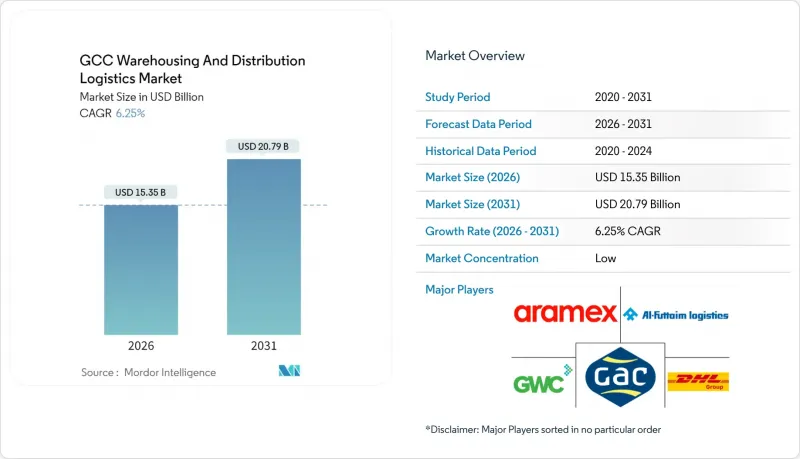
The expansion is anchored in the bloc's pivotal location on Asia-Europe sea lanes, accelerating economic-diversification spending, and a widening e-commerce footprint that pulls inventory closer to Gulf consumption hubs. Government programs such as Saudi Arabia's Vision 2030 and the UAE's Centennial 2071 channel sizeable public-private capital toward Grade A facilities, while 0%-tariff free-zone regimes and renewables-driven "green warehouse" mandates reshape facility specifications. Competitive intensity remains moderate: global integrators inject fresh capital, regional incumbents consolidate, and niche specialists pursue pharmaceutical cold-chain and micro-fulfillment plays. Land scarcity near tier-1 ports, rising build costs, and persistent labor-skill gaps temper the growth outlook, yet continue to stimulate technology adoption and multi-story designs across the GCC warehousing and distribution logistics market.
GCC Warehousing And Distribution Logistics Market Trends and Insights
Strategic Geographic Location Between Asia-Europe Trade Lanes
Cargo diversions triggered by Red Sea volatility steer shippers toward buffer inventory in Gulf free zones, sustaining double-digit volume gains at Jebel Ali and King Abdulaziz ports. Terminal expansions lifting capacity to 22.4 million TEU and 40 million TEU, respectively, elevate Dubai and Dammam as transshipment pivots that underpin the GCC warehousing and distribution logistics market. MSC's 2025 dual-routing network further cements the Gulf as a resilient transit node, prompting occupiers to lock in multi-year leases for duty-free storage that can flex across disrupted lanes.
Vision-Driven Economic Diversification Programs
Vision 2030, NEOM, and Centennial 2071 translate into sustained funding for automation-ready facilities across Riyadh, Jeddah, and Dubai South. Non-oil export surges-SAR 515 billion (USD 137 billion) in 2024 for Saudi Arabia-raise demand for specialized storage that meets stringent quality, safety, and sustainability benchmarks. Partnerships such as GFH-GWC's 200,000 m2 Grade A pipeline illustrate how sovereign agendas pull private capital into the GCC warehousing and distribution logistics market.
Land-Bank Shortages Near Tier-1 Ports & Airports
Scarcity around Jebel Ali, Dammam, and Jeddah forces developers to pivot toward secondary plots or vertical-stack designs that hike capex and transport distances. Warehouse build costs climbed 38% above pre-pandemic levels by 2024, squeezing developer margins and elongating payback horizons.
Other drivers and restraints analyzed in the detailed report include:
- Rapid B2C E-Commerce Penetration and Same-Day Delivery Pledges
- Expansion of Bonded & Free-Zone Regimes Enabling 0% Customs Duties
- Ongoing Trucking Driver and Forklift-Operator Skill Gap
For complete list of drivers and restraints, kindly check the Table Of Contents.
Segment Analysis
Refrigerated Warehousing and Storage is expected to grow fastest at a 4.92% CAGR (2026-2031) as halal biologics, fresh produce, and vaccine flows multiply. Emirates SkyCargo's GDP-compliant hub and DP World's 11,900 m2 cool facility showcase how temperature-controlled compliance enables premium pricing and barriers to entry.
Meanwhile, General Warehousing retained 54.45% of the GCC warehousing and distribution logistics market size in 2025 thanks to bulk cargo, e-commerce fulfilment, and consolidation services, though margin pressure intensifies from standardization. Developers increasingly layer cold chambers within multi-tenant parks to diversify revenue and meet rising health-code requirements, reinforcing the segment's strategic value within the GCC warehousing and distribution logistics market.
The GCC Warehousing and Distribution Logistics Market Report is Segmented by Warehouse Type (General Warehousing and Storage and Refrigerated Warehousing and Storage), Ownership (Private Warehouses and Public Warehouses), End-User Industry (E-Commerce & Retail, Food & Beverage, Pharma & Healthcare, and More), Country (Saudi Arabia, United Arab Emirates, Qatar, and More). The Market Forecasts are Provided in Terms of Value (USD).
List of Companies Covered in this Report:
- DHL Group
- GWC
- Aramex
- Al-Futtaime Logistics
- GAC
- Al-Majdouie Logistics
- Ceva Logistics
- Kuehne + Nagel
- FedEx
- DSV
- Integrated National Logistics
- Global Shipping & Logistics
- LSC Logistics
- Barq Express
- UPS
- Bahri Logistics
- Hellmann Worldwide Logistics
- Yusen Logistics (part of NYK Line)
- Tameem Logistics
- BrightLink Shipping and Logistics
Additional Benefits:
- The market estimate (ME) sheet in Excel format
- 3 months of analyst support
TABLE OF CONTENTS
1 Introduction
- 1.1 Study Assumptions & Market Definition
- 1.2 Scope of the Study
2 Research Methodology
3 Executive Summary
4 Market Landscape
- 4.1 Market Overview
- 4.2 Market Drivers
- 4.2.1 Strategic geographic location between Asia-Europe trade lanes
- 4.2.2 Vision-driven economic diversification programs (e.g., Saudi Vision 2030, UAE Centennial 2071)
- 4.2.3 Rapid B2C e-commerce penetration and same-day delivery pledges
- 4.2.4 Expansion of bonded & free-zone regimes enabling 0% customs duties
- 4.2.5 Adoption of solar-powered "green warehouses" for net-zero mandates
- 4.2.6 Pharma-grade cold-chain hubs for halal biologics export push
- 4.3 Market Restraints
- 4.3.1 Land-bank shortages near tier-1 ports & airports
- 4.3.2 Ongoing trucking driver and forklift-operator skill gap
- 4.3.3 Fragmented regional customs digitalisation standards
- 4.3.4 Rising construction-material costs inflating warehouse capex
- 4.4 Value / Supply-Chain Analysis
- 4.5 Regulatory Landscape
- 4.6 Technological Outlook
- 4.7 Porter's Five Forces
- 4.7.1 Bargaining Power of Suppliers
- 4.7.2 Bargaining Power of Buyers
- 4.7.3 Threat of New Entrants
- 4.7.4 Threat of Substitutes
- 4.7.5 Competitive Rivalry
5 Market Size & Growth Forecasts
- 5.1 By Warehouse Type
- 5.1.1 General Warehousing and Storage
- 5.1.2 Refrigerated Warehousing and Storage
- 5.2 By Ownership
- 5.2.1 Private Warehouses
- 5.2.2 Public Warehouses
- 5.3 By End-User Industry
- 5.3.1 E-commerce & Retail
- 5.3.2 Food & Beverage
- 5.3.3 Pharma & Healthcare
- 5.3.4 Automotive
- 5.3.5 Manufacturing & Engineering Goods
- 5.3.6 Others
- 5.4 By Country
- 5.4.1 Saudi Arabia
- 5.4.2 United Arab Emirates
- 5.4.3 Qatar
- 5.4.4 Kuwait
- 5.4.5 Oman
- 5.4.6 Bahrain
6 Competitive Landscape
- 6.1 Market Concentration
- 6.2 Strategic Moves
- 6.3 Market Share Analysis
- 6.4 Company Profiles (includes Global level Overview, Market level overview, Core Segments, Financials, Strategic Info, Market Rank/Share, Products & Services, Recent Developments)
- 6.4.1 DHL Group
- 6.4.2 GWC
- 6.4.3 Aramex
- 6.4.4 Al-Futtaime Logistics
- 6.4.5 GAC
- 6.4.6 Al-Majdouie Logistics
- 6.4.7 Ceva Logistics
- 6.4.8 Kuehne + Nagel
- 6.4.9 FedEx
- 6.4.10 DSV
- 6.4.11 Integrated National Logistics
- 6.4.12 Global Shipping & Logistics
- 6.4.13 LSC Logistics
- 6.4.14 Barq Express
- 6.4.15 UPS
- 6.4.16 Bahri Logistics
- 6.4.17 Hellmann Worldwide Logistics
- 6.4.18 Yusen Logistics (part of NYK Line)
- 6.4.19 Tameem Logistics
- 6.4.20 BrightLink Shipping and Logistics
7 Market Opportunities & Future Outlook
- 7.1 White-space & Unmet-need Assessment

