PUBLISHER: Mordor Intelligence | PRODUCT CODE: 1939717

PUBLISHER: Mordor Intelligence | PRODUCT CODE: 1939717
ASEAN Warehousing And Distribution Logistics - Market Share Analysis, Industry Trends & Statistics, Growth Forecasts (2026 - 2031)
The ASEAN Warehousing And Distribution Logistics Market size in 2026 is estimated at USD 32.95 billion, growing from 2025 value of USD 31.31 billion with 2031 projections showing USD 42.52 billion, growing at 5.23% CAGR over 2026-2031.
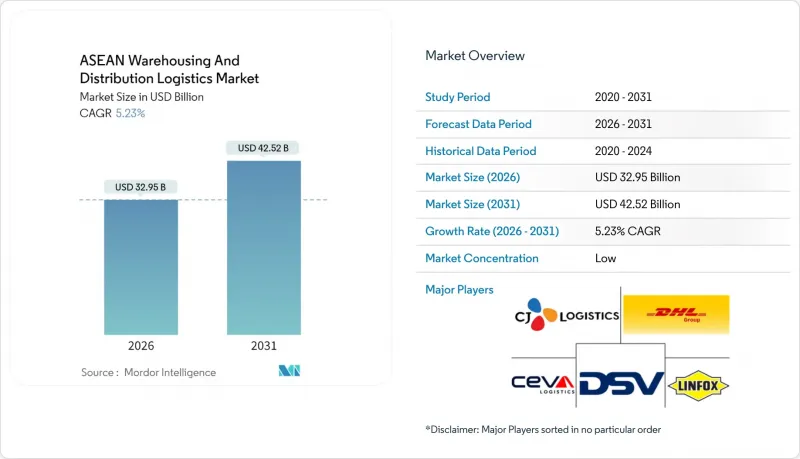
The region's rapid e-commerce growth, large-scale infrastructure programs, and expanding trade pacts combine to make the ASEAN warehousing and distribution logistics market one of the most attractive supply-chain opportunities worldwide. Induced demand from online retail, together with Thailand's USD 18.3 billion Eastern Economic Corridor program and Vietnam's USD 36 billion 2025 infrastructure target, is re-ordering warehouse footprints toward higher specification assets. Consolidation among third-party logistics providers (3PLs), exemplified by GEODIS acquiring Keppel Logistics, continues to reshape service capabilities. Meanwhile, climate shocks costing global supply chains more than USD 100 billion in 2024 are prompting resilient network design and automated warehouse investments across the ASEAN warehousing and distribution logistics market.
ASEAN Warehousing And Distribution Logistics Market Trends and Insights
Surge in e-commerce demand boosting last-mile fulfilment
The ASEAN warehousing and distribution logistics market is responding to an online retail boom that propelled Southeast Asia's digital economy toward USD 186 billion in 2025. Vietnam's last-mile delivery segment recorded a 39% annual growth rate with 3 billion parcels handled in 2024. Dark-store footprints are multiplying; operators plan 5,000-5,500 micro-fulfilment sites region-wide by 2026, forcing investors to pivot toward compact, automation-ready nodes inside dense city districts. Indonesia and Thailand, where mobile commerce penetration exceeds 80% demonstrate how proximity facilities within 3 kilometers of end consumers now determine service differentiation.
Government investment in logistics infrastructure
Large public outlays are adding new corridors, terminals, and rail spines that catalyze warehouse demand. Thailand's Eastern Economic Corridor is absorbing USD 18.3 billion for airport, seaport, and high-speed rail upgrades. Vietnam's USD 36 billion 2025 plan allocates record sums for expressways and deep-sea ports, while Malaysia's Port Klang expansion to 27 million TEUs underscores how port capacity growth forces hinterland storage expansion. Landlocked Cambodia benefits from new expressways that open fresh catchments for distribution centers.
Fragmented customs and regulatory processes
Despite pilot successes, the ASEAN Customs Transit System still reaches only selected corridors. Indonesia's 2025 import rules added new licensing layers that lengthen clearance cycles. Vietnam's updated electronic forms introduced in 2025 require platform integration tweaks. Over 5,000 identified non-tariff measures raise compliance complexity, slowing warehouse network rationalization and inflating working capital needs.
Other drivers and restraints analyzed in the detailed report include:
- Growing demand for cold-chain capacity
- ASEAN trade pacts (RCEP, CPTPP) accelerating cross-border flows
- Escalating land prices in tier-1 hubs
For complete list of drivers and restraints, kindly check the Table Of Contents.
Segment Analysis
Refrigerated facilities in the ASEAN warehousing and distribution logistics market are forecast to grow at a 5.24% CAGR. Demand springs from vaccine distribution, fresh food e-commerce, and temperature-controlled chemicals. In Indonesia, cold-store footprints grew 14% in 2024 as seafood exporters upgraded to meet EU traceability protocols. Operators retrofit hybrid buildings, inserting modular chill rooms inside ambient sheds to retain flexibility. Energy-efficient refrigerants, AI-enabled compressors, and renewable power purchasing lower operating costs by 12%, preserving margins despite high capital intensity.
Second-tier cities across Vietnam and the Philippines join the cold-chain map as grocery retailers decentralize networks to shorten lead times. Malaysia's first carbon-neutral cold-store by Equalbase cut energy use 50%, showcasing how ESG mandates and utility savings intersect. Multinationals now bundle temperature assurance with inventory financing solutions, opening ancillary revenue lines. The ASEAN warehousing and distribution logistics market continues to allocate development budgets disproportionately toward Grade-A refrigerated assets to outpace generic stock.
The ASEAN Warehousing and Distribution Logistics Market Report is Segmented by Warehouse Type (General Warehousing and Storage, Refrigerated Warehousing and Storage), Ownership (Private Warehouses, Public Warehouses), End-User Industry (E-Commerce & Retail, Food & Beverage, Pharma & Healthcare, and More), and Geography (Singapore, Thailand, Malaysia, Indonesia, and More). The Market Forecasts are Provided in Terms of Value (USD).
List of Companies Covered in this Report:
- DHL Supply Chain
- CEVA Logistics
- CJ Century Logistics
- DSV
- Linfox
- Kuehne + Nagel
- Yusen Logistics (Part of NYK Line)
- Kerry Logistics
- CWT Ltd
- Tiong Nam Logistics
- YCH Group
- Singapore Post
- Geodis
- Ninja Van
- J&T Express
- Pos Malaysia Logistics
- Nippon Express
- WeFreight
- Omni Logistics
- AIT Worldwide Logistics
Additional Benefits:
- The market estimate (ME) sheet in Excel format
- 3 months of analyst support
TABLE OF CONTENTS
1 Introduction
- 1.1 Study Assumptions and Market Definition
- 1.2 Scope of the Study
2 Research Methodology
3 Executive Summary
4 Market Landscape
- 4.1 Market Overview
- 4.2 Market Drivers
- 4.2.1 Surge in e-commerce demand boosting last-mile fulfilment
- 4.2.2 Government investment in logistics infrastructure
- 4.2.3 Growing demand for cold-chain capacity
- 4.2.4 ASEAN trade pacts (RCEP, CPTPP) accelerating cross-border flows
- 4.2.5 Urban dark-store and micro-fulfilment adoption
- 4.2.6 ESG-driven "green warehouse" financing
- 4.3 Market Restraints
- 4.3.1 Fragmented customs and regulatory processes
- 4.3.2 Escalating land prices in tier-1 hubs
- 4.3.3 Skilled-labour shortage for automated operations
- 4.3.4 Climate-risk exposure (floods, typhoons)
- 4.4 Value / Supply-Chain Analysis
- 4.5 Regulatory Landscape
- 4.6 Technological Outlook
- 4.7 Insights into Warehouse Rents
- 4.8 Free Zones and Industrial Parks Analysis
- 4.9 Porter's Five Forces
- 4.9.1 Threat of New Entrants
- 4.9.2 Bargaining Power of Suppliers
- 4.9.3 Bargaining Power of Buyers
- 4.9.4 Threat of Substitutes
- 4.9.5 Competitive Rivalry
- 4.10 Impact of COVID-19 and Geo-Political Events
5 Market Size and Growth Forecasts (Value)
- 5.1 By Warehouse Type (Value)
- 5.1.1 General Warehousing and Storage
- 5.1.2 Refrigerated Warehousing and Storage
- 5.2 By Ownership (Value)
- 5.2.1 Private Warehouses
- 5.2.2 Public Warehouses
- 5.3 By End-User Industry (Value)
- 5.3.1 E-commerce and Retail
- 5.3.2 Food and Beverage
- 5.3.3 Pharma and Healthcare
- 5.3.4 Automotive
- 5.3.5 Manufacturing and Engineering Goods
- 5.3.6 Others
- 5.4 By Geography
- 5.4.1 Singapore
- 5.4.2 Thailand
- 5.4.3 Malaysia
- 5.4.4 Vietnam
- 5.4.5 Indonesia
- 5.4.6 Philippines
- 5.4.7 Rest of ASEAN
6 Competitive Landscape
- 6.1 Market Concentration
- 6.2 Strategic Moves
- 6.3 Market Share Analysis
- 6.4 Company Profiles (includes Global level Overview, Market level overview, Core Segments, Financials as available, Strategic Information, Market Rank/Share for key companies, Products and Services, and Recent Developments)
- 6.4.1 DHL Supply Chain
- 6.4.2 CEVA Logistics
- 6.4.3 CJ Century Logistics
- 6.4.4 DSV
- 6.4.5 Linfox
- 6.4.6 Kuehne + Nagel
- 6.4.7 Yusen Logistics (Part of NYK Line)
- 6.4.8 Kerry Logistics
- 6.4.9 CWT Ltd
- 6.4.10 Tiong Nam Logistics
- 6.4.11 YCH Group
- 6.4.12 Singapore Post
- 6.4.13 Geodis
- 6.4.14 Ninja Van
- 6.4.15 J&T Express
- 6.4.16 Pos Malaysia Logistics
- 6.4.17 Nippon Express
- 6.4.18 WeFreight
- 6.4.19 Omni Logistics
- 6.4.20 AIT Worldwide Logistics
7 Market Opportunities and Future Outlook
- 7.1 White-space and Unmet-Need Assessment

