PUBLISHER: Mordor Intelligence | PRODUCT CODE: 1940591

PUBLISHER: Mordor Intelligence | PRODUCT CODE: 1940591
Beeswax - Market Share Analysis, Industry Trends & Statistics, Growth Forecasts (2026 - 2031)
The global beeswax market was valued at USD 579.37 million in 2025 and estimated to grow from USD 606.76 million in 2026 to reach USD 764.08 million by 2031, at a CAGR of 4.73% during the forecast period (2026-2031).
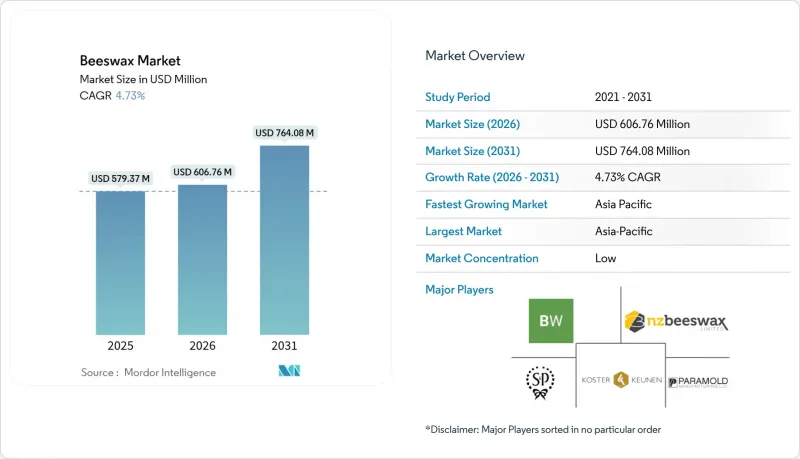
The market expansion is primarily driven by the increased adoption of beeswax in cosmetics formulations, pharmaceutical products, and natural food coatings, as manufacturers respond to evolving regulatory requirements for ingredient transparency. The Asia-Pacific region maintains its position as the dominant force in both production and consumption, with India's substantial contribution of one million kilograms per year. Meanwhile, established markets generate higher revenues through certified beeswax grades that satisfy stringent quality standards for residue limits and product authenticity. Although synthetic wax alternatives are emerging with benefits such as quality consistency and reduced contamination risks, natural beeswax continues to hold a strong market position due to its favorable regulatory status and widespread consumer acceptance, particularly in high-value product applications.
Global Beeswax Market Trends and Insights
Rising Demand for Natural/Organic Ingredients in Cosmetics and Personal Care
The cosmetics industry's fundamental transformation toward natural ingredients has elevated beeswax to a premium status as an emulsifier and texture enhancer, particularly benefiting lip care and protective barrier formulations. In response to market demands, major chemical suppliers have strengthened their natural ingredient portfolios, evidenced by Lubrizol's introduction of Carbopol BioSense and BASF's launch of Verdessense Maize as corn-derived film-formers. Beeswax brings significant value through its comprehensive functional properties, combining emulsification capabilities, film formation characteristics, and proven antimicrobial effectiveness against Staphylococcus aureus and Candida albicans. These attributes directly address formulators' growing requirements for ingredient consolidation while supporting clean-label initiatives. The regulatory framework further reinforces beeswax's market position, with FDA GRAS status (21 CFR 184.1973) and EU food additive approval (E-901) enabling manufacturers to incorporate it seamlessly across both cosmetics and food-contact applications.
Clean Beauty and Transparency Trends in Skincare/Cosmetics
The increasing consumer awareness and demand for ingredient transparency in personal care products has significantly enhanced beeswax's position in the market. As a natural component with well-documented safety records and centuries of traditional use, beeswax aligns perfectly with current consumer preferences. The clean beauty movement, which prioritizes biodegradable and non-toxic formulations, has created a substantial shift toward beeswax as manufacturers move away from petroleum-based alternatives. This transition has gained momentum as regulatory bodies implement stricter controls on synthetic polymers, particularly due to growing environmental concerns about microplastics. The market demonstrates clear price differentiation between cosmetic-grade beeswax, which commands USD 2.00 per ounce, and candle-grade beeswax at USD 1.25 per ounce, reflecting the stringent quality standards and purity requirements for cosmetic applications. Modern regulatory frameworks have evolved to mandate comprehensive ingredient disclosure and sustainability documentation, creating a favorable environment for established natural ingredients like beeswax, while new synthetic alternatives face lengthy and costly safety validation processes.
Fluctuations in Raw Material Supply Due to Environment/Weather
Climate-driven colony losses significantly impact the global beeswax supply chain, as evidenced by comprehensive studies from Latin America that reveal concerning annual colony mortality rates ranging from 16.2% in Mexico to 47.7% in Colombia. Multiple environmental challenges, including the ongoing loss of natural habitats, disruptions in seasonal flowering patterns, and the increasing frequency of extreme weather events, have substantially reduced both colony productivity and wax production capabilities. The process of wax production is particularly sensitive, as worker bees require precise environmental conditions during their critical 12-18 day wax-secretion phase. The Varroa destructor mite infestation continues to pose the most significant biological threat to colonies worldwide, with severe infestations dramatically decreasing both colony survival rates and wax accumulation. These supply uncertainties have created a market environment where premium prices are commanded for consistent, high-quality beeswax, consequently pushing manufacturers in price-sensitive industries toward synthetic alternatives. While regulatory bodies have increased their focus on supply chain transparency and resilience, the industry still lacks comprehensive quality standards compared to the well-established specifications in the honey market.
Other drivers and restraints analyzed in the detailed report include:
- Growing Use in Pharmaceuticals, Especially for Ointments and Salves
- Demand for Allergen-Free, Non-Toxic Food Additives/Coating Agents
- Stringent Global Regulations on Food and Pharma Ingredients
For complete list of drivers and restraints, kindly check the Table Of Contents.
Segment Analysis
Natural beeswax continues to dominate the market with an 84.65% share in 2025, as consumers increasingly gravitate toward natural and biodegradable ingredients. This market leadership is further reinforced by well-established regulatory approvals across multiple industries, including food, cosmetic, and pharmaceutical applications, where product safety and natural origin remain paramount considerations.
The synthetic wax segment demonstrates robust growth with a CAGR of 5.70%, primarily due to its ability to deliver consistent supply and contamination-free properties for sensitive applications. Fischer-Tropsch synthetic waxes, particularly notable in Sasol's product portfolio, offer enhanced thermal stability and adjustable melting points across paraffin, microcrystalline, and synthetic hard wax varieties. These products serve diverse industries from cosmetics to industrial coatings. The synthetic segment's independence from agricultural and climatic variables addresses the supply chain uncertainties that affect natural beeswax markets. Manufacturers of synthetic waxes can maintain precise composition control and ensure products free from pesticide residues, making them particularly valuable for pharmaceutical and food-contact applications where stringent purity standards must be met.
The Beewax Market Report is Segmented by Product Type (Natural, and Synthetic), Form (Blocks, Pellets / Pastilles, and Sheets / Beads), Application (Cosmetics, Pharmaceuticals, and Other Applications), and Geography (North America, Europe, Asia-Pacific, South America, and Middle East and Africa). The Market Forecasts are Provided in Terms of Value (USD).
Geography Analysis
The Asia-Pacific region currently commands the largest share of the global beeswax market, accounting for 37.84% in 2025. This dominance is primarily attributed to India's position as the world's largest producer, contributing 24.6 million kg annually to the global supply. China has emerged as a significant consumption market, although precise production figures remain unavailable. Japan's heavy reliance on imports, reflected in its mere 6% self-sufficiency in honey production, indicates substantial beeswax import requirements for various industrial applications.
The region's growth trajectory stands at an impressive 5.24% CAGR, outpacing all other geographical segments. This accelerated growth is supported by South Korea's substantial production capacity of 3.8 million kg, positioning it as the fifth-largest global producer. However, recent tariff pressures on Korean beauty exports to the US market have introduced new dynamics in the demand patterns for beeswax-containing cosmetic formulations, potentially influencing future growth rates.
In other regions, North America and Europe maintain their positions as mature markets, characterized by well-established regulatory frameworks and consumer willingness to pay premium prices for natural ingredients. The US market benefits from APHIS-approved refined beeswax export pathways to the EU, despite facing limitations on honeycomb imports and livestock feeding applications. European markets emphasize sustainability and contamination monitoring, with specific import protocols such as the UK's Category 3 material standards. South America contributes significantly through Argentina (5.0 million kg) and Brazil (1.8 million kg), though facing challenges from high colony loss rates ranging from 16.2% to 47.7%. Africa's production remains below its potential, contributing less than 25% of global beeswax output despite its rich beekeeping heritage, primarily due to technological and market access limitations.
- Koster Keunen Inc.
- Strahl & Pitsch Inc.
- British Wax Refining Co. Ltd.
- New Zealand Beeswax Ltd.
- Paramold Manufacturing LLC
- AADRA International
- Melland Ecogreen Technology Co., Ltd.
- Alfa Chemistry
- Beeswax Products Company LLC
- Beeswax-Store.com
- Roger A. Reed Inc.
- Poth Hille & Co. Ltd.
- Seidler Chemical Company
- Frank B. Ross Co. Inc.
- Taiwan San-Ei Oil Co., Ltd.
- Qian Xiao Beeswax Co., Ltd.
- Hase Petroleum Wax Co.
- Bioscope Sdn Bhd
- Tekwax Ltd.
- Thorne Corporation
Additional Benefits:
- The market estimate (ME) sheet in Excel format
- 3 months of analyst support
TABLE OF CONTENTS
1 INTRODUCTION
- 1.1 Study Assumptions and Market Definition
- 1.2 Scope of the Study
2 RESEARCH METHODOLOGY
3 EXECUTIVE SUMMARY
4 MARKET LANDSCAPE
- 4.1 Market Overview
- 4.2 Market Drivers
- 4.2.1 Rising demand for natural/organic ingredients in cosmetics and personal care
- 4.2.2 Clean beauty and transparency trends in skincare/cosmetics
- 4.2.3 Growing use in pharmaceuticals, especially for ointments and salves
- 4.2.4 Demand for allergen-free, non-toxic food additives/coating agents
- 4.2.5 Popularity of artisanal, hand-made, and heritage crafts.
- 4.2.6 Technological advancements in beeswax purification/processing
- 4.3 Market Restraints
- 4.3.1 Fluctuations in raw material supply due to environment/weather
- 4.3.2 Stringent global regulations on food and pharma ingredients
- 4.3.3 Pesticide contamination and residue risks in output
- 4.3.4 High labor and expertise requirements in beekeeping
- 4.4 Supply Chain Analysis
- 4.5 Regulatory Outlook
- 4.6 Porter's Five Forces
- 4.6.1 Threat of New Entrants
- 4.6.2 Bargaining Power of Buyers/Consumers
- 4.6.3 Bargaining Power of Suppliers
- 4.6.4 Threat of Substitute Products
- 4.6.5 Intensity of Competitive Rivalry
5 MARKET SIZE AND GROWTH FORECASTS (VALUE)
- 5.1 By Product Type
- 5.1.1 Natural
- 5.1.2 Synthetic
- 5.2 By Form
- 5.2.1 Blocks
- 5.2.2 Pellets / Pastilles
- 5.2.3 Sheets / Beads
- 5.3 By Application
- 5.3.1 Cosmetics
- 5.3.2 Pharmaceuticals
- 5.3.3 Other Applications
- 5.4 By Geography
- 5.4.1 North America
- 5.4.1.1 United States
- 5.4.1.2 Mexico
- 5.4.1.3 Rest of North America
- 5.4.2 Europe
- 5.4.2.1 Germany
- 5.4.2.2 United Kingdom
- 5.4.2.3 Italy
- 5.4.2.4 France
- 5.4.2.5 Rest of Europe
- 5.4.3 Asia-Pacific
- 5.4.3.1 China
- 5.4.3.2 India
- 5.4.3.3 Australia
- 5.4.3.4 Rest of Asia-Pacific
- 5.4.4 South America
- 5.4.4.1 Brazil
- 5.4.4.2 Argentina
- 5.4.4.3 Rest of South America
- 5.4.5 Middle East and Africa
- 5.4.5.1 South Africa
- 5.4.5.2 Saudi Arabia
- 5.4.5.3 Rest of Middle East and Africa
- 5.4.1 North America
6 COMPETITIVE LANDSCAPE
- 6.1 Market Concentration
- 6.2 Strategic Moves
- 6.3 Market Ranking Analysis
- 6.4 Company Profiles (includes Global-level Overview, Market-level Overview, Core Segments, Financials (if available), Strategic Information, Market Rank/Share, Products and Services, Recent Developments)
- 6.4.1 Koster Keunen Inc.
- 6.4.2 Strahl & Pitsch Inc.
- 6.4.3 British Wax Refining Co. Ltd.
- 6.4.4 New Zealand Beeswax Ltd.
- 6.4.5 Paramold Manufacturing LLC
- 6.4.6 AADRA International
- 6.4.7 Melland Ecogreen Technology Co., Ltd.
- 6.4.8 Alfa Chemistry
- 6.4.9 Beeswax Products Company LLC
- 6.4.10 Beeswax-Store.com
- 6.4.11 Roger A. Reed Inc.
- 6.4.12 Poth Hille & Co. Ltd.
- 6.4.13 Seidler Chemical Company
- 6.4.14 Frank B. Ross Co. Inc.
- 6.4.15 Taiwan San-Ei Oil Co., Ltd.
- 6.4.16 Qian Xiao Beeswax Co., Ltd.
- 6.4.17 Hase Petroleum Wax Co.
- 6.4.18 Bioscope Sdn Bhd
- 6.4.19 Tekwax Ltd.
- 6.4.20 Thorne Corporation
7 MARKET OPPORTUNITIES AND FUTURE OUTLOOK

