
PUBLISHER: Mordor Intelligence | PRODUCT CODE: 1940603

PUBLISHER: Mordor Intelligence | PRODUCT CODE: 1940603
United States Ice Cream - Market Share Analysis, Industry Trends & Statistics, Growth Forecasts (2026 - 2031)
The United States ice cream market was valued at USD 19.51 billion in 2025 and estimated to grow from USD 20.03 billion in 2026 to reach USD 22.84 billion by 2031, at a CAGR of 2.66% during the forecast period (2026-2031).
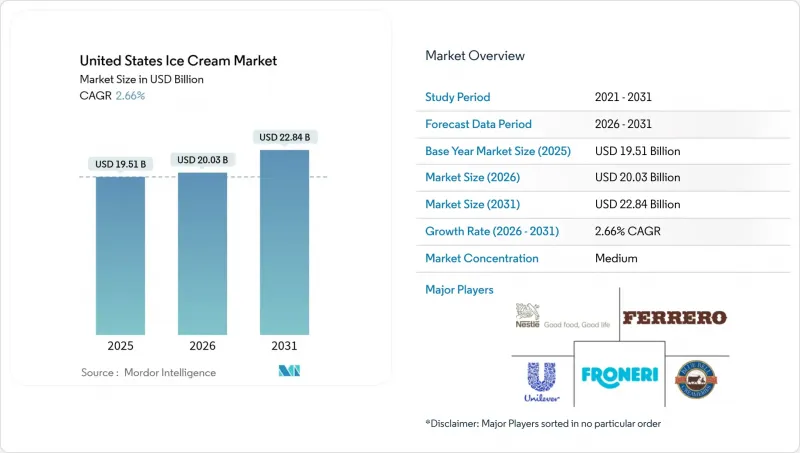
This growth highlights a mature yet resilient market, where premiumization continues to drive value growth despite the stabilization of overall volume. The market benefits from entrenched consumption habits, supported by the country's well-established cold-chain infrastructure and a plentiful domestic dairy supply, which collectively ensure consistent baseline demand. Additionally, the increasing popularity of premium artisanal ice cream, the expansion of plant-based innovations catering to evolving consumer preferences, and the adoption of technology-enabled distribution channels are creating new revenue opportunities. These factors collectively sustain the market's momentum and contribute to its long-term growth potential. Meanwhile, regulatory vigilance under 21 CFR 135.110 and ongoing input-cost volatility in dairy and sugar continue to shape strategic decisions across the value chain.
United States Ice Cream Market Trends and Insights
Growing demand for premium and artisanal ice cream
The growing demand for premium and artisanal ice cream is a significant driver of the United States ice cream market, supported by the country's high consumption levels. In 2024, United States ice cream producers churned out a remarkable 1.31 billion gallons, according to the International Dairy Foods Association, with the average American enjoying around 19 pounds or about 4 gallons of ice cream annually . This sustained enthusiasm for ice cream is increasingly shaped by consumers' preference for high-quality, indulgent, and unique flavor experiences. Shoppers are willing to pay a premium for products made with natural ingredients, minimal processing, and innovative recipes that emphasize craftsmanship and authenticity. Artisanal brands highlighting locally sourced dairy, small-batch production, and creative flavors are gaining popularity, while leading manufacturers are expanding their premium product offerings to capture this growing demand.
Innovation in exotic and unique flavors
Innovation in exotic and unique flavors is a key driver of the United States ice cream market, as consumers increasingly seek novelty and personalization in their dessert choices while still showing strong loyalty to classic favorites. According to a survey conducted by the International Dairy Foods Association, Vanilla, Chocolate, Strawberry, and Butter Pecan remain among the most preferred flavors in the country. At the same time, the survey highlights diverse topping preferences, with 35% of consumers favoring hot fudge, 29% choosing whipped cream, and 24% opting for caramel sauce . This balance between tradition and innovation is fueling market growth, as brands experiment with global-inspired tastes such as matcha, miso caramel, ube, and spicy-sweet combinations to satisfy adventurous palates. Manufacturers are also investing in research and development to launch limited-edition and seasonal offerings that enhance consumer engagement and brand loyalty. The push toward creative flavor experiences not only differentiates products in a competitive market but also supports premium positioning and repeat purchases across both retail and foodservice channels.
Health concerns over sugar and saturated fat content
Health concerns over sugar and saturated fat content act as a major restraint on the United States ice cream market, as consumers grow increasingly aware of the nutritional impact of traditional ice cream formulations. The scale of this health challenge is substantial, with the International Diabetes Federation reporting that 13.7% of adults in the United States are affected by diabetes as of 2024, translating to approximately 38,536,400 cases . Rising rates of obesity, diabetes, and cardiovascular diseases have motivated many Americans to reduce their intake of high-calorie, high-sugar, and high-fat foods, leading some to limit or substitute conventional ice cream consumption. Regulatory emphasis on nutritional labeling and public health campaigns further reinforce these behavioral shifts, pressuring manufacturers to reformulate products with healthier ingredients. Although indulgence remains a key purchase driver, the perception of ice cream as an occasional treat rather than a regular dessert continues to challenge market growth, particularly among health-conscious demographics seeking better dietary management.
Other drivers and restraints analyzed in the detailed report include:
- Expansion of healthier, low-sugar, and dairy-free options
- Effective marketing via digital channels and influencers
- Competition from alternative frozen desserts and snacks
For complete list of drivers and restraints, kindly check the Table Of Contents.
Segment Analysis
Impulse ice cream continues to dominate the United States ice cream market, accounting for a commanding 42.12% share in 2025. Its strong performance is driven by widespread availability across retail channels, from supermarkets to convenience stores, ensuring high accessibility for consumers. The segment's success is also supported by its alignment with on-the-go consumption habits, capturing both planned and spontaneous purchases. Major brands have strategically positioned impulse ice cream products through promotional tie-ins and seasonal flavor launches to sustain consumer interest. Additionally, single-serve packaging formats and expanding freezer presence in smaller retail outlets have reinforced its market penetration. This extensive distribution network and convenience-focused appeal have solidified impulse ice cream's position as the market leader, reflecting its ability to combine accessibility, affordability, and variety effectively.
The artisanal ice cream segment, on the other hand, represents the fastest-growing category, registering an impressive CAGR of 3.34%, far outpacing the overall market expansion. This growth is fueled by rising consumer preference for premium, small-batch products that emphasize craftsmanship and authentic ingredients. Artisanal brands leverage narratives around locally sourced dairy, handmade preparation, and unique flavor innovation to differentiate themselves from mass-market offerings. The trend toward indulgence with consciousness-balancing rich taste with clean labels and natural ingredients-has further attracted a niche but rapidly expanding consumer base. Premium pricing within this segment has not deterred demand; rather, it underscores consumers' willingness to pay more for perceived quality and exclusivity. As a result, the artisanal segment continues to reshape the competitive landscape, driving diversification and elevating value perception within the U.S. ice cream market.
The United States Ice Cream Market Report is Segmented by Product Type (Artisanal Ice Cream, Impulse Ice Cream, Take-Home Ice Cream), Category (Dairy, Non-Dairy), and Distribution Channel (On-Trade, Off-Trade). The Market Forecasts are Provided in Terms of Value (USD) and Volume (Units).
List of Companies Covered in this Report:
- Unilever PLC
- Ferrero International SpA
- Froneri International Ltd.
- Nestle S.A
- Blue Bell Creameries LP
- Turkey Hill Dairy
- Tillamook County Creamery Association
- Dairy Farmers of America Inc.
- Focus Brands LLC
- Van Leeuwen Ice Cream
- Gifford's Dairy Inc.
- Jeni's Splendid Ice Creams
- Van Leeuwen Ice Cream
- Giffords Dairy Inc.
- Alden's Organic Ice Cream
- Clover Sonoma
- Straus Family Creamery
- Stewart's Shops
- Braum's Ice Cream
- Perry's Ice Cream
Additional Benefits:
- The market estimate (ME) sheet in Excel format
- 3 months of analyst support
TABLE OF CONTENTS
1 INTRODUCTION
- 1.1 Study Assumptions and Market Definition
- 1.2 Scope of the Study
2 RESEARCH METHODOLOGY
3 EXECUTIVE SUMMARY
4 MARKET LANDSCAPE
- 4.1 Market Overview
- 4.2 Market Drivers
- 4.2.1 Growing demand for premium and artisanal ice cream
- 4.2.2 Innovation in exotic and unique flavors
- 4.2.3 Expansion of healthier, low-sugar, and dairy-free options
- 4.2.4 Effective marketing via digital channels and influencers
- 4.2.5 Surge in plant-based and vegan ice cream alternatives
- 4.2.6 Growing emphasis on eco-friendly and sustainable packaging
- 4.3 Market Restraints
- 4.3.1 Health concerns over sugar and saturated fat content
- 4.3.2 Competition from alternative frozen desserts and snacks
- 4.3.3 Volatile prices of key raw materials like dairy and sugar
- 4.3.4 Seasonal demand fluctuations affecting sales stability
- 4.4 Value/ Supply-Chain Analysis
- 4.5 Regulatory Landscape
- 4.6 Technological Outlook
- 4.7 Porter's Five Forces
- 4.7.1 Bargaining Power of Buyers/Consumers
- 4.7.2 Bargaining Power of Suppliers
- 4.7.3 Threat of New Entrants
- 4.7.4 Threat of Substitute Products
- 4.7.5 Intensity of Competitive Rivalry
5 MARKET SIZE AND GROWTH FORECASTS (VALUE AND VOLUME)
- 5.1 By Product Type
- 5.1.1 Artisanal Ice Cream
- 5.1.2 Impulse Ice Cream
- 5.1.3 Take-Home Ice Cream
- 5.2 By Category
- 5.2.1 Dairy
- 5.2.2 Non-Dairy (Plant-Based)
- 5.3 Distribution Channel
- 5.3.1 On-Trade
- 5.3.2 Off-Trade
- 5.3.2.1 Supermarkets/Hypermarkets
- 5.3.2.2 Specialist Retailers
- 5.3.2.3 Convenience Stores
- 5.3.2.4 Online Retail Stores
- 5.3.2.5 Other Distribution Channels
6 COMPETITIVE LANDSCAPE
- 6.1 Market Concentration
- 6.2 Strategic Moves
- 6.3 Market Share Analysis
- 6.4 Company Profiles (includes Global Overview, Market-level Overview, Core Segments, Financials, Strategic Information, Market Rank/Share, Products & Services, Recent Developments)
- 6.4.1 Unilever PLC
- 6.4.2 Ferrero International SpA
- 6.4.3 Froneri International Ltd.
- 6.4.4 Nestle S.A
- 6.4.5 Blue Bell Creameries LP
- 6.4.6 Turkey Hill Dairy
- 6.4.7 Tillamook County Creamery Association
- 6.4.8 Dairy Farmers of America Inc.
- 6.4.9 Focus Brands LLC
- 6.4.10 Van Leeuwen Ice Cream
- 6.4.11 Gifford's Dairy Inc.
- 6.4.12 Jeni's Splendid Ice Creams
- 6.4.13 Van Leeuwen Ice Cream
- 6.4.14 Giffords Dairy Inc.
- 6.4.15 Alden's Organic Ice Cream
- 6.4.16 Clover Sonoma
- 6.4.17 Straus Family Creamery
- 6.4.18 Stewart's Shops
- 6.4.19 Braum's Ice Cream
- 6.4.20 Perry's Ice Cream
7 MARKET OPPORTUNITIES AND FUTURE OUTLOOK

