
PUBLISHER: Mordor Intelligence | PRODUCT CODE: 1940883

PUBLISHER: Mordor Intelligence | PRODUCT CODE: 1940883
Africa Polyethylene Terephthalate (PET) - Market Share Analysis, Industry Trends & Statistics, Growth Forecasts (2026 - 2031)
Africa Polyethylene Terephthalate (PET) market size in 2026 is estimated at 644.17 kilotons, growing from 2025 value of 614.08 kilotons with 2031 projections showing 818.23 kilotons, growing at 4.9% CAGR over 2026-2031.
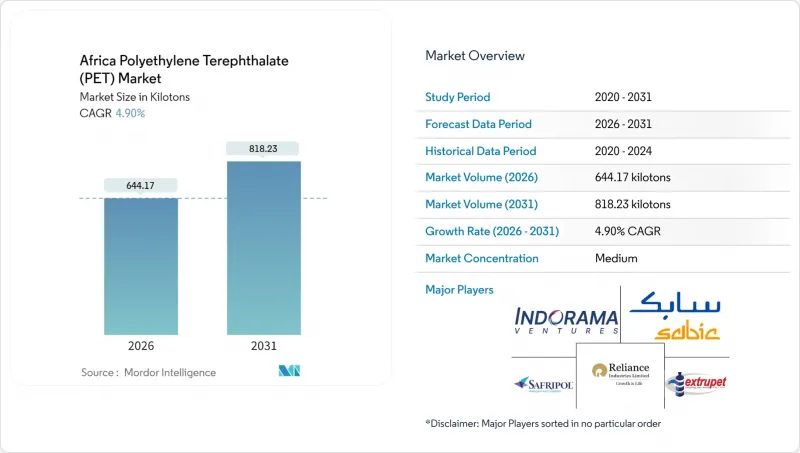
Sustained middle-class growth, tariff harmonization under the African Continental Free Trade Area (AfCFTA), and expanding local bottling capacity are the primary forces lifting demand. Brand owners favor PET for its clarity, strength-to-weight ratio, and familiarity in existing filling lines, while recycled grades gain momentum as producer responsibility rules tighten. Multinational fast-moving consumer goods (FMCG) players continue to build localized production hubs, shifting the supply balance away from imports and toward regional resin plants. Public-sector lending taps into circular economy objectives, directing large-scale blue-loans and green-bonds toward integrated collection and recycling infrastructure. Nonetheless, oil-linked feedstock swings and consumer interest in bio-based alternatives create strategic uncertainty that requires agile sourcing strategies and product innovation.
Africa Polyethylene Terephthalate (PET) Market Trends and Insights
Rising Beverage Consumption by the Region's Growing Middle Class
Rapid income gains across urban hubs propel demand for carbonated drinks, bottled water, and functional beverages. Coca-Cola HBC has earmarked USD 1 billion for Nigerian capacity additions, while Coca-Cola Beverages Africa opened a USD 50 million bottling line in Namibia in 2024. Higher throughput translates into larger off-take contracts for preforms and caps, locking in steady offtake for virgin resin. Growing consumption stresses underdeveloped waste systems, prompting cities such as Lagos and Accra to pilot deposit-return schemes funded by producer levies. Beverage converters respond by co-locating closure injection, stretch-blow, and filling lines, reducing freight cost and cutting lead times. Rising fill volumes compress per-unit packaging costs, preserving PET's price competitiveness against glass and aluminum.
Government Targets for Recycled-Content Packaging
Kenya's 2024 Extended Producer Responsibility (EPR) regulations impose KES 150 per imported item and require brand registration, creating explicit incentives for recycled content. South Africa's EPR framework, live since 2021, demands annual reporting on collected and processed volumes. Nigeria's regulator is drafting similar rules that will phase in minimum recycled content thresholds once infrastructure matures. PepsiCo Sub-Saharan Africa now targets 20% rPET inclusion across its beverage lines, setting an anchor for regional offtake contracts. Firms that certify higher rPET ratios gain shelf visibility advantages under emerging eco-labeling schemes. Effective enforcement, however, hinges on formalizing informal collectors and upgrading washing and solid-state polycondensation (SSP) units to food-grade standards.
Rising Consumer Shift to Bio-Based/Compostable Alternatives
Global food and beverage launches featuring bio-based packaging rose 60% annually between 2019 and 2024. European Union rules recognize certain biodegradable polymers as recyclable, creating a regulatory precedent that African policymakers may emulate. Brands test compostable coffee-capsules and starch-based pots, pressuring PET volumes in niche segments. Recycled PET often trades USD 150 per tonne above virgin, widening the motivation to test bio-based solutions if long-run cost parity can be achieved. Scaling biopolymer supply in Africa remains complex because feedstock logistics, specialized extrusion equipment, and industrial composting sites are still limited.
Other drivers and restraints analyzed in the detailed report include:
- Expansion of Local Bottling Capacity by Multinational FMCGs
- AfCFTA-Driven Tariff Alignment Lowering PET Import Costs
- Sub-Scale Collection Networks for rPET Feedstock
For complete list of drivers and restraints, kindly check the Table Of Contents.
Segment Analysis
Virgin PET secured 82.78% of the Africa Polyethylene Terephthalate (PET) market share in 2025 because converters prize its consistent intrinsic viscosity and broad food-grade approvals. The segment benefits from mature import corridors, duty concessions on raw materials, and plentiful preform conversion capacity. Bottle-to-bottle rPET remains supply-constrained as high-grade flake requires specialized hot-wash and SSP lines that only a handful of plants operate today.
Recycled PET is advancing at an 7.85% CAGR to 2031, propelled by EPR regulations and voluntary pledges from beverage majors that link executive remuneration to circular-packaging milestones. International Finance Corporation loans underwrite new wash lines and SSP debottlenecking, while chain-extension additives now restore intrinsic viscosity without compromising clarity. As these investments scale, the Africa Polyethylene Terephthalate (PET) market size for recycled grades could reach meaningful double-digit share by the end of the decade. Still, virgin resin will dominate until bale supply, regulatory coherence, and credit markets align to de-risk full-scale rPET integration.
The Africa Polyethylene Terephthalate (PET) Market Report is Segmented by Source Type (Virgin PET, Recycled PET), End-User Industry (Automotive, Building and Construction, Electrical and Electronics, Industrial and Machinery, Packaging, Other End-User Industries), and Geography (Nigeria, South Africa, Rest of Africa). The Market Forecasts are Provided in Terms of Volume (Tons) and Value (USD).
List of Companies Covered in this Report:
- Alpek S.A.B. de C.V.
- ALPLA
- Extrupet (Pty) Ltd.
- Far Eastern New Century Co., Ltd.
- Indorama Ventures Public Company Limited.
- Mohinani Group
- Mpact Group Limited
- PETCO
- Reliance Industries Limited
- SABIC
- Safripol Pty Ltd
- Sumilon Eco Pet Sarl
Additional Benefits:
- The market estimate (ME) sheet in Excel format
- 3 months of analyst support
TABLE OF CONTENTS
1 Introduction
- 1.1 Study Assumptions & Market Definition
- 1.2 Scope of the Study
2 Research Methodology
3 Executive Summary
4 Market Landscape
- 4.1 Market Overview
- 4.2 Market Drivers
- 4.2.1 Rising beverage consumption by the region's growing middle-class
- 4.2.2 Government targets for recycled-content packaging
- 4.2.3 Expansion of local bottling capacity by multinational FMCGs
- 4.2.4 AfCFTA-driven tariff alignment lowering PET import costs
- 4.2.5 Emerging DFI/IFC financing for PET recycling infrastructure
- 4.3 Market Restraints
- 4.3.1 Volatile crude-oil-linked feedstock prices
- 4.3.2 Rising consumer shift to bio-based/compostable alternatives
- 4.3.3 Sub-scale collection networks for rPET feedstock
- 4.4 Value Chain Analysis
- 4.5 Porter's Five Forces
- 4.5.1 Threat of New Entrants
- 4.5.2 Bargaining Power of Suppliers
- 4.5.3 Bargaining Power of Buyers
- 4.5.4 Threat of Substitutes
- 4.5.5 Competitive Rivalry
- 4.6 Import And Export Trends
- 4.7 Price Trends
- 4.8 Form Trends
- 4.9 Recycling Overview
- 4.10 Regulatory Framework
- 4.11 End-use Sector Trends
- 4.11.1 Aerospace (Aerospace Component Production Revenue)
- 4.11.2 Automotive (Automobile Production)
- 4.11.3 Building and Construction (New Construction Floor Area)
- 4.11.4 Electrical and Electronics (Electrical and Electronics Production Revenue)
- 4.11.5 Packaging(Plastic Packaging Volume)
5 Market Size & Growth Forecasts (Value and Volume)
- 5.1 By Source Type
- 5.1.1 Virgin PET
- 5.1.2 Recycled PET (rPET)
- 5.2 By End-User Industry
- 5.2.1 Automotive
- 5.2.2 Building and Construction
- 5.2.3 Electrical and Electronics
- 5.2.4 Industrial and Machinery
- 5.2.5 Packaging
- 5.2.6 Other End-user Industries
- 5.3 By Geography
- 5.3.1 Nigeria
- 5.3.2 South Africa
- 5.3.3 Rest of Africa
6 Competitive Landscape
- 6.1 Market Concentration
- 6.2 Strategic Moves
- 6.3 Market Share (%)**/Ranking Analysis
- 6.4 Company Profiles (includes Global level Overview, Market level overview, Core Segments, Financials, Strategic Information, Market Rank/Share for key companies, Products & Services, and Recent Developments)
- 6.4.1 Alpek S.A.B. de C.V.
- 6.4.2 ALPLA
- 6.4.3 Extrupet (Pty) Ltd.
- 6.4.4 Far Eastern New Century Co., Ltd.
- 6.4.5 Indorama Ventures Public Company Limited.
- 6.4.6 Mohinani Group
- 6.4.7 Mpact Group Limited
- 6.4.8 PETCO
- 6.4.9 Reliance Industries Limited
- 6.4.10 SABIC
- 6.4.11 Safripol Pty Ltd
- 6.4.12 Sumilon Eco Pet Sarl
7 Market Opportunities & Future Outlook
- 7.1 White-Space & Unmet-Need Assessment
8 Key Strategic Questions for CEOs

