
PUBLISHER: Mordor Intelligence | PRODUCT CODE: 2035021

PUBLISHER: Mordor Intelligence | PRODUCT CODE: 2035021
Japan OOH And DOOH - Market Share Analysis, Industry Trends & Statistics, Growth Forecasts (2026 - 2031)
The Japan OOH and DOOH market size was valued at USD 3.86 billion in 2025 and estimated to grow from USD 3.93 billion in 2026 to reach USD 4.28 billion by 2031, at a CAGR of 1.72% during the forecast period (2026-2031).
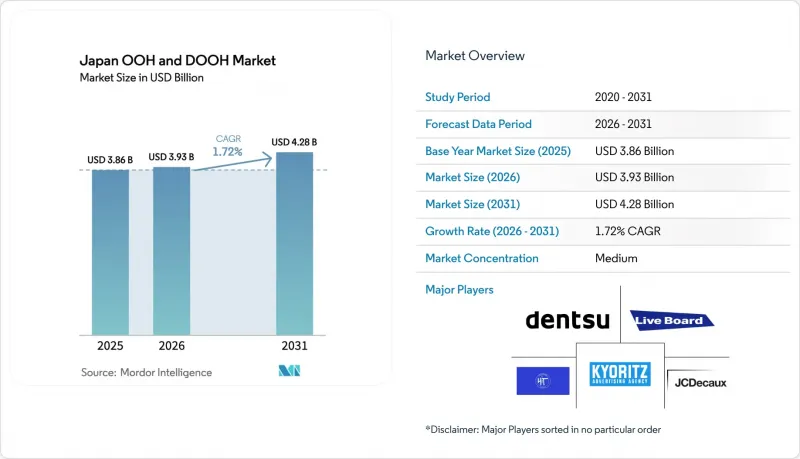
Static formats continue to supply volume, yet Digital OOH outperforms with a 4.47% CAGR, signaling a gradual share shift toward impression-based buying. Billboards command premium rents because high-visibility intersections such as Shibuya Crossing remain scarce, while the digital upgrade cycle ahead of the Tokyo 2025 World Expo accelerates screen deployments in Osaka's transit corridors. Rapid 5G rollout is converting location-based transactions to audience-based deals, letting buyers fuse telecom mobility data with programmatic platforms for near-real-time optimisation. Meanwhile, integration of retail media networks with outdoor screens creates omnichannel paths that join in-store first-party data with street-level impressions, lifting measurement precision. Market fragmentation persists top three vendors holding only 20% of inventory, so advertisers still juggle multiple owners to achieve national reach, yet software layers such as MASTRUM start to harmonise buying workflows.
Japan OOH And DOOH Market Trends and Insights
5G-enabled Programmatic Transaction Platforms Accelerating Media Buys
LIVE BOARD, the venture between NTT DOCOMO and Dentsu, delivers Japan's first impression-based Digital OOH exchange by combining anonymised mobile network data with screen playout logs. Its success pushes airport operators and municipal concessionaires to open inventory via openRTB pipes, cutting lead times from weeks to hours and aligning CPM quotes with dynamic audience swell. In April 2025, MCDecaux added 55 screens at Kansai and Osaka International Airports to its programmatic stack, signalling mainstream uptake across transport hubs. Buyers now routinely overlay telecom-verified foot-fall estimates on bid requests, raising effective reach while reducing waste. The capability also boosts accountability because advertisers receive unified post-campaign impression certificates tied to independent telecom counts. Together, these gains underpin the forecast uplift in the Japan OOH advertising market.
Tokyo 2025 World Expo Boosting Digital Street Furniture Expansion
From April 13 to October 13 2025 the Expo expects 28.2 million visitors, driving a fast rollout of weather-proof LCD totems and solar-powered LED shelters along rail lines linking Osaka Bay with Kansai suburbs.. Operators secure multiyear concessions that outlive the event, so the installed base of urban screens rises well beyond 2025. Brands booking Expo-era campaigns gain continuity because contracts extend into the legacy period when regional tourism and commuting patterns stay elevated. The Expo's "Living Lab" theme also provides a testbed for touch-free interfaces and AI-driven creative rotation, setting new benchmarks for contextual relevance. These factors combine to lift demand curves within the Japan OOH advertising market both during and after the event window.
Fragmented Ownership of Prime Urban Real Estate Elevating Installation Costs
With top three vendors holding only 20% inventory, agencies still face multi-party negotiations for even modest national roadmaps. The issue deepens in heritage neighborhoods where property plots are subdivided across family trusts, retailers and transport entities, lengthening lease cycles and raising entry costs. Automation layers such as MASTRUM reduce some friction yet cannot over-ride landowner consents, so screen roll-outs lag advertiser demand. Consequently, supply bottlenecks temper the projected expansion of the Japan OOH advertising market.
Other drivers and restraints analyzed in the detailed report include:
- Government Relaxation on Digital Billboard Regulation in Scenic Zones
- Retail Media Networks Extending to Outdoor Screens for Omnichannel Reach
- Rising Electricity Tariffs Eroding LED Board ROI
For complete list of drivers and restraints, kindly check the Table Of Contents.
Segment Analysis
Static formats contribute 62.68% of 2025 spend, underpinning broad visibility across commuter rail and municipal poster networks. Traditional posters cost less per play cycle and comply easily with local ordinances, so they remain a staple for FMCG launch bursts. Nevertheless, Digital OOH grows at 4.38% through 2031, driven by programmatic guarantees and rich-media storytelling. Programmatic already underwrites one-quarter of digital impressions, and telecom-data enrichment lifts yield. The Japan OOH advertising market size for digital screens will likely exceed USD 1.67 billion by 2031, reflecting the widening gap in growth paces. Static still posts modest upgrades, chiefly vinyl-to-paper substitutions that pare maintenance outlays, yet share will slip as advertisers chase trigger-based creatives and day-part optimisation.
Second-order signals reinforce the tilt. LIVE BOARD's NFT sale of a prime Aoyama facade validated alternative transaction models that resonate with digital asset investor.. Meanwhile, municipal tenders increasingly require sustainability metrics, where power-efficient LED packs score higher than paste-up steel frames. These forces keep digital on a compound trajectory and sustain headline growth inside the Japan OOH advertising market.
Japan OOH and DOOH Market Report is Segmented by Type (Static OOH, Digital OOH [Programmatic DOOH, Interactive OOH]), Application (Billboards, Transportation, and More), End-User Industry (Retail and Consumer Goods, Automotive, and More). The Market Forecasts are Provided in Terms of Value (USD).
List of Companies Covered in this Report:
- Dentsu Inc.
- MCDecaux (JCDecaux Group)
- LIVE BOARD Inc.
- Kyoritz Advertising Agency Co., Ltd.
- Hit Co., Ltd.
- Advertising Nagata Co., Ltd.
- Kesion Co., Ltd.
- Asahi Agency Inc.
- Fujikyuko OOH Media
- Tokyo Outdoor Advertising Co.
- Nishinippon Advertising Co.
- Hivestack Japan K.K.
- Moving Walls Pte Ltd
- One Day Agency (1D Agency Ltd)
- ASIAPAC Net Media Ltd
- United Screen Co.
- Pats Inc.
- Seiko Advance Ltd.
- Panasonic System Solutions Japan
- Sony Professional Solutions Japan
Additional Benefits:
- The market estimate (ME) sheet in Excel format
- 3 months of analyst support
TABLE OF CONTENTS
1 INTRODUCTION
- 1.1 Study Assumptions and Market Definition
- 1.2 Scope of the Study
2 RESEARCH METHODOLOGY
3 EXECUTIVE SUMMARY
4 MARKET LANDSCAPE
- 4.1 Market Overview
- 4.2 Market Drivers
- 4.2.1 5G-enabled Programmatic Transaction Platforms Accelerating Media Buys
- 4.2.2 Tokyo 2025 World Expo Boosting Digital Street Furniture Expansion
- 4.2.3 Government Relaxation on Digital Billboard Regulation in Scenic Zones
- 4.2.4 Retail Media Networks Extending to Outdoor Screens for Omnichannel Reach
- 4.3 Market Restraints
- 4.3.1 Fragmented Ownership of Prime Urban Real Estate Elevating Installation Costs
- 4.3.2 Rising Electricity Tariffs Eroding LED Board ROI
- 4.4 Regulatory Outlook
- 4.5 Technological Outlook
- 4.5.1 Audience Measurement and Analytics Platforms
- 4.5.2 Dynamic Creative Optimization Engines
- 4.6 Porter's Five Forces Analysis
- 4.6.1 Bargaining Power of Suppliers
- 4.6.2 Bargaining Power of Buyers/Advertisers
- 4.6.3 Threat of New Entrants
- 4.6.4 Threat of Substitutes
- 4.6.5 Intensity of Competitive Rivalry
- 4.7 Industry Ecosystem Analysis
- 4.8 Key Technological Innovations
- 4.8.1 Computer-Vision Based Impression Counting
- 4.8.2 Real-time Inventory Availability Dashboards
- 4.9 Key Case Studies of OOH and DOOH Campaigns in Japan
- 4.10 Positioning of OOH and DOOH Spend Versus Other Advertising Formats
5 MARKET SIZE AND GROWTH FORECASTS (VALUE)
- 5.1 By Type
- 5.1.1 Static OOH
- 5.1.2 Digital OOH
- 5.1.2.1 Programmatic OOH
- 5.1.2.2 Other Digital OOH Types
- 5.2 By Application
- 5.2.1 Billboard
- 5.2.2 Transportation
- 5.2.2.1 Airports
- 5.2.2.2 Other Transportation
- 5.2.3 Street Furniture
- 5.2.4 Other Place-Based Media
- 5.3 By End-user Industry
- 5.3.1 Automotive
- 5.3.2 Retail and Consumer Goods
- 5.3.3 Healthcare
- 5.3.4 Banking, Financial Services and Insurance (BFSI)
- 5.3.5 Entertainment and Media
- 5.3.6 Other End-user Industries
6 COMPETITIVE LANDSCAPE
- 6.1 Strategic Developments
- 6.2 Company Profiles (includes Global Level Overview, Market Level Overview, Core Segments, Financials as available, Strategic Information, Products and Services, Recent Developments)
- 6.2.1 Dentsu Inc.
- 6.2.2 MCDecaux (JCDecaux Group)
- 6.2.3 LIVE BOARD Inc.
- 6.2.4 Kyoritz Advertising Agency Co., Ltd.
- 6.2.5 Hit Co., Ltd.
- 6.2.6 Advertising Nagata Co., Ltd.
- 6.2.7 Kesion Co., Ltd.
- 6.2.8 Asahi Agency Inc.
- 6.2.9 Fujikyuko OOH Media
- 6.2.10 Tokyo Outdoor Advertising Co.
- 6.2.11 Nishinippon Advertising Co.
- 6.2.12 Hivestack Japan K.K.
- 6.2.13 Moving Walls Pte Ltd
- 6.2.14 One Day Agency (1D Agency Ltd)
- 6.2.15 ASIAPAC Net Media Ltd
- 6.2.16 United Screen Co.
- 6.2.17 Pats Inc.
- 6.2.18 Seiko Advance Ltd.
- 6.2.19 Panasonic System Solutions Japan
- 6.2.20 Sony Professional Solutions Japan
7 MARKET OPPORTUNITIES AND FUTURE OUTLOOK
- 7.1 White-Space and Unmet-Need Assessment

