
PUBLISHER: Mordor Intelligence | PRODUCT CODE: 2035111

PUBLISHER: Mordor Intelligence | PRODUCT CODE: 2035111
Japan Home Textile - Market Share Analysis, Industry Trends & Statistics, Growth Forecasts (2026 - 2031)
The Japan home textile market size was valued at USD 8.87 billion in 2025 and estimated to grow from USD 9.01 billion in 2026 to reach USD 9.74 billion by 2031, at a CAGR of 1.56% during the forecast period (2026-2031).
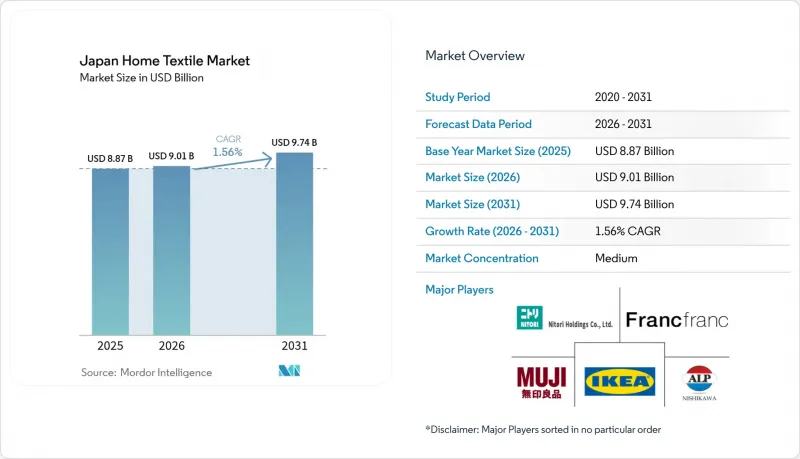
This growth path mirrors a mature consumer landscape where premiumization offsets low replacement rates, demographic aging fuels comfort-centric purchasing, and sustainability concerns nudge fiber choices toward bamboo blends and recycled synthetics. Single-person households, especially in Tokyo, accelerate demand for compact, multifunctional products, while retirees seek easy-care items that minimize physical effort. E-commerce penetration exceeding 31% for household goods introduces new competitive dynamics, with Korean and European brands challenging domestic incumbents . At the same time, tourism recovery revives commercial orders from hotels upgrading linens to differentiate guest experience. Government energy-efficiency subsidies and green-textile grants cushion manufacturers against raw-material volatility and encourage innovation in circular solutions.
Japan Home Textile Market Trends and Insights
Rising Urban Single-Person Households Drive Compact Living Solutions
Single-person households are projected to surpass 23.3 million by 2050, accounting for 44.3% of national households . In Tokyo, the ratio is expected to top 54%, prompting a decisive swing toward space-saving bedding, towels, and modular upholstery that fit micro-apartments. Search interest in single-seat sofas jumped 248% year over year, underscoring the appetite for compact upholstered items. Retailers now promote foldable futons, washable slipcovers, and storage-integrated cushions that amplify functionality per square meter. Uptake skews highest in dense metro areas, whereas rural consumers continue to prefer full-size formats. As the average household size falls toward 2.21 persons, the Japan home textile market benefits from steady demand for products scaled to smaller living environments.
Premiumization Transforms Bed and Bath Categories Through Wellness Positioning
Consumer willingness to pay for better sleep has multiplied bedding sales on major platforms 6.4-fold since 2019. Seniors' report heightened cold sensitivity, making thermal-regulating fabrics attractive. Nishikawa's MuAtsu mattresses, marketed with 30-year durability claims, grew shipments 123% year on year after a celebrity campaign . Nitori's SH01 long-pile towel line sold 2 million units within 18 months by combining premium absorbency with midrange pricing. Functional value now outweighs traditional luxury signals, and antimicrobial, quick-drying bath textiles command widening premiums as hygiene considerations linger post-pandemic.
Market Saturation Constrains Volume Growth Despite Value Expansion
Japan's home textile market experiences modest growth due to long replacement cycles and a strong consumer focus on durability. Fukui, known for its high per-capita orders of technical textiles, still faces limited volume growth. Manufacturers are addressing these challenges by introducing adjacent product lines and improving product functionalities. However, premiumization efforts are insufficient to fully counteract the decline in household formations. Bedding illustrates this issue, as high-quality sets designed to last for decades reduce the frequency of replacements. Although average ticket values are increasing, the extended lifespan of these products limits overall market growth.
Other drivers and restraints analyzed in the detailed report include:
- E-Commerce Expansion Accelerates Through Platform Diversification and Mobile Adoption
- Hospitality Recovery Stimulates Commercial Textile Demand and Innovation
- Raw Material Price Volatility Pressures Margins and Supply-Chain Stability
For complete list of drivers and restraints, kindly check the Table Of Contents.
Segment Analysis
Bed linen led the Japan home textile market with a 43.21% share in 2025. The segment benefits from demographic aging, humid summers, and wellness awareness that promote cooling, antimicrobial, and moisture-wicking fabrics. Nitori's N-Cool series illustrates how contact-cooling technology secures repeat purchases even in a saturated bedding field. Functional advances justify price premiums and compensate for longer replacement cycles. Bath linen remains the second-largest category, leveraging Japan's bathing culture and tourism revival. Kitchen linen holds stable through stain-resistant coatings, while upholstery's 7.41% CAGR is tied to compact living trends and the need for modular seating in single-person dwellings.
Demand nuances differ by region. Kyoto's hospitality sector drives exceptional towel volumes, whereas rural prefectures maintain demand for full-size futons and floor cushions. Upholstery uptake is fastest in new urban apartments where floor space averages below 40 square meters, spurring interest in stain-guarded, easy-wash slipcovers. Kitchen linen innovation focuses on heat-resistant mitts and antibacterial dishcloths that fit smaller kitchens. Carpets and rugs decline as modern flooring gains share, but niche growth persists for lightweight portable rugs suited to tatami conversions.
Cotton secured a 50.88% share of the Japan home textile market in 2025. Consumers favor natural hand feel, but price swings and water-use concerns accelerate the shift toward blends. Bamboo and other cellulosic materials, the fastest-growing material cohort at 7.89% CAGR, attract buyers with antimicrobial and moisture-management traits without sacrificing softness. Synthetic fibers retain relevance for durability and easy care; initiatives such as the 2025 Recycled Polyester Challenge target 45% recycled content, prompting domestic mills to trial bottle-to-fiber conversions.
Linen stays premium despite supply constraints, used in high-ticket bedding and decorative cushion covers. Wool gains renewed attention after Nippon Keori's AXIO yarn demonstrated superior odor control in performance blankets. Silk re-enters mainstream discussion through washable variants like Nishikawa's Newmine collection that pairs moisture retention with beauty-sleep positioning. Across categories, circular-economy principles guide R&D toward fiber recovery and low-impact dyeing.
The Japan Home Textile Market Report is Segmented by Application (Bed Linen, Bath Linen, Kitchen Linen, Upholstery, Others), Material (Cotton, Linen, Synthetic Fibers, Other Materials), End-User (Residential, Commercial), Distribution Channel (Offline, Online), and Geography (Hokkaido, Tohoku, Kanto, Chubu, Kansai, Chugoku, Shikoku, Kyushu & Okinawa). The Market Forecasts are Provided in Terms of Value (USD).
List of Companies Covered in this Report:
- Nitori Holdings Co., Ltd.
- Nishikawa Co., Ltd.
- Ryohin Keikaku Co., Ltd. (MUJI)
- IKEA Japan K.K.
- Francfranc Corporation
- Aeon Retail Co., Ltd. (Home Coordy)
- Uchino Co., Ltd.
- Toray Industries, Inc.
- Teijin Frontier Co., Ltd.
- Ito-Yokado Co., Ltd.
- Isetan Mitsukoshi Holdings Ltd.
- Takashimaya Co., Ltd.
- Seiyu GK
- Senshukai Co., Ltd. (Belle Maison)
- Maruhachi Mawata Co., Ltd.
- LIXIL Corporation
- WestPoint Home LLC
- Welspun Living Ltd.
- Sunvim Group Co., Ltd.
- Kingsway Home Fashion International Ltd.
Additional Benefits:
- The market estimate (ME) sheet in Excel format
- 3 months of analyst support
TABLE OF CONTENTS
1 Introduction
- 1.1 Study Assumptions and Market Definition
- 1.2 Scope of the Study
2 Research Methodology
3 Executive Summary
4 Market Landscape
- 4.1 Market Overview
- 4.2 Market Drivers
- 4.2.1 Rising urban single-person households
- 4.2.2 Premiumization of bed and bath linen
- 4.2.3 Expansion of home-decor e-commerce
- 4.2.4 Hospitality rebound post-COVID
- 4.2.5 Govt green-textile subsidies
- 4.2.6 Smart-fabric sleep-health demand
- 4.3 Market Restraints
- 4.3.1 Market saturation and slow volume growth
- 4.3.2 Cotton-price volatility
- 4.3.3 Costly circular-economy compliance
- 4.3.4 Skilled labor shortage in weaving
- 4.4 Value / Supply-Chain Analysis
- 4.5 Regulatory Landscape
- 4.6 Technological Outlook
- 4.7 Porter's Five Forces
- 4.7.1 Threat of New Entrants
- 4.7.2 Bargaining Power of Suppliers
- 4.7.3 Bargaining Power of Buyers
- 4.7.4 Threat of Substitutes
- 4.7.5 Competitive Rivalry
5 Market Size and Growth Forecasts
- 5.1 By Application
- 5.1.1 Bed Linen
- 5.1.2 Bath Linen
- 5.1.3 Kitchen Linen
- 5.1.4 Upholstery
- 5.1.5 Others (Carpets and Area Rugs)
- 5.2 By Material
- 5.2.1 Cotton
- 5.2.2 Linen
- 5.2.3 Synthetic Fibers
- 5.2.4 Other Materials (Wool, Hemp, Silk, Jute, Bamboo etc.)
- 5.3 By End-User
- 5.3.1 Residential
- 5.3.2 Commercial
- 5.4 By Distribution Channel
- 5.4.1 Offline
- 5.4.2 Online
- 5.5 By Geography
- 5.5.1 Hokkaido
- 5.5.2 Tohoku
- 5.5.3 Kanto
- 5.5.4 Chubu
- 5.5.5 Kansai
- 5.5.6 Chugoku
- 5.5.7 Shikoku
- 5.5.8 Kyushu and Okinawa
6 Competitive Landscape
- 6.1 Market Concentration
- 6.2 Strategic Moves
- 6.3 Market Share Analysis
- 6.4 Company Profiles (includes Global level Overview, Market level overview, Core Segments, Financials as available, Strategic Information, Market Rank/Share for key companies, Products and Services, and Recent Developments)
- 6.4.1 Nitori Holdings Co., Ltd.
- 6.4.2 Nishikawa Co., Ltd.
- 6.4.3 Ryohin Keikaku Co., Ltd. (MUJI)
- 6.4.4 IKEA Japan K.K.
- 6.4.5 Francfranc Corporation
- 6.4.6 Aeon Retail Co., Ltd. (Home Coordy)
- 6.4.7 Uchino Co., Ltd.
- 6.4.8 Toray Industries, Inc.
- 6.4.9 Teijin Frontier Co., Ltd.
- 6.4.10 Ito-Yokado Co., Ltd.
- 6.4.11 Isetan Mitsukoshi Holdings Ltd.
- 6.4.12 Takashimaya Co., Ltd.
- 6.4.13 Seiyu GK
- 6.4.14 Senshukai Co., Ltd. (Belle Maison)
- 6.4.15 Maruhachi Mawata Co., Ltd.
- 6.4.16 LIXIL Corporation
- 6.4.17 WestPoint Home LLC
- 6.4.18 Welspun Living Ltd.
- 6.4.19 Sunvim Group Co., Ltd.
- 6.4.20 Kingsway Home Fashion International Ltd.
7 Market Opportunities and Future Outlook
- 7.1 Closed-loop polyester-textile recycling ahead of 2030 circularity targets
- 7.2 Antimicrobial and thermo-regulating bedding for elderly care facilities

