
PUBLISHER: Mordor Intelligence | PRODUCT CODE: 2035137

PUBLISHER: Mordor Intelligence | PRODUCT CODE: 2035137
Japan Container Glass - Market Share Analysis, Industry Trends & Statistics, Growth Forecasts (2026 - 2031)
The Japan Container Glass Market size is expected to grow from 1.43 million tonnes in 2025 to 1.46 million tonnes in 2026 and is forecast to reach 1.65 million tonnes by 2031 at 2.37% CAGR over 2026-2031.
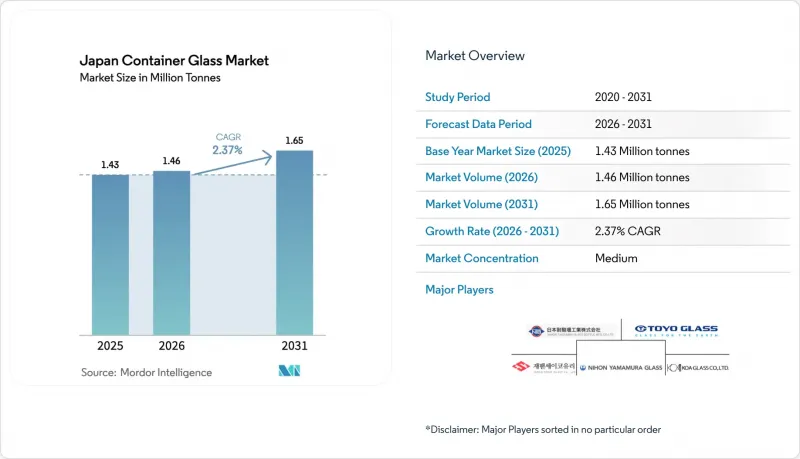
Healthy volumes continue despite intense competition from lightweight polymers because glass delivers premium shelf appeal, meets stringent pharmaceutical quality norms, and aligns with Japan's circular-economy policies. Premium alcoholic beverages and export-oriented brewers retain glass for brand authenticity, while regulatory scrutiny of per- and polyfluoroalkyl substances (PFAS) shifts some food-contact applications back toward glass. Manufacturers counter energy cost pressures through furnace electrification, hydrogen fuel trials, and lightweight bottle designs, which collectively stabilize margins. Meanwhile, a well-established glass-to-glass recycling loop supplies high-grade cullet that cushions raw-material inflation and supports national waste-reduction targets.
Japan Container Glass Market Trends and Insights
Environmental Sustainability and Regulatory Support
Japan's glass producers benefit from a policy mix that elevates glass as the most circular rigid-packaging substrate. The Glass Bottle Recycling Mark scheme grows cullet recovery rates, and emerging PFAS controls accentuate glass's inert nature in food contact settings. Nationwide waste-reduction targets encourage retailers to specify minimum recycled-content thresholds that glass can meet without quality loss. Energy-conservation mandates also incentivize furnace-rebuild projects that integrate electrical boosting, which cuts overall fuel intensity and unlocks carbon-price credits. Public sentiment favors plastic-waste reduction, creating an enduring demand pull that cushions the Japan Container Glass market against polymer substitution in sensitive categories.
Premium Branding and Product Differentiation
Brand owners leverage the tactile and visual cues of glass to justify premium shelf prices. Craft soft-drink maker Hata Kosen revived its all-glass Ramune bottle after a 30-year hiatus, capitalizing on nostalgia and sensory ritual to command case prices of JPY 7,776 (USD 53.7). In cosmetics, small-batch glass jars enable intricate embossing and color-spray effects that mass-market plastics cannot replicate at low volumes. Breweries maintain heavy glass formats for flagship beers abroad because exporters note a direct link between glass bottling and perceived authenticity. The design latitude benefits specialty converters that offer limited-run, high-margin orders, supporting a bifurcated competitive landscape.
High Energy and Production Costs
Fuel and electricity account for more than one-third of furnace operating expenses. Natural-gas import prices spiked after 2022, and a weak yen inflated soda-ash and additive costs, compressing margins for commodity bottle lines. Furnace rebuilds that integrate oxy-fuel or electric-boosting technology demand capex outlays that can reach USD 400 million, prolonging payback horizons. Although some producers test hydrogen blends, supply-chain scale remains limited, and carbon-price offsets have yet to fully compensate higher fuel bills. These dynamics weigh on near-term profitability and could slow capacity additions within the Japan Container Glass market.
Other drivers and restraints analyzed in the detailed report include:
- Robust Growth in Beverage and Alcoholic Drink Segments
- Rising Demand in Pharmaceuticals and Personal Care
- Intense Competition from Substitute Packaging Materials
For complete list of drivers and restraints, kindly check the Table Of Contents.
Segment Analysis
The beverages domain occupied 59.02% of the Japan Container Glass market share in 2025, illustrating how entrenched drinking rituals and export ambitions underpin bulk volumes. Alcoholic brands continue to favor glass for flavor neutrality and premium heft, while ready-to-drink cocktails and craft sodas adopt custom bottles that amplify visual storytelling. Non-alcoholic mainstream lines have partly migrated to PET, yet smaller artisanal players counterbalance this slide by choosing glass to convey heritage and authenticity. Pharmaceutical demand remains steady because injectable drugs and vita-liquids require inert, impermeable primary containers. Cosmetics and personal care advance at a 3.18% CAGR, propelled by consumer willingness to pay for refillable glass jars that enhance bathroom aesthetics and reduce plastic waste. Food applications are split between premium condiments, where transparency reinforces quality cues, and commodity sauces that lean on plastic to save on transport costs. Perfumery, although niche, adds high-margin tonnage because brand owners demand complex shapes and color effects that only glass can sustain.
Continued beverage dominance ensures base-load furnace utilization, yet margin growth shifts toward specialty segments. Cosmetics formulators increasingly specify color-spray coatings, electroplated finishes, and low-profile neck finishes that smaller converters can deliver with agile tooling. Pharmaceutical suppliers uphold top-tier clean-room standards and hero products such as Type I borosilicate vials, which carry price premiums over standard soda-lime bottles. Export-oriented brewers and sake producers blend traditional bottle silhouettes with lightweight structures, showing that even volume-centric categories aim for material reduction. The Japan Container Glass market therefore evolves from a single-segment powerhouse toward a diversified demand portfolio that balances volume stability with premium revenue streams.
The Japan Container Glass Market Report is Segmented by End-User (Beverages [Alcoholic {Beer, Wine, Spirits, Other Alcoholic Beverages}, and Non-Alcoholic {CSDs, Dairy Product Based Drinks, and More}], Food [Jam and Jelly, and More], Cosmetics and Personal Care, Pharmaceuticals, and Perfumery), Color (Green, Amber, Flint, and Other Colors), and Geography (Japan). The Market Forecasts are Provided in Terms of Volume (Tonnes).
List of Companies Covered in this Report:
- Toyo Glass Co., Ltd. (Part of Toyo Seikan Group Holdings Ltd)
- Nihon Yamamura Glass Co., Ltd.
- Japan Seiko Glass Co., Ltd.
- KOA Glass Co., Ltd.
- Ishizuka Glass Co., Ltd.
- Nipro Corporation
- Nihon Taisanbin Glass Bottle MFG Co., Ltd.
- Okubo Glass Co., Ltd.
- DAI-ICHI GLASS CO., LTD.
- DAISHO GLASS Co., Ltd.
- Takemoto Yohki Co., Ltd.
Additional Benefits:
- The market estimate (ME) sheet in Excel format
- 3 months of analyst support
TABLE OF CONTENTS
1 INTRODUCTION
- 1.1 Study Assumptions and Market Definition
- 1.2 Scope of the Study
2 RESEARCH METHODOLOGY
3 EXECUTIVE SUMMARY
4 MARKET LANDSCAPE
- 4.1 Market Overview
- 4.2 Market Drivers
- 4.2.1 Environmental Sustainability and Regulatory Support
- 4.2.2 Premium Branding and Product Differentiation
- 4.2.3 Robust Growth in Beverage and Alcoholic Drink Segments
- 4.2.4 Rising Demand in Pharmaceuticals and Personal Care
- 4.2.5 Technological Advancements in Glass Manufacturing
- 4.3 Market Restraints
- 4.3.1 High Energy and Production Costs
- 4.3.2 Intense Competition from Substitute Packaging Materials
- 4.3.3 Fragility and Risk of Breakage During Handling and Transport
- 4.3.4 Supply Chain Vulnerabilities and Raw Material Constraints
- 4.4 PESTEL Analysis
- 4.5 Industry Value Chain Analysis
- 4.6 Container Glass Furnace Capacity and Locations in Japan
- 4.6.1 Plant Locations and Year of Commencement
- 4.6.2 Production Capacities
- 4.6.3 Types of Furnaces
- 4.6.4 Color of Glass Produced
- 4.7 Export-Import Data of Container Glass - Covering Key Import and Export Destinations
- 4.7.1 Import Volume and Value, 2021-2024
- 4.7.2 Export Volume and Value, 2021-2024
- 4.8 Porter's Five Forces Analysis
- 4.8.1 Threat of New Entrants
- 4.8.2 Bargaining Power of Suppliers
- 4.8.3 Bargaining Power of Buyers
- 4.8.4 Threat of Substitutes
- 4.8.5 Competitive Rivalry
- 4.9 Raw Material Analysis
- 4.10 Recycling Trends for Glass Packaging
- 4.11 Demand vs Supply Analysis for Glass Packaging
5 MARKET SIZE AND GROWTH FORECASTS (VOLUME)
- 5.1 By End-user
- 5.1.1 Beverages
- 5.1.1.1 Alcoholic
- 5.1.1.1.1 Beer
- 5.1.1.1.2 Wine
- 5.1.1.1.3 Spirits
- 5.1.1.1.4 Other Alcoholic Beverages (Cider and Other Fermented Drinks)
- 5.1.1.2 Non-Alcoholic
- 5.1.1.2.1 Juices
- 5.1.1.2.2 Carbonated Drinks (CSDs)
- 5.1.1.2.3 Dairy Product Based Drinks
- 5.1.1.2.4 Other Non-Alcoholic Beverages
- 5.1.1.1 Alcoholic
- 5.1.2 Food (Jam, Jelly, Marmalades, Honey, Sausages and Condiments, Oil, Pickles)
- 5.1.3 Cosmetics and Personal Care
- 5.1.4 Pharmaceuticals (excluding Vials and Ampoules)
- 5.1.5 Perfumery
- 5.1.1 Beverages
- 5.2 By Color
- 5.2.1 Green
- 5.2.2 Amber
- 5.2.3 Flint
- 5.2.4 Other Colors
6 COMPETITIVE LANDSCAPE
- 6.1 Market Concentration
- 6.2 Strategic Moves and Developments
- 6.3 Company Market Share Analysis, (Based on Latest Production Capacity)
- 6.4 Company Profiles (includes Global level Overview, Market level overview, Core Segments, Financials as available, Strategic Information, Market Rank/Share for key companies, Products and Services, and Recent Developments)
- 6.4.1 Toyo Glass Co., Ltd. (Part of Toyo Seikan Group Holdings Ltd)
- 6.4.2 Nihon Yamamura Glass Co., Ltd.
- 6.4.3 Japan Seiko Glass Co., Ltd.
- 6.4.4 KOA Glass Co., Ltd.
- 6.4.5 Ishizuka Glass Co., Ltd.
- 6.4.6 Nipro Corporation
- 6.4.7 Nihon Taisanbin Glass Bottle MFG Co., Ltd.
- 6.4.8 Okubo Glass Co., Ltd.
- 6.4.9 DAI-ICHI GLASS CO., LTD.
- 6.4.10 DAISHO GLASS Co., Ltd.
- 6.4.11 Takemoto Yohki Co., Ltd.
7 MARKET OPPORTUNITIES AND FUTURE OUTLOOK
- 7.1 White-space and Unmet-Need Assessment

