PUBLISHER: Mordor Intelligence | PRODUCT CODE: 2043914

PUBLISHER: Mordor Intelligence | PRODUCT CODE: 2043914
US Facade - Market Share Analysis, Industry Trends & Statistics, Growth Forecasts (2026 - 2031)
The US Facade Market size is projected to be USD 45.10 billion in 2025, USD 47.47 billion in 2026, and reach USD 61.30 billion by 2031, growing at a CAGR of 5.25% from 2026 to 2031.
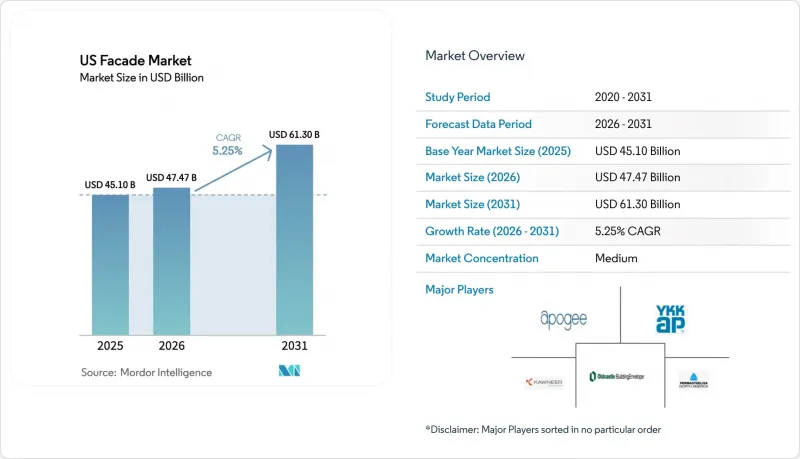
Three structural shifts propel this expansion, including the rebound in non-residential construction after pandemic-era delays, the nationwide roll-out of stricter 2024 International Energy Conservation Code (IECC) and ASHRAE 90.1-2022 building-envelope standards, and a wave of hyperscale data-center investments requiring specialized blast-resistant and thermally efficient assemblies.Together, these forces boost demand for high-performance curtain walls, ventilated rainscreen cladding, and low-carbon aluminum framing. At the regional level, the South accounted for 35.32% of the US facade market in 2025, while the West is projected to be the fastest-growing region at 5.46% CAGR through 2031, aided by California's Buy Clean Act and seismic mandates. Commercial end-users dominated with 67.65% of demand in 2025 as office-tower modernizations and data-center campuses accelerated orders for unitized systems that cut on-site labor by 25-30%.
US Facade Market Trends and Insights
Rebound in Non-Residential Construction Increases Demand for Advanced Facade Systems
Design billings strengthened throughout 2025, with the AIA Index averaging 51.2, foreshadowing a sustained pipeline of office towers and mixed-use projects across Sunbelt metros. Developers favor unitized curtain-wall assemblies that cut installation time by up to 30%, helping contain labor costs amid skilled-trade shortages. Class A+ buildings now routinely target LEED Platinum or WELL certification, which encourages facade U-factors below 0.30 and visible-light transmittance above 40%. A marquee example is the 1.1 million-sq-ft Pioneer Natural Resources headquarters in Irving, Texas, clad with 3,000 high-performance curtain-wall units featuring Viracon glass that delivers 44% VLT and 0.26 SHGC. Taken together, these projects amplify orders for thermally broken framing, low-e insulated glass, and robust anchorage systems. The trend is expected to continue through 2027 as developers race to future-proof assets against tightening energy benchmarks.
Stricter IECC and ASHRAE 90.1 Building-Envelope Codes Drive High-Performance Facade Adoption
The 2024 IECC tightened curtain-wall U-factor limits to 0.36-0.40 in colder zones, while ASHRAE 90.1-2022 cut allowable air leakage by 25%. Compliance now demands triple-glazed IGUs, continuous air barriers, and advanced gaskets that raise assembly costs by 12-15%. Yet state utility programs in California, New York, and Massachusetts rebate USD 8-12 per sq ft for facades that outperform code by 20%, shrinking payback periods to less than nine years. Oldcastle BuildingEnvelope's Series 3000 XT storefront achieves U-factors of 0.20, well below code, highlighting how fabricators are repositioning toward premium, high-performance products. As 38 states had adopted the 2024 IECC by early 2026, a uniform national baseline now accelerates widespread adoption of advanced envelope technologies.
Volatility in Aluminum and Glass Prices Raises Facade System Project Costs
Aluminum spot prices climbed 30.5% year-over-year in early 2025 due to curtailments in Chinese smelting, while a 25% U.S. tariff on imported metals added further strain. Float-glass producers faced 15% cost hikes as natural-gas prices spiked, sending contract prices for oversized IGUs sharply higher. Facade contractors lost 200-300 basis points of margin and renegotiated fixed-price deals, delaying some mid-rise office and multifamily starts. YKK AP America mitigated risk by signing long-term deals with low-carbon aluminum smelters for 80% of its demand, stabilizing input pricing yet limiting its ability to exploit short-lived market dips. Vertically integrated majors such as Apogee, with in-house glass and finishing, weathered volatility better than regional independents, widening competitive gaps.
Other drivers and restraints analyzed in the detailed report include:
- Aging Commercial Building Stock Triggers Large-Scale Facade Retrofit and Modernization Projects
- Rising Demand for High-Performance Glazing Improves Building Energy-Efficiency Outcomes
- Shortage of Certified Facade Installers Delays Project Execution and Increases Labor Costs
For complete list of drivers and restraints, kindly check the Table Of Contents.
Segment Analysis
Ventilated rainscreen assemblies captured 50.48% of the US facade market share in 2025 and are projected to expand at a 5.01% CAGR through 2031 as code bodies prioritize moisture management in coastal climates. The design introduces a 0.75-1.5-inch cavity that drains vapor, cutting condensation risk by up to 50% relative to barrier walls. Adoption accelerates in IECC Climate Zones 4A-5A, covering the Eastern seaboard, where wind-driven rain challenges traditional sealed facades. Insurance carriers offer 5-10% premium discounts when ventilated cavities are documented, reinforcing financial motivation for owners.
Non-ventilated systems remain dominant in the arid Southwest, where low humidity keeps failure rates minimal, and cost efficiency trumps performance. Hybrid products, such as Kingspan's QuadCore panels that integrate continuous insulation inside a drained cavity, blur the lines between categories and allow designers to meet both energy and moisture objectives. As investors demand resilient and low-carbon assets, ventilated designs are expected to become the baseline specification in all but the driest regions, ensuring their steady ascent within the broader US facade market.
Curtain walls accounted for 52.40% of the US facade market size in 2025, owing to their stronghold in high-rise construction. However, rainscreen cladding is projected to grow fastest at 5.08% CAGR to 2031, riding a wave of retrofit projects that favor lightweight over-cladding with minimal tenant disruption. Decoupling of structural and weatherproofing layers reduces thermal bridging by 60-70%, meeting stringent IECC 2024 targets for U-factor performance.
High-rise office towers, such as Montebello Gateway in California, still depend on custom curtain walls to achieve panoramic glass facades. Yet for aging Class B stock, rainscreens offer a practical upgrade path, and regional players like Dextall provide prefabricated kits that slash on-site labor by 30%. Looking ahead, hybrid systems that merge operable vents and drainage cavities into curtain-wall frames could neutralize the competitive gap, but for now, rainscreens enjoy a structural growth advantage in the US facade market.
The US Facade Market Report is Segmented by Type (Ventilated, Non-Ventilated, and Others), by Facade System Type (Rainscreen Cladding, Curtain-Wall Systems, and Others), by Material (Glass, Metal, Plastics and Fibers, and More), by Installation (New Construction, Renovation & Retrofit), by End-User (Commercial, and More), and by Region (Northeast, Midwest, South, and West). The Market Forecasts are Provided in Terms of Value (USD).
List of Companies Covered in this Report:
- Apogee Enterprises Inc.
- Oldcastle BuildingEnvelope
- YKK AP America
- Kawneer North America
- Permasteelisa North America
- Enclos Corp
- Walters & Wolf
- Benson Industries
- EFCO Corporation
- CENTRIA
- Kingspan Insulated Panels US
- Sto Corp.
- Clark Pacific
- C.R. Laurence (U.S. Aluminum)
- National Enclosure Company
- GlassFab Tempering Services
- Technical Glass Products
- PPG Architectural Coatings
- Guardian Glass North America
- Schuco USA
Additional Benefits:
- The market estimate (ME) sheet in Excel format
- 3 months of analyst support
TABLE OF CONTENTS
1 Introduction
- 1.1 Study Assumptions and Market Definition
- 1.2 Scope of the Study
2 Research Methodology
3 Executive Summary
4 Market Landscape
- 4.1 Market Overview
- 4.2 Market Drivers
- 4.2.1 Rebound in non-residential construction increases demand for advanced facade systems
- 4.2.2 Stricter IECC and ASHRAE 90.1 building envelope codes drive high-performance facade adoption
- 4.2.3 Aging commercial building stock triggers large-scale facade retrofit and modernization projects
- 4.2.4 Rising demand for high-performance glazing improves building energy efficiency outcomes
- 4.2.5 Expansion of hyperscale data centers increases investment in specialized facade structures
- 4.2.6 FEMA resilience grants encourage installation of hurricane-rated and disaster-resistant facades
- 4.3 Market Restraints
- 4.3.1 Volatility in aluminum and glass prices raises facade system project costs
- 4.3.2 Shortage of certified facade installers delays project execution and increases labor costs
- 4.3.3 Insurance exclusions for combustible cladding under NFPA 285 limit material choices
- 4.3.4 City-level embodied carbon regulations such as Buy Clean policies increase compliance costs
- 4.4 Value/Supply-Chain Analysis
- 4.5 Regulatory Landscape
- 4.6 Technological Outlook
- 4.7 Pricing Analysis
- 4.8 Consumer Behavior Analysis
- 4.9 Sustainability Trends
- 4.10 Porter's Five Forces
- 4.10.1 Bargaining Power of Suppliers
- 4.10.2 Bargaining Power of Consumers
- 4.10.3 Threat of New Entrants
- 4.10.4 Threat of Substitutes
- 4.10.5 Intensity of Competitive Rivalry
5 Market Size and Growth Forecasts (Value in USD)
- 5.1 By Type
- 5.1.1 Ventilated
- 5.1.2 Non-Ventilated
- 5.1.3 Others
- 5.2 By Facade System Type
- 5.2.1 Rainscreen Cladding
- 5.2.2 Curtain-Wall Systems
- 5.2.3 Others
- 5.3 By Material
- 5.3.1 Glass
- 5.3.2 Metal
- 5.3.3 Plastic & Fibres
- 5.3.4 Stone
- 5.3.5 Others
- 5.4 By Installation
- 5.4.1 New Construction
- 5.4.2 Renovation & Retrofit
- 5.5 By End-User
- 5.5.1 Commercial
- 5.5.2 Residential
- 5.5.3 Others
- 5.6 By Region
- 5.6.1 Northeast
- 5.6.2 Midwest
- 5.6.3 South
- 5.6.4 West
6 Competitive Landscape
- 6.1 Market Concentration
- 6.2 Strategic Moves
- 6.3 Company Profiles (includes Global level Overview, Market level overview, Core Segments, Financials as available, Strategic Information, Products & Services, Recent Developments)
- 6.3.1 Apogee Enterprises Inc.
- 6.3.2 Oldcastle BuildingEnvelope
- 6.3.3 YKK AP America
- 6.3.4 Kawneer North America
- 6.3.5 Permasteelisa North America
- 6.3.6 Enclos Corp
- 6.3.7 Walters & Wolf
- 6.3.8 Benson Industries
- 6.3.9 EFCO Corporation
- 6.3.10 CENTRIA
- 6.3.11 Kingspan Insulated Panels US
- 6.3.12 Sto Corp.
- 6.3.13 Clark Pacific
- 6.3.14 C.R. Laurence (U.S. Aluminum)
- 6.3.15 National Enclosure Company
- 6.3.16 GlassFab Tempering Services
- 6.3.17 Technical Glass Products
- 6.3.18 PPG Architectural Coatings
- 6.3.19 Guardian Glass North America
- 6.3.20 Schuco USA
7 Market Opportunities & Future Outlook
- 7.1 White-Space & Unmet-Need Assessment

