PUBLISHER: Mordor Intelligence | PRODUCT CODE: 2043918

PUBLISHER: Mordor Intelligence | PRODUCT CODE: 2043918
Europe Student Accommodation - Market Share Analysis, Industry Trends & Statistics, Growth Forecasts (2026 - 2031)
The Europe student accommodation market size is expected to grow from USD 15.58 billion in 2025 to USD 17.13 billion in 2026 and is forecast to reach USD 27.50 billion by 2031 at 9.93% CAGR over 2026-2031..
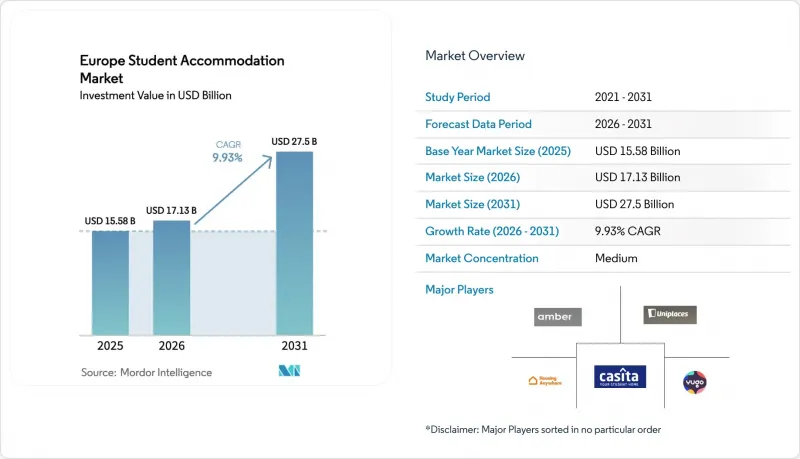
The market is supported by persistent demand-supply imbalances in major university cities, which sustain high occupancy levels. Rental growth remains resilient as purpose-built student accommodation continues to attract strong pre-leasing activity. Rising international student mobility across the UK, Germany, France, Spain, and the Netherlands is a key structural growth driver. Increasing participation in higher education and cross-border study programs further strengthens demand fundamentals. Institutional investors are expanding allocations to the sector, attracted by stable, long-duration cash flows and defensive characteristics. Cross-border capital deployment is particularly strong in core UK markets and emerging Southern European hubs. Supportive policy measures and housing-focused initiatives are helping accelerate planning approvals and project funding. Developers are increasingly adopting modular construction methods to manage rising land and material costs. ESG-certified and energy-efficient buildings are gaining traction as sustainability becomes a priority for investors and students alike. Digital leasing platforms and data-driven pricing strategies are enhancing occupancy optimization and tenant retention.
Europe Student Accommodation Market Trends and Insights
Increasing International Student Enrollment Across Europe
International enrollment expanded strongly into 2026, following a 16.3% increase between 2019 and 2024, with EU-27 totals surpassing 1.76 million in 2023, as Germany, France, and the Netherlands attracted the largest cohorts among member states. Germany hosted 423,200 foreign students, while France recorded 276,200 and the Netherlands 169,500, reinforcing diversified demand anchors across multiple language markets within the Europe student accommodation market. Affordability and living costs feature in student decision-making, and policy support, such as Germany's Skilled Immigration Act and Spain's post-study work reforms, improve study-to-work transitions that sustain length of stay. Stricter visa regimes in other destinations have redirected flows, reflected in higher non-EU applications to UK universities into 2026 and broadened interest across Continental campuses with English-taught programs. Conversion from application to arrival remains constrained by local housing bottlenecks, with many inbound students citing accommodation availability as a key uncertainty that drives pre-booking and the adoption of all-inclusive packages in the Europe student accommodation market.
Growing Institutional Investment in PBSA Assets
Institutional investment in European purpose-built student accommodation (PBSA) is rising sharply as investors respond to strong demand and limited supply. Across Europe, there are an estimated two million PBSA beds, with a growing share owned by private institutional operators. Investors surveyed by Savills, representing roughly 16 percent of private PBSA stock with about 132,000 beds and an estimated USD 29.9 billion in assets, are planning significant portfolio expansion. These investors expect to increase the number of beds they own by around 70 percent over the next few years, adding approximately 92,500 beds and deploying an additional USD 25.9 billion of capital into the sector. PBSA has been ranked among the most sought-after living sectors for future investment, with many investors targeting the asset class and planning substantial deployments. Even with this anticipated growth, overall PBSA provision levels are expected to increase only modestly relative to total student numbers, highlighting the continuing opportunity for institutional capital to address the ongoing supply shortfall across European markets.
Rising Land and Construction Expenses
Escalating development costs continue to constrain growth in the Europe student accommodation market. Per-bed build costs have increased significantly in core markets, driven by higher materials, labor, and financing expenses, which compress returns and challenge the feasibility of new projects, particularly in dense urban cores. Across the continent, construction cost inflation remains elevated relative to long-term averages, adding pressure to developers' pro forma models and increasing their sensitivity to land pricing. Limited land availability in constrained city centers further exacerbates cost pressures, prompting some investors to look to secondary cities with lower land and permitting costs. While institutional equity supports well-capitalized sponsors, tighter lending criteria and conservative loan terms make financing more difficult for smaller development schemes. These dynamics are slowing the pace of new supply and sustaining the existing supply-demand imbalance, which continues to place upward pressure on rents and occupancy levels in the student housing sector.
Other drivers and restraints analyzed in the detailed report include:
- Government Reforms Accelerating Planning Approvals
- Modular and Micro-Living Units Reducing Construction Costs
- Challenging Zoning and Rent-Cap Regulations
For complete list of drivers and restraints, kindly check the Table Of Contents.
Segment Analysis
Halls of Residence captured 43.05% of the European student accommodation market share in 2025, maintaining a strong base among first-year students who value on-campus proximity and inclusive pricing aligned with university calendars. Private Student Accommodation is forecast to expand at a 6.03% CAGR through 2031, reflecting investor appetite for professionally managed assets that offer gyms, study areas, and high-spec connectivity that drive resilience in occupancy. International students account for a larger share of PBSA tenants than of total student populations across Continental Europe, which supports demand for furnished, all-inclusive contracts that simplify utility management and payments. Investor focus has shifted to larger platforms and pipeline-led strategies to capture operating efficiencies, ESG performance, and brand-led demand in the Europe student accommodation market. Over time, accreditation frameworks and national quality codes reinforce a preference for regulated PBSA over fragmented private rentals, thereby supporting standardization in service and safety for the European student accommodation market.
The Europe student accommodation market for Private Student Accommodation is projected to expand at a 6.03% CAGR between 2026 and 2031, narrowing the revenue gap with Halls through asset upgrades, digital leasing, and value-add refurbishments aligned with net-zero objectives. Hybrid co-living formats complement PBSA by offering shorter stays and shared amenities, which can absorb exchange and Erasmus cohorts who require flexible terms within university semesters. Regulatory tightening in private HMO markets is redirecting some demand to PBSA, aided by transparent pricing and bundled rent models that reduce bill shock during peak energy seasons in the Europe student accommodation market. As planning reforms take effect and capital costs stabilize, professionally managed assets are positioned to capture continued share gains, especially in metros with rising international enrollments and large university clusters. Brand differentiation now spans community programming, wellness, and study support, increasing stickiness and renewal rates for PBSA operators in the core and growth cities of the Europe student accommodation market.
City-center properties accounted for 56.72% in 2025, helped by proximity to campus clusters, transit hubs, and urban amenities that support premium rents and high year-round utilization in the Europe student accommodation market. As affordability challenges mount, periphery locations are advancing at a 7.48% CAGR through 2031, supported by rail and metro upgrades that compress travel times and expand development options where land is more available. Investors calibrate between prime city cores and super-prime regional locations, balancing yield differentials with leasing depth, brand awareness, and local permitting dynamics in the Europe student accommodation market. Markets with high average city-center rents like Amsterdam are pushing students to nearby cities, which broadens catchments and diversifies occupancy risk during intake peaks. Transit-oriented development near new lines and interchanges is a growing theme in Copenhagen, Madrid, and Milan, with operators clustering beds around multi-campus footprints for route redundancy and convenience.
Provision rates show wide dispersion between Northern and Southern Europe, which influences pricing strategies and the sequencing of new beds within city pipelines across the Europe student accommodation market. Pipelines in 2025 covered only a small fraction of deficits in the largest cities, reinforcing the case for phased deliveries and mixed typologies that match demand by year of study and budget bands. Campuses with higher international shares achieve stronger PBSA rental premia, which supports near-campus positioning even as periphery gains momentum with improved transit links in the Europe student accommodation market. Fire safety and building safety rules raise retrofit needs for older city-center blocks, which also redirects some capital to greenfield periphery sites with modern compliance from day one. Over the forecast, balanced exposure to center and periphery assets can help stabilize occupancy and rate growth through seasonal and macro cycles in the Europe student accommodation market.
The Europe Student Accommodation Market Report Segments the Industry Into by Accomodation Type (Halls of Residence, Rented Houses or Rooms, Private Student Accomodation), by Location (City Centre, Periphery), by Rent Type (Basic Rent, Total Rent), by Mode (Online, Offline), and by Country (Germany, Iceland, Ireland, Italy, France, Belgium, Norway, Rest of Europe).
List of Companies Covered in this Report:
- Unite Students
- iQ Student Accommodation
- Student Roost
- GSA
- Scape
- Nido Student
- Greystar (Chapter, Canvas)
- Xior Student Housing
- Campus Living Villages
- Collegiate AC
- CRM Students
- Amro Real Estate Partners
- The Social Hub (formerly The Student Hotel)
- Basecamp Student
- UPP (University Partnerships Programme)
- Aparto
- Patrizia AG
- Hines
- Yugo
- STAY Club
Additional Benefits:
- The market estimate (ME) sheet in Excel format
- 3 months of analyst support
TABLE OF CONTENTS
1 Introduction
- 1.1 Study Assumptions & Market Definition
- 1.2 Scope of the Study
2 Research Methodology
3 Executive Summary
4 Market Landscape
- 4.1 Market Overview
- 4.2 Market Drivers
- 4.2.1 Rising international student enrolment across Europe
- 4.2.2 Supply-demand imbalance in tier-1 university cities
- 4.2.3 Institutional capital inflows into PBSA assets
- 4.2.4 Government reforms accelerating planning approvals
- 4.2.5 Modular micro-living units lowering construction cost (under-the-radar)
- 4.2.6 ESG-certified buildings commanding premium occupancy (under-the-radar)
- 4.3 Market Restraints
- 4.3.1 Escalating land & construction costs
- 4.3.2 Complex municipal zoning & rent-cap regulations
- 4.3.3 Competition from short-stay rental platforms (under-the-radar)
- 4.3.4 Falling domestic student cohorts in parts of Europe (under-the-radar)
- 4.4 Value / Supply-Chain Analysis
- 4.5 Regulatory Landscape
- 4.6 Technological Outlook
- 4.7 Porter's Five Forces
- 4.7.1 Threat of New Entrants
- 4.7.2 Bargaining Power of Suppliers
- 4.7.3 Bargaining Power of Buyers
- 4.7.4 Threat of Substitutes
- 4.7.5 Competitive Rivalry
5 Market Size & Growth Forecasts
- 5.1 By Accommodation Type
- 5.1.1 Halls of Residence
- 5.1.2 Rented Houses or Rooms
- 5.1.3 Private Student Accommodation
- 5.2 By Location
- 5.2.1 City Center
- 5.2.2 Periphery
- 5.3 By Rent Type
- 5.3.1 Basic Rent
- 5.3.2 Total Rent
- 5.4 By Mode
- 5.4.1 Online
- 5.4.2 Offline
- 5.5 By Geography
- 5.5.1 United Kingdom
- 5.5.2 Germany
- 5.5.3 France
- 5.5.4 Spain
- 5.5.5 Italy
- 5.5.6 BENELUX (Belgium, Netherlands, Luxembourg)
- 5.5.7 NORDICS (Denmark, Finland, Iceland, Norway, Sweden)
- 5.5.8 Rest of Europe
6 Competitive Landscape
- 6.1 Market Concentration
- 6.2 Strategic Moves
- 6.3 Market Share Analysis
- 6.4 Company Profiles (includes Global level Overview, Market level overview, Core Segments, Financials as available, Strategic Information, Market Rank/Share for key companies, Products & Services, and Recent Developments)
- 6.4.1 Unite Students
- 6.4.2 iQ Student Accommodation
- 6.4.3 Student Roost
- 6.4.4 GSA
- 6.4.5 Scape
- 6.4.6 Nido Student
- 6.4.7 Greystar (Chapter, Canvas)
- 6.4.8 Xior Student Housing
- 6.4.9 Campus Living Villages
- 6.4.10 Collegiate AC
- 6.4.11 CRM Students
- 6.4.12 Amro Real Estate Partners
- 6.4.13 The Social Hub (formerly The Student Hotel)
- 6.4.14 Basecamp Student
- 6.4.15 UPP (University Partnerships Programme)
- 6.4.16 Aparto
- 6.4.17 Patrizia AG
- 6.4.18 Hines
- 6.4.19 Yugo
- 6.4.20 STAY Club
7 Market Opportunities & Future Outlook
- 7.1 Conversion of ageing city-center office stock into hybrid student-co-living assets
- 7.2 Leveraging AI-driven dynamic pricing platforms to optimise yield management across pan-European portfolios

